
URBS ANTIQUA
The Old City · District · Nova Romae
"These streets were Roman before the Rift. This is not a fact that becomes less significant the more you think about it. It becomes more so."
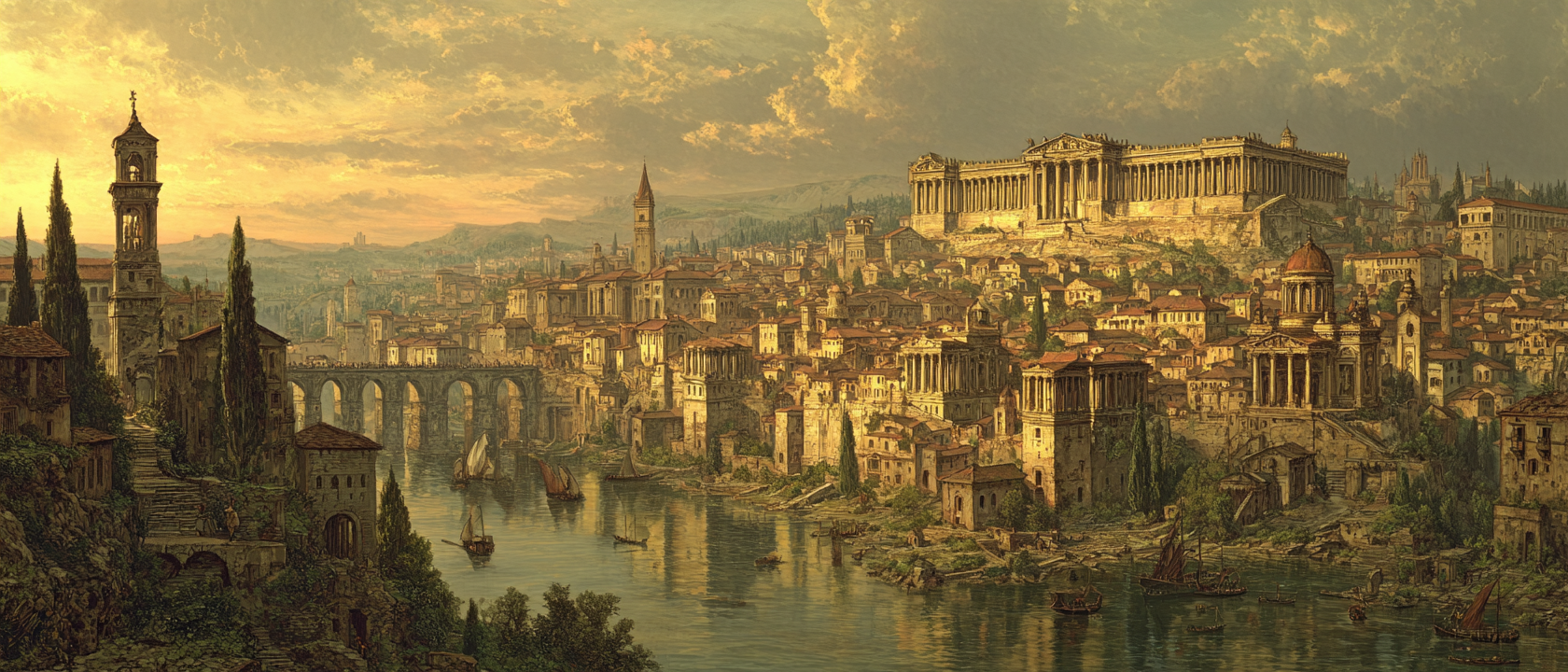
The Urbs Antiqua is the geographic heart of Nova Romae and its most emotionally significant district — the kernel around which twelve centuries of expansion have accumulated in concentric rings. It is the oldest part of the city in the most literal sense: these streets, this market square, this river-path were Roman before the Rift. The town that became an empire was already here. The hill that became the Palatine already had the governor's residence on it. On the morning of Year One, everything that had always been ordinary became historical, and the first generation of Aethermarch-born Romans — who had never seen the old world — made the decision in 103 A.P. to preserve what remained as a memorial not to glory but to the fact of the morning itself.
Demographics
The Old City's permanent population of approximately thirty thousand is mixed in the way of old urban cores: long-established families whose ancestors lived here before the district acquired cultural significance, scholars and researchers with professional reasons to be proximate to the Antiquarium, pilgrims who have extended their stays into semi-permanent residence, the owners and staff of the inns and food vendors who serve the Antiquarium's visitors, and a small community of artisans producing the kind of goods that benefit from proximity to a pilgrimage site. The population is more stable than the Subura's and less wealthy than the Senate Quarter's. It is, in Varro's estimation, the most historically aware population in Aethermarch.
Government
The Old City falls under the Praefectura Urbis's general jurisdiction but benefits from a special administrative designation — the Lex Antiquitatis — that restricts what can be built, demolished, or altered within the preserved section. The Antiquarium is governed by its own directorate answerable to the Imperial Academy. The Aedilitas — the civic infrastructure office — has jurisdiction over the non-preserved streets and exercises it with a caution born of the significant political consequences that follow from any perceived disrespect to the district's heritage status.
Defences
No garrison. The Cohortes Vigilum maintain a station at the Platea Prima — one of the twelve district stations in the city — that provides more visible presence here than in other districts, partly because of the Antiquarium's collections and partly because the area's symbolic importance makes disorder here politically consequential in a way that equivalent disorder in the Subura is not. The preserved section is not physically fortified; it is protected by the Lex Antiquitatis and by the fact that damaging it would be the most politically expensive act available to any Roman outside the Palatine.
Industry & Trade
The Old City's economy is significantly pilgrimage-adjacent. The Antiquarium draws visitors from across the Empire whose need for accommodation, food, guided services, and souvenirs sustains a substantial local economy. The inns in the district's western quarter are among the oldest continuously operating hospitality businesses in Nova Romae; several can trace their management lineage back five or six generations. The preserved section supports a specialised trade in historically themed goods — reproductions of pre-Rift objects, scholarly texts about the Permutatio, the maps and guides that visitors purchase before their Antiquarium visit — that is commercially minor but visible.
Infrastructure
The Old City retains the original street layout within the preserved section, including the drainage channels that predate the main sewer system. These channels connect to the later infrastructure at the ring road boundary; the junction is a source of periodic maintenance challenges that the Aedilitas manages with resigned professionalism. The Antiquarium's storage facilities include a climate-controlled underground vault for the most fragile collection items — a dwarven engineering contribution from the fourth century, installed when the collection's value became apparent and its original storage conditions became inadequate.
Guilds and Factions
The Antiquarium directorate is the district's dominant institutional presence — managing the collection, the visitor flow, and the ongoing scholarly programme of documentation and research. The current Director, Gaius Sextus Volso, is sixty-eight, in his twelfth year, and is engaged in an ongoing low-intensity argument with the Academy Faculty about which institution has ultimate authority over pre-Rift scholarship. The argument is about funding and is conducted in the language of academic principle.
The Old City neighbourhood association — an informal body with no legal standing — has been managing the practical politics of heritage conservation, pilgrim management, and the interests of long-term residents for two centuries. It has no legal authority and considerable moral authority. The two are frequently sufficient.
History
The preserved section was designated in 103 A.P. by the first Aethermarch-born generation — the children of the original eight thousand, who had grown up hearing about a world they had never seen and who recognised that what remained of it was finite and would not last without deliberate protection. The Antiquarium was established in 300 A.P. to house what the preserved section could not. The Lex Antiquitatis was passed in 450 A.P. after a property developer obtained permission to demolish two structures in the preserved section and was stopped by a combination of public outrage and a senatorial intervention that produced the legal protection still in force twelve centuries later.
For full chronological detail, see: Annales Mundi.
Points of interest
The Locus Primus is a low stone enclosure in the Platea Prima marking the point where the Permutatio exchange is believed to have occurred — where, as best the first-generation scholars could determine, the boundary between the old world and the new ran through the ground beneath the original market square. Built in 103 A.P. from stone salvaged from pre-Rift structures demolished in the expansion. The choice was deliberate: the memorial is built from what was already Roman, already here. It is the most visited single location in Nova Romae. On a quiet morning, before the pilgrims arrive, it is a small stone enclosure in a market square. On festival days it is something else.
The Antiquarium Urbis twelve centuries of Roman occupation in four galleries: the Pre-Rift Heritage collection (objects from the original settlement, including the farmer's tool from two miles outside the city whose dating makes it the oldest artefact in Aethermarch the Contact Collection (first-generation accounts of encounters with the other peoples, supplemented by objects acquired through trade and diplomacy the Construction History gallery (the architectural record of Nova Romae's expansion and the Living Tradition gallery (the cultural production of twelve centuries of Aethermarch-born Romans). A junior curator has found a document in the Contact Collection referencing something the Romans encountered in the early years after the Permutatio that does not appear in any official history.
The preserved streets — Vicus Antiquus, Via Prima, Platea Prima, and the old river-path — are maintained under the Lex Antiquitatis to their Year One appearance as closely as possible. The buildings that line them are occupied, maintained, and lived in; they are not a museum but a neighbourhood whose residents happen to live in structures that predate everything around them. The effect is strange and affecting in a way that the neighbourhood's permanent residents have largely stopped noticing.
Tourism
The Old City is the most-visited district in Nova Romae for pilgrimage purposes. Romans from every province come to stand at the Locus Primus — to be in the place where the world changed, or as close to it as twelve centuries of scholarship can determine. The Antiquarium receives approximately four thousand visitors on a normal day and considerably more on festival days. The district has twelve centuries of practice accommodating pilgrims, and the result is an efficient and occasionally overwhelming hospitality infrastructure capable of processing very large numbers of people with minimal disorder.
Architecture
The preserved section of the Old City — four streets maintained as closely as possible to their Year One appearance — is architectural time travel. The buildings are smaller than anything built in Nova Romae in the last ten centuries, their stone work less precise than later Roman technique, their proportions those of a prosperous provincial town rather than an imperial capital. They are, by any objective measure, less impressive than everything around them. They are also the only buildings in the city that were standing on the morning the world changed.
Outside the preserved section, the Old City has been rebuilt and expanded like the rest of the city, though the old street lines constrain what can be built and produce a district of narrower, older-feeling streets than the outer rings. The Antiquarium Urbis, established in 300 A.P. on the site of a third-century warehouse, is an exception: a large, well-lit building built specifically for its purpose, its architecture deliberately referencing the preserved section's scale while serving the needs of a collection twelve centuries deep.
Geography
The Old City occupies the original settlement's footprint at the centre of Nova Romae's ring development — a roughly oval area of perhaps forty hectares bounded by the first ring road on all sides. Within this boundary the street plan is the oldest in the city: narrow by later Roman standards, irregular in the way of streets that grew from paths rather than being laid out by surveyors, following the natural drainage lines of the ground as it was before anyone thought to manage them. The Platea Prima — the original market square — sits at the district's centre. The old river-path, which was already a path when the town was young, runs along the western edge. The Palatine and Capitoline hills rise at the northern boundary.
Access
Access Fully publicly accessible. Antiquarium open daily; special collections by scholarly accreditation.

Comments