
TRANS-FLUMINIS
The Far Bank · District · Nova Romae
"The wealthiest Romans in the world have arranged their lives so that every morning they look across a river at everything that made them wealthy, from a comfortable distance. I have thought about this for years and I am still not certain whether it is wisdom or irony."
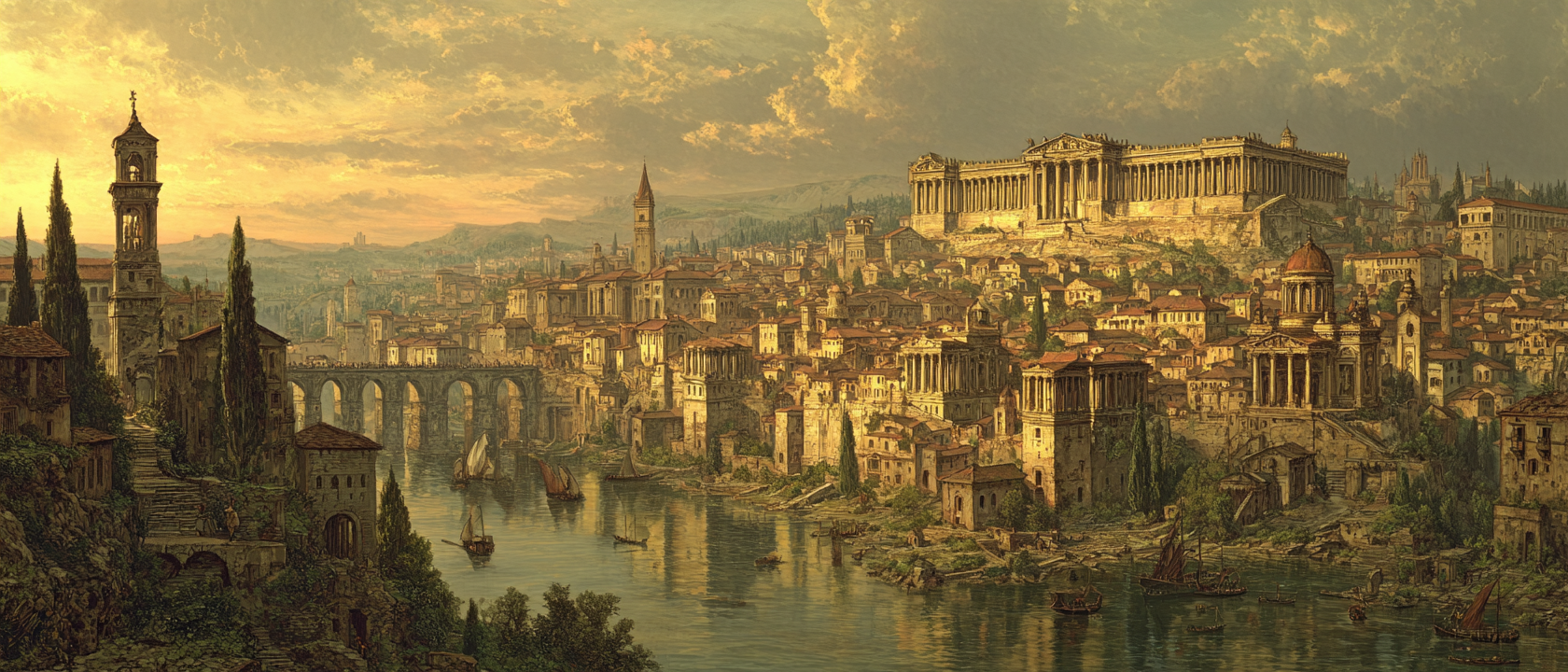
Trans-Fluminis — across the river — is what Nova Romae became when it ran out of room and crossed the Fluminis Magnus. The far bank rises in natural terraces from the river's edge, and the wealthy and powerful of the city recognised immediately what terraced high ground facing back toward the Old City and the Palatine Hill represented: the finest view available for purchase. Every dining room in Trans-Fluminis faces east across the river. Every breakfast is eaten looking at twelve centuries of Roman history arranged on the far bank in the morning light, the Palatine Palace above it all. To have a terrace that looks at Rome's history is the most expensive view available for purchase in Aethermarch, and the people who can afford it have purchased it.
Demographics
Trans-Fluminis's permanent population of approximately one hundred and fifty thousand is the wealthiest district population in Nova Romae outside the Palatine. The upper terraces house the senatorial class and the most successful merchants; the middle terraces house the prosperous professional class; the lower terraces, closer to the river commerce, house the successful trading families whose wealth is newer and whose architecture slightly more demonstrative. The domestic staff population — stewards, household slaves and freedmen, the small armies required to maintain residences of this scale — constitute perhaps a third of the total population and are economically distinct from their employers in ways that the district's physical arrangement tends to render invisible.
Government
Trans-Fluminis falls under the Praefectura Urbis's jurisdiction but functions with the semi-autonomous character of wealthy districts everywhere: the residents have sufficient political influence to ensure their infrastructure is maintained, their complaints are heard, and their preferences are accommodated. The Aedilitas's building inspectors visit Trans-Fluminis less frequently than they visit the Subura, which is partly because the buildings are better maintained and partly because the owners of the buildings have connections that the inspectors find professionally discouraging.
Defences
No garrison; the Cohortes Vigilum maintain a presence on the Pons Magnus at both ends, and the wealthier residents' private security arrangements are, by all accounts, effective. The river itself is a natural boundary; the Pons Magnus is the single primary crossing point, which is surveilled continuously. The Via Obscura maintains a permanent presence at the Pons Magnus's stalls and has done so since the bridge opened — information about who crosses, when, and with whom is available for a price.
Industry & Trade
Trans-Fluminis is commercially significant in two registers. At the river level, the Pons Magnus's eastern approaches are occupied by money-changers, notaries, and the offices of commercial houses whose clients are both the senatorial residents above and the merchants passing through below. The upper terraces are the residential economy of wealth: the management of estates, the investment of capital, the political commerce conducted across dining tables that constitute the district's primary productive activity. Several of the upper-terrace residences are effectively headquarters for commercial operations of considerable scale conducted through sufficiently discreet intermediaries.
Infrastructure
Trans-Fluminis has the best-maintained private infrastructure in Nova Romae and the most recently improved public infrastructure — the road surfaces on the terrace streets are relaid more frequently than in any other district, partly due to the residents' influence and partly because the gradient requires better drainage management than flat ground. The district's aqueduct connection is the most recent major extension of the Aqua Magna, completed in 1050 A.P. after three decades of lobbying by the Trans-Fluminis residents' association. The Pons Magnus is the district's most critical infrastructure piece and the joint responsibility of the Aedilitas and the dwarven maintenance team that has serviced the bridge under a perpetual contract since its construction.
Guilds and Factions
The Trans-Fluminis residents' association has no legal standing and considerable practical influence — particularly with the Aedilitas and the Praefectura's budget committee. Several of its most active members are senators; several more are merchants with senatorial connections. The organisation's official purpose is neighbourhood improvement; its actual function includes the coordination of political pressure in directions that benefit the district's residents.
The Mercatorum has its most significant Nova Romae presence in Trans-Fluminis's commercial district, where several of the river-front counting houses are effectively Mercatorum operational offices, though none of them are identified as such.
History
The Pons Magnus was completed in the sixth century, and Trans-Fluminis development followed within a generation — the wealthy recognising the terrace opportunity and building accordingly. The district has been continuously developing since, the upper terraces becoming progressively more expensive as the view became more recognised and the residences more established. The two unknown-ownership upper terrace residences have been owned by unknown parties for approximately thirty and forty years respectively. Their acquisition records are sealed under a legal instrument that the Tabularium will not discuss.
For full chronological detail, see: Annales Mundi.
Points of interest
The Pons Magnus is the physical and symbolic link between the old city and its western expansion: dwarf-engineered, marble-faced, wide enough to feel like a street rather than a bridge. The central span's keystone bears the text of the engineering agreement between the second Emperor and the High Thane of that period — one of the few bilingual public monuments in Nova Romae, in both Latin and Dwarvish, which the College of Pontiffs has never quite resolved how to categorise. The bridge is lined with merchant stalls on its western approaches and money-changers' offices on the eastern side. It is the most surveilled crossing in the city. Information about who crosses and when is available from the Via Obscura for a price.
The Terrae Superiores — the upper residential terraces — constitute the most exclusive address in Nova Romae outside the Palatine. The architecture is deliberately plain, the walls high, the gardens invisible from the street. Senator Corvinus owns here. Two other residences have owners of unknown identity and staff of exceptional discretion. One of these residences recently received, through its entirely unremarkable front door, a visitor whose identity the Via Obscura would pay considerably to know. The visit lasted two hours. The visitor departed by hired boat.
The Trans-Fluminis commercial district, at the base of the terraces along the river road, contains the counting houses and trading offices of the Empire's most successful merchants — institutions whose names are known in Lacusum and Portus Meridiani and whose principals dine in the upper terraces above. The district is quieter than the harbour but moves more money.
Tourism
Trans-Fluminis is accessible to visitors in the sense that its streets are public, though the character of those streets — high walls, unrevealing facades, residents who consider foot traffic in their neighbourhood a mild imposition — communicates clearly that visitors are tolerated rather than welcomed except at the commercial lower level. The Pons Magnus itself is a tourist destination: the view from its centre, looking east toward the Old City and the Palatine above it, is one of the standard Nova Romae experiences. The stalls on the western approach sell the same range of goods as the Old City's souvenir economy, at marginally higher prices.
Architecture
Trans-Fluminis architecture is the architecture of deliberate restraint — the most expensive form of expression available. The wealth here is expressed in space and view rather than ornament: large private residences separated from each other by walled gardens, each positioned to maximise the river prospect, their facades plainly finished in a way that communicates confidence rather than display. The lower terraces, closer to the river and more commercially oriented, are somewhat less restrained; the counting houses and offices of the Pons Magnus's eastern approaches have the functional grandeur of serious commercial infrastructure. The upper terraces are residential almost exclusively, their walls high and their street frontages unrevealing.
Senator Corvinus owns a residence on the upper terraces that he uses rarely and maintains immaculately. Two other upper-terrace residences are owned by individuals whose identities are not publicly known and whose staff are exceptionally discreet.
Geography
The far bank rises from the Fluminis Magnus in three natural terrace levels, the lowest along the river's edge and the highest — the Terrae Superiores — commanding views across the city that on clear days extend to the Capitoline and, from the highest points, the Palatine above it. The district is bounded by the Pons Magnus at its southern end, by the river road to north and south, and by the gradual transition to suburban villas and agricultural land to the west. The terrain is the opposite of the Old City: open, elevated, oriented outward rather than inward, the whole district arranged to look at Rome rather than to be looked at.
Access
Access Streets publicly accessible. Residences private. Pons Magnus fully public.

Comments