
COLLIS PALATINUS
The Palatine Hill · District · Nova Romae
"The Palatine is the only hill in Nova Romae from which you can see, on a clear day, the southern coast. From every other point in the city you can see the Palatine. This arrangement was not accidental when it was created and it has not become accidental in twelve centuries of use."
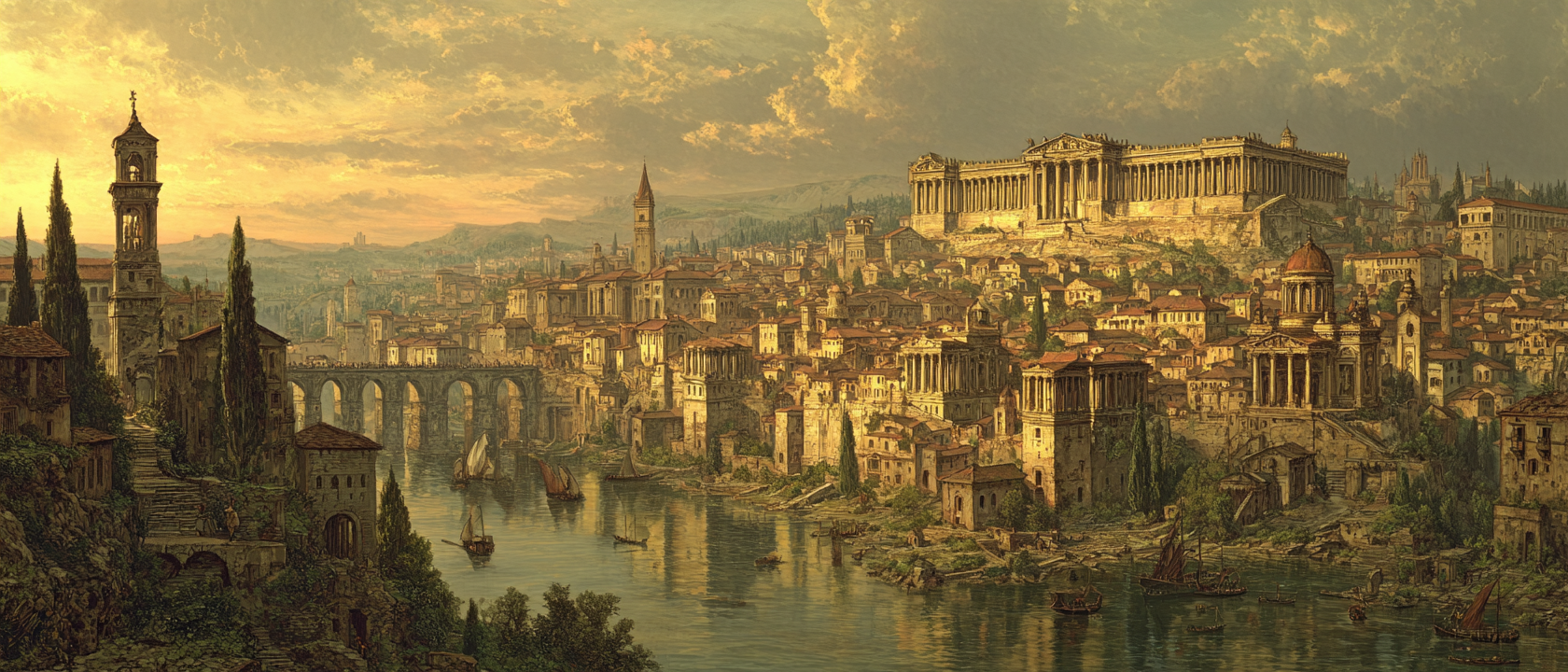
The Palatine Hill is the highest point in Nova Romae, rising one hundred and sixty feet above the Forum Novum at its base, and it has been the seat of Imperial authority since 203 A.P. when the first Emperor chose it deliberately: a city that can always see its ruler is a city that is always aware of being governed. The hill is entirely occupied by the Imperial complex — palace, gardens, administrative buildings, the Emperor's private temples, the barracks of Legio II Palatina — within walls that are both defensive and ceremonial, thick enough to withstand siege and faced in white marble that makes the hill glow at sunset. From the city below, the seat of power is literally luminous. This is not accidental either.
Demographics
Population approximately eight thousand permanent residents — the Emperor and his household, the senior palace administration, the families and households of palace staff, and the Legio II Palatina's four thousand soldiers in the Castra Palatina on the northern face. Daily visitors number approximately forty thousand: petitioners, officials, diplomats, merchants with Imperial contracts, scholars with palace permissions, and the twice-monthly crowds admitted to the Horti Palatini on garden days. The Palatine is the most densely administered square kilometre in Aethermarch.
Government
The Palatine is Imperial territory, administered by the Imperial Household under the Master of the Palace — currently Titus Aelius Marcianus, sixty-one, eighteen years in the role. Marcianus manages the palace staff of approximately four thousand, the household budget, the Emperor's schedule, the diplomatic reception protocols, and the considerable political complexity of being the person through whom access to the Emperor is mediated. He is courteous, precise, and entirely aware that his position makes him one of the most powerful people in Nova Romae.
The Legio II Palatina operates under its own command structure within the Castra Palatina, responsible exclusively to the Emperor through the Magister Militum. The relationship between the palace household and the Palatina's command is formally cooperative and practically careful on both sides.
Defences
The Palatine walls are the primary defensive perimeter — four metres thick at the base, manned continuously, with the four ceremonial gates controlled by Palatina detachments. The Castra Palatina's four thousand soldiers constitute a standing garrison capable of holding the hill against any force the Empire could plausibly face in its own capital. The gardens' southern terracing, while civilian in purpose, provides defensive depth on the least-walled face. The hill has not been attacked since 187 A.P., when a senatorial faction attempted a coup that ended badly for the senators involved. The Palatina have not been allowed to forget this. They are unlikely to let it happen again.
Industry & Trade
The Palatine produces decisions. The palace is the administrative centre of a twenty-two million person empire: Imperial decrees, military commissions, provincial appointments, trade licences requiring Imperial seal, diplomatic correspondence, and the judicial reviews that only the Emperor can conduct pass through the palace offices. The palace's commercial activity is largely procurement — feeding and equipping eight thousand people and forty thousand daily visitors requires a supply chain that constitutes one of the capital's larger institutional purchasing operations. The Imperial stables maintain approximately three hundred horses.
Infrastructure
The Palatine has its own dedicated aqueduct branch — the Aqua Palatina — separate from the city's civilian supply, a security precaution dating from the third century. The palace has its own granary stores capable of sustaining the hill for approximately six months without resupply, another legacy of the 187 A.P. coup attempt. The underground service passages connecting the palace's working areas — kitchens, storerooms, staff quarters — to the formal reception spaces above constitute a secondary circulation system that the household staff navigate by memory and that visitors find entirely invisible.
Guilds and Factions
The Imperial Household under Marcianus is the dominant organisational force on the hill — managing access, resources, and the daily machinery of Imperial administration. The Legio II Palatina operates as a parallel institution under its own command, with the two bodies maintaining a careful professional relationship. The Emperor's personal staff — secretaries, physicians, scholars, and the handful of advisors who have genuine regular access — constitute an informal inner circle whose composition is a matter of intense interest to the Senate Quarter and deliberate opacity on the Palatine's part.
History
The hill was the governor's residence before Year One — the first and highest point of Roman administrative authority in what became Aethermarch. The first Emperor's declaration in 203 A.P. formalised what the hill had already become. Eight emperors have built on it since; the ninth has chosen to occupy the oldest part. The coup attempt of 187 A.P. produced the defensive infrastructure that has made the hill impregnable since. The current Emperor has lived here for over a hundred years and has, by all accounts, a precise knowledge of every room.
For full chronological detail, see: Annales Mundi.
Points of interest
The Palatium Imperatoris is the palace proper: interconnected buildings covering the summit, the oldest section in the northwest corner and the grandest in the east-facing reception wing. The great audience chamber — the Aula Magna — seats three hundred, its walls inlaid with maps of the Empire's provinces in coloured stone. The Emperor's private dining room holds twelve. The war room, on the palace's eastern face, has a window overlooking the Forum Novum; the Emperor is said to occasionally sit there during Senate sessions, though this has not been confirmed by anyone who would say so officially.
The Horti Palatini — the terraced gardens on the southern face — are the most beautiful space in Nova Romae and open to the public on the first and fifteenth of each month by Imperial decree. The gardens contain specimens from every part of the known world, including tabaxi plants from the Solarhet diplomatic mission and, tended with considerable anxiety by the Academy's botanists, specimens of forest flora from the Sylvanmere border that have been declining in a way that does not match any known disease. A report was written. The report has been filed.
The Castra Palatina occupies the northern face: four thousand soldiers in barracks built to the same standard as the palace proper, which is to say considerably better than campaign conditions. The soldiers are the best-equipped in the Empire. The Via Triumphalis, the formal processional road that runs from the Forum Novum up the hill's eastern face to the palace gates, is paved in marble and used for Imperial processions, diplomatic arrivals, and the ceremonial induction of each new Emperor.
Tourism
On garden days, the Horti Palatini draw thousands of visitors from every district of the city and from the provincial population in transit through the capital. Access to the gardens is free; access to anything else on the Palatine requires either an appointment, an Imperial invitation, or a military commission. The gardens are the only part of the Palatine where an ordinary Roman citizen can stand and look at the palace from the inside of its walls, which is the point: the tradition was established by an emperor three centuries ago who believed that a city whose people had never seen beauty in proximity to power would eventually make poor decisions about both.
Architecture
The palace complex is twelve centuries of accumulated ambition. The original structure — a substantial governor's residence already in place on the morning of Year One — is now a core around which eight subsequent emperors have added their architectural signatures, producing a layered complex that architectural scholars find fascinating and that the Emperor's household staff find navigationally challenging. The oldest section, in the palace's northwest corner, is built to the scale of a prosperous provincial house. The audience chambers and administrative wings are considerably grander. The current Emperor's private quarters are in the oldest section, which he chose deliberately when he came to power.
The wall enclosing the hill is dwarf-assisted construction from the fourth century — faced in white Lunense marble, its towers rising above the crest at intervals calculated to provide overlapping fields of observation. The Horti Palatini, the terraced gardens descending the southern face, are maintained to the highest standard the Imperial household can achieve, which is a very high standard indeed.
Geography
The Palatine occupies the highest ground in the original Roman settlement, rising steeply from the Forum Novum on its eastern face and from the old river-path on its western side. The hill's summit plateau covers roughly twelve hectares — enough for the palace complex, its service buildings, and the gardens that descend the southern face in a series of terraced levels down to the ring road below. The northern face drops to the Castra Palatina at a gradient that makes the barracks a natural defensive advantage as well as a convenient billet. The eastern face, closest to the Senate Quarter, is where the formal approach ramps and ceremonial gates are situated. The western face looks toward the Fluminis Magnus and, from the highest windows of the palace, across the river to Trans-Fluminis.

Comments