
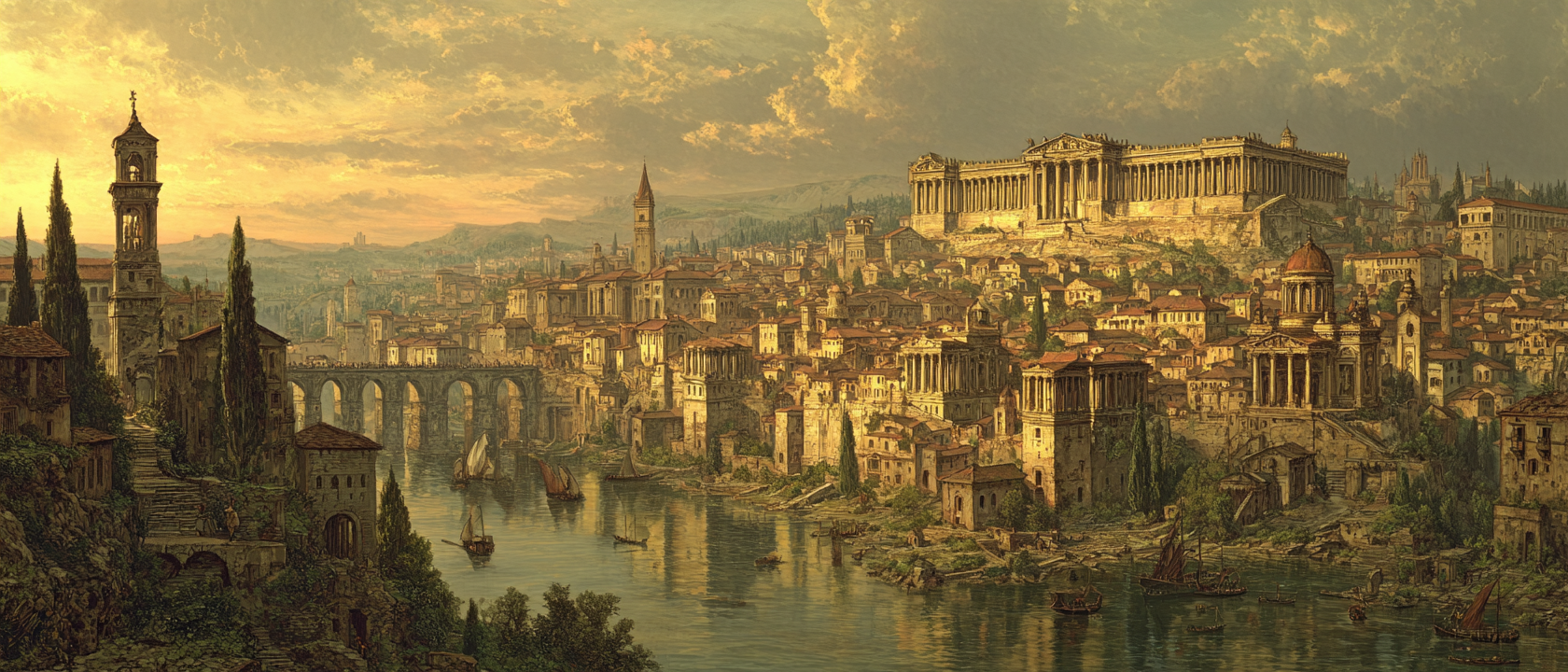
REGIO SENATUS
The Senate Quarter · District · Nova Romae
"The Senate Quarter is where Rome thinks about itself. Whether the thoughts are accurate is a separate question, and one the Senate Quarter does not consider it polite to raise."
The Senate Quarter occupies the ground between the Palatine Hill's eastern face and the Forum Novum — close enough to the palace that senators can walk to an Imperial summons and far enough that the distance is meaningful. Every building in the quarter announces that its occupants consider themselves significant. Most of them are correct. In 1200 A.P. the Senate Quarter is a place of considerable political tension, expressed primarily in the language of social obligation: dinner parties, corridor conversations, the precise ordering of names on documents, which senator is seen entering which colleague's residence and at what hour.
Demographics
The Senate Quarter's permanent population of approximately twenty-five thousand is the most politically concentrated in Aethermarch. The three hundred active senators and their household establishments account for perhaps ten thousand; the remaining fifteen thousand are staff — secretaries, stewards, legal advisers, household slaves and freedmen, the various functionaries of senatorial life. During Senate sitting days the quarter receives tens of thousands of additional visitors: petitioners, lobbyists, provincial delegates, merchants with business before Senate committees, and the journalists — a category that does not officially exist — who record the public sessions and sell summaries to clients throughout the Empire.
Government
The Senate Quarter is governed by the Senate itself in the sense that no external authority exercises jurisdiction here without senatorial consent. The Cohortes Vigilum do not patrol the quarter's interior streets; the senatorial houses maintain their own security. The Curia is managed by the Quaestor Publicus, who controls building access and session administration. In practical terms, the quarter is a self-governing enclave within the city whose internal affairs are conducted according to a social code of considerable complexity that has accumulated over twelve centuries and that outsiders find, on first encounter, bewildering.
Defences
The Senate Quarter has no formal military garrison and considers this appropriate. The senatorial townhouses maintain private security — bodyguards, doorkeepers, the occasional retired Legionary employed as a household steward — calibrated to protect against individual violence rather than organised assault. The implicit assumption is that any threat serious enough to require military response would be a matter for the Palatina, not the senators' own staff. In 187 A.P., when this assumption was tested, it proved correct in the narrow sense that the Palatina did respond, and incorrect in the broader sense that several senators were dead by the time they arrived.
Industry & Trade
The Senate Quarter produces legislation, appointments, and policy. Its secondary economy is influence: the quarter is where lobbyists, provincial governors, foreign ambassadors, and commercial interests come to purchase access to the people who make decisions. The senatorial townhouses are the venues for this commerce — the dinner tables where the real business is conducted, the morning receptions where favour is sought and granted, the corridor conversations that determine what reaches the Senate floor and what does not. The Thermopolium Senatus is the quarter's premier commercial venue in the social sense, though it would object to being described this way.
Infrastructure
The Senate Quarter has priority access to the Aqua Secunda's cleanest supply and the best-maintained street surfaces in Nova Romae outside the Palatine. The Via Senatorius is wide enough for four carriages abreast and is relaid every twenty years from the civic budget, a tradition that no Praefectus Urbi has successfully interrupted despite several attempts. The Curia's underground archive — the Tabularium — connects via a sealed passage to the Old City's records office, giving the Senate institutional access to documents that predate the building itself.
Guilds and Factions
The Senate is divided in 1200 A.P. into three rough Rift XIII factions. The conservative bloc under Corvinus believes the frontier should be reinforced before any new diplomatic engagement; they have held the western frontier stable for forty years and see no reason to risk it. The reformer bloc under Senator Aquila advocates for a broader diplomatic positioning, including the goblin treaty the Emperor has quietly authorised. The third faction — numerous, vocal, internally incoherent — believes the current management of the crisis is inadequate and that they could do better, without having fully articulated what better would mean. These alignments shift by question; the same senator may hold different positions on the railway negotiation and on military disposition.
The Mercatorum is not a senatorial faction but operates through one. Its Senate allies protect the Praefectura's budget in exchange for regulatory accommodation, and its parallel railway negotiations have been conducted through senatorial contacts whose relationship to the official committee is one of useful ambiguity.
History
The Senate Quarter developed in the first century of expansion as the administrative class that the Empire required grew beyond the Old City's capacity to house it. The Curia was built in 89 A.P. and has been the seat of Roman legislative authority since — rebuilt twice, renovated continuously, but on the same site. Corvinus has been in the Senate for sixty-four years. He has outlasted four emperors, a constitutional crisis, and two attempted coups. He is not the oldest senator by decades, and this tells you something about the patrician class's relationship to time.
For full chronological detail, see: Annales Mundi.
Points of interest
The Curia Aethermarchensis is the senate chamber: a rectangular building of white marble and dark timber, its floor inlaid with a map of the known world in coloured stone that was accurate in 600 A.P. and has not been updated since, which is a source of ongoing academic complaint. The Senate meets on the first, tenth, and twentieth of each month. Public galleries hold two hundred observers; access requires a pass from the Quaestor Publicus's office, obtainable with sufficient persistence. The senate session on the twentieth of Martius will debate matters that no senator currently knows are on the agenda, and several of them will find this inconvenient.
The Domus Corvini — the townhouse of Senior Senator Marcus Fabius Corvinus — is the most politically significant private residence in Nova Romae outside the Imperial Palace. Corvinus has held court here for sixty years. The breakfast table at which he meets colleagues is considered the most important informal political venue in the city. The house is old, furnished with the aggressive simplicity of a man who considers conspicuous display a character flaw in others. His steward maintains a list of every visitor and when they came. This list has never been requested by any official. Several people would pay significant sums to see it.
The Thermopolium Senatus — not actually a tavern, the name is ironic — is a private dining club occupying three floors of a building adjacent to the Curia, membership by invitation only. A new member was recently elected over the quiet objection of Corvinus, whose objection was quiet precisely because making it loudly would have revealed information he would prefer not to have revealed. The new member does not yet know about the objection.
The Forum Novum opens at the quarter's southern boundary — the great public square that is the Empire's civic heart, where Senate votes are posted within hours of their passage and where the golden milestone marks the centre from which all Imperial road distances are measured. The forum belongs to no single district; it is the hinge between the Senate Quarter, the Old City, and the Capitoline.
Tourism
The Senate Quarter is accessible to the public in a limited and carefully managed sense. The Via Senatorius is a public street and can be walked freely, though the experience of doing so — passing the walls of townhouses that reveal nothing, watched by doorkeepers who reveal less — is instructive about the quarter's relationship to public life. The Curia's public galleries are open on Senate sitting days to visitors with passes. The Forum Novum at the quarter's southern end is fully public and draws visitors from across the Empire. Everything else in the Senate Quarter is private and intended to remain so.
Architecture
Deliberately impressive. The Senate Quarter was built to communicate authority, and twelve centuries of senatorial investment have produced an architectural vocabulary of wide colonnaded streets, townhouses behind high walls, and public buildings of white marble that has no equal in the city except the Palatine itself. The Curia Aethermarchensis at the quarter's heart is the grandest secular building in Nova Romae — rectangular, white marble and dark timber, its proportions calibrated to produce the specific sensation of standing inside a decision. The senatorial townhouses that line the Via Senatorius are old-money architecture: restrained in ornament, expansive in footprint, the walls high enough that the gardens behind them are entirely invisible from the street.
Geography
The Senate Quarter occupies the second ring of Nova Romae's concentric development, between the Palatine Hill's eastern base and the Forum Novum. It is bounded on the north by the Academy District and on the south by the old first ring road that now functions as the Via Senatorius, the broad colonnaded street that marks the formal entry to the quarter. The terrain is flat — the quarter sits in the natural depression between the Palatine and Capitoline hills — and the street grid is the original Roman plan, wider and more regular here than in any other district outside the Old City. The Forum Novum opens at the quarter's southern end.

Comments