
CAPITOLIUM
The Capitoline · District · Nova Romae
"The Capitoline is not the tallest hill in Nova Romae — the Palatine takes that distinction — but it is the most sacred. Whether this represents a distinction between temporal and divine authority, or merely a difference in elevation, is a question I have been thinking about for thirty years without a satisfactory answer."
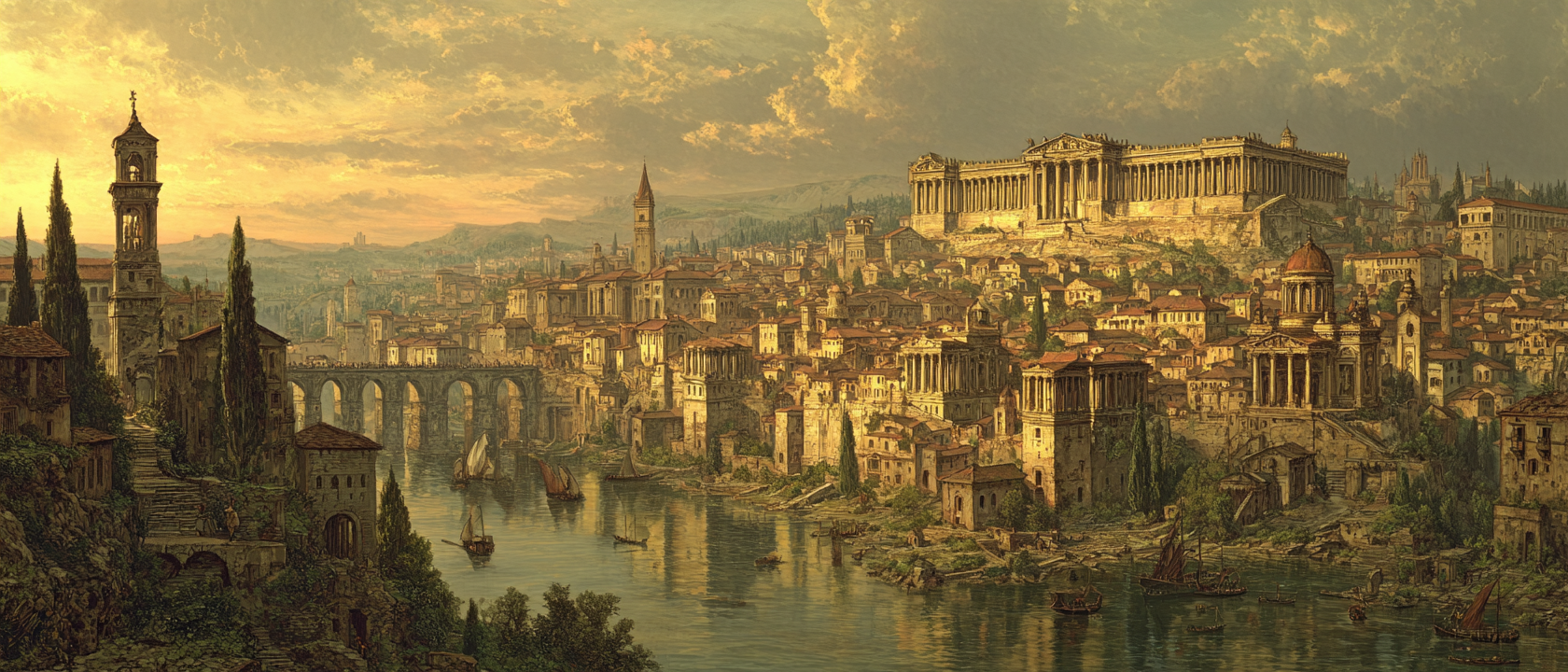
The Capitoline is the sacred hill of Nova Romae — lower than the Palatine by perhaps twenty feet, higher in every other sense that matters to the Roman religious tradition. The great temple complex at its summit has been in continuous operation for twelve hundred years, accumulating divine attention in quantities that sensitive practitioners describe as physically perceptible: a warmth, a clarity, a sense of being observed by something enormous and essentially benevolent. Roman clerics who have trained elsewhere say their abilities function at higher capacity on the Capitoline than anywhere else in the known world. The Academy has been trying to quantify this for three centuries with limited success. The College of Pontiffs considers the Academy's limited success appropriate.
Demographics
The Capitoline's permanent population of approximately twelve thousand is almost entirely priestly and scholarly in function. The College of Pontiffs and their household establishments, the training college for Roman clergy, the archive staff, the temple maintenance guilds, the Hearth-Keepers of the Free Temples and their resident communities — together these constitute a population whose daily life revolves around religious practice, theological study, and the administration of the Empire's official divine tradition. Worshippers flow through the hill constantly; on major festival days the Capitoline receives crowds from every district of the city.
Government
The Capitoline is governed by the College of Pontiffs under the Pontifex Maximus — independent of the Senate on religious matters, accountable in theory to the Emperor who nominally appoints the Pontifex, accountable in practice to a tradition twelve centuries old that no emperor has successfully overridden. The Pontifex Maximus has his official residence in the Domus Pontificia at the hill's crest, sleeping within consecrated ground every night of his tenure as the institution requires. The Free Temples are technically under the College's jurisdiction; in practice, the Hearth-Keepers administer them entirely, and the College's oversight is exercised at the level of periodic inspections that find nothing to object to and produce nothing to act on.
Defences
The Capitoline has no military garrison. The College of Pontiffs maintains temple wardens — armed, trained, operating under priestly rather than military authority — whose function is the security of the sacred precincts rather than military defence. The hill's sacred status has, historically, made it a neutral point that even the 187 A.P. coup did not directly threaten. Whether this protection would extend to a more serious disruption is a question the College prefers not to test.
Industry & Trade
The Capitoline produces religious services and theological product: augury, blessing, clerical training, the management of the sacred calendar, doctrinal rulings, and the interpretatio romana — the formal identification of foreign divine entities with Roman equivalents — that constitutes one of the Empire's more consequential ongoing intellectual projects. The temple complex's economic activity includes the sale of sacrificial animals, the management of temple property across the Empire, and the considerable revenue generated by the Templum Iovis's augury service, whose ninety-four percent accuracy rate makes it the most commercially significant divine service in Aethermarch.
Infrastructure
The Capitoline has dedicated water supply from the Aqua Sacra — a small dedicated branch of the Aqua Magna established specifically for ritual use, whose water is used in temple ceremonies throughout the city. The underground archive of the Pontifical records extends beneath the hill's southern face, connecting to the Tabularium in the Senate Quarter via a sealed passage that has been used for document transfer for six centuries and for other purposes that the respective institutions have not discussed.
Guilds and Factions
The College of Pontiffs is the Capitoline's governing institution — seventy priests administering the Empire's official religious tradition. The College is not monolithic: the interpretatio romana project is a persistent source of internal debate, with conservative members arguing that the identification of foreign gods with Roman equivalents risks theological contamination and reformers arguing that a tradition that cannot accommodate twelve centuries of encounter with other divine traditions is insufficiently robust. This debate has been ongoing for most of those twelve centuries.
The Hearth-Keeper community at the Free Temples maintains its own internal governance entirely separate from the College, answerable formally to the halfling religious authority in Brindala and practically to the traditions of the six temples themselves. The Hearth-Keepers and the College maintain a relationship of mutual courtesy and studied non-interference that both parties find workable and neither finds entirely comfortable.
History
The Capitoline's temple was operational within the first decade after the Permutatio — the Roman religious tradition required a functioning sacred site and the hill was consecrated within months of Year One. The Templum Iovis was rebuilt in the second century to the scale its accumulated divine significance demanded. The Free Temples were established in 1010 A.P., following the formal absorption of halfling religious practice into the extended Roman pantheon — a process that took two years of negotiation and produced a document that both the College of Pontiffs and the Hearth-Keepers signed without being entirely happy with it, which was generally considered a good outcome.
For full chronological detail, see: Annales Mundi.
Points of interest
The Templum Iovis Optimi Maximi is the primary temple of the Roman state religion, the most divinely potent location in Aethermarch, and the building that defines the Capitoline's character. In continuous operation for twelve centuries. The augury accuracy rate of ninety-four percent — documented by the Academy in a study the College found simultaneously flattering and presumptuous — makes it the empirical centre of Roman religious practice. Something has recently changed in the temple's divine atmosphere. Three senior priests have noticed independently. They have not compared notes.
The Domus Pontificia is the official residence of the Pontifex Maximus: a building of deliberate modesty adjacent to the greatest temple in the Empire, expressing the correct relationship between the officeholder and the office. The Pontifex's private correspondence with the High Priest of Solarhet is stored in a locked cabinet in his study. Three people know it exists. The Living Goddess knows it exists. The Living Goddess has read it.
The Collegium Pontificum is the College of Pontiffs' administrative building and the centre of Roman theological governance — temple appointments, the sacred calendar, doctrinal questions, interpretatio romana. Currently staffed by twelve overwhelmed scholars managing the Rift XIII theological implications while the Pontifex conducts correspondence the Senate doesn't know about.
The Free Temples, at the hill's base, are the officially sanctioned space for halfling religious practice in Nova Romae — six active temples maintained by the Hearth-Keepers, each dedicated to a halfling deity now considered part of the extended Roman pantheon. The temples are small, warm, and aggressively comfortable in a way entirely unlike any other sacred space on the Capitoline. Roman worshippers visit them more frequently than the College finds theologically comfortable, because the halfling gods' response rate to practical prayers — safe journeys, fortunate trades, healthy children — is very high. A young Roman cleric has begun practicing at the Free Temples in secret. Her capabilities have improved markedly. She doesn't fully understand why and is afraid to ask.
Tourism
The Capitoline receives worshippers continuously — the temples are open every day, the augury services by appointment, the major festivals drawing crowds from every province. The hill is one of the standard pilgrimage destinations for Roman citizens travelling to the capital, and the experience of standing before the Templum Iovis for the first time — the scale, the accumulated divine presence, the specific quality of the light on the marble — is one that visitors from the provincial towns find genuinely affecting. The Free Temples draw a more intimate traffic: regulars from the Subura and the harbour district who have been coming for years, visitors from Brindala in transit through the capital, and an increasing number of Roman citizens who have simply found the halfling gods' response rates more reliable than their own tradition's.
Architecture
The Capitoline's architecture is sacred rather than administrative, and the distinction is immediately perceptible. Where the Palatine expresses power and the Senate Quarter expresses authority, the Capitoline expresses something older: the accumulated weight of twelve hundred years of Roman religious practice concentrated in a relatively small area. The Templum Iovis Optimi Maximi at the summit is the largest and most elaborately decorated temple in the Empire, its columns of Luna marble rising forty feet, its gilded roof visible from the Trans-Fluminis terraces across the river. The Domus Pontificia, adjacent to the temple, is deliberately modest by comparison — a signal about the relationship between priestly office and divine presence.
The Free Temples at the hill's base are architecturally distinct from everything else on the Capitoline: small, warm, fragrant with cooking smells and beeswax candles, their interiors arranged for intimacy rather than grandeur. They occupy buildings originally dedicated to minor Roman divinities and have been adapted by the halfling Hearth-Keepers with a thoroughness that makes the spaces feel as though they were always halfling. They were not always halfling. But they feel that way now.
Geography
The Capitoline rises between the Forum Novum on its eastern face and the old river-path on its western side, separated from the Palatine by a saddle of lower ground that has been occupied since the second century by the administrative buildings connecting the two hills. The hill's summit is smaller than the Palatine's — the temple precinct occupies it almost entirely — and its southern face descends toward the first ring road in a series of natural terraces that have been developed over twelve centuries into the priestly quarter, the training colleges, the Pontifical archives, and the Free Temples at the hill's base.

Comments