
PORTUS LACUS
The Naval Base · City · Provincia Lacus Interioris
Portus Lacus is the most militarily organised civilian settlement in the interior provinces, and I use 'civilian' loosely. The town that has grown around the naval base is staffed by the families of naval personnel and the service businesses that supply the base, and the rhythm of their days is set by the base's operational schedule rather than by any commercial or agricultural calendar. It is a company town whose company is the Classis Lacensis, and the company's commander, Admiral Marcus Nauta Fortis, runs it with the conviction of a man who believes that the Inland Sea's security is the Classis's achievement and that anyone who suggests otherwise has not adequately understood the Inland Sea's security. The halfling harbour master in Lacusum, who has been managing the commercial fleet's navigation for twenty years, has a different assessment. She has shared it with me. I will not share it here.
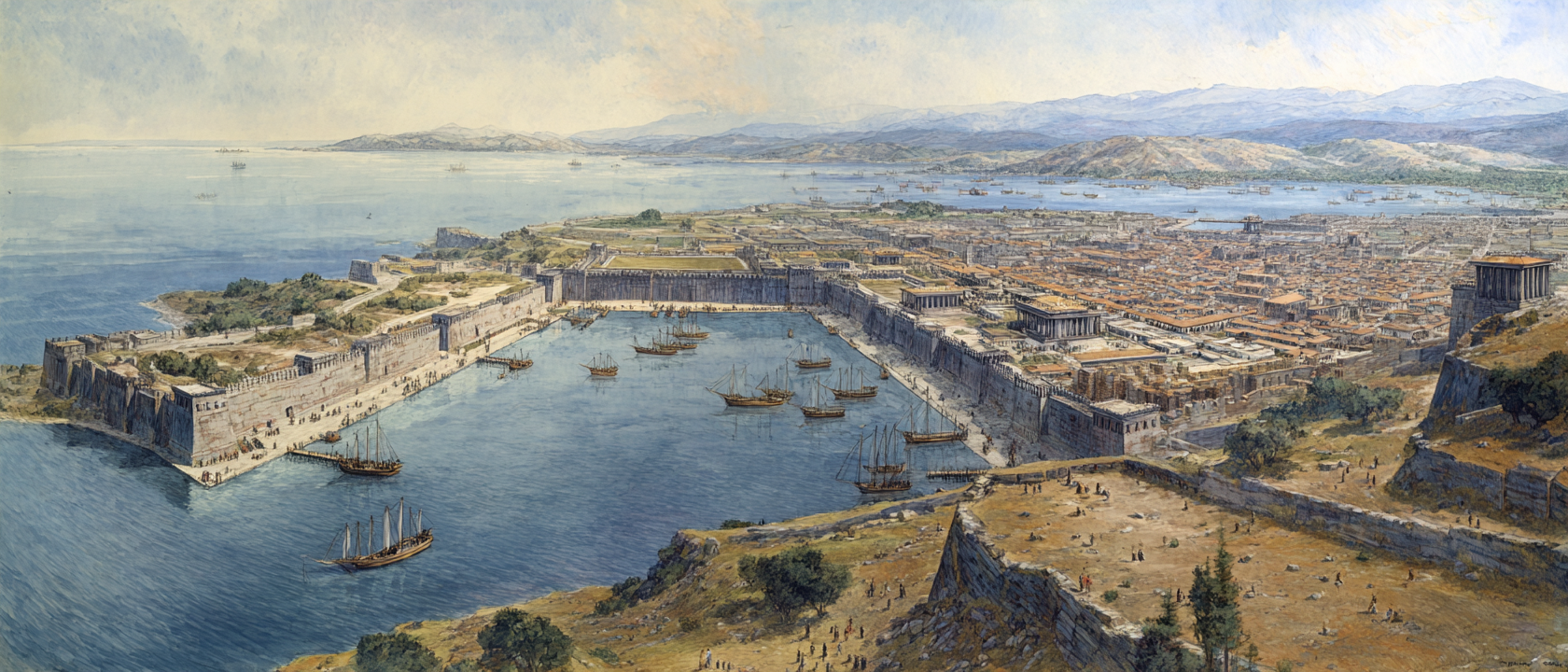
Portus Lacus is the home of the Classis Lacensis: the inland fleet of forty-two warships that patrols the Inland Sea's trade routes, responds to maritime emergencies, and provides the military deterrent that keeps the sea lanes secure for the commercial traffic constituting the empire's economic foundation. The base and the town around it occupy a natural harbour on the Inland Sea's northern shore, its position giving the fleet direct access to both the main east-west sea lanes and the southern approach to Lacusum. The population of approximately eighteen thousand is the smallest of the province's two significant settlements and in most practical respects entirely subordinate to Lacusum's commercial operations, a relationship Admiral Nauta Fortis considers a mischaracterisation of the Classis's strategic importance and that he has been articulating to the Magister Militum's office in a series of reports he considers well-reasoned and that the Magister Militum's staff consider accurate in their facts and politically unaware in their conclusions.
The town that has grown around the base has the specific character that naval towns produce: direct, physically capable, organised around the operational calendar of the institution it serves, and possessed of the specific civic pride of people who believe they are doing something important that the rest of the empire does not adequately appreciate. The streets are clean by naval standards. The buildings are maintained by naval standards. The population is fit and punctual in ways that Lacusum's commercial population is not, and the commercial population of Lacusum, which is aware of this, finds it both admirable and somewhat self-satisfied.
Demographics
Approximately eighteen thousand permanent residents: the base's naval complement of four thousand sailors and officers, their families, and the service community that provides everything the base and its population requires. The civilian service community is the most militarily adjacent civilian population in the interior provinces. The families who have been supplying the base for generations carry the specific practical knowledge of naval operations that comes from being the people who fix the ships, feed the sailors, and raise the children who frequently become sailors themselves. Career continuity between base families and fleet service is the highest of any naval installation in the empire.
Government
Admiral Marcus Nauta Fortis, in his eighth year, commands the base and the fleet with the operational authority that the Classis's charter gives him and the civic authority the base's dominant presence in the town's life produces informally. The town's civilian administration, a prefect appointed by the Governor's office, manages civil matters with the specific deference to the Admiral's preferences that eight years of working with him has made efficient. The Governor's office's relationship with Portus Lacus is straightforward in a way that its relationship with Lacusum is not: the Admiral wants adequate funding, consistent provisioning, and recognition of the Classis's strategic importance. He receives the first two reliably and the third intermittently, which is the source of his ongoing report-writing to the Magister Militum.
DM ONLYDefences
The Classis Lacensis: forty-two warships ranging from the fleet's four heavy triremes to the patrol craft that work the coastal routes and the Fluminis Magnus mouth approaches. The fleet's composition reflects the Inland Sea's threat environment. The heavy warships provide deterrence and emergency response capability; the patrol craft provide the continuous presence on the sea lanes that commercial traffic requires. The fleet's response time to any point on the Inland Sea is measured in hours rather than days, and its operational effectiveness in the specific threat environment of an enclosed sea is, by the Admiral's assessment, the highest in the empire per ship deployed.
DM ONLYIndustry & Trade
The base's provisioning requirements are the town's primary commercial activity. The supply contracts for the fleet's food, materials, and equipment are the most stable commercial relationships in the province, and the supply families manage them with careful attention to contract terms. The ship repair yards are the town's second significant commercial activity, their capabilities extending beyond the fleet's needs to the commercial repair work that brings merchant vessels from Lacusum's harbour for maintenance that the commercial harbour's facilities cannot handle. The Admiral's relationship with the commercial repair business is his most direct economic connection to Lacusum's world, and the repair yard operators are the people most likely to give him an accurate assessment of the commercial harbour's operational character, if he were to ask.
Districts
Portus Lacus organises naturally around the institution it serves. The Base is the secured naval precinct, accessible only to military personnel and their immediate business: the fleet anchorage, the command buildings, the repair infrastructure, the training facilities, and the ordnance and provisioning warehouses that sustain forty-two warships in continuous operation. The Service Town is the civilian district providing everything the base requires and housing everyone who provides it: provisioning merchants, repair families, medical practitioners, and the full range of service trades that a population of this size generates, organised around proximity to the base's supply gates and the rhythms of the fleet's departure and return schedule. The Waterfront Quarter is the public-facing section of the town, its shore facilities accessible to commercial vessels using the repair yards and to the fishing community working the northern shore's coastal waters, and the only district where non-base visitors have regular presence. The Officers' Quarter is the residential district where the fleet's senior officers and their families live, maintained in the specific separation from the enlisted community that naval hierarchy produces, quieter and more formally organised than the Service Town.
Guilds and Factions
The naval chain of command is the dominant institutional structure, with the Admiral's authority unchallenged within his operational domain. The civilian supply families constitute the town's commercial faction, their relationship with the base built on supply contracts held for generations. The fishing community is the smallest faction and the most independent: the northern shore's fishing grounds are not controlled by the base, and the fishing community's relationship with the base is cordial and minimal, the two populations sharing the waterfront without significant overlap.
History
Portus Lacus was established as the Classis Lacensis's base in the third century A.P., when the Inland Sea's commercial traffic reached a volume requiring formal naval protection. The base's current infrastructure dates primarily from the fifth century rebuild following storm damage. The current fleet composition was established in the seventh century and has been adjusted in every generation as the sea lanes' threat environment has changed. For full chronological detail, see: Annales Mundi.
Points of interest
The fleet at anchor (base harbour, accessible from harbour frontage with authorisation) — forty-two warships in operational configuration, the patrol craft rotating in and out on their sea lane schedules, the heavy triremes at the harbour's inner berths. The most complete expression of the Classis's purpose available to any visitor admitted to the base's harbour frontage.
The Admiral's weekly briefing (harbour authority building, open to civilian leadership) — the fleet's operational status and sea lane security assessment, presented in terms that the civilian audience finds informative and that Vara Swiftledger's information brokers, attending through a commercial representative they maintain in the town, find extremely useful for calibrating the Council's own assessment of what the Classis knows, and more importantly what it does not.
DM ONLYTourism
The town receives limited visitors beyond those with base business — the commercial repair customers, the provisioning suppliers, the occasional scholar or official. The public harbour front is accessible and the fleet at anchor is visible from it, which provides a sufficient experience for visitors whose interest is in the Classis without requiring base access. The Admiral's office responds to official visitor requests with the thoroughness of a command that considers visibility part of its advocacy for adequate resourcing, and senior officials who visit the base receive briefings that leave them with a higher assessment of the Classis's importance than they arrived with, which is the outcome the Admiral designs each briefing to produce.
Architecture
Military and naval construction throughout: the base's buildings in the standard Legion construction style, functional and permanent; the town's civilian buildings in the same materials with the specific design modifications that families living adjacent to a working naval base develop over generations. The buildings near the waterfront have the deepest foundations in the settlement, the result of storm-proofing requirements developed after the third-century storm that damaged the original base's infrastructure.
I have spent time at Portus Lacus on four occasions and have found it, each time, a more interesting place than its straightforward naval character suggests. The Admiral is a professional of genuine distinction whose analysis of the Inland Sea's strategic situation is among the most rigorous available. His analysis has a gap in it, which is the halfling navigation intelligence, and the gap makes his conclusions about the Classis's indispensability partially incorrect. I have not told him this. I have discussed it with the Lacusum harbour master. She is aware of the gap and has been deciding for some years whether to inform the Admiral directly or to allow the situation to continue producing outcomes she finds commercially useful. She has not yet decided.
Geography
The base occupies a natural harbour on the northern shore: a sheltered anchorage large enough for the forty-two-ship fleet with space for the repair yards, the provisioning infrastructure, and the training facilities a functional naval base requires. The town has grown southward from the base's civilian boundary, its streets extending along the shoreline in both directions from the base's main gate. The northern shore's position gives the base direct sightlines across the Inland Sea to the southern shore: on clear days, the Lacusum breakwater is visible from the harbour frontage, and the Admiral's morning briefings include this visual context as what he considers an essential element of operational awareness.
Climate
The northern shore's exposure to the Inland Sea's prevailing weather gives Portus Lacus a rougher maritime climate than Lacusum on the southern shore. The storms that come from the north strike the base before they reach the city, and the base's weather monitoring operations provide the earliest warning of significant weather events available to the Inland Sea's southern shore communities.
DM ONLYMilitary
42 warships, Classis Lacensis. 4,000 naval personnel. Interior empire's primary maritime military force.
Economy
Fleet provisioning supply contracts (dominant).
Ship repair yards (secondary, including commercial vessel repair).
Northern shore fishing (minor, independent).

Comments