
LACUSUM
The Great Trading City · City · Provincia Lacus Interioris
I confess that I find Lacusum more comfortable than Nova Romae. It is a city that knows what it is for. Everyone in it is engaged in commerce of some kind, and the result is a pragmatism and directness that I find refreshing after the Senate Quarter's elaborate performances of political positioning. A merchant in Lacusum will tell you what something costs. A senator in Nova Romae will tell you what it ought to cost and then charge you something else entirely. The city is not beautiful in the way that Nova Romae is beautiful. It is purposeful in the way that a very well-made tool is purposeful, and I have come to prefer purposeful to beautiful in the way that a person who has spent sixty years getting things done eventually does.
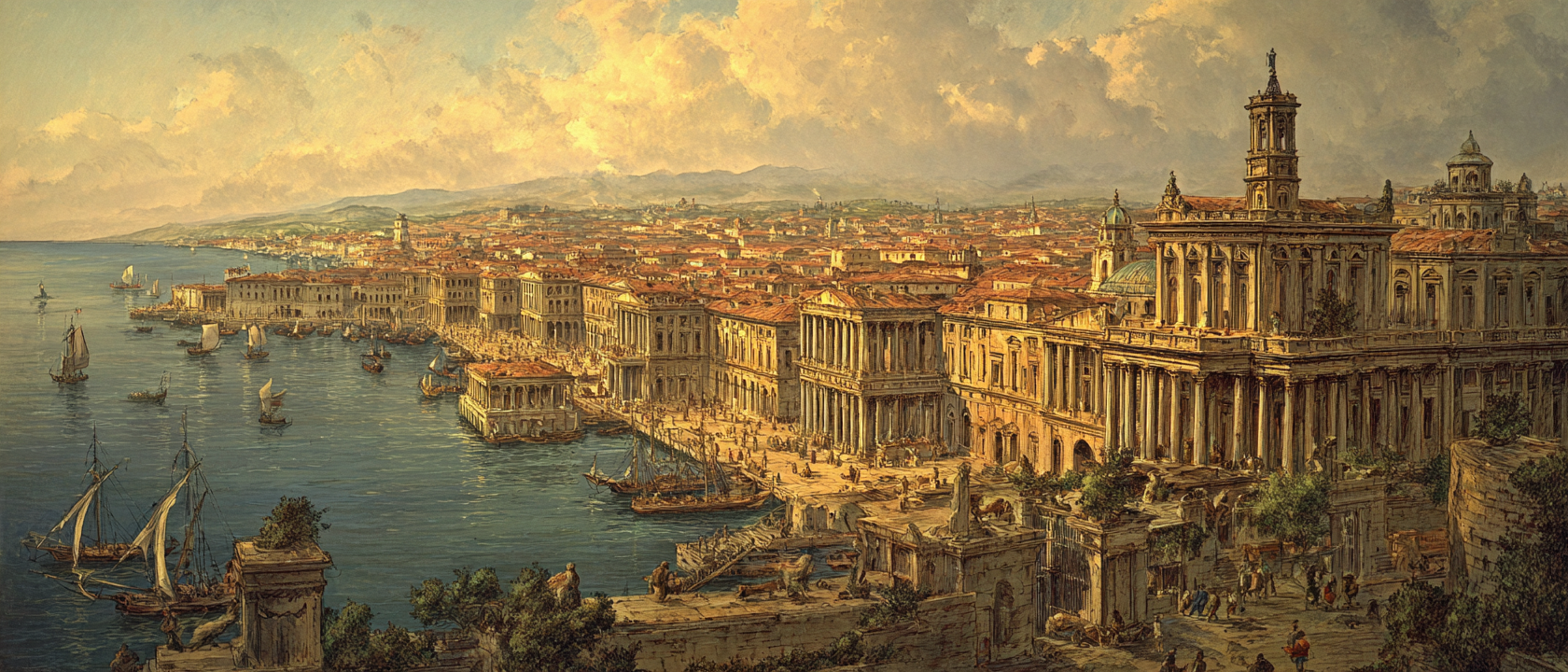
Lacusum is the empire's great trading city — two hundred thousand people organised around the single purpose of moving goods, setting prices, and making money with a sophistication that the capital's political culture has never fully understood and has consistently underestimated. It sits on the Inland Sea's northern shore, its bay sheltering two hundred ships simultaneously behind a breakwater that took forty years to build and that the city's engineers consider their finest achievement. The grain futures that determine what the Annona pays for Nova Romae's food supply are set here. The insurance exchange that underwrites every significant cargo on the empire's sea lanes operates here. The halfling Merchant Council's largest mainland office — the operational headquarters of the most sophisticated commercial intelligence network in the known world — is here, and the woman who actually runs it has been doing so for twenty years with a thoroughness that Tobias Clearwater, who is nominally her superior and practically her instrument, has never found occasion to criticise.
The Mercatorum faction's real power base is Lacusum, not Nova Romae. The counting houses and trading floors and merchant family villas that line the harbour front are where the faction's commercial authority is grounded, and the senators who represent Mercatorum interests in the capital are translating decisions made here into legislative form rather than making decisions independently. The Senate knows this in the abstract. It does not fully reckon with what it means in practice, which is that the most commercially significant city in the empire is governed by commercial logic rather than political logic, and that the Annona's attempt to retain control of the grain futures market against the lobbying pressure of the Nova Romae merchant families is a dispute about whether political authority or commercial authority should set the price of the empire's food. This is not a dispute with an obvious correct answer, and both sides know it.
The bay at Lacusum on a summer morning, with two hundred ships at anchor and the breakwater catching the early light, is one of the most practically impressive sights in Aethermarch. I do not mean impressive in the way that the Forum Novum's columns are impressive, or the Iron Spine's peaks, or the Sylvanmere treeline. I mean impressive in the way that a very large number of people doing something very well simultaneously is impressive — the harbour pilots threading between the anchored vessels, the lighters moving between ship and shore, the counting house clerks on the waterfront whose morning calculations will determine what grain cuts in Nova Romae next month. I have stood on the breakwater at dawn and tried to count the ships. I have never managed it.
Demographics
Two hundred thousand residents with the specific demographic character of the empire's primary commercial city: more halflings per capita than anywhere in the empire outside of Brindala, a permanent population of dwarf commercial agents managing the goods that flow from the mountain province's trading posts through Lacusum to the capital, a significant tabaxi merchant presence operating the southern trade connections, and the Roman commercial families who have been here for twelve generations and who consider the city's non-Roman residents essential commercial partners and only occasionally remember to be politically uncomfortable about this. The city's cosmopolitanism is not ideological — it is the natural result of two hundred years of being the node through which every significant trade route on the primary continent passes.
The halfling community is the city's most commercially significant minority and its most institutionally powerful. The Merchant Council's Lacusum office employs approximately three hundred halflings directly and has commercial relationships with every significant trading house in the city. Vara Swiftledger, sixty-two, who has directed the Lacusum operation for twenty years, is known by name and reputation to every commercial operator in the empire and is known personally to approximately no one outside a circle of about forty people, which is precisely the condition she has maintained deliberately.
DM ONLYGovernment
Governor Marcus Portus Lacens, fifty-nine, in his fifth year, administers a city whose commercial operations are largely self-governing through the market institutions that have developed over twelve centuries, and whose governance challenges are primarily the management of disputes between institutions rather than the direction of civic life. The grain futures market dispute — the Annona's control versus the Nova Romae merchant families' lobbying for influence — is the most politically significant ongoing dispute in the province, and Lacens has navigated it by the expedient of declining to take a position that he has not first cleared with both the Senate's fiscal committee and the Emperor's household staff, a process that ensures his positions are always politically safe and almost always too late to affect events. The merchant families find him predictable. The Annona finds him reliable. Vara Swiftledger finds him useful.
The city's practical governance is distributed across the harbour authority, the grain exchange's management board, the insurance exchange's regulatory committee, and the Banca Brindala's local risk assessment office — a set of institutions whose collective decisions shape daily commercial life more directly than anything the Governor's office produces. Lacens has a better relationship with these institutions than most of his predecessors, partly because he is genuinely interested in commercial administration and partly because he made the specific choice, in his first month in the role, to attend the grain exchange's morning session without notice and was subsequently treated by the commercial community as someone who had passed a test they had not announced.
Defences
The city has no Legion garrison in the conventional sense — the inland provinces' security does not require it. The city watch, enlarged to account for the population, manages civil order in a city whose commercial culture produces specific categories of dispute that the standard watch training does not cover. The harbour authority's enforcement arm manages maritime security and has the closest working relationship with the Classis Lacensis of any civilian institution in the city, a relationship that the Admiral at Portus Lacus cultivates carefully because the harbour authority's intelligence on shipping movements is the most complete available source and the Admiral is not prepared to acknowledge this to anyone who might tell the halflings.
Industry & Trade
The grain futures market is the province's most politically significant commercial institution — the mechanism by which the Annona determines what to pay for the empire's food supply, and the arena in which the Nova Romae merchant families are currently attempting to expand their influence against the Annona's resistance. The market operates on the exchange floor's transparent pricing system while the coded trader communications route around the transparency, and the net result is a price that is more accurate than any alternative mechanism available while being less transparent than the design intended. The Annona has been aware of the coded communications for sixty years and has not suppressed them because suppressing them would require acknowledging their existence.
DM ONLYThe insurance exchange is the less politically visible but equally commercially significant institution — the body that underwrites the risk of every significant cargo on the empire's sea lanes and whose pricing decisions determine whether specific trade routes are commercially viable. The halfling Merchant Council's actuarial team, housed in the Lacusum office's upper floors, produces the risk assessments that the exchange's underwriters use as their primary reference. This makes the Merchant Council's Lacusum office the de facto setter of insurance prices for the empire's entire maritime trade, a role that is not formally acknowledged in any institutional document and that Vara Swiftledger considers her office's most strategically significant function.
The Banca Brindala's primary mainland office in Lacusum is the financial infrastructure through which the commercial city's enormous transaction volume flows. Its relationship with the Argentarium Imperiale is the standard cooperative-competitive arrangement that both institutions have maintained since the Banca's arrival two hundred years ago, with the renegotiation terms moving consistently in the halflings' favour each decade. The current renegotiation — driven by Clearwater's planned conversation with the Emperor in the next six weeks — will be prepared in detail in the Lacusum office before Clearwater presents it in Nova Romae as his own analysis.
The grain exchange floor's coded trader communication system has evolved over sixty years into something significantly more sophisticated than the Annona's analysis suggests. What began as simple price-signalling between allied trading houses has become a parallel market that operates simultaneously with the official floor — real prices negotiated in the coded system while official prices are recorded on the transparent floor at levels that satisfy regulatory requirements. Vara Swiftledger's actuarial team has been mapping the coded system for four years and has produced, in the past six months, a complete translation key. The Council has not shared this with the Annona, the Governor, or the Senate's fiscal committee. They are using it to provide their commercial clients with the most accurate grain price forecasts available in the empire, which is the basis of the Merchant Council's claim, made in its consultation brochure, that its rate consultation service provides more accurate market intelligence than any alternative source. This claim is true. The reason it is true is not in the brochure.
DM ONLYDistricts
Lacusum organises naturally around its harbour. The Harbour Front is the commercial core — the counting houses, the exchange buildings, the Merchant Council's headquarters, the most commercially dense kilometre of real estate in the interior empire. The Grain Quarter is the physical infrastructure of the futures market — the warehousing, the weighing halls, the barge terminals where the Septentrionalis harvest arrives. The Merchant Villas District is where the commercial families live, their houses the specific expression of Lacusum's aesthetic of restrained prosperity. The River Mouth District is the southern quarter where the Fluminis Magnus enters the city, the barge traffic terminus and the point of connection to Nova Romae. The Common Quarter is the residential and service district that houses the majority of the city's two hundred thousand people and that the city's commercial culture has produced as a relatively prosperous working environment compared to equivalent districts in other provincial capitals.
Guilds and Factions
The Mercatorum faction's real power base is the commercial families and trading houses of the Harbour Front — the counting houses, the grain exchange management board, the merchant family villas that line the waterfront. Their senators in Nova Romae translate Lacusum decisions into legislative form. The Mercatorum's Lacusum presence is where commercial strategy originates; the Senate presence is where it is implemented. The current strategic question — whether to pursue a direct Senate purchase strategy without Mercatorum intermediation — is being actively calculated by the Aurantius family in Portus Meridiani and has not yet reached the Mercatorum's Lacusum management. It has reached Vara Swiftledger. The Mercatorum is not aware of this.
The Merchant Council's Lacusum office under Vara Swiftledger is the halfling faction in the city's commercial politics and the most complete intelligence operation in the interior empire. Its commercial relationships with every significant trading house, its actuarial control of insurance pricing, its coded communications translation capability, and its position as the financial infrastructure of the Banca Brindala renegotiation give it more information about the empire's commercial landscape than any other institution, including the Annona and the Senate's fiscal committee. The Council's Lacusum operation does not seek political influence. It seeks commercial accuracy. The distinction, in Vara's assessment, is meaningful. In the Senate's assessment, it would be alarming if the Senate fully understood what it meant in practice.
The Banca Brindala operates from the Harbour Front as the financial infrastructure of Lacusum's commercial volume and the empire's most sophisticated banking institution. Its relationship with the Argentarium Imperiale is formally cooperative and practically competitive, its renegotiation terms historically consistent and consistently favourable to the halflings. The current renegotiation will be the most consequential since the Banca's arrival.
History
Lacusum was established in the first century at the point where the Fluminis Magnus enters the Inland Sea, the location's commercial logic immediately apparent. The city achieved commercial significance within three centuries and has maintained that position since, despite the capital's political and administrative primacy. The breakwater was constructed over forty years in the sixth and seventh centuries. The grain exchange was built in the third century. The halfling Merchant Council established its mainland headquarters here rather than in Nova Romae within fifty years of the halflings' arrival, a locational decision that every subsequent generation of Council leadership has confirmed as correct.
For full chronological detail, see: Annales Mundi.
Points of interest
The Breakwater at Dawn (public infrastructure, two-kilometre walk from harbour) — the experience Varro recommends to every visitor and the one that most completely expresses what Lacusum is. The walk from the harbour to the breakwater's end, with the anchored fleet on the left and the open sea on the right and the city's limestone facades catching the early light behind you, produces in most visitors the specific understanding that a city of this purpose requires a physical experience rather than a description to communicate. The engineers' maintenance post at the breakwater's end is staffed at all hours. The engineers will answer questions about the breakwater's construction from anyone who demonstrates genuine interest. They will provide considerably more detail than most visitors require.
The Merchant Council's Mainland Headquarters, Harbour Front (ground floor publicly accessible for commercial business) — the rate consultation desk, the cargo documentation service, the insurance referral service that directs clients to the exchange's underwriters using the Council's actuarial assessments as the basis for the recommendation. The upper floors are not accessible. The building's exterior is three storeys of well-maintained pale limestone with no signage more prominent than a small brass plate beside the door reading 'Merchant Council — Lacusum Office.' The plate has been there for two hundred years. It has been polished every morning for two hundred years. The polish is the most significant maintenance the exterior receives, which is a deliberate choice.
The Grain Exchange Trading Floor, Grain Quarter (gallery publicly accessible, floor by licensed admission) — five hundred people in a space designed for transparency, communicating in a coded system that the design's architects did not anticipate, producing prices that the Annona in Nova Romae is required to accept as the market reference and that the Nova Romae merchant families are lobbying to influence through Senate action. The gallery above the floor is publicly accessible. Watching a session from the gallery without understanding the coded communications produces the impression of organised chaos. Understanding the communications produces the impression of organised deception. Both impressions are partially accurate.
The Aula Assecurationis, Harbour Front (accessible to licensed underwriters and their clients) — the insurance exchange where every significant cargo on the empire's sea lanes is priced for risk. The halfling actuarial team's assessments are the primary reference used by the exchange's underwriters, a fact visible to anyone who watches a morning session carefully and notices that the underwriters check a specific document before submitting their rates. The document is prepared in the Council's upper floors and delivered at 8 a.m. daily. It has no official name. It is referred to in the exchange's informal communications as 'the Swiftledger.' Vara is aware of this. She has not discouraged it.
Tourism
Lacusum receives visitors primarily for commercial purposes — the trading houses, the exchange sessions, the Council's documentation services, the banking facilities. The small number who come without commercial business come for the harbour, which Varro has done more than anyone to establish as a destination in its own right. The city is hospitable to visitors in the specific way of a place that processes large numbers of transients as a commercial function and has developed efficient infrastructure for doing so. The food is excellent — the city's cosmopolitan population has produced a culinary tradition that the interior provinces cannot match — and the Merchant Council's rate consultation desk will provide a commercial visitor with a more accurate assessment of current market conditions than anything else available in the empire, free of charge, because the Council's business model is built on being the most useful commercial intelligence source available and free consultations are the most effective advertisement for that usefulness.
Architecture
Lacusum is built in warm limestone throughout — the local material, pale gold in the morning light, a deliberate contrast to the utilitarian granite of the mountain province and the dark sandstone of the frontier. The harbour front's counting houses are the city's architectural signature: five and six storey commercial buildings whose facades display the commercial success of their owners with the specific restraint of people who know that ostentation in a city of traders signals poor commercial judgment. The Merchant Council's mainland headquarters — at the harbour front's eastern end, its exterior deliberately modest and its interior the most completely equipped commercial intelligence facility in the known world — is the most extreme expression of this aesthetic. It looks like a prosperous merchant's offices. It functions like the empire's commercial nervous system.
The grain exchange — the building where the Annona's futures contracts are set and where the Nova Romae merchant families' lobbying pressure is most visibly applied — is the city's largest single commercial structure, its trading floor capable of accommodating five hundred people simultaneously and designed, by its third-century architects, to make every transaction feel as public and transparent as possible. The design has been credited with producing the most honest pricing market in the empire. It has also produced the most elaborate system of coded communication between floor traders that any market in the known world has developed, which partially negates the transparency the design was intended to create.
Geography
The city occupies the Inland Sea's largest bay on the northern shore, its bay depth sufficient for the largest merchant vessels to anchor without difficulty and its shelter from the prevailing southern winds making it the obvious location for the empire's commercial centre. The breakwater is the city's western boundary, extending the natural headland by two kilometres; the natural headland itself is the eastern anchor. Twelve centuries of investment have made the obvious location into the optimal one. Nova Romae lies to the south via the Inland Sea and then overland — barges from the river system reaching the sea at Confluentes, then coastal vessels north to Lacusum. The city extends inland from the harbour in the standard Roman grid, its density decreasing as distance from the water increases, the waterfront itself the most commercially valuable real estate in the empire outside of Nova Romae's Forum Novum.
Climate
The Inland Sea's moderate maritime climate — warmer than the mountain province, cooler than the southern coast, the sea's thermal mass moderating the temperature extremes that the agricultural interior experiences. The city's summer is the busiest commercial season; the harbour's capacity is tested most severely in late summer when the Septentrionalis harvest arrives by barge and is processed through the grain exchange simultaneously with the year's peak shipping traffic. The autumn storms that cross the Inland Sea in the later months are the harbour authority's primary annual challenge and the insurance exchange's primary annual pricing event.
Natural Resources
The harbour is the city's primary resource — the deep bay formed where the rivers from the Iron Mountains meet the Inland Sea, enlarged and perfected by the breakwater into the finest commercial anchorage on the primary continent. The breakwater itself, extended by two kilometres over forty years of construction in the sixth and seventh centuries, transformed an already good harbour into one capable of sheltering two hundred ships simultaneously. The engineers attribute its survival through twelve centuries of Inland Sea weather to sound construction. Varro attributes it to sound construction and the quality of dwarf engineering consultation applied to the original design.
The city's second resource is its position — the node through which every significant trade route on the northern shore of the Inland Sea passes, a geographical fact that requires no institutional maintenance and that no competitor has been able to replicate. The Inland Sea itself, approximately 1,000 kilometres east to west and 400 kilometres north to south, is the empire's internal trade highway, and Lacusum sits at its most commercially productive point on the northern shore: where the sea routes connect the northern and eastern provinces, where the Septentrionalis grain surplus loads onto vessels for distribution, and where the road south reaches toward Confluentes and the Fluminis Magnus river system beyond.
Military
City watch (enlarged for population). No Legion garrison. Harbour authority enforcement arm manages maritime security. Classis Lacensis close relationship — Admiral at Portus Lacus cultivates harbour authority intelligence access.
Economy
Grain futures market (Annona price-setting for empire's food supply).
Insurance exchange (de facto pricing authority for empire's sea-lane trade).
Inland Sea trade hub (all eastern shore provinces).
Halfling Merchant Council mainland headquarters (commercial intelligence).
Banca Brindala primary mainland office.

Comments