
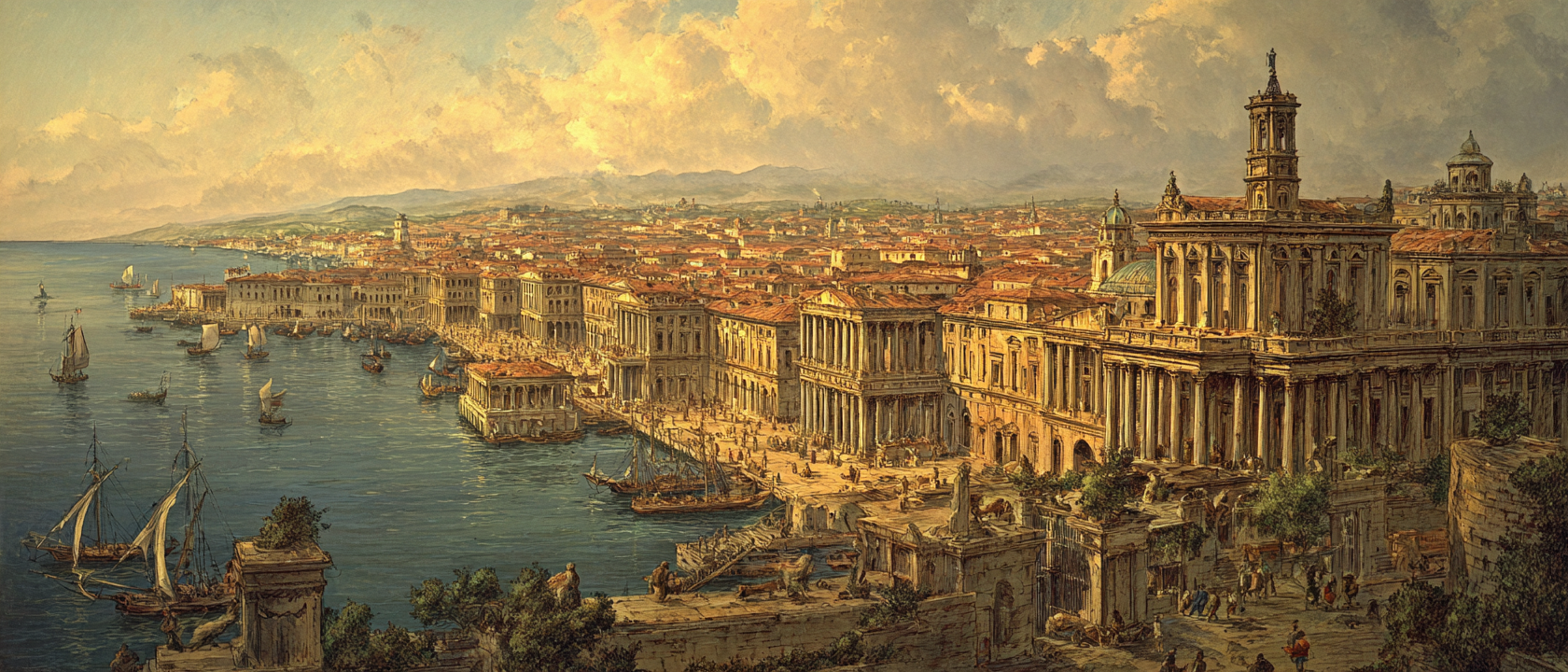
HARBOUR FRONT
The Commercial Core · District · Lacusum
"The Harbour Front is a kilometre of limestone facades that collectively represent the most concentrated commercial intelligence in the empire. The counting houses hold information that the Senate's external affairs committee would pay considerable money to access. The Merchant Council's ground floor consultation desk will give you a more accurate market assessment than anything the Annona publishes. The insurance exchange's morning session prices risk with an accuracy that the Imperial treasury's actuaries have been attempting to replicate for sixty years without success. And the harbour itself — the ships, the lighters, the pilot boats threading between them — is the physical expression of what all this intelligence is ultimately for: moving things from where they are to where they are worth more."
The Harbour Front is the empire's most commercially dense district — a kilometre of waterfront from the river mouth to the breakwater's landward end, its buildings the counting houses, exchange halls, banking offices, and commercial intelligence facilities that constitute the practical governance of the empire's trade. The district never fully stops; the grain exchange's floor is dark overnight but the counting houses work through the night on the transactions that the day's trading generates, and the harbour authority's operations are continuous by necessity. The halfling presence is highest here — three of every ten people on the Harbour Front at any given hour are halflings, a proportion that reflects the Council's operational concentration in the district.
Demographics
The Harbour Front's five and six storey limestone buildings are the definitive expression of Lacusum's commercial aesthetic: facades that signal prosperity through quality of construction and maintenance rather than decoration, ground floors designed for commercial access with wide doorways and display windows, upper floors housing the counting rooms and intelligence offices whose contents are worth considerably more than the buildings' exteriors suggest. The grain exchange is the district's only building that abandons this aesthetic — its large trading floor required a structure of unusual breadth rather than height, its glass roof panels bringing daylight onto the floor in a way that the transparency-focused architects considered essential and that the floor traders have spent sixty years using the resulting light to signal each other.
Government
The Governor's harbour authority manages the waterfront's physical operations. The grain exchange's management board, the insurance exchange's regulatory committee, and the Merchant Council's operations manage everything else. The Governor's office's practical authority in the district is limited to the harbour authority's enforcement functions and the resolution of commercial disputes that the market institutions cannot resolve internally — a category that is smaller than the volume of disputes would suggest, because the commercial community's preference for resolving disputes without external authority is as strong here as anywhere in the empire.
History
The Harbour Front was the first district established when Lacusum was founded — the waterfront buildings preceding the residential districts behind them in the standard pattern of a commercial city growing outward from its commercial purpose. The grain exchange is third-century. The insurance exchange is fifth-century. The Merchant Council's headquarters was established within fifty years of the halflings' arrival, two hundred years ago, and has expanded in every decade since without the expansion ever being visible in the building's exterior dimensions. For full chronological detail, see: Annales Mundi.
Points of interest
The Merchant Council's headquarters at the eastern waterfront — its brass plate polished every morning, its ground floor consultation desk staffed by halfling commercial specialists whose assessments are more accurate than any paid service in the empire, its upper floors containing the actuarial and intelligence operations that make those assessments accurate. The consultation desk is genuinely free and genuinely useful. It is also the point at which the Council's information brokers assess every visitor for commercial intelligence value, a process so practiced as to be invisible.
The grain exchange's trading floor, accessible from the gallery above during sessions. The session rhythm is established: morning pricing for the day's contracts, midday adjustment for incoming barge reports, late afternoon settlement. The coded communications between floor traders are visible as a pattern of gesture and position to anyone watching from the gallery who knows what they are looking at. The Council's actuarial team has produced a guide to interpreting these communications for internal use. The guide is in the upper floors. It has never left the building.
The insurance exchange's western end upper floor has the best view of the harbour available from any building in the district — a panoramic prospect of the bay, the anchored fleet, and on clear days the northern shore where Portus Lacus is visible as a smudge of building and mast. The underwriters use this view functionally, assessing weather and traffic conditions as inputs to their daily pricing. Visitors admitted to this floor by the exchange's management — a courtesy extended to significant commercial figures — find it affects their understanding of what insurance pricing actually is in a way that the exchange's published rate tables do not.
Architecture
The Harbour Front's five and six storey limestone buildings are the definitive expression of Lacusum's commercial aesthetic: facades that signal prosperity through quality of construction and maintenance rather than decoration, ground floors designed for commercial access with wide doorways and display windows, upper floors housing the counting rooms and intelligence offices whose contents are worth considerably more than the buildings' exteriors suggest. The grain exchange is the district's only building that abandons this aesthetic — its large trading floor required a structure of unusual breadth rather than height, its glass roof panels bringing daylight onto the floor in a way that the transparency-focused architects considered essential and that the floor traders have spent sixty years using the resulting light to signal each other.
Geography
The district runs along the bay's southern edge from the river mouth at the east to the breakwater's land junction at the west, its landward buildings extending two streets back from the waterfront before the city's commercial density decreases and the character changes to the mixed residential and commercial streets of the Common Quarter behind it. The grain exchange is at the district's eastern end, near the barge terminals where the harvest arrives. The Merchant Council's headquarters is at the eastern end, positioned where the commercial intelligence it houses is closest to the transactions it monitors. The insurance exchange is at the western end, positioned where the harbour view from its upper floors gives its underwriters the most complete visual access to the fleet they are pricing.
Access
Waterfront — public.
Exchange floors — credentialled commercial parties.
Council ground floor — public.
Council upper floors — Council staff only.

Comments