
NOVA CONSPECTUS
The Watching City · City · Provincia Campi
Nova Conspectus is the empire's youngest provincial capital and the only city in Aethermarch where a centaur elder arriving at the civic forum is not an event. This sounds like a small thing. It is not a small thing. It has taken nine hundred and seventy-five years of careful relationship-building, one military decision on a hilltop, and the accumulated patience of people on both sides who understood that the alternative to relationship-building was a conflict neither could conclusively win. The centaur elders who walk through the forum gates do so because Rome, at a specific moment, proved it was worth walking through gates for. The Senate, which administers from a distance and sometimes needs reminding of this, would do well to remember that the proof is not permanent and can be unmade faster than it was made.
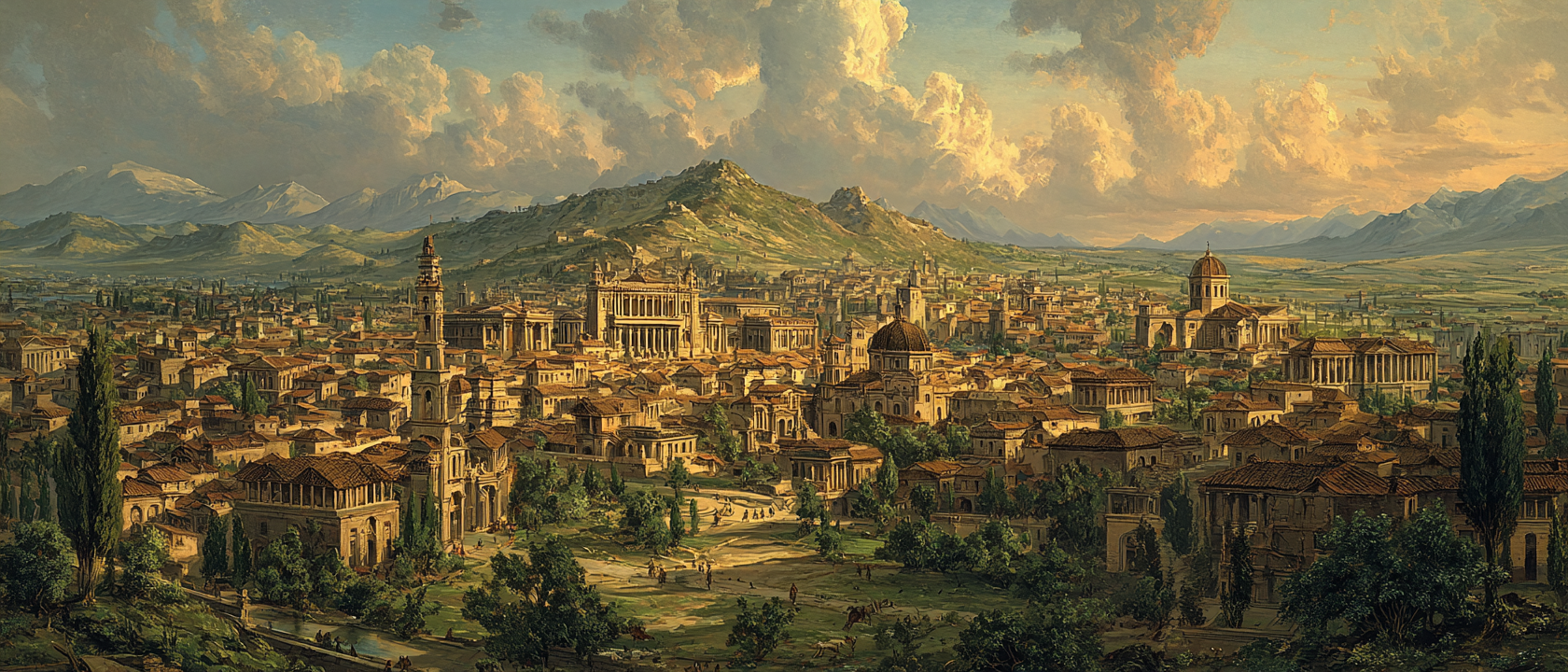
Nova Conspectus sits on the flat grassland plain of Provincia Campi's northern reach, the youngest provincial capital in the empire at roughly six centuries of continuous settlement, its character organised around two defining institutional facts: the Legio XIV Gemina garrison whose ancestor-formation made the decision at Mons Conspectus in 225 A.P., and the Diplomatic Mission that administers the most consequential bilateral relationship in the empire's southern frontier. The hill for which both city and province are named is a short walk north — visible from the city's northern streets, a distinctive rounded rise above the grassland horizon, its summit marked by the monument to Aquilus that has been rebuilt four times and that the city's residents can see from the upper floors of the taller buildings on clear days without needing to climb the hill themselves. The relationship between the city and the hill is that of a place that knows its founding story without being defined by it, which is the specific maturity that young cities develop when they have been doing the same important work long enough to take it seriously without making it theatrical.
The city's Lead Diplomat, Cornelia Fides Camporum, in her eleventh year, is the most informed person in the empire on the subject of the Rome-centaur relationship and the most frustrated person in the empire on the subject of the Senate's capacity to listen to informed advice about it. She has sent eleven formal reports to the Foreign Office in the past two years documenting the frontier marker disputes' escalating significance, Arrak's diminishing patience, and the specific window — which she assesses at between eighteen months and three years — before Arrak's public position shifts from formal complaint to formal withdrawal of cooperation. The Foreign Office has acknowledged nine of the eleven reports. It has acted on none of them. Arrak knows she is trying. He does not know whether trying will be enough, and he has told her so directly, which she considers the most honest communication she has received in eleven years of diplomacy and the most alarming.
I have visited Nova Conspectus once, in my seventy-ninth year, and found it a city that understands its position in the world with unusual clarity — not the grandiose clarity of Nova Romae, which knows it is the capital and behaves accordingly, nor the commercial clarity of Lacusum, which knows it is the counting house and behaves accordingly, but the quieter clarity of a place that knows it is the hinge between two civilisations and that the hinge's function requires it to hold tension without breaking. The city holds the tension well. Whether the Senate will allow it to continue doing so is a different question.
Demographics
Forty thousand permanent residents with the specific demographic character of a frontier diplomatic city: the garrison population and its associated families and service community; the diplomatic mission's staff and their dependents; the scholarly community that has grown up around the Mission's archive and the unique research access the city provides to centaur cultural material; the commercial community that services the city's institutional functions; and the contingent of centaur cultural liaisons — currently eleven individuals from three eastern clans who have chosen to live in the city on a semi-permanent basis, a category of resident that exists nowhere else in the empire and for which the city's civic administration has developed, across three centuries of practice, the most sophisticated non-Roman residency framework in Aethermarch outside Nova Romae's Foreign Quarter. The eleven liaisons are not diplomats. They are people who have chosen, for their own reasons, to live at the intersection and who serve as the informal connective tissue between the city's Roman institutional life and the centaur world beyond the southern gate.
Government
Governor Titus Campus Explorator, in his second year, is a competent military administrator who retired from a Terminus posting and has been recalibrating his instincts for the past twenty-four months. The frontier diplomacy of the kind Provincia Campi requires, and Campus Explorator has been learning the difference at the pace of someone who is intelligent enough to recognise what he doesn't know and honest enough to ask for help from the people who do. He asks Fides Camporum's advice regularly and follows it about seventy percent of the time, which she considers a significantly better ratio than his predecessor managed and which she hopes will improve as his confidence in the diplomatic context increases. His military instincts are sound and have not yet been required, which he understands is the correct outcome and which he has been told, by the Mission's senior centaur scholar, is the outcome the Stonehoof Clan has also been managing for.
The city watch under Watch Commander Gaius Vigil Aequus, manages the specific civic order challenges of a city where centaur elder visitors interact with Roman civic infrastructure with a protocol manual that is now in its seventh edition and that Vigil Aequus has been updating continuously since his appointment three years ago. The manual's core principle — that accommodation of centaur visitors in civic spaces is not a special case requiring exceptions but a normal operational parameter requiring advance planning — was established by the Mission's founders and has been refined over three centuries into a practical framework that other provinces occasionally request copies of and that the Foreign Office has twice suggested standardising empire-wide, a suggestion the Mission has twice declined on the grounds that the framework's effectiveness depends on its being built from local knowledge rather than central directive.
Defences
The Legio XIV Gemina under Legate Marcus Fortis Alatus, maintains the province's military presence with the specific professional character of a legion whose founding act was a decision not to stand aside. The XIV is the most diplomatically experienced legion in the empire and the one whose soldiers are most likely to have a working knowledge of centaur, whose officers are more likely to have read the Mission's briefing materials on Hav'keth culture, and whose Legate is most likely to have a personal relationship with the Stonehoof Clan's senior outsiders that predates his appointment. Fortis Alatus served two earlier postings in the province at junior rank and considers the XIV his home formation in the way that soldiers develop attachments to institutions that match their temperament. He and Fides Camporum have worked together for four of his current posting's three years and have developed the collegial relationship that effective frontier governance requires — their assessments occasionally diverge on questions of military versus diplomatic priority, and when they diverge they discuss it, which is the institutional behaviour that makes the difference.
Industry & Trade
The city's economy is organised around its institutional functions rather than commercial production — the garrison payroll, the Mission's operational budget, the scholarly community's research economy, and the service sector that supports all three. The one distinctively local commercial activity is the centaur-adjacent craft trade: goods produced in the eastern clan ranges that enter the Roman commercial system through Nova Conspectus, handled by the centaur cultural liaisons' networks and sold through the Forum market's designated eastern goods section. This trade is modest in volume and significant in kind — the materials and craft items produced by the Hav'keth have no equivalent in the Roman commercial system, and the Forum market's eastern goods section attracts specialist buyers from as far as Nova Romae and Lacusum who understand that what is available here cannot be obtained anywhere else. The Mission monitors this trade carefully. It is one of the few areas where the economic relationship between Rome and the Hav'keth produces a Roman commercial benefit that the centaur participants have chosen to permit, and its continuation is contingent on Roman behaviour in the broader relationship in ways that Roman commercial buyers tend not to fully appreciate.
Infrastructure
Three imperial roads connect Nova Conspectus to the wider empire. The road north runs approximately 400 kilometres to Castellum Magnum in Provincia Terminus, the primary military supply route for the province and the connection through which Legion reinforcement would arrive if required. The road northeast runs approximately 600 kilometres to Claustra, the eastern valley garrison city in Terminus, providing the province's secondary military connection and the route through which Claustra's frontier intelligence occasionally reaches the Mission faster than the official dispatch system. The road east-southeast runs to the Mare Profundum coast, then follows the shoreline north toward Provincia Mediorum, serving the coastal communities along the province's eastern shore and connecting them to the Via Mediorum network.
The city's internal infrastructure reflects its function: wide streets capable of accommodating centaur visitors without the traffic disruptions that narrower urban layouts produce; public spaces scaled generously at the civic centre where the diplomatic functions require it and more modestly in the residential districts where the same scale would be wasteful. The Diplomatic Mission compound is the city's most architecturally significant building — a walled complex on the western edge of the forum whose gates are wide enough for centaur elder visitors and whose interior courtyard has a ceiling height that was specified by the Mission's founders based on consultation with the Stonehoof Clan about what indoor spaces centaurs find comfortable.
Districts
The Forum Quarter is the city's civic centre — the Diplomatic Mission compound, the governor's residence, the provincial administration buildings, and the forum itself where centaur elder visits take place. The Garrison Quarter occupies the northeastern section — the fort, the legionaries' residential streets, the military supply infrastructure. The Scholars' Quarter has grown organically around the Mission's archive and the accommodation of the research community it has attracted, its character the specific mixture of intellectual focus and political awareness that proximity to the empire's most sensitive diplomatic archive produces. The Plains Quarter is the southern residential district whose southern wall faces the Campus Magnus directly — the city's most culturally mixed neighbourhood, home to the centaur cultural liaisons and the residents whose daily lives most directly intersect with the plains world beyond the gate.
Guilds and Factions
The Diplomatic Mission under Lead Diplomat Cornelia Fides Camporum is the city's dominant institutional fact — its operational budget, its information networks, its centaur relationships, and its staff's accumulated expertise make it more consequential in Provincia Campi than the governor's office on all questions that touch the plains. The Mission has twelve diplomatic staff, forty support personnel, and the centaur scholar Hessa, a human woman of forty-one who grew up in a frontier farming community within sight of the Stonehoof Clan's eastern circuit and who has spent twenty years becoming the most knowledgeable Roman scholar of Hav'keth culture alive. Hessa is not a diplomat. She is the person the diplomats consult when they need to understand what they are actually dealing with, and her assessments have been accurate often enough that Fides Camporum treats them as more reliable than the Foreign Office's analytical products, a preference she has not communicated to the Foreign Office.
The Legio XIV Gemina's institutional culture is the city's second faction — not in competition with the Mission but in the specific complementary relationship that military and diplomatic functions develop when they have been working alongside each other in the same posting for generations. The legion's institutional memory of the centaur relationship is carried in its oral traditions as much as its written records — stories passed from senior soldiers to junior ones about the nature of the alliance, the correct behaviour in centaur encounters, the difference between the eastern clans' diplomatic openness and what that openness does and does not mean. Some of these oral traditions are more accurate than the written record. Some are less. The distinction matters more than it appears to, and Hessa has been trying, for three years, to work with the legion's senior centurions to identify which traditions are which.
History
The province was established in the fourth century following the consolidation of the Rome-centaur alliance that began at Mons Conspectus in 225 A.P. Nova Conspectus was founded as the provincial capital in approximately the same period, its location chosen for its proximity to the founding site and its defensible position on the plain's northern edge. The Diplomatic Mission was formally established in the third century, making it older than the city that now houses it — the Mission predates the city's formal establishment, which the Mission's staff consider a fact of institutional significance and the governor's office considers a historical curiosity.
For full chronological detail, see: Annales Mundi.
Points of interest
Mons Conspectus (landmark, short walk north) — the rounded hill above the grassland plain, its summit marked by the fourth iteration of the Aquilus monument, now visible in three directions on clear days. The hill receives a steady stream of visitors: scholars, soldiers, senators on inspection tours, and the occasional centaur elder who climbs it not to see the monument but to stand where the decision was made and look at the ground where the engagement turned. The monument itself is Roman in the specific style of commemorative martial architecture. The centaur elders' commemoration is at the base, where Aquilus's patrol came down, and involves no Roman monument at all. Both have been occurring in parallel for almost a thousand years.
The Mission's Public Archive (accessible by appointment) — the most complete record of the Rome-centaur diplomatic relationship that exists anywhere — every treaty, every formal communication, every official visit recorded in both Roman and centaur-translated form across nine hundred and seventy-five years. The archive is maintained by the Mission's archivist, Quintus Memoria Veteria, sixty-three, who has been in the post for twenty-seven years and knows the contents of every document it holds with the completeness of someone who has read them all multiple times and has been adding to them continuously. He is also the person in the empire who most completely understands the gap between what the official diplomatic record shows and what the Mission's internal correspondence — not in the public archive — reveals about the state of the relationship at any given point. The gap has been widening for two years.
The Sixth Permutatio Site (restricted, Campus Magnus territory, ~100km southwest) — the ruins of the unknown people's city, just across the Campus Magnus boundary under centaur territorial jurisdiction. The Academy maintains a permanent archaeological team there under diplomatic arrangements with the local centaur clans. Access for Roman scholars requires Mission facilitation and Stonehoof Clan permission, both of which the Mission provides when the requesting scholar has demonstrated the appropriate combination of academic credentials and diplomatic awareness. Varro has not visited. He has read every report the team has filed. He finds the gap between what the reports say and what they don't say as interesting as anything they describe.
The Domus Hav'keth (centaur residence, Plains Quarter) — the permanent residence established for the centaur cultural liaisons, the only purpose-built centaur accommodation in any Roman city outside the Mission compound's guest facilities. Its architecture is the result of the same consultation process that produced the Mission compound's courtyard dimensions — built to centaur physical requirements, furnished according to centaur practice, and maintained by the Mission's staff to the standard that centaur visitors expect. The eleven current liaisons use it as a base; their actual daily presence in the city extends well beyond it into the Plains Quarter and, increasingly, the Forum Quarter and the Scholars' Quarter.
DM ONLYTourism
Mons Conspectus is the province's primary destination, drawing Legion veterans, Roman patriots, and — with increasing frequency in recent years — centaur scholars and travellers who want to see the place from the Roman side. The monument at the top is genuinely affecting; the view from it genuinely explains why Aquilus waited three days and why, when he came down, he did not hesitate. The plains are very large. The battle, at distance, would have been very clear.
The border market towns in the province's southwestern section draw commercial visitors with centaur trading interests and the occasional scholar of centaur culture who has managed to establish enough relationship with the Stonehoof Clan to use the province as an entry point for extended time on the Campus Magnus. These are rare; the relationship-building takes years; the experience is, by every account that has been written up, worth the investment.
The Academy's archaeological team at the Sixth Permutatio site does not encourage visitors, but receives a steady stream of scholars who have heard about the ruins and want to see them. The team's policy is to permit observation of the excavation from designated viewing points. The ruins themselves are visible from those points. They are, by every account, unlike anything else in Aethermarch. What they are unlike, specifically, no one has yet been able to say.
Architecture
Nova Conspectus is built in the practical style of frontier settlements that expect to function for a long time and have designed their infrastructure accordingly — solid limestone construction, wide streets capable of accommodating centaur visitors without the traffic disruptions that narrower urban layouts produce, public spaces scaled generously at the civic centre where the diplomatic functions require it and more modestly in the residential districts where the same scale would be wasteful. The Diplomatic Mission compound is the city's most architecturally significant building — a walled complex on the western edge of the forum whose gates are wide enough for centaur elder visitors and whose interior courtyard has a ceiling height that was specified by the Mission's founders based on consultation with the Stonehoof Clan about what indoor spaces centaurs find comfortable. This consultation, conducted in the third century when the Mission was established, is noted in the Mission's founding documents and is cited, by Mission staff who know their institutional history, as the first formal accommodation of centaur physical requirements in Roman construction practice.
The garrison fort occupies the city's northeastern quarter in the manner of frontier garrison installations throughout the empire, its presence more institutional than defensive in a city whose military relationship with its nearest neighbours is an alliance rather than a confrontation. The fort's walls are maintained to standard but the atmosphere inside is that of a professional military establishment at ease — the Legio XIV Gemina's current posting is the most diplomatically complex in the empire and the legion has absorbed, across generations, a cultural understanding of its role that distinguishes it from the frontier garrison culture of Provincia Terminus or the interior posting culture of the capital legions. Soldiers of the XIV who are stationed elsewhere describe the re-adjustment to conventional garrison expectations as disorienting in both directions.
Geography
The city occupies flat grassland terrain at the northern edge of the province, the Campus Magnus plains beginning immediately south of the southern wall and extending to the horizon. The Fluminis Campi, a modest river descending from the hills to the northwest, provides the water supply and runs along the city's western edge before continuing south across the plains toward the distant Montes Dividentes. Mons Conspectus rises approximately two kilometres north — close enough to be part of the city's visual experience, far enough that the city's character is its own rather than defined by the hill's proximity.
Three imperial roads connect the city to the wider empire. The road north runs approximately 400 kilometres to Castellum Magnum in Provincia Terminus. The road northeast runs approximately 600 kilometres to Claustra, the eastern valley garrison in Terminus. The road east-southeast runs to the Mare Profundum coast, then follows the shoreline north toward Provincia Mediorum, serving the coastal communities along the province's eastern shore. The Campus Magnus begins immediately beyond the southern gate — the plains' openness is the city's dominant geographical experience, and on the days when the Stonehoof Clan's eastern circuit brings their outriders to within visible distance of the walls, the plains between the city and the centaur presence are the most diplomatically significant open ground in Aethermarch.
Approximately 100 kilometres southwest, just across the Campus Magnus boundary in Stonehoof Clan territory, lie the ruins of the Sixth Permutatio site. The Academy maintains a permanent archaeological team there under diplomatic arrangements that the Mission facilitates. The ruins are the province's most significant site of scholarly interest after Mons Conspectus itself, and the Mission's relationship with the Stonehoof Clan's territorial administrators has been the enabling condition for every season of excavation the Academy has conducted.
Climate
The plains climate at the continent's southern frontier — warm summers with the steady interior air movement that the eastern shamans describe as carrying what the continent is thinking, winters that are mild by northern province standards but felt as cold by a city without the river valley's thermal buffering. The grassland wind is the defining atmospheric feature: constant, directional, carrying the smell of the plains that the city's residents know as simply the smell of home and that visitors from the interior provinces find unexpectedly affecting. The centaur cultural liaisons have told the Mission's scholars that the wind carries information in a sense that is not entirely metaphorical, and the Mission's shamanic consultant has been attempting to understand this claim with the specific rigour of someone who has stopped treating centaur observations about the natural world as poetic expression.
Natural Resources
The surrounding grassland plain is the province's most significant resource in diplomatic terms — the shared territory whose management defines the practical content of the Rome-centaur relationship. The Fluminis Campi, a modest river descending from the hills to the northwest, provides the city's water supply and runs along the city's western edge before continuing south across the plains toward the distant Montes Dividentes. The limestone quarries in the northern hills supply the city's construction needs. Agricultural production in the northern sections around the city is above average — the southern climate and grassland-adjacent soils produce grain and livestock of good quality — but the province's primary resource is the relationship itself: the centaur horse trade through the eastern frontier markets, the specialist craft goods that the eastern clans bring to the Forum market, and the diplomatic knowledge accumulated in the Mission's archive over nine hundred and seventy-five years.
DM ONLYMilitary
Legio XIV Gemina (~5,000 legion strength) under Legate Marcus Fortis Alatus. City watch under Watch Commander Gaius Vigil Aequus.
Economy
Institutional (garrison payroll, Mission budget, scholarly research economy).
Centaur-adjacent craft trade through the Forum market's eastern goods section.
Service sector supporting garrison, Mission, and scholarly community.
Horse trade facilitation through eastern frontier markets.

Comments