
MONS CONSPECTUS
The Observation Hill · Sacred Site / Monument · Provincia Campi
"I have stood on Mons Conspectus twice. The plains below are vast — the Campus Magnus extends to the horizon in three directions. On a clear day you can see the Montes Dividentes to the southwest, the dividing range that separates the eastern and western centaur clans. I tried to imagine what Aquilus saw from this hill, what it felt like to watch that battle and make that decision. The monument on the hill says he acted from Roman honour. I think he acted because the centaurs were losing and he was a soldier. Both things can be true simultaneously."
Mons Conspectus is a rounded rise above the grassland plain approximately two kilometres north of Nova Conspectus, visible from the city’s upper floors on clear days and from the Via Aquilae from the moment one leaves the northern gate. It is not a large hill. It is not a dramatic hill. It is the hill where, in 225 A.P., Senior Centurion Gaius Aquilus waited three days at its summit watching a battle between orc war-bands and centaur clans on the plains below, and then descended and intervened on the centaur side. The alliance that began in that descent has been the defining fact of Provincia Campi’s existence for nearly a thousand years. The hill is the founding story made physical: not a symbol of what Rome built, but a location where Rome made a choice, and the choice is still reverberating.
In 1200 A.P. Mons Conspectus is simultaneously the province’s most significant historical site, an active point of theological and scholarly interest maintained by both the College of Pontiffs and the Imperial Academy, and the location that centaur elder visitors to Nova Conspectus will sometimes request to see — not to observe the Roman monument, but to stand on the ground where the decision was made and look at the terrain below it. These visits are not diplomatic. They are something else, for which the Mission’s protocol manual does not have a category, and the Mission has learned not to insist on one.
Purpose / Function
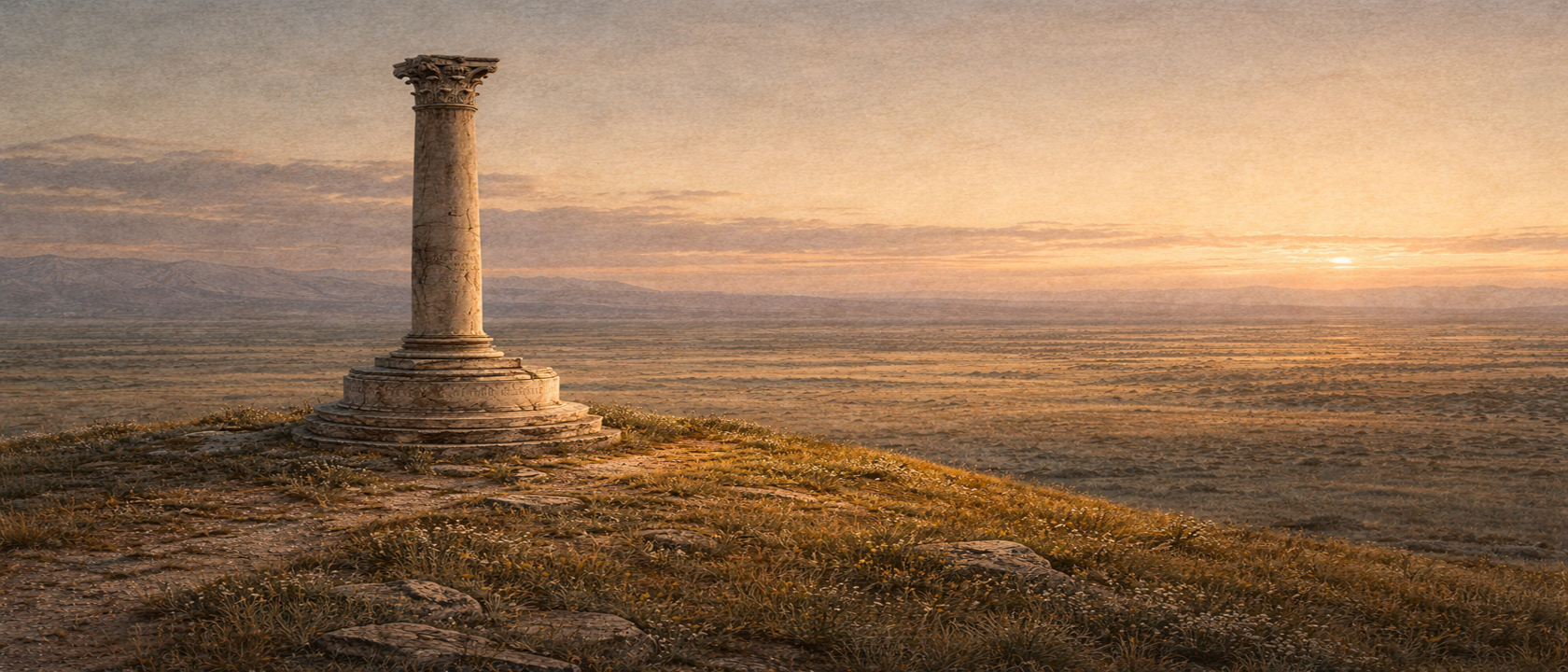
The monument at the summit has been rebuilt four times: first by the XIV Gemina in the fourth century, when the garrison at the newly founded provincial capital understood that the founding act needed a physical marker; again in the seventh century after structural deterioration; again in the tenth century after storm damage; and most recently in 1089 A.P. after the third monument’s base was found to have subsided unevenly. Each rebuild has been to the same design: a single upright stone column of local limestone, approximately four metres tall, with the inscription cut into its south-facing face where it catches the light from the plains below.
HIC DESCENDIT AQUILUS. ROMA ELEGIT.
Here Aquilus came down. Rome chose.
The inscription has not changed across four rebuilds. The design decision — the same words, the same face, the same limestone, the same height — was made by the XIV Gemina’s legate at the first monument’s construction and recorded in the legion’s institutional archive as a standing instruction: if the monument requires replacement, replace it exactly. The instruction has been followed three times since. The current monument is indistinguishable from the ones that preceded it except in the freshness of the cut stone, which weathers to match the hill’s colour over the course of a century. The tenth-century rebuild, now one hundred and eleven years old, has reached the point where the limestone has taken on the same warm grey-brown of the hill itself, and the inscription’s letters hold shadow the way the earlier monuments’ letters held it in the illustrations the Mission’s archive preserves.
The monument says he acted from Roman honour. Varro’s note about this is private. It is correct.
Mons Conspectus is not administered by any single institution, which is a practical consequence of the competing legitimate claims on its significance: the College of Pontiffs considers it sacred ground in the specific sense of a place where a morally consequential act shaped history; the Imperial Academy considers it a primary research site for the archaeology of the 225 A.P. engagement and the provincial founding period; the Mission considers it diplomatically significant as the location that centaur elder visitors sometimes request access to; and the XIV Gemina considers it their founding monument and maintains a standing instruction that no development of any kind on or adjacent to the summit will proceed without the legate’s specific authorisation.
In practice, this means the hill is managed by a quiet agreement among the four parties that has never been written down and has functioned for several generations. The agreement’s substance: the Academy’s presence at the base is permanent and accepted; the College’s annual commemoration at the summit is unchallenged; the Mission’s centaur visitor access is facilitated without protocol; and nobody makes structural changes to anything within fifty metres of the monument without the legate’s nod. The agreement has worked because everyone involved has understood that the alternative to an unwritten arrangement that functions is a written one that produces disputes.
Sensory & Appearance
The hill before dawn, when the grass is still wet and the plains below are dark: the specific quality of silence that flat open country produces, broken only by the wind and the distant sound of the city’s early activity two kilometres south. The light arriving from the east across the plains before it reaches the city behind you, the grassland turning from grey to gold in a sequence that moves visibly from east to west. Varro’s description of this view — from his second visit, in his seventy-ninth year — is the most frequently quoted passage in the province’s guidebook literature, which he would find unsurprising and slightly unfortunate.
At midday, when the light is directly overhead and the plains below flatten visually: the monument’s inscription losing its shadow and becoming harder to read, which is when the letters are least dramatic and the stone itself most present. At late afternoon, when the shadow returns to the inscription and the Montes Dividentes to the southwest are visible as a dark line on the horizon, which is the condition Varro recommends arriving for. At evening, when the last light from the west catches the summit while the plains below are already in shadow: the specific effect of a hilltop that sees the sun later than the country around it, producing a brief period each evening when Mons Conspectus is the last lit point in a darkening plain.
Defenses
None. The hill is open ground. The XIV Gemina’s standing instruction against structural modification near the summit is the closest thing to a formal protection the site has, supplemented by the political cost of damaging the province’s founding monument, which is approximately the same cost as damaging the Locus Primus in Nova Romae and which no one has seriously proposed testing. The Academy’s station has a standard lock on its correspondence room. Observator has a personal lock on the storage room where the excavation materials are kept.
History
The engagement of 225 A.P.: Legio XIV Gemina patrol under Senior Centurion Gaius Aquilus crests the rise and observes the battle. Three days’ observation. The descent. The engagement turns. The orcs withdraw. Two days later, a centaur elder approaches the Roman position. The interpreter’s rendering. The alliance is made.
The hill has carried the name Mons Conspectus since the fourth century, when the province was formally established and the founding monument placed. Before that it was unnamed in any Roman record, though the Mission’s archive contains a centaur oral history fragment, donated by a Stonehoof liaison in the seventh century, in which the hill is referred to by a Hava’keth name that the archivist of that period translated as approximately ‘the place that looked both ways.’ The fragment is in the restricted archive. Memoria Veteris has read it. He considers the name more accurate than the Roman one, which refers only to observation. The centaur name refers to the choice.
The four monuments: 4th century, 7th century, 10th century, 1089 A.P. Each to the same design, the same inscription, the same limestone, by the same standing instruction. The fifth will be the same. For full chronological detail, see: Annales Mundi.
Tourism
Mons Conspectus receives a steady flow of visitors: scholars, soldiers, senators on provincial inspection tours, the occasional provincial pilgrim who has come to stand where the decision was made. The walk from Nova Conspectus takes approximately thirty minutes along the Via Aquilae and then the path up the hill’s northern face; the entire visit, summit to return, can be done in two hours at a comfortable pace. The Academy station does not conduct guided tours but Observator will discuss the engagement site’s physical evidence with any visitor who demonstrates genuine interest, which he defines as knowing who Aquilus was before arriving and not asking to have the inscription explained. He will walk the eastern slope’s excavation sites with serious researchers. He has a standing invitation from the Mission for these conversations to include the Mission’s centaur scholar Hessa, which he has accepted twice and found productive in ways he did not anticipate.
Centaur elder visitors come rarely, perhaps once every two or three years, and always through Mission arrangement. These visits are not publicised. The Mission’s protocol for them is the quietest in the manual: notify the Academy station, make the southern approach available, send one Mission staff member who understands when not to speak, and file a record afterward. The record does not describe what occurs at the summit. It records that the visit took place.
The annual College commemoration at dawn on the engagement’s anniversary date produces effects that Lucius Caecilius Pius has been documenting privately for eleven years and has not reported to the College. The nature of the effects is in his private records in Nova Romae. He withdrew from this year’s assignment six weeks ago.
Proximity
2km north of Nova Conspectus via Via Aquilae. Approximately 30 minutes on foot from the city’s northern gate.
Access
Hill and summit: publicly accessible, no restriction.
Academy station: Observator’s discretion; research visitors by appointment.
College commemoration site: College staff only on commemoration date; otherwise open.
Via Hava’keth approach: available to centaur elder visitors through Mission arrangement.

Comments