
INSULA MAIOR
Vini Caput · Town · Provincia Insularis
The town at the centre of Insula Maior has no official name beyond the island's own, which tells you something about how the islanders think about themselves. They are not a town. They are the island, and the island has been producing wine since before anyone alive can remember and will be producing wine after everyone currently arguing about the futures price has been dead for two centuries. The senators who come here in late summer for the annual exchange session are guests. They have been guests for nine centuries. They behave with the specific graciousness of people who want something and know that the people who have it are under no particular obligation to provide it at a price that the Senate considers appropriate.
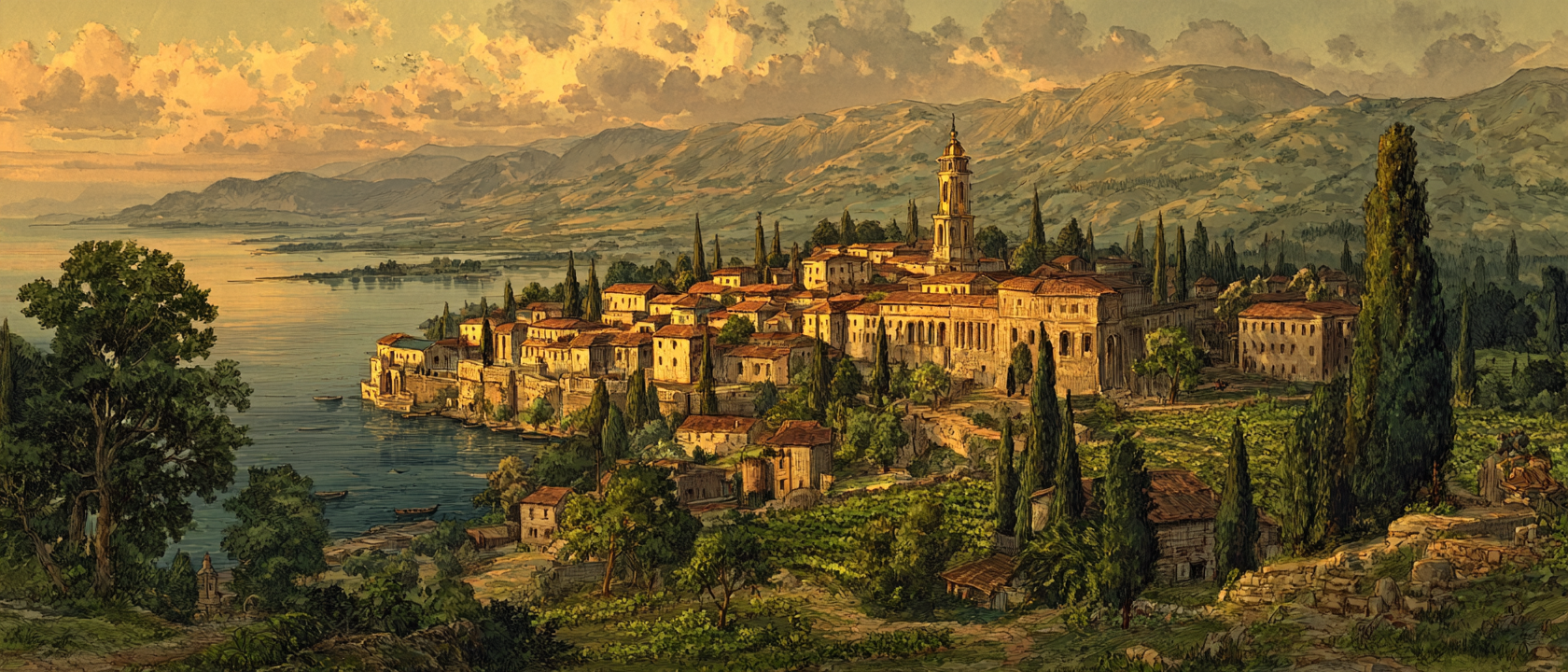
Insula Maior Town is the provincial capital of Provincia Insularis, home to approximately twenty-five thousand people, the Lighthouse Engineers' Guild's administrative headquarters, the provincial governor's residence, and the wine exchange where the empire's most socially significant commercial event takes place each autumn. It is not a large city by imperial standards and does not aspire to be one. The island's identity is organised around production rather than administration — the vineyards cover two-thirds of Insula Maior's viable farmland, the harvest is the year's primary event, and the annual exchange session at which Nova Romae's senatorial families compete for allocation of the best estates' output is the moment at which nine centuries of island autonomy express themselves most completely. The senators come to the island. They have always come to the island. The island has never gone to them.
The town's civic culture is the distilled expression of what nine centuries of comfortable provincial membership produces in a population that has never been militarily threatened, never administratively overburdened, and never required to be anything other than what it already was. The islanders are not hostile to Rome — they are, genuinely and without performance, part of the empire. They pay their taxes with reasonable punctuality, they supply their navigation expertise and lighthouse maintenance with professional thoroughness, and they serve on the guild's Senate liaison committee with the patient competence of people who have been explaining the same technical standards to successive Senate fiscal committees for three centuries. What they do not do is defer. The affectionate condescension that mainland visitors notice within hours of arriving is not arrogance — it is the natural manner of people who know that what they produce cannot be replicated elsewhere and that this knowledge is old enough to have become unremarkable.
I have visited the island six times over thirty years and have attended the wine exchange session twice. The first time I attended, I was struck by the reversal of the usual social geometry: senators who command rooms in Nova Romae sat quietly and listened to island estate managers explain the year's harvest conditions in terms that made clear the senators' opinions of the quality were neither solicited nor relevant. The second time I attended, I understood that this is not the island being accurate. The wine is what it is. The senators' desire for it is what it is. The gap between those two facts is the exchange rate, and the island sets it.
Demographics
Twenty-five thousand permanent residents with the demographic character of an island that has been producing a single prestige product for nine centuries: the estate families whose vineyards generate the wine, the technical workers whose labour produces it, the lighthouse engineers who live here when not posted to a lighthouse, the guild's administrative staff, the small commercial community that serves the town's daily needs, and the governor's household. The halfling presence is small but commercially significant — two halfling merchant families have maintained permanent residences here for generations, their relationships with the estate families the mechanism through which a portion of the island's wine reaches markets that the annual exchange session does not serve. The island is aware of this arrangement. The exchange session's participants are not, which is a situation the halflings and the estate families have maintained with mutual satisfaction for eighty years.
DM ONLYGovernment
The provincial administration under Governor Vitarius manages the formal requirements of imperial membership — tax collection, legal jurisdiction, the maintenance of the post road to the harbour — while the island's actual civic decisions are made by the Estate Council, a body of the twelve senior wine-producing families that has been operating since the fourth century and that predates the provincial administration by several hundred years. The Estate Council sets annually, on the question that no mainland institution has successfully influenced, how much Vinum Insulare is produced each year. The answer to this question has been the same for two centuries: less than the market wants. The Estate Council's position on this point is that the island produces what the island produces, and that the market's desires are not the island's concern. The Senate's periodic attempts to address this through the Governor have produced nine successive governors' reports explaining, with varying degrees of delicacy, that the Estate Council is not susceptible to the leverage the Senate imagines it has.
Governor Lucius Amoenus Vitarius, sixty-one, in his fourth year, has made the residence comfortable in the way that a man of means and leisure makes a comfortable place more comfortable, and has contributed nothing to the town's civic life that the town had not already arranged for itself before his arrival. He is not an ineffective governor. He is a governor whose effectiveness is defined by the domains the island has left him. He governs them competently and without friction. The island finds this arrangement satisfactory.
Defences
The island has no garrison. It has never needed one. The Classis Lacensis patrols the Inland Sea lanes and considers the island part of its operational area of responsibility, an assessment that Admiral Nauta Fortis makes in his quarterly reports and that the island's population regards as technically accurate and practically irrelevant. The one occasion in the past century when a maritime security situation required a response in the island's waters — a dispute about a grounded merchant vessel's cargo rights, in 1183 A.P. — was resolved by the harbour authority before the Classis's patrol craft arrived. The islanders noted this without comment.
Industry & Trade
The wine is everything. Vinum Insulare is produced exclusively on Insula Maior, in quantities that the Estate Council determines, from vine stock that has been maintained on the island since before the province's annexation nine centuries ago. The wine's character — the specific combination of soil, microclimate, and technique that distinguishes it from every imitation — is not reproducible elsewhere. This has been tested. Three senatorial families in the second century transplanted island vine cuttings to mainland estates and produced wine that the island's master vintners described, politely, as indicating the transplantation had been successful. The island's population found this response adequate.
The annual wine exchange session, held in the exchange hall each autumn after the harvest assessment, is the empire's most socially loaded commercial event. The session runs for three days. The first day is devoted to the harvest report — the Estate Council's master vintner presents each estate's output by volume and quality classification, without allowing questions. The second day is the allocation session, at which the attending senatorial representatives bid for futures contracts on specific estates' output. The third day is the settlement session, at which the terms are confirmed and the contracts signed. The second day is the event. What happens in those hours — the social dynamics of senators competing for allocations that signal status as clearly as any office or title, the island estate representatives watching without visible interest as the mainland's most powerful families manoeuvre against each other on island ground — is the annual expression of the relationship between the island and Rome in its most compressed and revealing form. Varro attended in 1189 A.P. and 1195 A.P. and has written about both sessions in his private journal, not his published work, on the grounds that publishing his observations would affect the dynamics he found worth observing.
DM ONLYInfrastructure
The harbour handles the island's commercial needs with the modest infrastructure of a port whose primary commercial event occurs once a year and whose regular traffic is wine export, supply import, and the lighthouse service vessels that the Engineers' Guild maintains on a regular schedule. The post road from the harbour to the exchange hall and the governor's residence is the island's primary maintained infrastructure, its condition reflecting the Senate's interest in ensuring that visiting officials arrive at the exchange session without incident. The wine storage and fermentation facilities — the Domus Fermentariae and the estate cellars distributed across the island's interior plateau — are the island's most significant industrial infrastructure, maintained to a standard that the Estate Council considers non-negotiable and the provincial budget considers aspirational.
Districts
The town organises around its harbour and its single dominant commercial event. The Harbour Quarter is the arrival point and the location of the exchange hall. The Estate Quarter is the residential district where the estate families maintain their town houses, separate from their vineyard residences. The Guild Quarter is the northern residential and administrative zone where the Lighthouse Engineers' Guild maintains its administrative function alongside the engineers' town residences. The Common Quarter houses the working population and the town's daily commercial life. The Governor's compound sits apart from these districts at the town's southeastern edge, its formal Roman architecture conspicuous among the island's practical limestone.
Guilds and Factions
The Estate Council of twelve families is the island's primary governing institution in practice. The Lighthouse Engineers' Guild maintains its administrative presence here as a matter of geographical logic — Insula Maior, where the Guild Hall is built, is a comfortable place to conduct administrative correspondence with the Senate — and the guild's Insula Maior administrative office is run by the Guild Secretary, a position that has been held by members of the same island family for four generations. The halfling commercial presence operates quietly and the estate families prefer it that way. The Governor's household is a faction only in the sense that it represents a formal claim to authority that no other institution recognises as operationally significant.
History
The island was incorporated into the Roman Empire in the third century, the province formally constituted at the point when the Senate determined that the Inland Sea's islands were economically significant enough to require formal administration. The wine had been produced and exported to Nova Romae since the late second century, predating provincial status by several decades — the island was already selling to the empire before the empire had formally decided it was part of the empire. The estate families regard this sequence as clarifying. The annual exchange session was established in the fourth century, the exchange hall built in the fifth, the current session format codified in the seventh and not revised since.
For full chronological detail, see: Annales Mundi.
Points of interest
The Wine Exchange Hall, Harbour Quarter (public during exchange session, restricted otherwise) — a fifth-century hall at the harbour's landward end, its interior designed for the specific theatre of the annual session: tiered seating for the estate representatives, a central floor where the allocation bidding takes place, and a gallery above that has accommodated observers since the building's construction. The gallery benches are the most coveted free seats in the interior empire for three days each autumn. Varro has been in both the gallery and the floor. He recommends the gallery without qualification.
The Western-Slope Vineyard Walk (accessible by arrangement with individual estates) — the estate families receive visitors outside harvest season with the courtesy of hosts who are not particularly interested in being visited but understand that hospitality is its own form of communication. The walk from the town to the highest western estate takes two hours on the path that the estate workers use daily, passes through the full range of the island's viticultural terrain, and ends at an elevation from which, on a clear day, both the eastern harbour and the western sea horizon are visible simultaneously. The engineers' apprentices are not the only people on the island who use this view to understand something.
The Lighthouse Engineers' Guild Administrative Office, Guild Quarter (accessible for official correspondence) — the Guild Hall is built where the Guild Hall is built: Insula Maior is a comfortable place to conduct administrative correspondence with the Senate, and the guild's Insula Maior administrative office is run by the Guild Secretary, a position that has been held by members of the same island family for four generations. The halfling commercial presence operates quietly and the estate families prefer it that way.
The Domus Consilii, Estate Quarter (private, Estate Council use only) — the building where the Estate Council has been meeting since the fourth century, predating the provincial administration by several hundred years. Its founding documents are older than the province. The Governor has never been invited inside. He has not requested an invitation, which the Estate Council considers the correct instinct.
Tourism
The island receives visitors throughout the year — travellers who come for the wine, scholars who come to study the viticultural tradition, occasional officials who come to see the governor and find the governor considerably less interesting than the island. The exchange session's three days bring the largest single influx of visitors the town accommodates, the harbour crowded with senatorial ships and the town's accommodation used to capacity for the only time in the year. The island's residents manage this influx with the patient efficiency of a community that has been doing it for nine centuries and has optimised the process to the point where the visitors' experience is comfortable, the residents' disruption is minimal, and the exchange session concludes without the town having been materially changed by it. This is, the estate families would say, the point.
Architecture
The town has built itself in the pale limestone that the island's quarries produce, the buildings accumulating modifications that a sea-facing settlement develops over centuries — shutters designed for the Inland Sea's autumn storms, roof drainage systems that manage the seasonal rain, harbour-facing ground floors that accommodate the arrival of commercial shipping with the practical adjustments of long experience. The wine exchange building is the town's most significant structure: a fifth-century hall at the harbour's landward end, its interior designed for the specific theatre of the annual session — tiered seating for the estate representatives, a central floor where the allocation bidding takes place, and a gallery above that has accommodated observers since the building's construction. The gallery benches are the most coveted free seats in the interior empire for three days each autumn. The Lighthouse Engineers' Guild administrative office, on the town's elevated northern edge, is the second most institutionally significant building and considerably less visited.
The Governor's residence is the largest single building in the town and the least architecturally interesting, having been constructed to senatorial specifications that reflect what the Senate imagined a provincial capital required rather than what an island town actually develops. Governor Lucius Amoenus Vitarius, sixty-one, in his fourth year, has made the residence comfortable in the way that a man of means and leisure makes a comfortable place more comfortable, and has contributed nothing to the town's civic life that the town had not already arranged for itself before his arrival.
Geography
The town occupies the island's sheltered eastern bay — the natural harbour that faces toward the mainland, its position making it the arrival point for every ship crossing from Lacusum or Nova Romae. The vineyards begin immediately west of the town's last buildings and extend across the island's interior plateau in the specific arrangement that nine centuries of viticultural optimisation has produced: the highest-regarded estates on the western-facing slopes where the afternoon light and the sea breeze combine to produce the conditions that distinguish Vinum Insulare from every mainland imitation. The town's harbour is modest by Lacusum's standards — capable of handling the seasonal increase in shipping that the exchange session brings, not designed for anything beyond the island's regular commercial needs.
Climate
The Inland Sea's most temperate microclimate — warmer than the northern shore, moderated by the sea on all sides, the western slopes' afternoon exposure providing the specific growing conditions that the vine requires. The island's weather is the most closely monitored in the province, not by any official body, but by the estate families themselves, whose harvest journals represent the most complete microclimate record available for any location in the interior empire. The senior vintner of the oldest estate has records going back eleven generations. She has shared extracts with the Lighthouse Engineers' Guild's weather observation programme. She has not shared them with the Governor.
Natural Resources
The vineyards are the island's resource, its economy, its identity, and its primary point of leverage with the mainland. The vine stock maintained on the island's interior plateau and western slopes represents nine centuries of selection, the specific varieties developed on Insula Maior producing a character that the island's climate and soil enable and that no transplanted cutting has replicated. The island's secondary natural resources — the limestone that builds the town, the fishing that feeds the population, the timber from the island's northern woodlands — are sufficient for the island's needs and unremarkable by any broader standard. The island's most significant non-viticultural resource is the knowledge held in the estate families' harvest journals, the accumulated microclimate and viticulture record that the senior vintner of the oldest estate has maintained for eleven generations.
DM ONLYMilitary
No garrison. Classis Lacensis patrols the Inland Sea lanes and considers the island part of its operational area. Harbour authority patrol craft for maritime security.
Economy
Vinum Insulare production (exclusively island-grown; quantity controlled by Estate Council).
Annual wine exchange session (empire's most socially significant commercial event).
ighthouse Engineers' Guild administrative revenue.
Halfling merchant monitoring operation (informal).

Comments