
ESTATE QUARTER
Old Families, Old Vines · District · Insula Maior Town
"The estate families' town houses are where the island's governance actually happens, in the dinners and visits and corridor conversations that the Estate Council meeting is only the formal conclusion of. I have been invited to two of these dinners, once by the Lacus Aureus family and once by the Mons Sereni family, on occasions separated by six years. The conversations were on different topics. The quality of the wine served was, both times, from estates other than the host's own. I note this without drawing a conclusion I cannot support, except to observe that the island's social culture has a sophistication that its comfortable self-presentation tends to obscure."
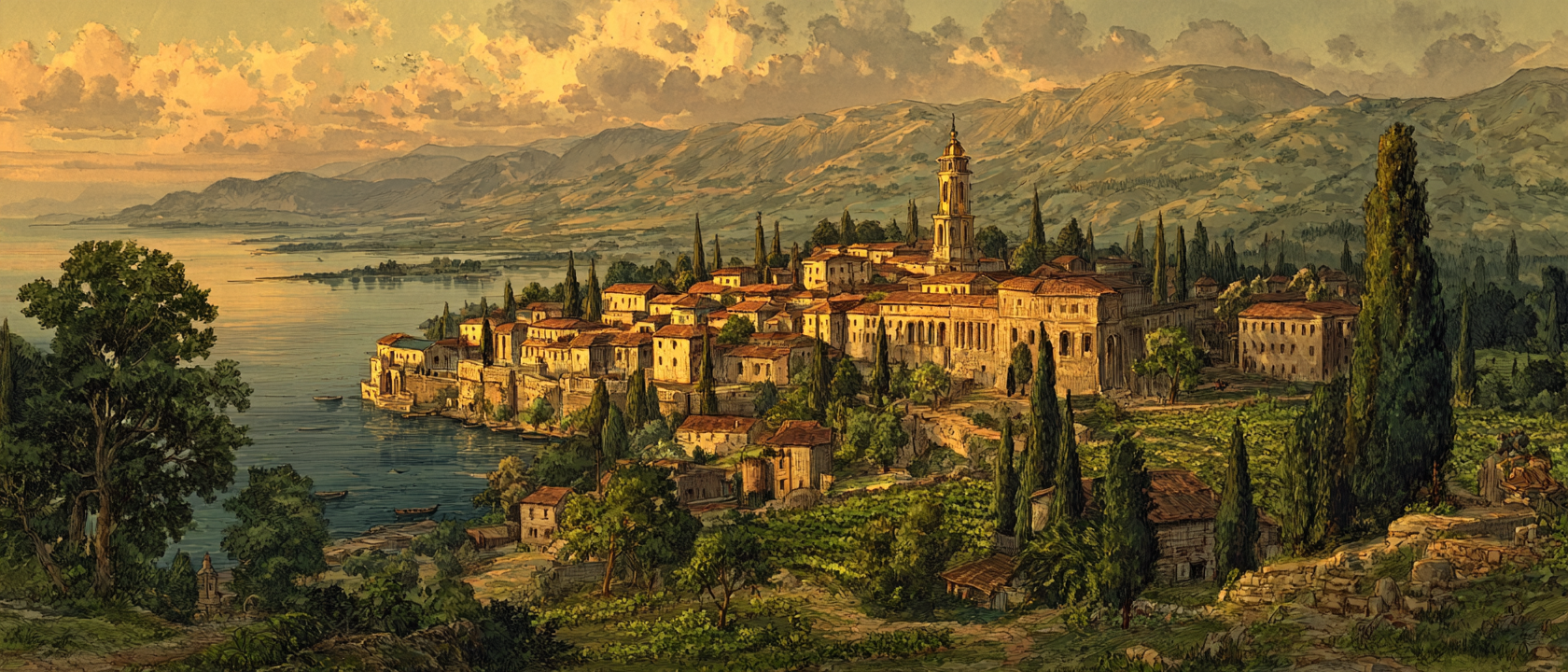
The Estate Quarter is the residential district where the twelve families of the Estate Council maintain their town houses — their presence in the town separate from, and necessary complement to, their vineyard residences in the island's interior. The quarter's social life is the island's governing conversation: the dinners at which the harvest's quality classifications are informally settled before the master vintner's formal assessment, the visits at which the exchange session's allocation strategy is discussed without being decided, and the specific conversations that occur in the evenings before the Estate Council's formal meetings that make the formal meetings' outcomes predictable to anyone who knows which families have been speaking to which. The quarter is not secretive. It is simply operating at a register that visitors from the mainland find difficult to read.
Demographics
The twelve estate families and their households, approximately three thousand permanent residents, with the domestic and administrative staff that managing significant wine production from a town house requires. The quarter's social density is higher than its residential density — the constant movement of family members between the town and the vineyard residences, the visits of the estate managers who report to their families during the growing season, and the informal meetings that the Estate Council's twelve families conduct throughout the year make the quarter a more continuously active social environment than its quiet streets suggest.
Government
The Estate Council meets formally four times per year: the spring planting assessment, the midsummer growth review, the harvest session at which the year's classification decisions are made, and the post-exchange settlement at which the session's outcomes are formally recorded. The harvest session is the most significant and is held in the Council's meeting room in the Estate Quarter's oldest building, the Domus Consilii, which has been the Council's formal meeting place since the fourth century and whose walls carry the carved records of every harvest assessment made in that time. The carving is functional rather than decorative — the records are there because the Council decided in the fifth century that harvest assessments should be permanent and public, a decision that has made the Domus Consilii the most complete agricultural archive on the island and the source from which Marta Vitae's temperature analysis was partly drawn.
History
The estate families' town presence dates from the third century. The Domus Consilii was built in the fourth century. The Estate Council formalised its current structure in the fourth century simultaneously with the construction of its meeting hall. The practice of carved harvest records was established in the fifth century. For full chronological detail, see: Annales Mundi.
Points of interest
The Domus Consilii's carved harvest records — accessible to any visitor during the building's public hours — represent nine centuries of island agricultural history in a format that requires some specialist knowledge to read but that yields, to a reader who understands what they are looking at, a picture of the island's viticultural development that no written document matches. The senior vintner of each estate has traditionally contributed the carving of their own tenure's records, a practice that means the records are in different hands across the centuries, the variation in style making the historical sequence visually as well as textually legible. Marta Vitae's contributions, from the past fifty-three years, are the most technically detailed in the archive's history.
Architecture
The Estate Quarter is the residential district where the twelve families of the Estate Council maintain their town houses — their presence in the town separate from, and necessary complement to, their vineyard residences in the island's interior. The quarter's social life is the island's governing conversation: the dinners at which the harvest's quality classifications are informally settled before the master vintner's formal assessment, the visits at which the exchange session's allocation strategy is discussed without being decided, and the specific conversations that occur in the evenings before the Estate Council's formal meetings that make the formal meetings' outcomes predictable to anyone who knows which families have been speaking to which. The quarter is not secretive. It is simply operating at a register that visitors from the mainland find difficult to read.
Access
Streets — public.
Domus Consilii public rooms — public during open hours.
Council meeting room — Council members and invited guests.
Estate family town houses — private.

Comments