
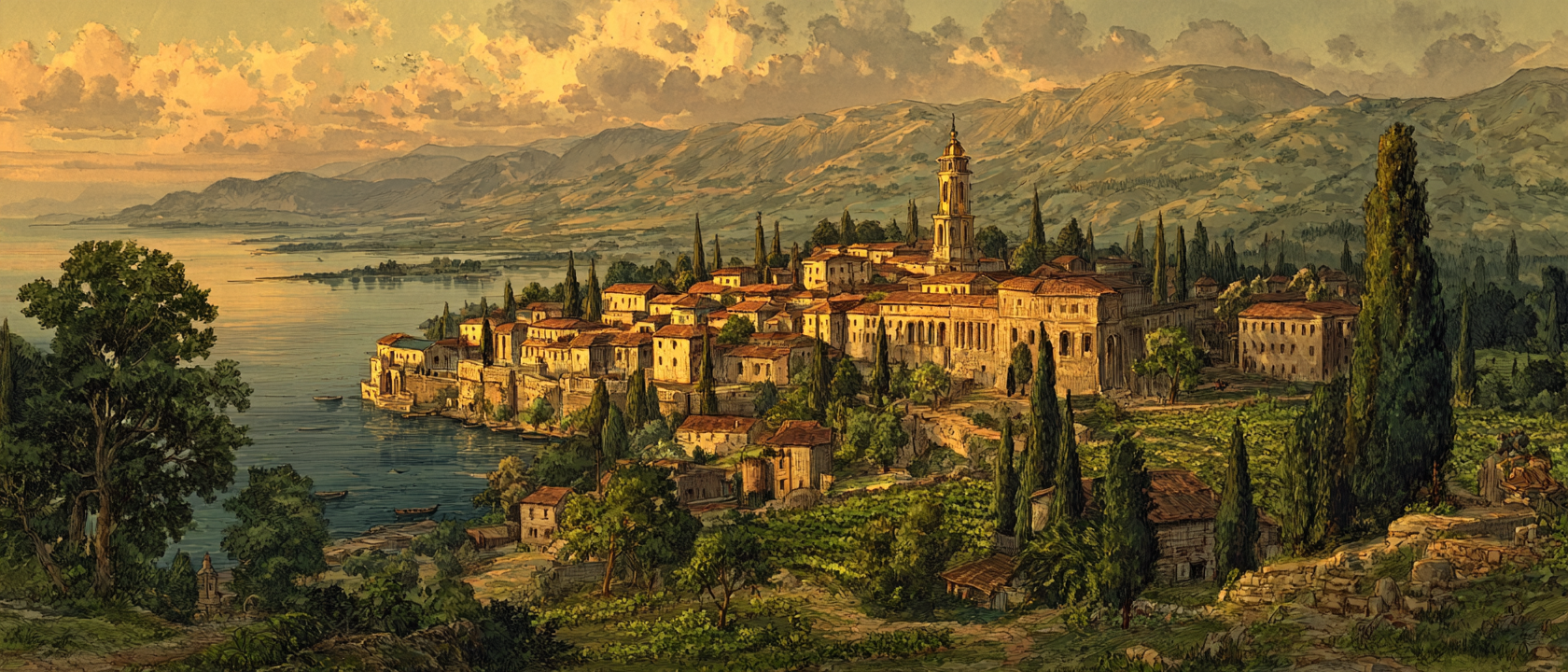
AULA VINI
The Wine Exchange Hall · Exchange Venue · Harbour Quarter, Insula Maior Town
"The first time I attended the allocation session I was struck by the reversal of the usual social geometry: senators who command rooms in Nova Romae sat quietly and listened to island estate managers explain the year’s harvest conditions in terms that made clear the senators’ opinions of the quality were neither solicited nor relevant. The second time, I understood that this is not the island being rude. It is the island being accurate. The wine is what it is. The senators’ desire for it is what it is. The gap between those two facts is the exchange rate, and the island sets it."
The Aula Vini is the most socially significant commercial venue in the interior empire for three days each autumn and a well-maintained, comfortably empty building for the other three hundred and sixty-two. Built in the fifth century to replace the open-air harbour square arrangement that the estate families considered adequate and the senatorial representatives considered undignified, the hall was designed by an architect who understood the specific requirement: the proceedings on the central floor must be visible from every position in the building simultaneously, so that nothing occurring between a senator and an estate representative can be conducted with any expectation of privacy. The design has worked for seven centuries. The participants have spent seven centuries finding ways to work around it.
In 1200 A.P. the hall carries a specific institutional complication that it has been carrying for seven years: the Mons Sereni estate’s allocation has gone to the Corvii family through a bidding process that the other attending representatives have found implausibly efficient. Two of the twelve Estate Council families believe privately that the Corvii’s representative receives a summary of the harvest report’s key quality assessments before the first day’s presentation. The source is not in the estate families. The harvest report passes through the guild secretary’s administrative office on its way to the hall.
Design
Fifth-century island limestone: tiered seating for three hundred and fifty on three sides of the central floor, a clerestory window arrangement designed to illuminate the central floor without casting shadows that would obscure any participant’s features. The gallery above the seating tiers is the building’s most sought-after vantage point during the allocation session — the unobstructed view of the floor below makes it the ideal position for anyone who wants to watch the social dynamics unfold. Varro used the gallery’s eastern position on both his visits. The gallery benches are the most coveted free seats in the interior empire for three days each autumn.
Sensory & Appearance
Three days, each with a distinct character. Day one: the harvest report presentation. The master vintner of each estate presents that year’s output by volume and quality classification. Questions are not taken. The senatorial representatives sit and listen and make notes whose content determines their bidding strategy for the following day. Day two: the allocation session. The central floor is where the empire’s social hierarchy expresses itself in commercial terms, and where the island’s quiet dominance over that hierarchy is most visibly demonstrated. Day three: the settlement session. Contracts are confirmed, the session’s social dynamics are processed in a hundred private conversations, and the ships begin loading for the return to the mainland.
The gallery on the second day is the best place to be in the empire if you want to understand what Nova Romae’s senatorial families actually think of each other. Seven years of watching the Corvii family’s implausibly efficient bidding strategy succeed on the Mons Sereni allocation have produced, in the other attending families’ representatives, a frustration that the hall’s design makes visible and that no one has yet formalised into a complaint.
History
The exchange session was established in the fourth century, the hall built in the fifth. The current session format was codified in the seventh century and has not been revised since. The practice of conducting the session in three days — report, allocation, settlement — was established from the beginning and reflects the Estate Council’s view of the correct sequence: information first, competition second, commitment third. For full chronological detail, see: Annales Mundi.
Tourism
The allocation session on the second day is the empire’s most observed commercial event. Access to the hall floor requires official session credentials; access to the gallery is by invitation or by the unchallenged convention that the gallery’s benches are available to anyone who arrives before they fill. The hall outside session season is viewable during public hours as a historical building of significance; the clerestory design is particularly noted by architectural visitors as a technical achievement of the fifth-century island building tradition.
Clerestory window design: illuminates the central floor without shadow from any seating position. The architect’s intention that nothing on the floor be unobservable has been the session’s defining physical constraint for seven centuries.
Access
During session: floor by credentials, gallery by convention.
Off-season: public viewing hours for the building as a historic structure

Comments