
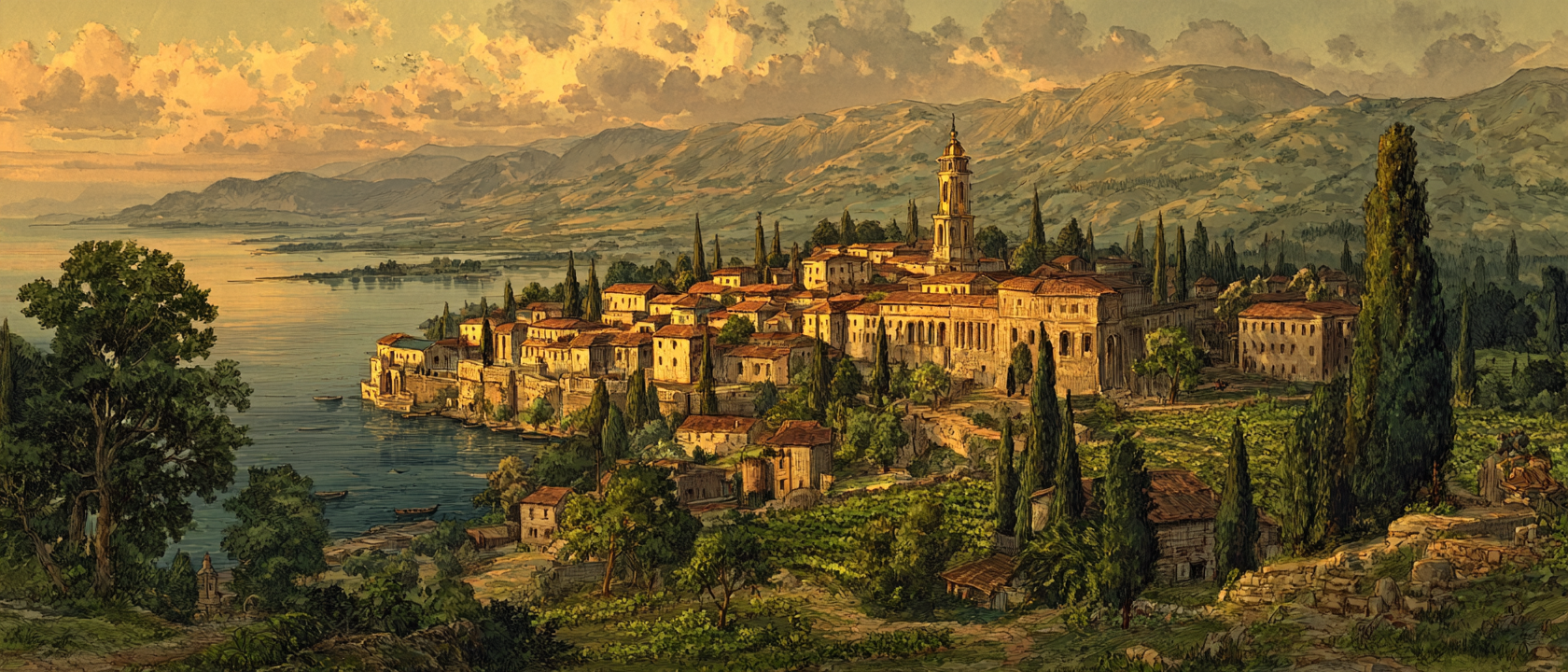
COMMON QUARTER
The Vine Workers' Town · District · Insula Maior Town
"The wine that senators bid against each other to acquire is made by people in the Common Quarter whose names no senator knows and whose opinions of the exchange session are not recorded in any document I have found, which I consider a significant gap in the historical record. I have spent time in the quarter on all six of my visits to the island and have found it, consistently, the most informative part of the town. The estate families understand the wine as a product of their land and their judgment. The people who actually make it understand it as a product of their hands and their knowledge, which is a different understanding and, in several respects I will not enumerate here, the more complete one."
The Common Quarter is the largest district in Insula Maior Town by population and the least visible by institutional standing — fourteen thousand people whose labour produces the wine that the empire's most powerful families compete to purchase, living in the streets between the harbour and the estate quarter in the specific community that nine centuries of proximity to a single skilled industry creates. The quarter is not poor. The island's wine economy distributes its prosperity broadly enough that the cellar workers and vineyard labourers and coopers who live here have material conditions that compare favourably with equivalent working populations in the interior provinces. What the quarter lacks is not money but visibility — the annual exchange session brings senators to the harbour quarter and the estate representatives to the exchange floor, and the people who pruned the vines and managed the fermentation and filled and sealed the amphorae are not present in that room and are not expected to be.
The quarter has the culture that long-established skilled working communities develop: an expertise it does not perform for outsiders, a social solidarity that does not require articulation, and an opinion of the annual exchange session that is consistent across the quarter's population and has never been formally expressed to anyone in a position to record it. Varro has it in his private journal. He has characterised it as: accurate, unsentimental, and expressed with a brevity that the Senate's most accomplished orators could learn from.
"I asked a cellar worker at the Mons Sereni estate, on my second visit, what she thought of the fact that a single amphora of the previous year's output had sold at the exchange session for more than her annual wage. She considered the question for a moment and said: 'That's the price. We made the wine.' I have thought about this answer for six years. I believe it contains a complete philosophy of labour and value that several centuries of Roman economic thought have not quite managed to articulate as cleanly."
Demographics
Fourteen thousand permanent residents encompassing the full range of trades that wine production at the island's scale requires. The vineyard workers are the largest single group — the pruners and trellisers and harvest pickers whose seasonal rhythm defines the quarter's annual calendar as completely as the exchange session defines the harbour quarter's. The cellar workers are the quarter's most skilled population, their knowledge of fermentation and ageing conditions the technical foundation on which the estate families' viticultural reputations rest. The coopers, the bottlers, the carriers, the harbour loaders, and the fishing community that works the bay's near-shore grounds make up the remainder. The fishing community is the quarter's oldest continuous occupant — the fishers were here before the wine industry was large enough to be the island's primary activity, and they have maintained their practice alongside the vine economy with the independence of people whose livelihood does not depend on the harvest.
The quarter's skill transmission is almost entirely oral and practical — the cellar workers pass their fermentation knowledge through apprenticeship relationships that the estate families do not oversee and cannot fully document. The estate families are aware that what their master vintners know about the final product depends on what the cellar workers know about the process, and that the cellar workers' knowledge is not written down anywhere. Marta Vitae, who understands this dependency more clearly than any other senior vintner on the island, has spent thirty years building relationships with the quarter's most experienced cellar workers that the other estate families' vintners have not attempted. Her harvest results over thirty years reflect this.
The Harvest Season
The harvest season — the six weeks in late summer and early autumn when the grapes are picked, pressed, and transferred to the first fermentation stage — is the moment at which the Common Quarter's centrality to the island's economy is most visible. The quarter empties each morning as the vineyard workers move to the estates, fills each evening with the specific exhaustion and satisfaction of physical labour done well in good conditions, and operates at a social intensity that the rest of the year does not approach. The quarter's taverns during harvest season are the most genuinely informative places on the island — the daily conversation about the harvest's progress, the quality assessment of each estate's picking conditions, and the cellar workers' preliminary judgments about the fermentation's early signs are the best available real-time intelligence on what the coming exchange session will trade. The estate families know this. Several of them have longstanding informal relationships with specific tavern proprietors that they maintain year-round for the access to harvest conversation that the relationships provide.
Government
The relationship between the Common Quarter and the estate families is not adversarial and is not simple. The estate families provide stable, skilled employment in conditions that the island's workers consider acceptable. The workers provide the labour and knowledge that makes the estates viable. Both parties understand this. What the relationship lacks is the acknowledgment that the knowledge flows in both directions — the estate families know what the wine is worth and where it goes; the workers know how to make it. This asymmetry is old enough to be structural rather than resentful, and the quarter's culture has developed around it with the pragmatic intelligence that working communities develop when resentment would be expensive and competence is its own form of power.
The halfling merchant families who maintain residences on the island have their most substantive relationships in the Common Quarter rather than the estate quarter, a fact that both the halflings and the quarter's residents treat as unremarkable and that the estate families have chosen not to examine closely. The halflings are interested in the wine's production characteristics — the factors that determine a vintage's quality before the exchange session classifies it — and the people who know those factors best are the cellar workers, not the vintners. The information that moves through these relationships has been commercially useful to the halflings for eighty years and has never been the subject of a complaint from any estate family, because the estate families prefer not to have formally noticed it.
History
The Common Quarter predates the town's formal administrative structure — the working population was present before the provincial capital was constituted, living adjacent to the harbour that the wine trade required and the vineyard access that the work required. The quarter's current street pattern is largely second-century, established when the wine industry reached the scale that required a permanent skilled residential community rather than seasonal labour. The Torchio has been in operation since the fourth century under its current name. The fishing community's harbour access rights predate the town's formal founding and have been maintained against every subsequent civic reorganisation by the specific legal mechanism of never having been challenged. For full chronological detail, see: Annales Mundi.
Points of interest
The quarter's central tavern — the Torchio, named for the wine press, in operation for four centuries under successive owners all of whom have maintained the same name and the same practice of serving the current vintage alongside whatever the house has kept from notable previous years — is the informal social centre of the quarter's working population and the closest thing the island has to a public record of the wine's quality over time. The proprietor, Betta Calcatura, fifty-five, has been running it for twenty-two years and maintains a tasting ledger of every vintage served across her tenure with notes that the island's master vintners would find professionally interesting if they knew the ledger existed. Marta Vitae knows it exists. She has read three entries, with Betta's permission, and has incorporated what she read into her temperature analysis without citing the source.
The fermenting houses on the quarter's western edge are not tourist destinations and do not present themselves as such. They are large, functional, malodorous at certain stages of the process, and staffed by workers whose relationship to the visitor who has wandered in out of curiosity is polite, brief, and clearly terminal. The one exception is the three weeks immediately after the harvest press, when the early fermentation smell that fills the western quarter streets is the specific signal that the current vintage has begun its transformation, and when the workers emerging from the fermenting houses in the evening are willing to talk about what they have observed that day with anyone who demonstrates the right quality of interest. Varro demonstrated this quality of interest on his first visit and considers the conversation that followed one of the most technically illuminating he has had in sixty years of fieldwork.
Architecture
Two-storey limestone buildings in the island style, built more densely than the estate quarter and maintained with the practical attention of people who own their homes and lack the staff to do anything beyond what they do themselves. The quarter has no architectural ambition and considerable architectural honesty — the buildings are what they need to be, modified over generations by the people living in them in response to what living in them has revealed about what they need to be. The coopers' workshops are the largest ground-floor spaces in the quarter, their doors wide enough for barrel passage, the smell of new wood a constant presence in the streets near them. The fermenting houses — the large low buildings on the quarter's western edge where the early-stage wine processing happens before the product moves to the estate cellars — are the quarter's most significant industrial structures and the ones whose operational smell the rest of the quarter navigates by season.
Geography
The quarter occupies the town's western and southern extent — the streets behind the harbour quarter's commercial waterfront, spreading south toward the island's agricultural interior and west toward the vineyard approaches. Its position between the harbour and the vineyards is not accidental: the quarter grew where it did because the people who work in the vineyards need to be able to reach them, and the people who work in the cellars and bottling houses need to be near both the production facilities and the harbour loading point where the finished wine departs. The result is a district whose daily movement of people traces the wine's own journey through production: west in the morning toward the vines and the cellars, east in the evening back through the quarter toward the harbour.
Access
Fully publicly accessible.
Fermenting houses — working access only outside harvest explanation windows.
The Torchio — public tavern.
Key NPCs
Betta Calcatura
Corso Vitis

Comments