
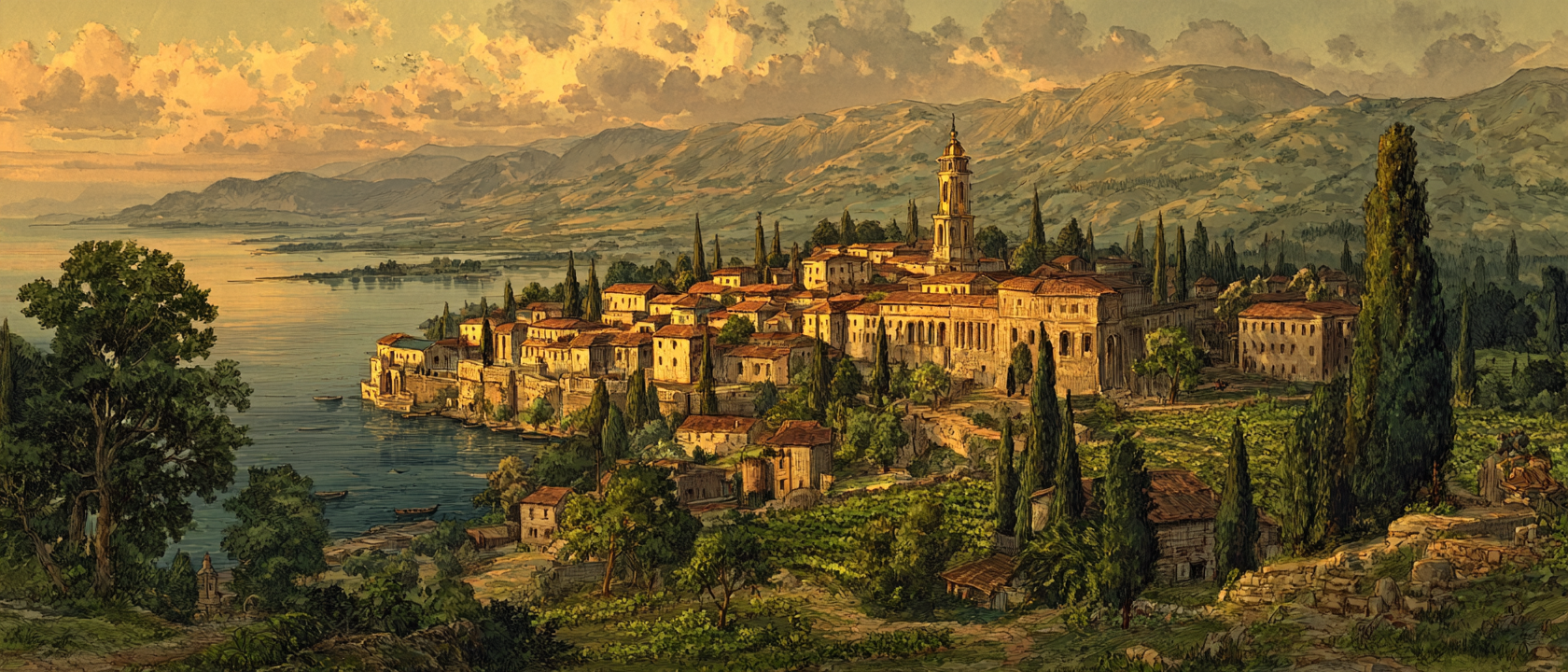
GUILD QUARTER
The Engineers' Shore · District · Insula Maior Town
"The Lighthouse Engineers' Guild maintains its administrative presence on Insula Maior for the practical reason that the Senate cannot be expected to conduct correspondence with Insula Minor, where the Guild Hall is built, because the Senate's correspondence staff find the crossing uncomfortable. This is the official reason. The actual reason, which the guild secretary has confirmed to me off the record, is that having the administrative office here rather than at the Guild Hall keeps certain categories of document at a comfortable remove from the guild's most sensitive archive. I asked which categories. He said: the categories that benefit from being at a comfortable remove. I found this answer informative."
The Guild Quarter is the northern residential and administrative district of the town, its character set by the Lighthouse Engineers' Guild's mainland administrative presence and the residential community of engineers who live here when not posted to a lighthouse station. The engineers are the province's most technically skilled population and its most institutionally independent one — the guild maintains its own records, sets its own standards, and has never been successfully audited by any Senate committee, not through resistance but through the reliable demonstration that the committee members lack the technical background to evaluate what they are examining. The guild has been loyal to Rome for nine centuries. It has also, for nine centuries, been its own institution first.
The Administrative Office
The guild's Insula Maior administrative office manages the Senate liaison function, the lighthouse posting assignments for the Inland Sea network, and the weather observation programme that the guild maintains as both a professional requirement and a cover for the specific observation categories that Titus Faber Notus does not route through the standard reporting system. The office's public function — lighthouse certification applications, posting correspondence, the annual technical standards publication that the guild produces for the Senate's record — is managed with the professional thoroughness that the guild maintains across all its public operations. The office's private function is managed by Notus alone, in the upper floor's filing system whose organisational logic is his own and whose contents he has not described to anyone.
Notus has been Guild Secretary for eleven years. He took the position knowing about the Pharus Record — the knowledge was passed to him by his predecessor along with the office keys and the advice to read the 412 A.P. entry before he read anything else. He read it on his first day. He has been thinking about it at irregular intervals for eleven years. The cross-referencing request he routed through the weather observation programme three months ago — looking for unusual current patterns in the northeastern sector — was the first active step he has taken in response to anything in the eleven years since. The Pharus Orientalis engineer's response arrived six weeks ago. Notus has been sitting with it since.
Demographics
Approximately two thousand permanent residents — the administrative staff, the engineers in their shore-posting rotation, and the families of engineers whose lighthouse postings keep them away for months at a time. The quarter has the social character of a professional community that shares a technical culture and a specific relationship with remote posting: the engineers return from lighthouse stations with the quality of attention that prolonged solitary observation of a single environment produces, and the quarter's social life has adapted to accommodate people who are comfortable with long silences and precise language.
The Pharus Network
The Lighthouse Engineers' Guild maintains seventeen lighthouses on the Inland Sea — six on the northern shore, four on the southern shore including the Pharus Magnus at Lacusum's breakwater end, four on the islands, and three on the eastern and western sea approaches. Each lighthouse is staffed by a posted engineer and their assigned crew. Each station submits monthly observation reports to the administrative office covering light operation, weather conditions, and sea traffic observations. The Pharus Magnus reports are the most voluminous given its position at the Inland Sea's most trafficked point. The Pharus Orientalis reports, from the northeastern sea approach, are the least voluminous. They have been the most closely read by Notus for the past three months.
History
The guild's Insula Maior administrative presence was established in the sixth century when the Senate liaison function grew beyond what the Guild Hall on Insula Minor could conveniently manage. The guild secretary position has been held by island residents from the fourth century. Titus Faber Notus is the sixth member of the Faber family to hold the position. The Pharus Record from 412 A.P. is held in the Guild Hall archive on Insula Minor. A copy exists in the Insula Maior administrative office's upper floor filing system. The copy was made by Notus's predecessor. It has not been requested by anyone else. For full chronological detail, see: Annales Mundi.
Architecture
The quarter's buildings are the most functionally designed in the town — the engineers build to the standard they apply to lighthouses, which is: adequate for the purpose, capable of withstanding the conditions it will face, and maintainable by the people who will be maintaining it. The administrative office is three storeys of compact, well-constructed limestone whose upper floor has the best view of the northeastern sea approaches available from any building in the town. This is not the reason the office was built where it was. It is a quality that Notus finds useful and has not mentioned in his reports to the guild's senior masters.
Access
Streets — public.
Administrative office ground floor — public business hours.
Administrative office upper floor — guild staff only.

Comments