
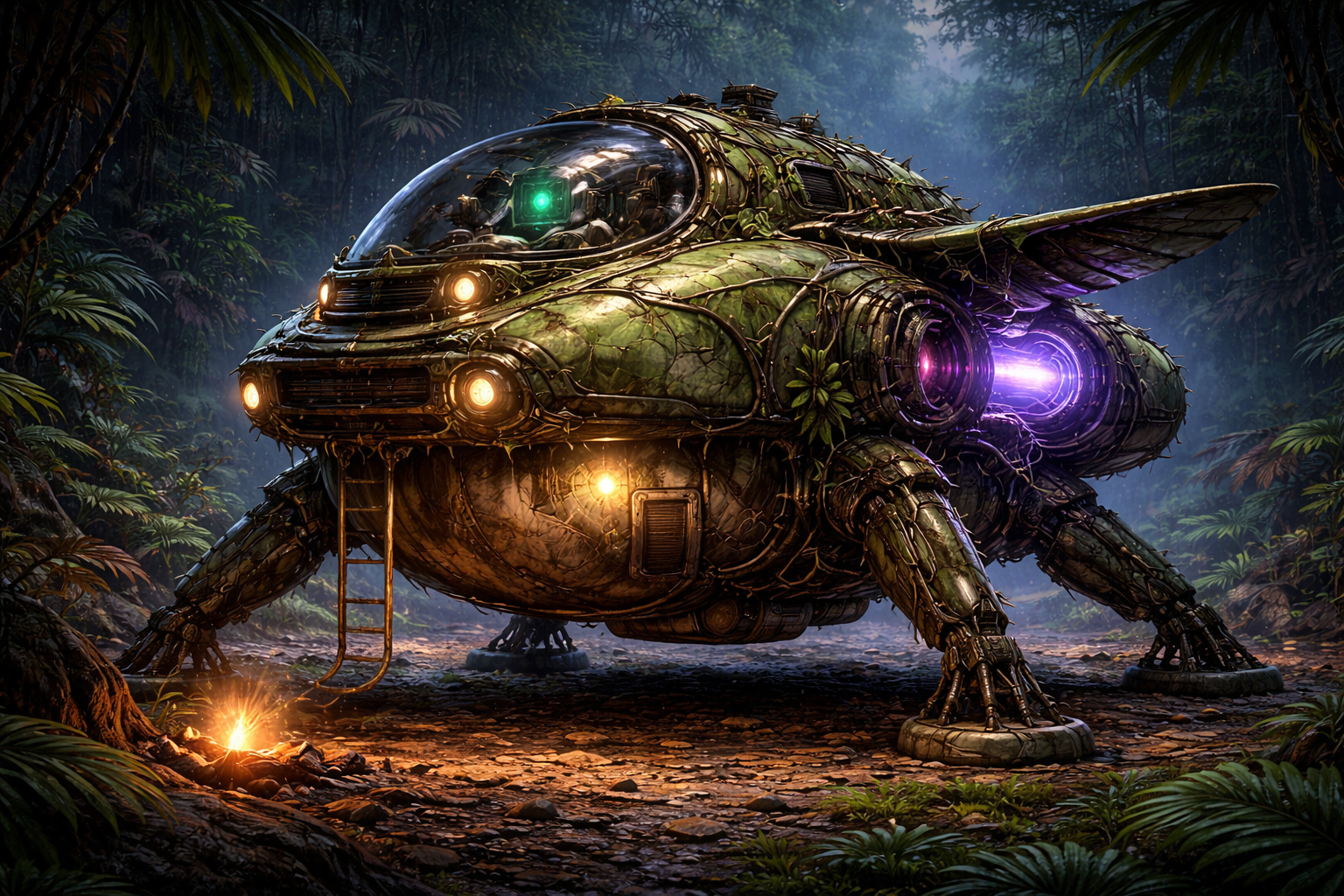
Star Hunter
Koko’s first hunt alone began not with glory, but with absence. The Floran Star Hunters fractured in the wake of their failed burrow hunt beneath Halcyon Verge, and without her grandmother to anchor them, the group dissolved into scattered individuals. Refusing to drift with them, Koko turned instead to the work that remained—small contracts, quiet jobs, anything that might begin to build a name. In the Splitlight System, she found it: a simple delivery to a salvage crew working deep within the frozen canyons of White Steppe. The journey was long and lean, sustained more by stubbornness than comfort, but the promise of land, prey, and purpose was enough to carry her through.
The job itself proved less simple. The salvage site lay buried deep within winding ice-cut ravines, where local canyon dwellers gathered in uneasy ritual around something unseen. The crew urged caution, and Koko pressed on alone. The descent was a trial of stone, snow, and gravity, her progress marked as much by falls as by forward motion. When she finally reached the depths, the delivery revealed its value—a key to a hidden cache within a wrecked ship, filled with relic equipment of lethal precision. Koko chose a set of shadowed blades, trading protection for presence, spectacle for lethality. The climb out was worse. Missteps, sabotage, and a brief, brutal clash with a native warrior left her bloodied and fading in the snow. She survived through instinct and defiance, claiming a trophy and her life in equal measure—though not for long. By the time she reached her ship, the trophy was gone, shattered in one final fall, leaving only the story behind.
What remained was not triumph, but proof. The Salvage Cartel paid, the locals marked her passage with a crude gesture of respect, and Koko left orbit with new scars, new gear, and a clearer understanding of the work ahead. Reputation would not come easily. But it would come.
Koko’s next contract brought her back to Briarfall, this time under the quiet authority of a sealed park and a problem no one local seemed willing to solve directly. A nesting burrow had appeared within what was meant to be a controlled, creature-free zone, and something inside had claimed it. The job was simple in wording—remove the pair, preferably alive—but the details were not. With no clear identification of the creatures and no time to wait for proper expertise, Koko took the advance and handled reconnaissance herself. Under cover of dusk, she slipped into the park and found them: a mated pair of low-glowing burrowers, wary and territorial, their presence turning the dark earth into something quietly dangerous.
Preparation proved as important as instinct. Armed with specialized bait and a protective salve against radiation, Koko returned the following night and drew the creatures out. They did not take easily to her presence, nor to restraint, and the encounter turned quickly from capture to survival. In the confined dark of the burrow, the fight was brutal and close, but Koko held the advantage—her shadow blades striking where the creatures could not see, her preparation dulling the worst of their bite. When it ended, the threat was gone, though not in the way her employer had hoped. Payment came regardless, along with a selection of salvaged equipment of mixed value, but for Koko the outcome was simpler: a clean hunt, a new trophy, and further proof that even in controlled spaces, nothing in the Splitlight System stays contained for long.
Koko’s next contract drew her out into the quieter reaches of the Splitlight System, to a gas extraction platform hanging above the drifting clouds of the so-called Drift Giant. What should have been a stable, long-running operation had recently fallen under new control—local thugs, working without sanction, had seized the platform and taken its foreman hostage in an attempt to convert it into a private revenue stream. The job was straightforward in intent: restore the platform, remove the occupiers, and bring the foreman home. With no larger faction backing the takeover and only a private bounty posted by the foreman’s brother, the situation carried the familiar scent of opportunism rather than strategy—dangerous in its own way.
Koko approached under the guise of a buyer and was allowed inside without resistance, the platform’s lack of security proving as much a weakness as an opportunity. What she found was not a fortified holdout, but a fragile occupation—thugs spread thin through living quarters and control spaces, relying more on presence than discipline. Choosing to strike early, Koko attempted to break the group before they could organize, opening fire into a cluster of off-duty guards. The plan collapsed quickly. In the tight confines of the control room, outnumbered and pressed into close quarters, she was forced into a brutal melee where the environment itself became a weapon against her. Though she ultimately cut her way free, the cost was too high to continue.
Badly wounded and unable to press deeper into the platform, Koko withdrew, taking only a small piece of proof from the encounter. The foreman remained in captivity, the platform in hostile hands. The client accepted the attempt without penalty, but the failure lingered. For the first time since striking out on her own, Koko had been forced to turn back—not from lack of will, but from the simple limits of what she could survive alone.
Koko’s next contract carried a different weight than her usual hunts. What began as the pursuit of a displaced beast master—driven out after the Briarfall park incident—quickly turned into something more urgent. A child had gone missing, and an abandoned shelter on the outskirts of town offered the only lead. The job was clear: secure the site, deal with any remaining creatures, and uncover what had happened. Koko arrived prepared, outfitted with a custom webcaster and expecting another controlled hunt. Instead, she found a place already picked over by scavengers and steeped in the remnants of something far less contained than a simple animal trade.
The shelter revealed itself piece by piece. Above ground, a stripped radio outpost; below, a maze of repurposed rooms and crude enclosures. Irradiated creatures lingered throughout—some restless, some merely surviving. Koko moved carefully at first, avoiding unnecessary conflict where she could, driving off lesser animals and clearing paths through the structure. But deeper in, the truth sharpened. Chained hounds, starved and conditioned for violence, left no room for restraint. The equipment scattered through the shelter—reinforced armor, improvised containment, isolated signal equipment—suggested something more deliberate than trafficking. This had been a place for control, for training, perhaps even for spectacle. Not a market, but something closer to an arena.
By the time the shelter was secure, the child was nowhere to be found. Signs showed they had been there, hiding at the edges of the structure, slipping away during the chaos of Koko’s arrival. The trail led into the briar and vanished. What followed was not a hunt, but a search—days of coordinated effort between Koko and the local community, combing through terrain that resisted even the most experienced trackers. It ended without resolution. The child was not recovered. The beasts were gone, the shelter cleared, but the absence remained. Payment came not in salvage, but in knowledge, as Koko stayed on to train under a local doctor, refining skills she had only begun to rely on. The work was done, but for once, it did not feel complete.
Koko’s pursuit of the rogue beast master led her to Dustroot, where opportunity and compromise had already begun to reshape the future. A coalition of salvage captains, eager to establish the first foothold in the planet’s only viable oasis, sought to remove the liability quietly—less out of justice than optics. The promise of future contracts and prime access to a new colony made the job attractive, but the reality on Dustroot proved far less controlled. Even the approach was unstable, her landing swallowed by a damp sinkhole riddled with old hunting tunnels and abandoned traps. Signs of prior activity were everywhere—broken chains, discarded tools, even another shield like those used to train attack beasts. The beast master had not just passed through. They had worked this ground.
By nightfall, Koko reached the oasis and found her target. The camp was active, surrounded by caged creatures drawn from Dustroot’s harsh ecosystem, and the beast master—an Avian—rested at its center. Koko struck first, moving quickly to contain and overwhelm before the situation could escalate. It failed. The beast master endured her opening assault with alarming resilience, pushing through webbing and blade alike, and brought her down with a specialized capture weapon built for exactly this purpose. Koko’s last act before losing consciousness was to trigger her beacon, calling in the captains to claim their prize.
They arrived too late to change the outcome—but not too late to redefine it. At dawn, rather than enforce the contract, the captains negotiated. The beast master was not removed; they were incorporated. The oasis would become something else entirely—part colony, part spectacle, built around controlled violence rather than free settlement. Koko, now a liability rather than an asset, was excluded from the agreement and retained as part of it. What followed was not a single defeat, but a prolonged captivity. For months, she was held within the growing structure, her role reduced to that of a controlled combatant, as Dustroot’s first settlement rose not in spite of the beast master, but because of them.
Koko’s captivity did not end cleanly—it was negotiated. Beast Master Cuauhtemoc, having broken and tested her in the arena, offered a final task in exchange for her release: confirm rumors of power crystals beneath the oasis. The framing was deliberate—simple reconnaissance, nothing more—but the tone carried something sharper. Koko prepared and descended anyway, using a fabricated rebreather to slip beneath the surface into a network of spring-fed caverns where artificial farms gave way to deeper, older tunnels.
Below, the truth revealed itself quickly. The caves were not unexplored—they were occupied, controlled, and working. Hostile creatures and Ventsea guards patrolled the depths, and beyond them, a living crystal vein was already being mined by enslaved labor. The setup was too complete, too organized to be recent. It became immediately clear: Cuauhtemoc had known all along. Koko had not been sent to discover anything—she had been sent to witness it and keep it buried. A convenient outsider to validate a lie.
Koko played her part. She returned to the surface, made shallow follow-up dives, and filed a clean report: nothing of value, nothing to pursue. Cuauhtemoc never confirmed the deception, but honored the agreement regardless. Her ship was recovered, her freedom restored. The arena was behind her—but not gone. Now Koko carries something far more dangerous than a trophy: proof of the operation beneath Dustroot, and the knowledge that Cuauhtemoc deals in truths he never needs to speak.
Koko’s next move was meant to be simple—a return to form. After a brief, almost trivial hunt on Briarfall to steady her instincts, she set her sights on Ventsea, chasing the promise of something worthy. The world did not disappoint. From orbit, the geothermal seas revealed dense forests of eyestalk flora swaying beneath shallow waters, something large moving just beyond visibility. It was the kind of place that rewarded boldness—and punished it just as quickly. Koko made landfall regardless, committing her ship to an uneasy float and arranging for its later recovery. For now, she was grounded, alone, and hunting.
But this time, she hesitated.
Rather than rush into the depths, Koko spent days observing. Patterns, movement, pressure in the water—she tried to build a picture of her quarry without ever seeing it. It was a marked shift from the instincts she had been raised on, the kind that had cost her grandmother her life. The longer she watched, the clearer the truth became: what she had learned before was not hunting, not really. It was force masquerading as skill. Faced with something truly unknown, that approach offered nothing but risk. And for the first time, Koko chose not to engage.
When the week ended, she left Ventsea empty-handed.
The cost was more than just the tow to recover her ship—it was a quiet confrontation with herself. The title of Star Hunter still meant something to her, but now it felt unfinished, unearned. Not abandoned, but redefined. Koko resolved to rebuild from the ground up: to learn properly, to prepare properly, and to survive on more than instinct and momentum. A better ship. Real practice. And, for the first time, a commitment to something lasting—a Cloning Pod of her own. The next hunt would come, but it would not look like the last.
Koko returned to the drifting harvester platform with a different mindset than before—not to prove strength, but to test control. The job was familiar: reclaim the site she had once failed to take. This time, the resistance she expected never materialized. The gang that had seized it had moved on, leaving the platform sealed and running in automated self-service, guarded only by locked systems and the bare minimum of fabricated defenses. What had once been a deadly close-quarters fight was now a quiet exercise in access and patience. Koko forced her way inside with crude improvisation, retracing her own past damage as she moved deeper, the frozen scars of her earlier attempt still etched into the walls.
Inside, the platform revealed its truth—not a stronghold, but an abandoned machine continuing its work without purpose or oversight. The core systems were intact, the living spaces empty, and the threat entirely absent. It was a hollow victory, but a meaningful one. Koko recognized what had changed: not the job, but her approach to it. Where she had once committed too early and paid the price, she now advanced carefully, stopping when the situation no longer justified escalation. Even the discovery of a lead—the gang’s ship in orbit—was treated with restraint. It was a fight she could start, but not one she needed to.
With the contract complete and the platform secured, Koko took a decisive step forward. The payout, combined with her accumulated spoils, allowed her to abandon the limitations of her old transport and invest in something real—a proper ship. Larger, faster, and built for growth, it marked the first true foundation of her independence. Outfitted with a full hull, expanded systems, and a personal pixel printer, it was less a vehicle and more a commitment. Koko was no longer operating job to job. She was building something—and for the first time, it felt like it might last.
Koko’s latest contract took her to Stillfield, a lifeless world of fossilized grass and razor stone, where a routine salvage operation had uncovered something far older than the wreck that revealed it. A researcher, drawn in by the discovery, had become trapped within the ruins beneath a crashed cruiser as opportunistic bandits moved in to strip the site. The job was clear: extract the researcher, secure the ruins, and do as little damage as possible to whatever lay buried beneath. Koko approached carefully, though the terrain itself fought her every step of the way, forcing a painful advance through the cutting fields before she could even reach the site.
Below the wreck, the ruins told a different story. Ancient stonework still pulsed with faint yellow light, corridors half-collapsed but unmistakably deliberate in design. The bandits had already begun their work, tearing into the structure in search of anything valuable. Koko moved quickly once contact was made, relying on speed and resilience rather than positioning, cutting through the first group and discovering at the heart of the complex something impossible: a teleportation beacon of unknown origin, built not from advanced alloys but from glowing stone, and operating at a level far beyond modern capability. It was not salvage. It was something else entirely.
The second engagement nearly ended her. Pressed by a larger group deeper in the structure, Koko fought through sustained fire, her cryo shield absorbing punishment until it could not. She brought most of them down—but not before collapsing herself. What followed was not rescue, at least not in any familiar sense. Koko awoke in a reconstructed space that defied logic, a sealed stone chamber open to the vacuum beyond, where the researcher and surviving bandits had also been brought. There, an alien presence revealed itself—not hostile, but absolute. The being spoke in terms that reframed the entire discovery: remnants of an ancient exodus, survivors of a dead arm of the galaxy, their technology and intent far beyond the understanding of those who had stumbled into it.
The encounter ended as abruptly as it began. Koko found herself returned to the ruins, now occupied by silent alien custodians restoring what had been disturbed. The message was clear without being stated: this place was not for them. Koko took the researcher and left without resistance. The story would spread, but without proof or access, it would linger somewhere between rumor and myth. For Koko, the lesson was more immediate. She had stepped into something vast and survived only because she was allowed to. Back in open space, she turned her focus inward once again—refining her weapons, strengthening her capabilities, and preparing for a future where survival would depend on more than luck and restraint.
A few weeks after Stillfield, the researcher contacted Koko directly with a new lead. The patterns taken from the Ruin there had revealed a second site on Ventsea, buried in one of the planet’s hazardous thermal regions among vent fields, migrating fauna, and scattered family groups of Ventsea Folk. The task sounded simple—find the entrance and open the way in—but nothing on Ventsea stayed simple for long. Koko searched from the water beneath her Hunter Platform, moving through warm currents and strange seabed formations until she found the first real clue: an unnatural reverse vent pulling water inward through a mineral-choked grate of the same dark lavender stone she had seen before. It confirmed the structure was there, but not how to reach it.
As she widened the search, Ventsea itself answered with violence. Koko crossed paths with a nest of Ventsea Folk clustered around their eggs and watched, detached but not unseeing, as a massive armored predator fell upon them in a frenzy she chose not to interrupt. When the creature turned on her instead, she killed it with a single heavy cryo round and took its dorsal fin as a trophy, then returned to the work. The deeper she pushed into the region, the stranger the site became: abandoned nests, toxic magma chambers, forcefield-shrouded stone, and hints of infrastructure that seemed to disappear as soon as she thought she understood it. For a time the entire search threatened to dissolve into heat, geology, and false paths.
The breakthrough came not in the depths, but at the feature she had nearly dismissed. Returning to a broad flat section of seabed she had used as a navigation marker, Koko found the floor open beneath her and swallow her into the structure itself. What waited inside was not a grand temple or vault, but something far more disorienting: an automated facility still running its ancient routines in perfect isolation. Its first chamber was a kitchen, still manufacturing elaborate plant-based meals from drifting kelp and sea growth and discarding them untouched into a lower waste system. The absurdity of it might have been comic if it had not also been lethal. Knife-armed kitchen drones and maintenance machines still defended the place, and Koko had to fight her way through them while piecing together how the site functioned.
Within the machinery she found what she needed: an access tag, a better understanding of the facility’s strange internal logic, and eventually the controls that governed its surface aperture. By the time she emerged again, she had mapped the hidden entrance well enough to make it visible and usable for the researcher. The job was complete. More importantly, it proved something Koko had been building toward for several sessions now—that she could survive the unknown not by forcing her way blindly through it, but by observing, adapting, and enduring long enough to make sense of it. Even so, Ventsea left its usual impression: alien, hostile, and faintly disgusting, with secrets buried not beneath ruins of war, but beneath systems still quietly doing exactly what they had been made to do.
Koko’s next contract looked, at first, like the kind of opportunity every independent hunter waits for: two separate backers, one shared objective, and enough reward to justify the risk. The researcher had been forced out of the intact Cinderwake site on Ventsea, not by ancient defenses, but by hostile intruders. The researcher’s own captain wanted the site cleared, while Salvage Cartel interests wanted it protected from looters and stripped properly under controlled terms. On paper, it was a clean reclaim-and-secure operation.
The reality was much larger. Approaching from the seafloor for reconnaissance, Koko found the site under a bright floodlit perimeter dome, guarded not by scavengers or bandits, but by an unmarked force with military discipline, advanced scanners, heavy troops, a submersible dropship, and a mecha exoskeleton. Whatever had taken the site was unofficial, but not underfunded. In Kaleidescope, that level of organized force was rare enough to be a statement by itself. When Koko was detected, the warning came immediately over comms: leave the area.
She complied. The point was made again when she surfaced and found the same exoskeleton standing on the deck of her own platform, silent except for an encrypted burst of traffic before it returned to the sea. Koko understood the message perfectly: she and her ship were still intact because she had obeyed. The mission was unwinnable as posted, and everyone involved recognized that once she reported back. No penalty followed. The job had not failed because Koko lacked nerve or preparation; it failed because the site had already become something far beyond a salvage dispute.
Koko’s final job before leaving her small-time hunter life behind was not a hunt at all, but a betrayal disguised as one. In orbit over White Steppe, the raider capital ship she had tracked from the gas platform incident was finally under siege, with both the raiders and the Salvage Cartel offering pay for extra guns. Koko saw the opening clearly: take the raiders’ contract, place the Hunter Platform between them and the blockade, and wait until proximity turned trust into vulnerability.
The deception worked. Koko sold herself as hired security long enough to get into position, traded enough fire with the Cartel side to make the act convincing, then turned her guns on the raiders once the trap closed. The battle ended quickly, and the salvage haul was substantial. The raider threat was broken, the Cartel got what it wanted, and Koko proved she had learned how to read a battlefield beyond the reach of her claws.
But the cost was reputational. In a culture held together by direct agreements and contract trust, the Cartel could not ignore that Koko had taken a job and betrayed it, even against a common enemy. She won the fight and lost the net. Blacklisted from the work that had carried her this far, Koko was forced toward the next version of herself: no longer a local bounty hunter scraping for trophies and upgrades, but someone who would need her own power, her own ship, and her own name strong enough to stand without the Cartel’s permission.
Threads:
- Local thugs occupying gas extraction platforms successfully increasing crime rate in the system
- Capitol ship base found in orbit around white steppe
- Fleeting Cinderwake contact made in ruins
- Intact site on the Ventsea floor
- Occupied by unknown black ops military group with mecha and drop ship support
- Beast Master Cuauhtemoc
- Under oasis crystal mining in secret on Dustroot Koko knows about
- Running an illicit arena on Dustroot