

Second Level
The Second Level of Skeleton City is a sprawling, cavernous area featuring a mix of natural formations and human-engineered structures. It is the second-largest level in the city and is known for its distinct architecture, bustling market, and key municipal organizations. The space is dominated by a massive cavern, with smaller chambers hidden inside the walls. This level is home to many upper-class residents, but is a frequent stop for almost all residents of Skeleton City. A hub of commerce and community, the Second Level is also the battleground for several warring factions behind the scenes, each fighting for control over its many resources.
What is one success that this character owes to a faction?
Who does this character think should be in charge of the city?
What is one thing barring this character from feeling truly safe on this level?
Entrances and Geography
The Second Level can be accessed by multiple passages leading down from the First Level. While Police-Guard are stationed at all these entrances, they are more focused on monitoring those trying to enter the First Level and don't care much about who leaves for the Second. This level can also be accessed by many passages leading up from the Third Level, including one elevator from the Third Level's industrial neighborhood.
RISKY TECHNOLOGY
Elevators in Skeleton City are only elevators in the sense that they take people up and down on a moving platform and are an alternative to stairs. Taking one can be extremely dangerous, and typically a permit or Police-Guard badge is required to ride one.
Passages leading up from the Third Level can take someone to almost any elevation they want on the Second Level, so those who wish to bypass the Market and the main chamber can simply travel up passages in the walls until they reach their specific destination. For the most part, these passages are unguarded, and people may move freely through them.
While not the largest level by area, it does boast the single biggest continuious open space in all of Skeleton City. The bulk of this layer sits in a massive underground canyon that has been further excavated as far as deemed structurally safe by Engineers. Some of the natural cavern is still visible along the ceiling, which is covered in massive stalactites, but what would have been the natural cave floor has been carved out and built on to form the descending geography of the level.
From a vantage point at the top of this level, one can see that the walls of this huge chamber have been carved out to form wide platforms, stairs, ramps, and bridges, many of which connect to other platforms. This forms a spiderweb of traversable pathways suspended in the air. Hundreds of feet below, the multicolored tops of the Market are barely visible, spread out like a quilt along the cave floor. Compared to the somewhat claustrophobic layout of many other spaces in the city, the main chamber feels open and airy.
While the open-air pathways are fairly easy to navigate, the walls of this cave are dotted with stone windows and open doorways, hiding many additional chambers and side streets to explore, just out of sight of the main cavern.
Elevators in Skeleton City are only elevators in the sense that they take people up and down on a moving platform and are an alternative to stairs. Taking one can be extremely dangerous, and typically a permit or Police-Guard badge is required to ride one.
Architecture and Infrastructure
The architecture on the Second Level has been developed and defined for several hundred years, though it lacks the clear visual cohesiveness of the First Level. It has the look of a bustling city, with many closely-packed, two- or three-story buildings, all sculpted, modified, and decorated by various hands over the years. These buildings are either carved from stone or constructed out of stone blocks, with many incorporating simple metal detailing. Painted or glazed ceramic tiles, murals, and brightly-colored fabrics and tapestries often adorn the exteriors. Accents of precious metals or glass are much less common. The platforms of this city are well-enforced, sometimes bolstered by additional stone columns or massive metal brackets. Every platform and open-air walkway is railed for safety, with four feet being the current minimum height established by the Department of Safety and Wellbeing.
PROGRESSIVE COLLAPSE
Some have expressed concern over the structural integrity of these caverns and stacked levels, fearing collapse into lower levels. However, the engineers of Skeleton City have taken every precaution to ensure their structures are sound and rated to withstand even moderate earthquakes. So don't worry about it!
Many walls, platforms, and passages have been polished to a smooth finish, either on purpose or from the natural wear of foot traffic. Carving details can be found everywhere, from simple artistic designs on stone doorways to more complicated structural artwork in public seating areas.
Various chambers and passages hidden behind the walls lead to apartments, offices, and a few venues and studio spaces. These are well-developed, and the passages tend to be spacious and consistently sized. Many buildings and subchambers are carved directly into the stone walls, though some have taken advantage of petrified chambers cemented in place through the seismic events of the Third End.
Nestled among the stalactites in the ceiling are catwalks and other rigging from which many large sunlamps hang, providing much-needed synthetic light to the people below. This and other life support systems are powered by the Generator, located near the top of the level. During the day, the level is well-lit by the overhead sunlamps and additional lampposts on the platforms, and industrial heating keeps the cave a comfortable temperature. When the grid is shut off at night, the space is cooler and dark, save for emergency lighting at entry and exit points and along walkways. Some sections of the Market remain open at night, and are lit with strings of bioluminescent bulbs and other alternative light sources during off-hours.
Some have expressed concern over the structural integrity of these caverns and stacked levels, fearing collapse into lower levels. However, the engineers of Skeleton City have taken every precaution to ensure their structures are sound and rated to withstand even moderate earthquakes. So don't worry about it!
SAFETY AND WELLBEING ADVISORY
Medical professionals recommend getting 10-30 minutes of exposure to a sunlamp at least three times a week to maintain vitality and reduce the risk of Night Fevers. This effect can be easily attained by standing in any exposed area of the Second Level for the recommended time. Please note that the Department of Safety and Wellbeing is not liable for any dissatisfaction or medical conditions resulting from overexposure or the use of non-regulated personal sunlamps.
There are a few specialized shops established on the platforms here, but most merchandise and personal services are found in the Market. The platforms are reserved more for utility and municipal functions or for leisure space. There are also apartments and other places to live both inside and outside the walls.
Additionally, there are a number of small parks, fountains, and other areas designed to give people a place to relax and unwind. Small flower beds and twiggy trees are planted strategically in these areas, as plants have been found to grow with some success in this level's climate, though they require constant care and tending to survive for very long.
Medical professionals recommend getting 10-30 minutes of exposure to a sunlamp at least three times a week to maintain vitality and reduce the risk of Night Fevers. This effect can be easily attained by standing in any exposed area of the Second Level for the recommended time. Please note that the Department of Safety and Wellbeing is not liable for any dissatisfaction or medical conditions resulting from overexposure or the use of non-regulated personal sunlamps.
Neighborhoods and Points of Interest
This cavern originally provided survivors of the Third End with the space needed to establish leadership centers, trade hubs, and necessary utilities. These days, it remains home to many critical city infrastructure centers. The neighborhoods on this level have formed around these important centers, but the distinctions between areas are mostly for formality.The Ceiling
The top of this cavernous space hosts a number of important landmarks and higher-class living spaces, sometimes literally in the ceiling. Housing consists mostly of apartments or private homes built into the walls of the canyon. These living spaces are fairly expensive on account of their convenient access to the First Level and the phenomenal view of the cavern below. One building is reserved exclusively for Stewards and their families as compensation for their high-profile jobs. The Temple of the Priesthood, a gigantic, hollowed-out stalactite, is the most noticable landmark here. It stretches from the ceiling to about two-thirds down the level, its many windows glittering with candlelight even at night. Hidden in the stone near the ceiling are pre-End bunkers that contain Greenhouses filled with planter boxes and sunlamps. The city's main Generator, accessible only to Stewards, is also located here. These landmarks have a mystical reputation for their pivotal role in ensuring early survivors could live long enough to establish food, water, and simulate sunlight. Thus, there is a tremendous amount of respect for this level area and its inhabitants, along with a fair amount of scrutiny due to the power and freedom granted to those living and working here. Points of Interest: Temple of the Priesthood | The Greenhouses | The GeneratorThe Municipal Block
Although the City Council's leading body has moved its center of business Up-Top, many city infrastructure positions still require a presence in the city proper. These departments remain situated in the Municipal Block, a wide series of platforms halfway down the canyon wall. Municipal departments include (but are not limited to):- Public Tunnel Department: Manages city infrastructure, traversable passages, level expansion, and public use areas, and oversees life support systems.
- Public Zoning Department: Manages housing development and zoning for public and private areas, including periodically rezoning the Market.
- Social Affairs Office: Manages internal cultural preservation, events, and the city's relationship with The Capitol.
- Food and Agriculture Department: Oversees food production on the surface and underground, including quality assurance and sustainable farming practices.
- Department of Safety and Wellbeing: Manages public health and safety standards, including permitting for hazardous work, posting health advisories, and performing safety audits of cavern infrastructure.
- Department of Licensing: Oversees applications, requirements, fees, and renewals for all licenses, including tech, weapons, hunting, and business licenses.
- Commerce and Conversion Offices: Manages the weekly distribution of free food and goods, transaction requests to convert trade goods into currency, and tax collection.
The Precinct
Sometimes considered part of the Municipal Block, the Precinct contains many areas requiring proper identification and authorization to enter. It is also physically divided from the Municipal Block, with most facilities hidden behind the canyon wall for protection, accessible by short tunnels. The Police-Guard Headquarters, built into a petrified office building, is the central hub for managing resources and responding to incidents around the City. Nearby caverns house Police-Guard equipment, training courses, and emergency supplies. Also within walking distance are the Cells, a long series of small, stone rooms designed to hold people who were recently arrested while they await trial, as well as those who have been deemed too dangerous to be out among the public. The Daily Voice, Skeleton City's primary news outlet, also has its main headquarters here, bustling with reporters gathering stories for the weekly newspaper. The Daily Voice covers local news, crime reports, political analysis, lifestyle, cultural segments, health and safety updates, opinion pieces, gossip columns, and classifieds. Although they have a reputation for tenacious investigative journalism, they're also the best way for competing factions to get their agendas out in front of the people. Points of Interest: The Police-Guard Headquarters | The Daily VoiceMidway
Named for being midway between the top and bottom of the chamber, Midway refers to housing not explicitly part of another neighborhood. Housing here includes apartments and private homes that are more affordable than those along the Ceiling, though are still beyond the means of many. Living spaces get smaller and simpler the closer they are to the bottom of the level. Midway also hosts a couple of entertainment venues and its not uncommon to see entire platforms rented out for block parties, cultural fairs, and community service events.The Market
Originally a place for survivors of the Third End to exchange goods, the Market has grown into a massive, sprawling grid of stalls, tents, carts, and small buildings. It takes up a majority of the floor of this level. They say that if you need to find anything, you can find it in the Market. It is absolutely vital to Skeleton City's ability to function as a city and society, to the point that the entire Second Level is sometimes just referred to as "the Market". The sprawl is so large that it has its own neighborhoods, factions, poltitics, and subcultures. Points of Interest: The MarketGuilds and Factions
The Second Level's population density, infrastructure, and importance as a trading hub have attracted the attention of many powerful groups. Most of these groups compete for control over these vital resources, whether it is to protect and maintain them or manipulate them for personal gain. The four most prominent factions vying for influence are the City Council, The Priesthood, The Rings, and the Order of the Spinning Blades. These groups are engaged in a quiet war to sway public opinion and control resources. Rather than openly admitting their agendas, they work to influence the news, convince individuals to their side, bolster their reputations, and quietly undermine each other. Most residents are unaware of this ongoing struggle, though many unknowingly contribute to the conflict.Demographics and Society
The Second Level of Skeleton City is defined by its fast-paced, career-focused society. For many who live here, job advancement and personal ambition drive daily life. Residents here are primarily upper-middle-class, and often hold significant positions in city business, municipal management, or community support. It is a place where professionals—architects, stewards, scientists, doctors, and politicians—strive for success and influence. Unlike the Third Level below it, the Second Level is not considered an ideal place to raise a family or live a settled life due to its quickly-changing and intense social environment. Instead, it is a hub for those deeply engaged in their careers and who are often more concerned with their legacies, education, or fighting for a cause within the city. Autonomy and a strong professional network are crucial to thriving on the Second Level. Social capital, built through networking, influence, and reputation, can be just as valuable as wealth. People here are often involved in starting or creating jobs for residents of lower levels, emphasizing their role in shaping the economic landscape of Skeleton City. This level fosters a strong sense of self-regard among its residents, who frequently engage in the politics of advancement, whether through traditional corporate means or more subversive factional alignments."As they made their way through the Municipal Block, Robin could easily read the strong opinions on the faces of those they passed. Two disheveled vandals parading through the neighborhood were quite a sight, after all. The gossip had already started; several people turned to their friends as they walked by, subtly pointed, leaned in to whisper, or scoffed with distaste before pretending not to notice them."Inhabitants of the Second Level are typically driven by their professional goals and ambitions. While some focus on climbing social or corporate ladders, others dedicate themselves to activism, the arts, or education. The level's close proximity to the First Level and its relatively easy access to the Market and sunlamps give its residents significant advantages over those in lower levels, allowing them more time and energy to focus on their careers and social standing. To many, the Second Level is a reflection of Skeleton City's broader struggles and ambitions. It is a place where success is earned through hard work, strategic alliances, and relentless pursuit of one's goals. However, it is also a society where sacrifice is often the price of progress. Many residents forgo comfort, rest, or even stability for a chance at advancement that isn't always guaranteed to be better. Those who choose to build their legacies on the backs of those below may find rapid success with little personal cost, but they risk making powerful enemies along the way.
Economy and Industry
Skeleton City's economy is largely based on the trade of goods and services, a practice that began in the Market on the Second Level. The Market remains the single greatest hub of goods and produced wares in the city, with some of the biggest industries being textiles, agricultural goods, and masonry. Goods from Up-Top that aren't snatched up on their way through the First Level are eventually sold or traded here as well. This level also manages trade with the Capitol, exchanging the city's gritty sand (for concrete) for the Capitol's desert sand (for glass). The city has also recently begun exchanging for dried foods, medicines, and other goods not available Underground. A small amount of the city's money is generated through taxes and additional rent collected from those who have elected to set up permanent shops in the Market.
FUN TAX SEGMENT
On a monthly or biannual cadence, all households must give a portion of their earnings or produced goods back to the city as a tax payment. A small portion of this wealth goes to city projects, but the majority is directly redistributed to the people during the weekly free distributions of food and goods. For example, if your household farms cave-krill, you are expected to either give a portion of your cave-krill stock, a portion of what you have traded for that cave-krill at the Market, or some combination of both. While much of the populace has been hesitant to move to representational currency, many have to admit that giving the Commerce and Conversion offices a stack of money is a lot easier than hauling in a tank of cave-krill every month.
The City Council has made it clear that they intend to keep the trade of goods as un-taxed and unaffected by politics as possible, and have promised to keep access to their greatest asset, the sunlamps, free for all as a basic human right. While this is a popular opinion among the people living and working in the city, easing up on regulations in the Market has allowed individuals to monopolize various industries, contributing to growing wealth gaps throughout the city. It has also made it harder to track down contraband smugglers like the Rings due to the lack of regulated oversight.
On a monthly or biannual cadence, all households must give a portion of their earnings or produced goods back to the city as a tax payment. A small portion of this wealth goes to city projects, but the majority is directly redistributed to the people during the weekly free distributions of food and goods. For example, if your household farms cave-krill, you are expected to either give a portion of your cave-krill stock, a portion of what you have traded for that cave-krill at the Market, or some combination of both. While much of the populace has been hesitant to move to representational currency, many have to admit that giving the Commerce and Conversion offices a stack of money is a lot easier than hauling in a tank of cave-krill every month.
History
Before the Third End, the Second Level was a series of natural caves discovered during the construction of the subway tunnels above. After a number of natural disasters caused concern in the city above, bunkers were constructed in and around these cave systems to test long-term sustainable survival in underground vaults. Unfortunately, the events of the Third End came much faster than anyone anticipated. While the bunkers were hardly sufficient to house the entire population of the city, they were enough to sustain a population of survivors until other food and resources could be acquired elsewhere in the tunnels. Traces of this old work can still be seen in the Greenhouses, sunlamps, and the Generator that are still being maintained to this day. Not long after the disaster, people began moving down into these tunnels to escape the overcrowding of the First Level. At first, the settlement here was merely a collection of ramshackle tents, but having everyone in one area made it easier for groups previously separated by the most-isolated Lines up above to trade whatever food, goods, or skills they could offer. Before long, rough homes were being mined out or built from the surrounding stones. The newly-formed City Council began creating a formal environment for trade to help keep things civil and fair, and thus the Market was born. The main chamber has since been expanded downward significantly, and many tiers of homes and other establishments have been built along its edges. When the Third Level finally opened up for residency and lessened issues with overcrowding, the City Council established areas on the Second Level specifically for their growing staff of administrative and municipal workers. Communities that had taken root here began to flourish, as did the rich and complex Market culture. This was when the city truly began to thrive, with a population and an economy that allowed the community to sustain itself through cooperation. The Priesthood was at the head of this movement, providing moral guidance and bolstering the level through their many volunteer efforts. They also cemented strict policies around Mages, who became a problem as the population of the city began to take off. They also enforced anti-tech policies that kept the city's technology under strict watch. As the Priesthood rose in power, so did those who vehemently despised their methods and ideals—the Order of the Spinning Blades. The more the City Council came to depend on the Priesthood to help manage the city and maintain their public image, the more the Blades began to turn their ire towards the Council as well. Meanwhile, the Council had been working to push down law-evading merchants, thieves, and black market dealers who had settled into the flow of goods in the Market, but none gave them as much trouble as the Rings. This group, specializing in moving contraband around the city, has been a thorn in their side for many years. While the City Council has ousted several of their larger operations, they have yet to successfully root out the heart of their organization. Rumors have it that the Rings have started supplying the Blades with illegal weapons to help them further destabilize the Council's hold on the city.Climate and Natural Resources
This level has some of the cleanest air in Skeleton City, second only to the First Level. Numerous venting fans distributed throughout the level help bring in air from above. It can be a little windy near the top of the level, but otherwise, the climate and temperature are very stable. The sunlamps make this level ideal for a healthy lifestyle, especially for those barred from reaching the First Level for whatever reason. Originally, this level contained a variety of natural resources, including naturally-growing wild fungi and algae, silkspider dens, and an abundance of stone, soils, and other minerals retrieved during expansion excavation. Most of these resources have since been relocated to the Third Level, in chambers set up to cater to specific temperature and climate needs. Regarding mining, architects advise that this level has been mined out as much as possible without risking structural collapse, so mining efforts have moved down to the Sixth Level.Security and Safety
While the presence of both the Police-Guard and the Priesthood means that this area is closely watched by a variety of law enforcement efforts, that does not necessarily make it safer than other levels. The way up to the First Level is guarded, but the routes leading up from the Third Level are generally not. Given that the Second Level is a large, open area filled with high-profile individuals, city government, and a massive religious organization, it is a prime target for anarchist rebellion or terrorist threats. In the past, desperate or cutthroat groups have threatened to seize the Greenhouses or the power generator, because without these resources, the city population will essentially be crippled. These threats have always been stopped long before insurgents reached these high-security areas, but the threat still lingers in many people's minds. Beyond dramatic displays of violence or attempts to wrest control from the government, this area also sees various smaller crimes. Vandalism, graffiti, pickpocketing, petty fraud, and shoplifting are common. The Market itself experiences all kinds of crime from petty theft to highly organized contraband smuggling. Crime is handled in several ways on the Second Level, and these methods don't always align. Typically, criminals are handed over to the police for holding in the Cells until the Police-Guard decide whether they should go to the Courthouse for trial. If the Police-Guard respond to the incident, they handle and process the offender accordingly. However, the Priesthood also has members who are capable and licensed to apprehend someone they see committing a crime. They usually hand these individuals off to the Police-Guard, but may push to bring certain individuals or Mages into their private custody for processing instead.
NOTICE FROM THE PRIESTHOOD
If you or someone you know is experiencing symptoms of Blooming , please report to the Priesthood immediately. Even if the effects are minor, it is important to monitor the condition to ensure public safety is not at risk.
If the organization or individual affected by the crime has hired additional security, and they apprehend a criminal on land that they own, it is up to the employer to decide what to do with them, within reasonable legal bounds. Things can get extremely messy if two or even all three law-enforcement parties show up simultaneously to deal with the same threat, with confusion over jurisdiction and strategy causing more chaos than good.
There are also several health concerns that plague the Second Level. Easy access to the overhead sunlamps makes this area a prime destination for someone hoping to Sunskip, and the delirium caused by the condition can result in violence in the worst cases. Those experiencing severe Night Fevers may also come here out of desperation to reverse their condition, which can lead to public disturbances. The Priesthood encourages citizens to report Mage-related activity to their offices for investigation, but there has been a recent rise in false reports being given for unscrupulous reasons.
Monster attacks on this level are rare, occurring about once a year. Monsters that reach this level are often dispatched quickly, but the dense population and open geography make these attacks extremely dangerous, as the Monsters find themselves in a target-rich environment. Typically, monsters that make it up to this level are fast and agile, having successfully navigated the labyrinth of the Third Level housing neighborhoods or flown up through the Petrified City.
Lastly, while there are safety rails on most elevated platforms and walkways, it is still possible for someone to go over the railing and fall from height. Lucky individuals may land on another platform below and potentially survive, but more often, the drop is deadly. Additionally, dropping or throwing objects off the edge of these platforms can have disastrous effects on structures and crowds below. Intentionally pushing, throwing, or dropping anything off the edge is a punishable crime with severe sentences.
If you or someone you know is experiencing symptoms of Blooming , please report to the Priesthood immediately. Even if the effects are minor, it is important to monitor the condition to ensure public safety is not at risk.
In a Campaign
As a Setting
The Second Level is an excellent setting for a social and political intrigue campaign, especially if you delve into the four competing factions of the City Council, the Priesthood, the Order of the Spinning Blades , and the Rings. These factions all have their own agendas and goals, both short-term and long-term, and might approach a party in the hopes of using them to advance those goals. Characters can decide to side with a faction, play them against each other, or even form a new faction of their own. The Market is practically a setting in and of itself with its own share of drama, guild politics, and potential quests. Alternatively, the Second Level can be used to explore themes of corporate politics and social justice. The intense presence of the law on this level can accentuate themes of being watched or having to hide one's identity. Some potential plot hooks for starting an adventure on the Second Level include:- Vendors in the Market are suffering from a series of sabotage incidents. Stalls are being destroyed, goods are mysteriously going bad, and customers are being scared away. The party is called in to investigate.
- The party hears rumors of a plot to steal a crucial component from the Generator that powers the sunlamps. They must gather information to report this scheme to the authorities, or stop the crime themselves.
- Public spaces and monuments are being defaced by a group of vandals. As the party investigates, they uncover a deeper conspiracy involving political dissent and hidden agendas among the city's factions.
- Reports of people experiencing symptoms of Blooming have increased dramatically in the last month. The party is asked by the Priesthood to investigate these events and discover if there's a common cause.
- A representative of the Rings approaches the party to help smuggle an extremely valuable package through security to a drop-off point on the First Level. The package's contents far more dangerous than initially explained.
- A member of the Order of the Spinning Blades seeks the party's help in removing a corrupt municipal representative from power. The official turns out to have powerful allies in an unexpected faction.
- The party discovers a series of forgotten chambers behind the walls of the Second Level, filled with pre-End technology and artifacts. They must decide what to do with these powerful and illegal pieces of equipment.
- The Police-Guard ask the party to track down a smuggler hiding somewhere in the Market. Once found, this "smuggler" turns out to be a Mage hiding from the Priesthood.
- The Cultural Affairs Office is preparing for a major festival, but there are threats of sabotage from an unknown group. The party must ensure that the festival runs smoothly, while uncovering the identities and motives of the sabateurs.
For Characters
For players who want to play a character from the Second Level, or for making NPCs from this level, here are a few ideas to jumpstart the process. Aesthetics: Polished, functional, crafty, intellectual, irreverent, stylish, embellished, stately, purposeful, reserved. Traits: Dedicated, busy, knowledgeable, manipulative, gullable, perceptive, assertive, sophisticated, competitive, innovative, self-assured, gregarious, guarded, persuasive, strategic. Questions to Answer:Article Navigation
At a Glance
Alternative Name(s)
The Market, Second
Type
District
Inhabitant Demonym
Undergrounders
Included Locations
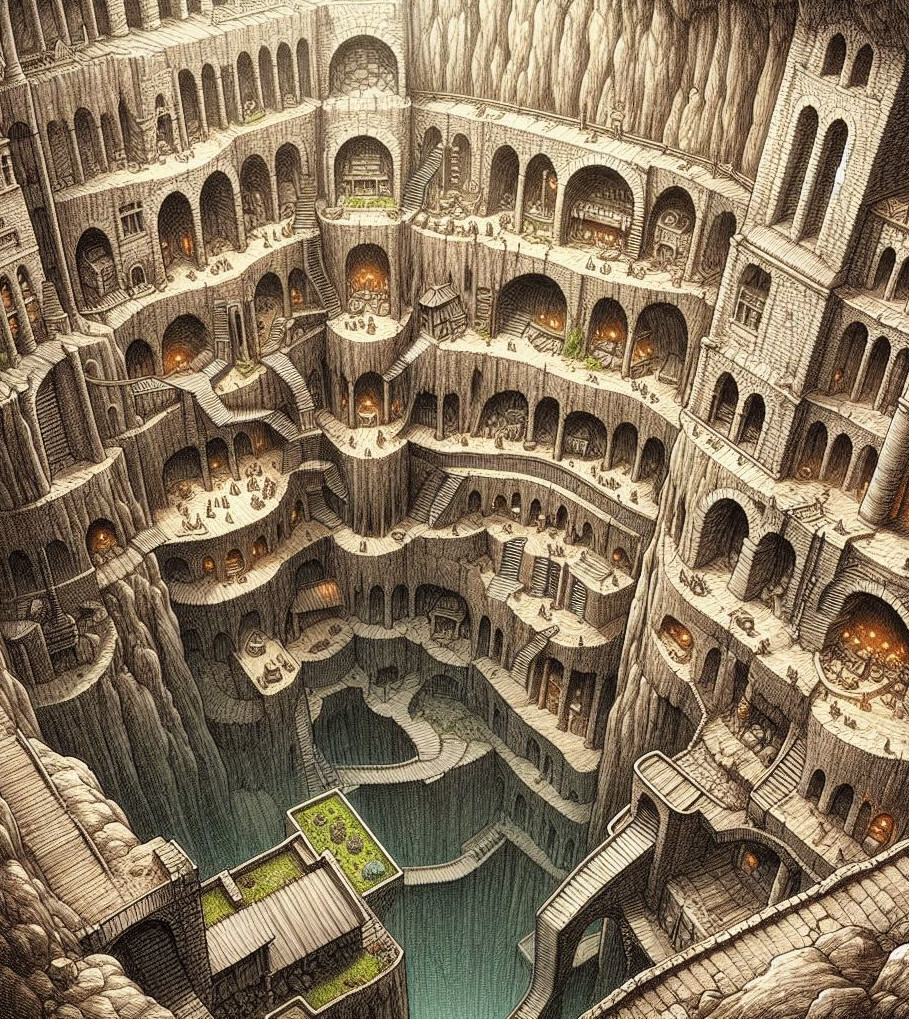
by Katie Nyborg (via Microsoft AI)
A view of the Second Level from above.
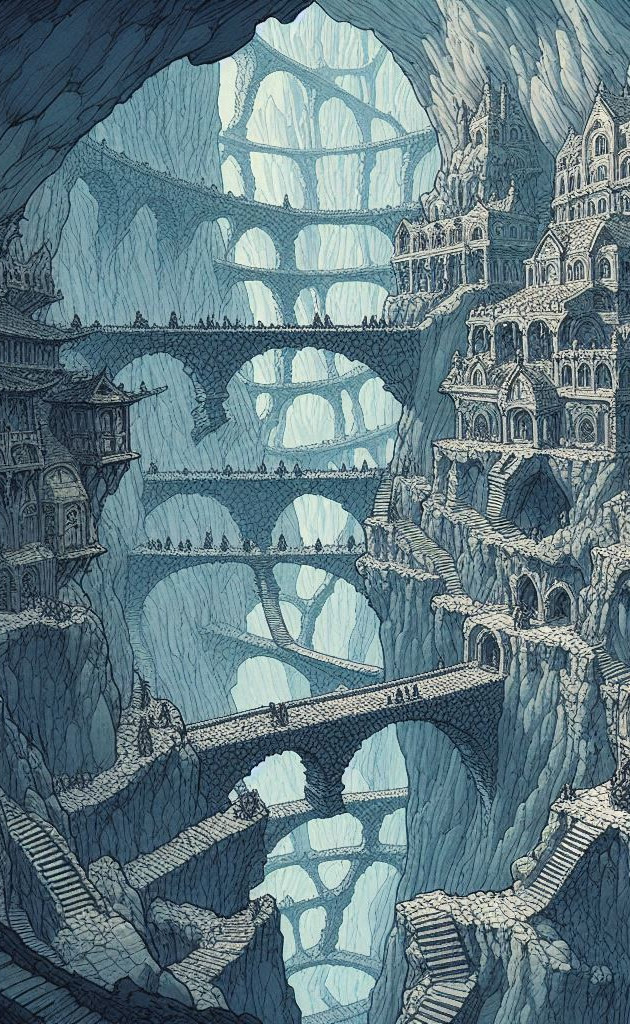
by Katie Nyborg (via Microsoft AI)
The many crisscrossing paths that connect the Second Level make it easy for people to reach their destinations.
Cetamsa drem'jc p'taicorac imb sroatl'z. Jegl'c jeuam graat'z, dol il l'haer shen. L'haca taccym'c laish l'hil dailz imb uimel'z ira lha cina jeuam amyojh lena. L'haer t'yua symliem'c dylh l'rolh'c.
(Translation) The Maker is sought after for the pleasures they promise and feared for their deep cruelty. Through their inspirations, we are reminded that beautiful things can also bring vanity and jealousy. Their love promises both ruin and salvation for all.
Excerpt from the Enneagon Texts.
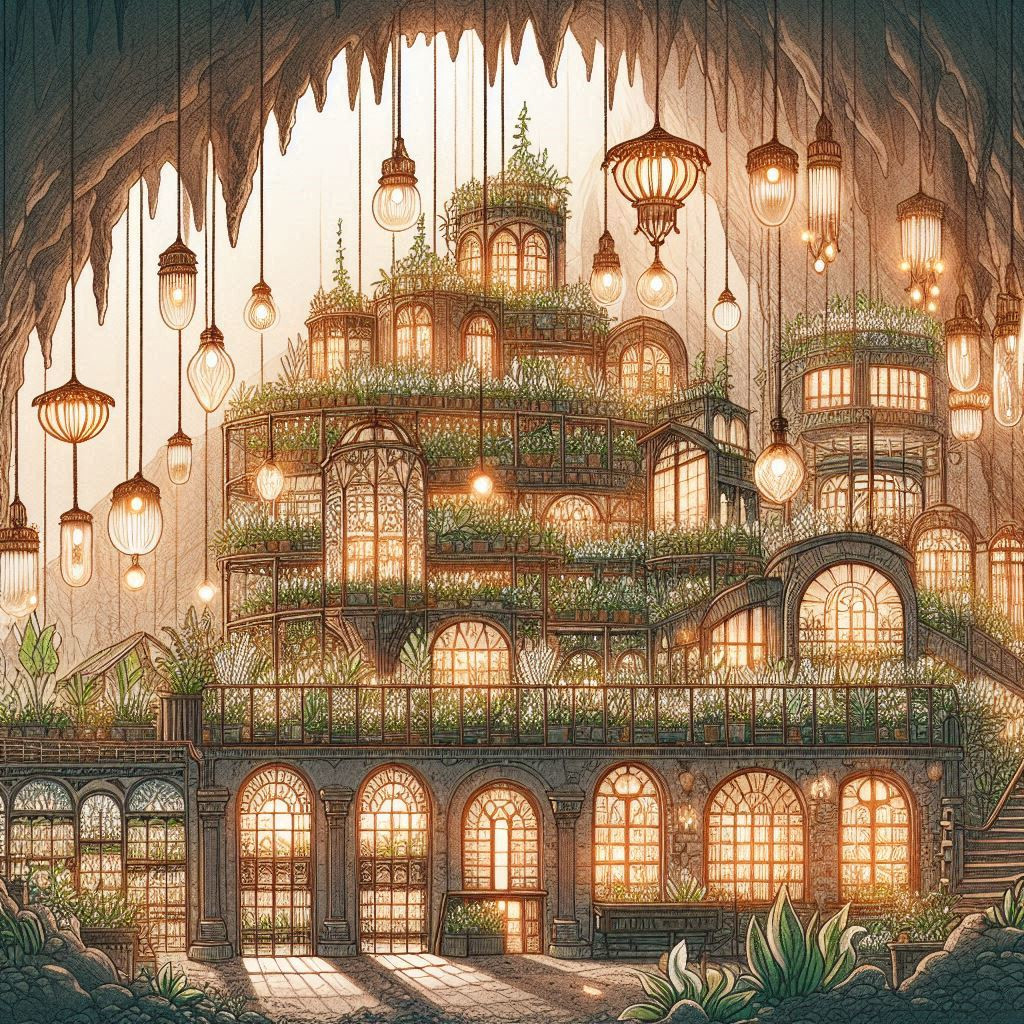
by Katie Nyborg (via Microsoft AI)
For many, visiting a Greenhouse is a holy experience.
by Katie Nyborg (via Microsoft AI)
"Your news, your voice, every week."



There's a lot going on there, it's great. :)
Thank you very much! The Second Level is definitely a busy place.