

First Level
The First Level of Skeleton City, known colloqually as the Lines, is a highly developed and luxurious district to visit. The tunnels are laid out in large loops with platforms hosting a wide variety of high-end establishments, from art galleries and theaters to casinos and exclusive restaurants. The level is known for its vibrant colors, lavish architecture, and sophisticated atmosphere, catering to the wealthy elite of the city. However, the level is also rife with social drama, political machinations, and criminal activity, as the privileged residents compete to maintain their status and power. Despite the First Level's glamour, it is isolated from the struggles of the lower levels, leading many to view its denizens as out-of-touch with the true culture of the city.
How did this character acquire their wealth?
What is one thing this character wants but does not have?
What secret are they hoping never gets discovered?
Entrances and Geography
The first level can be accessed from Up-Top by descending a series of ancient stone steps just past the public Arch entrance. Other entrances into Skeleton City from the surface world do exist, but they are either intentionally sealed, accidentally blocked from outside, or otherwise inaccessible. The First Level can be accessed from the Second Level by a number of stairwells and upward-sloping tunnels. One of the easier levels of Skeleton City to navigate, the traversable tunnels are laid out in a dozen large, miles-long loops that occasionally intersect. Most of this tunnel system is uniform in size and shape, with smooth, curved ceilings and consistently flat ground. Periodically, these tunnels open into much larger chambers on one or both sides of the path, but these platform-like areas are isolated from one another, and most foot traffic has to flow down the established "Lines" of tunnels. There are very few shortcuts or side passages on this level. If someone wants to cross to a different Line, the easiest option is likely to go down to the Second Level, then come back up underneath their desired destination. There are rumored to be a few well-hidden hatches and old maintenance hallways that lead to secret sections of the Lines, but as of now those rumors seem to be largely insubstantial.Architecture and Infrastructure
While the tunnels themselves have been around since before the Third End, the many things built there since then make this level the jewel-encrusted crown of the city, especially considering the City Council's efforts to make it look nice for tourists. All of the platforms (and some stretches of the tunnels themselves) have been packed with fine establishments, luxuries, and entertainment nestled into expertly and artistically crafted venues. While many buildings here are made of brick or polished stone, they feature lavish details like wooden floors, glass windows, and gold-plated finishes. Walking down almost any of the Lines is like wandering through a glittering wonderland of advertisements and lit-up storefronts promising beauty, excitement, and expensive delights. The infrastructure of the First Level is easily the best in all of Skeleton City. During the day, the Lines are lit with strings of lightbulbs running along the tunnel ceilings, and weak sunlight filters in through the massive overhead fans atop cylindrical shafts in the ceiling. At night, the streets are aglow with dozens of bioluminescent streetlamps, neon signs, and gently strobing angler bulbs, washing each platform in a rainbow of tantalizing colors. Beautification projects have resulted in numerous small gardens and flower boxes scattered throughout the level for the public to enjoy.
FLOWERS & STATUS
Traditional flowering plants are extremely hard to grow in the Underground due to the lack of sunlight, soil, and fresh air. For centuries, the resources to sustain these plants were strictly reserved for agricultural and pharmaceutical priorities. Now, flowers have become a loaded status symbol - a sign of being well-off enough to live somewhere that can support them, or wealthy enough to afford wasting resources on something as trivial as a pretty plant.
The walls in many tunnels are covered in murals commissioned by local artists. Larger platforms have been tiled, painted, and decorated to give them a unique aesthetic identity, with some groups even attempting to refurbish historic art and sculptures from before the Third End. However they're decorated, most areas generally try to exude a sense of luxury and sophistication. Some venues are as small as a four-foot-wide booth, while a few venues are so large they essentially take up entire intersections, making it so that visitors must pass through the establishment to reach destinations on the other side.
The neighborhoods here are always bustling, with many businesses open around the clock. Foot traffic through the Lines varies - some tunnels get congested during "peak" hours but are nearly empty otherwise, while others see a steady stream at all hours, especially if those tunnels connect to other Lines.
Despite this level being ideal for human habitation, very little long-term housing is actually available, and what does exist is extremely expensive. Outward expansion of the tunnel systems has proven slow and costly, due to concerns about structural integrity under the forest and a lack of easily fortifiable stone for tunneling.
Traditional flowering plants are extremely hard to grow in the Underground due to the lack of sunlight, soil, and fresh air. For centuries, the resources to sustain these plants were strictly reserved for agricultural and pharmaceutical priorities. Now, flowers have become a loaded status symbol - a sign of being well-off enough to live somewhere that can support them, or wealthy enough to afford wasting resources on something as trivial as a pretty plant.
Neighborhoods and Points of Interest
Identifiable neighborhoods have formed naturally in isolated "sections" of the Lines over time, with many becoming even more defined as the City Council has worked to bolster each neighborhood's marketable identity. Some neighborhoods have been nicknamed after the color of their Line, harkening back to when the tunnels had identifying colors at their entrances and exits. Those colors have long since worn off the physical structures, but they remain visible on modern maps. While one can find almost any manner of high-end establishment along the Lines, each neighborhood tends to have a higher concentration of a certain type. Some of the more well-defined neighborhoods are described below.The Galleria
This First Level neighborhood is known for its buzzing art scene. Along this Line, you'll find black box theaters, music clubs, art galleries, fashion shows, poetry slams, sculptural installations, and bizarre performance art pieces attracting a curious audience. The tunnel view is colorful, a constantly evolving art show of its own - bunting, murals, and painted posters greet the eyes, while sounds of musical instruments (played with varying degrees of skill) float through open windows and alleys built onto the platforms.
WHAT'S IN A NAME?
"Galleria" is an old word from before the Third End that doesn't mean what most Galleria residents think it means. However, knowledge of its original definition has been lost to time, so no one is about to correct them.
The Galleria is one of the few neighborhoods with rentable living arrangements, often communal art lofts or studio spaces reserved for artists. Applying usually requires providing samples of your craft, and the competition to get accepted can be intense. Originally, the application process was meant to give all artists a chance based on the quality of their work, but the integrity of this system has waned over time. It's no secret these establishments have waived the application for bribes or as part of favors owed to powerful families in the past, and that's not taking into account the very subjective and influencable nature of the judging process.
Competition between Galleria vendors varies, but is especially tense where artists with similar styles have landed near each other, competing directly for customers. Rival galleries fight for attention, theater troupes try to sabotage each other, and there's often drama over someone stealing another's ideas.
While the Galleria's art is often beautiful or thought-provoking, it is just as often criticized by those on the lower levels for being pretentious, self-absorbed, and having little value beyond its price. Most who live and work in the Galleria are of a younger generation, and many believe lack the grit and experience of those raised in harder times. Quite a few artists here are supported by family funds or separate business ventures, and don't need their art to make them money.
"Galleria" is an old word from before the Third End that doesn't mean what most Galleria residents think it means. However, knowledge of its original definition has been lost to time, so no one is about to correct them.
"Tonic never really considered himself an 'artist' - a skilled clothier, possibly, a maker of quality wares... But not one of those creative types, those who sit around and pontificate about abstract shapes and hidden meanings for the sake of meager validation from their peers."As it is everywhere, there are exceptions - a few well-known, older artists have settled here, enjoying semi-retirement. Some younger artists are working hard to make a name for themselves here, creating thoughtful, socially-minded works out of genuine passion, and their work is often the most beloved by visitors from other levels of the City. Points of Interest: ER-SE | Gossamer Alley
The Gold Line
A section of this Line has been paved with a beautiful blue mosaic, with accents of white and gold scattered among the tiles. Ironically, this neighborhood was named after the gold used in the street art, not the sheer amount of money its residents possess. When the rich move into the Lines, this is where they go. Many platform along this line, including a few large, multi-story stations, have been developed into gorgeous condominiums. Other large, multi-room homes have been built on smaller platforms, and some even have private (albeit small) gardens hidden behind exquisitely-crafted iron gates. These clean, spacious, glimmering homes belong to Skeleton City's elite - the few who can afford the luxury of a large floorplan. The social circle of these elites is very tight-knit, but also rife with drama. One constant issue is that due to the spatial limitations, no one new can move in unless the old families move out or are deemed unfit to be homeowners (such as in the event of their "untimely demise"). Many plot and scheme to get into this neighborhood by getting someone else kicked out, and even those who already live there will occasionally try to oust a competitor to move into their larger, more spacious home. The area is extremely appealing to businesses, however. A few specialty boutiques and stands have strongarmed their way into this Line, setting up small shops in the tunnels between estates. These establishments provide very exclusive services most in Skeleton City could never afford, but offer a luxury to Gold Line residents by allowing them to never have to leave their neighborhood. Getting a spot in the Gold Line requires the approval of the Housing Board, however, which essentially requires approval of each and every resident of the Gold Line who have put their names on the Housing Board membership list. The Gold Line is a polarizing place. Some aspire to live there in luxury, without a care, while others see it as a morally reprehensible waste of space and resources. Some go so far as to say the Gold Line is proof that the Council caters more to the wealthy than the common good.Tourist Row
While not neccessarily a true "neighborhood" Tourist Row is a strange break from the glamor and glitz of the Lines. This area has grown up around the Up-Top entrance tunnel in only the last year or two, with colorful stalls and booths catering to the needs of visitors arriving or departing the Underground. Some of these booths sell genuinely helpful items for those heading Up-Top, like paper umbrellas to block the sun, or scarves to reduce some of the symptoms of Sky Sickness. There are also products to assist Underground visitors, such as earplugs for acclimating to cave echoes, or Beacons for first-time travellers. However, the majority of goods sold here are gimmicky trinkets, novelty clothing, or ineffective remedies for real and imagined maladies. Several stalls make their money by agreeing to advertise for other venues, regardless of what they sell. There's often a rumor that one stall is a front for pickpocketing or smuggling illegal goods, but the target of that rumor tends to change weekly. Unlike the rest of the Lines, this area was not planned by the City Council. The Council tries to impose regulations to force the shops into their standards for quality, but booth owners work around this by swapping which one they operate out of every couple of days, making it nearly impossible for the Council to know which booth to pin with fines. Shops that do get forced out are quickly replaced by similar ones a few days later. Points of Interest: Culvert's SupplyThe Strip
Named for its long, straight-running layout, the Strip is where the rich and famous go to cut loose. This neighborhood is primarily a long line of brightly-lit establishments tucked alongside the main walkway. Even at night, this place is bright enough you don't need a Beacon to see - many establishments try to outdo each other with the brightest, most ostentatious spectacles to attract customers. Walking down this road is like stepping into a dizzying wonderland, with gently flashing bulbs and neon-painted signs advertising bars, restaurants, and live music by Skeleton City's hottest acts. These establishments are often guarded by bouncers or door watchers to ensure no obvious "troublemakers" enter - though what constitutes trouble varies widely from place to place. Aside from the venues, the Strip has some wilder visual spectacles, like a 30-foot public fountain, a building-sized underground aquarium, and a tunnel wall coated in glowing pink and purple crystals. More than any other neighborhood, the Strip is busy around the clock. Many casinos have found their homes here - The Grand Manor, for instance, has taken over an entire intersectional station, letting passersby stop for a few rounds of cards on their way to other Lines. There are also lots of dance clubs to choose from, where musicians play jazzy string, brass, and percussion numbers to delighted audiences. Dancing is one of Skeleton City's most popular pastimes, and this is no different for the First Level.
NOTICE FROM THE PRIESTHOOD
Remember that electronic music amplification devices like microphones and speakers are strictly prohibited by city-wide policy. If you see someone breaking the rules, please report them to the Priesthood for further investigation.
There are many famous restaurants on the Strip, and each brings their own unique aesthetic and culinary flair. Many restaurants on the First Level are in heavy competition to acquire scarce, highly-valued Aboveground ingredients to add unique flavors to their dishes and help them stand out.
Points of Interest: Grand Manor | Sport Court | The Eel and Eatery
Remember that electronic music amplification devices like microphones and speakers are strictly prohibited by city-wide policy. If you see someone breaking the rules, please report them to the Priesthood for further investigation.
The Green Line
The First Level's climate is one of the better in Skeleton City for those in need of rest and healing. Considerable thought has gone into constructing amenities in the Green Line neighborhood to cater to vulnerable populations - assuming they can afford the price of This neighborhood is not as large as others, with a nearly-isolated loop intentionally chosen to limit entry and exit points. This, in theory, helps prevent patients with Illnesses from spreading them to others strolling the Lines. Once you make it into the neighborhood, the Green Line is filled with spas, relaxation centers, and medical treatment facilities for various ailments and injuries. These places are designed with space, airflow, and cleanliness in mind, staffed by some of Skeleton City's most prestigious and respected medical professionals.
SCIENCE & MEDICINE
After the Third End, academia entered something of a dark age, forcing the population to relearn a lot about science and good health practices. As a result, healthcare here is a little archaic, and the quality varies widely depending on where and who you go to.
While the accommodations are lovely, space is limited, and these establishments are usually at capacity. The spaces simply can't handle the demand, leading to problems like overcrowding, overworked staff, and absurdly long waitlists. Some businesses have turned to accepting bribes to let people skip waitlists, and it is suspected that some establishments even reserve rooms as favors to powerful figures instead of leaving them available to patients who need them.
This isolated Line also hosts several development labs. Their work ranges from public city improvement projects (like better Electricity routing) to top-secret experiments conducted in hidden spaces and unmarked buildings.
The Green Line sees more Priesthood oversight than other neighborhoods. While the Priesthood has interest in maintaining anti-tech policies in public development labs, their focus is mainly on volunteering and community service efforts in the area. They hope to leverage the facilities here to expand their own branch of healthcare at no cost to visitors, but the complex logistics of this plan are a long way from being ironed out.
Points of Interest: Ivanata Garden
After the Third End, academia entered something of a dark age, forcing the population to relearn a lot about science and good health practices. As a result, healthcare here is a little archaic, and the quality varies widely depending on where and who you go to.
Guilds and Factions
The largest faction presence on the First Level is the City Council. While their control over the Second Level is tenuous, they maintain a strong hold over the First Level, regulating its zoning, aesthetics, and operations. Their power is significant enough that it is difficult to accomplish anything outside of their vision without their approval. However, rumors suggest that the Rings have found a foothold on this level, possibly somewhere along Tourist Row. If true, their presence is small but likely serves as an important drop-off point for contraband moving in and out of the city. The Priesthood also has a presence here. However, the generally well-off nature of the residents means their usual methods of establishing positive community connections through charity and outreach are not viable, making it difficult for them to gain political influence. While the City Council and the Priesthood appear to have a complementary relationship on the Second Level, some speculate that the City Council is intentionally dragging its feet to keep control of the First Level out of the Priesthood's hands. Several formal business networks exist to help First Level business owners share resources, coordinate events, and strengthen industry contacts. These have an open joining policy and do not require a contractual commitment. Additionally, there is the Housing Board, comprised of individuals who own homes or pay rent above a certain threshold in the Gold Line. Although the Board has published several eloquent statements of purpose, these documents are mostly fluff designed to obscure the fact that the group was formed as an excuse to gatekeep their neighborhood against those below a certain status.Demographics and Society
Most First Level residents are wealthy compared to the city average, having amassed substantial fortunes through successful business ventures, trade networking, or inheriting family wealth. However, Skeleton City's most wealthy individuals live Up-Top, meaning any particularly ambitious residents of the First Level are either being barred from moving up to the very top, or are engaged in activities that wouldn't withstand higher Council scrutiny. That said, any amount of money confers power in Skeleton City. Those who can afford to live or do business on this level are among the movers and shakers of society and culture. The exact manner of their influence varies widely - some are business owners with multiple establishments across the city, while others are fashion icons with venues desperate to be graced by their extremely lucrative presence.
SPEAKING OF FASHION
Fashion on the First Level is on the cutting-edge - from iconic Beacon styles to rhinestone-covered braziers, those who regularly appear in public do so in a memorable, avant-garde way. Trends that circulate below often originate within the "upper crust" of the Lines and their styles.
Living, working, or simply being seen regularly on the First Level confers significant social status, as the lifestyle is highly desirable. Belonging to this "elite" group means many will pay handsomely just to experience what one has to offer, which helps maintain one's vast fortunes. However, the limited space means these spots are in high demand, leading to fierce competition and even sabotage to claim or keep positions of power.
The denizens of the Lines come with many different personalities, preferences, and opinions. Some have risen through hard work, while others had the lifestyle handed to them. Some gained their place in society legitimately, while others climbed here through scamming, extortion, and exploitation. Generally speaking, denizens of the First Level are viewed by those of the lower levels as disconnected from reality - ignorant of common struggles at best, spoiled and bratty at worst.
Gossip is a major pastime, as social currency is just as valuable as money. The First Level's proximity to the surface gives it insight into government and political rumblings, and the Capitol's visitors often pass through as tourists. This makes it a prime location to gather information about the world Aboveground without raising the suspicions of those living there.
Fashion on the First Level is on the cutting-edge - from iconic Beacon styles to rhinestone-covered braziers, those who regularly appear in public do so in a memorable, avant-garde way. Trends that circulate below often originate within the "upper crust" of the Lines and their styles.
Economy and Industry
By far, the biggest money-maker on the first level is tourism. Most who frequent this level don't live there; it's considered more of a vacation destination, with those from lower levels saving up for relaxing trips or overspending on day visits to restaurants and galleries. In fact, most who work the Lines commute in from the Second or Third Levels. The second-biggest industry is art, driven largely by the works produced in the Galleria neighborhood. Goods like this can range from simple-hand printed cards to a lavish dress being auctioned off after a famous lounge singer wore it to a party. This level generates little in material goods or resources compared to others, instead focusing on offering luxuries or reselling items acquired elsewhere. One thing they have over other levels, however, is that all goods transported from the surface to the rest of the Underground must pass through the Lines, allowing many First Level merchants first pick of rare foods, lumber, and other goods.
WHAT WAS THAT ABOUT A RHINESTONE BRAZIER?
The First Level is the primary driver of Skeleton City's gemstone industry. There's incredible demand for precious gems along these glamorous Lines, though the actual miners on lower levels rarely see the results of their labor, and many don't understand the obsession with these rocks they dig up.
Due to space restrictions and the sheer size of transactions, there is far less trade of goods on the First Level compared to lower levels. Representational tokens are the norm as currency, with trade of services and contractual favors as the second-most common. The few businesses that do accept major material trades typically keep offsite warehouses on the Second or Third Levels.
The First Level is the primary driver of Skeleton City's gemstone industry. There's incredible demand for precious gems along these glamorous Lines, though the actual miners on lower levels rarely see the results of their labor, and many don't understand the obsession with these rocks they dig up.
History
When the Third End consumed the world, the old city's former surface dwellers fled into the underground infrastructures below, including an extensive subway system that ran for miles. For a time, the tunnels were packed with survivors living in a chaotic, cramped system not originally meant for human habitation. However, those subway tunnels also became the foundation for the city's nascent trade economy, and were the start of many communities that persist today in name or spirit. As people expanded downward into the caves, the subway rails were ripped up for scrap metal, and the train cars completely dismantled for parts. Anything aside from the concrete walls was taken for use elsewhere, and the track paths were naturally packed down into traversable roads over time. With a bit more breathing room, people began decorating the walls and their encampments as a form of self-expression and community care. As the city expanded into The Third Level, these old subway tunnels became known as the "Old Town", renowned for its deeply-rooted, thriving art scene. Its proximity to the surface gave it a certain allure and holiness that many people found heartening. However, the Old Town's location near the top made it an important area for the City Council to maintain control over. Now given room, the Council reserved sections of the First Level for scientific endeavors, surface exploration, and eventually a staging area for humanity's return to the surface. In the exciting transition, those with the resources to potentially secure positions Up-Top muscled their way onto this level buddy-up with the Council, pushing many long-established businesses and communities further down. When the Capitol first reached out to establish trade, the Lines were "cleaned up" to impress visitors. This "beautification" project had multiple motivations - drumming up business, impressing stakeholders, and improving living conditions and infrastructure. The project was also said to commemorate the first beating heart of Skeleton City, the symbolic gate between the Aboveground and the Underground. At its most romantic, it was seen as an homage to hope, a symbol of humanity thriving even in dire circumstances. In modern times, the First Level is a subject of much discussion and mixed opinion. With the Council now Up-Top, the level is largely occupied by the economic elite - who are either trying to reach the top themselves, or using their position to exert power on surrounding levels. While the art scene remains active, many who remember or were told of the old neighborhood believe the work now is now hollow, self-indulgent, and lacking the context of passion that once uplifted entire communities.Climate and Natural Resources
The Lines are known for having the cleanest air in all of Skeleton City, second only to the Up-Top itself. Large ventilation shafts in the ceilings lead to massive overhead fans that run all hours of the day. While this makes some sections noisy and windy, and especially cold in winter, it's a small price to pay for preventing suffocation in most other parts of the city. The climate is one of the best for growing plants in the whole Underground. This is why beautification efforts often include gardens and flower boxes. The climate also makes it an ideal destination for those recovering from illnesses or injuries, or who are vulnerable to sickness in general. Otherwise, these tunnels have almost no natural resources of their own.Security and Safety
The Lines are some of the most well-guarded spaces in Skeleton City, for better or worse. While the Police-Guard has a strong presence on the Second and Third levels, security on the First Level is largely privatized. Each business provides its own security to keep the peace both inside their establishment and on their platform. This means private guards are everywhere, but the quality of their work varies widely from area to area. Some neighboring businesses have adopted a strong "I watch your back, you watch mine" policy. They either have all guards watch the same platform area together or pool resources to hire multiple guards from the same company, managed by one person. Other businesses instruct their guards to only protect their own premises, sometimes even turning a blind eye to trouble outside their jurisdiction. Because security is centered around businesses, stretches of the Lines with no platforms are less guarded. The Police-Guard will come up to this level if called, and will post a Guard in trouble spots if necessary or during an investigation. There is usually a Guard stationed near every known entrance and exit, keeping an eye out for obvious troublemakers. Those who look too suspicious are turned away "for safety," though this practice has sparked much debate about the fairness of these calls, as this can be a barrier for those not able to attain a certain level of appearance or identification before entering. The exit to Up-Top is guarded similarly.
SAFETY AND WELLBEING ADVISORY
Visitors from lower levels are advised to be wary of Sky Sickness and its potential side effects. Those displaying symptoms may be escorted off the First Level for safety. Due to a recent rise in Sunskipping, individuals with excessive skin and eye coverings will be turned away at all entry points until further notice.
Despite the security presence on this level, it is a ideal target for pickpockets. People on this level generally carry more money and valuables than those on lower levels. Businesses here are also the prime targets for burglars looking for a big score, and more than one famous heist has taken place in the casinos and palatial halls of this level. Given their high visibility, the movers and shakers of the Lines are also frequently targeted for kidnappings, blackmail, and stalking.
Trouble also comes from inside the level itself; many business owners have ties to darker society, engaging in smuggling, extortion, or gaining wealth through organized crime on the Fifth Level.
Lastly, Monster attacks on this level are incredibly rare. The last recorded incident occurred nearly four years ago, when a particularly slithery one phased through a majority of the Underground before wreaking havoc on this and the Second Level.
Visitors from lower levels are advised to be wary of Sky Sickness and its potential side effects. Those displaying symptoms may be escorted off the First Level for safety. Due to a recent rise in Sunskipping, individuals with excessive skin and eye coverings will be turned away at all entry points until further notice.
In a Campaign
As a Setting
The First Level is great setting to explore corporate, capitalist, and economic themes in, especially if you’re interested in thwarting the evils of greed at the top of the economic food chain. Alternatively, you could dive into the drama with a game of social intrigue, political machinations, or a "Real Housewives of Skeleton City" subplot focused on people with nothing better to do than ruin each other’s lives. The many wealthy businesses, art galleries, and expensive homes make this area a prime target for heists, and it's one of the two levels of Skeleton City where an art or performance-themed group would really shine. Some potential plot hooks to begin an adventure on the First Level include:- A famous artist's latest work is vandalized before a big gallery opening. The party is hired to find the culprit and prevent further attacks.
- A wealthy resident is being blackmailed with a dark secret. The party must uncover the blackmailer and protect their client’s reputation.
- Actors at a blackbox theater in the Galleria report seeing a ghost. The party investigates to uncover the truth behind the hauntings.
- A prominent figure in the Green Line disappears without a trace. The party is hired to find them, uncovering his secret resarch project along the way.
- A scientist from a Green Line lab suspects a colleague of espionage. The party must uncover the spy and prevent sensitive information from being sold to the highest bidder.
- At a high-profile fashion show, a model’s outfit is stolen mid-event. The party needs to recover the stolen garment before the scandal breaks.
- The party is invited to an exclusive event in the Gold Line, only to uncover a plot against the elite attendees.
- A high-stakes game at the Grand Manor is rigged. The party is hired to expose the cheaters and restore the casino’s reputation.
- A young entrepenuer from the Gold Line goes missing. Their family believes they've been kidnapped, but the party is hired to uncover the truth.
For Characters
For players who want to play a character from the First Level, or for making NPCs from this level, here are a few ideas to jumpstart the process. Aesthetics: Glamorous, edgy, sophisticated, luxurious, bold, exquisite, intricate, experimental, vibrant, theatrical. Traits: Charismatic, elusive, influential, spoiled, cultured, wealthy, dramatic, ambitious, deceptive, eloquent, cunning, self-centered, resourceful, artistic, strategic. Questions to Answer:Article Navigation
At a Glance
Alternative Name(s)
The Lines, Old Town, First
Type
District
Inhabitant Demonym
Undergrounders
Included Locations
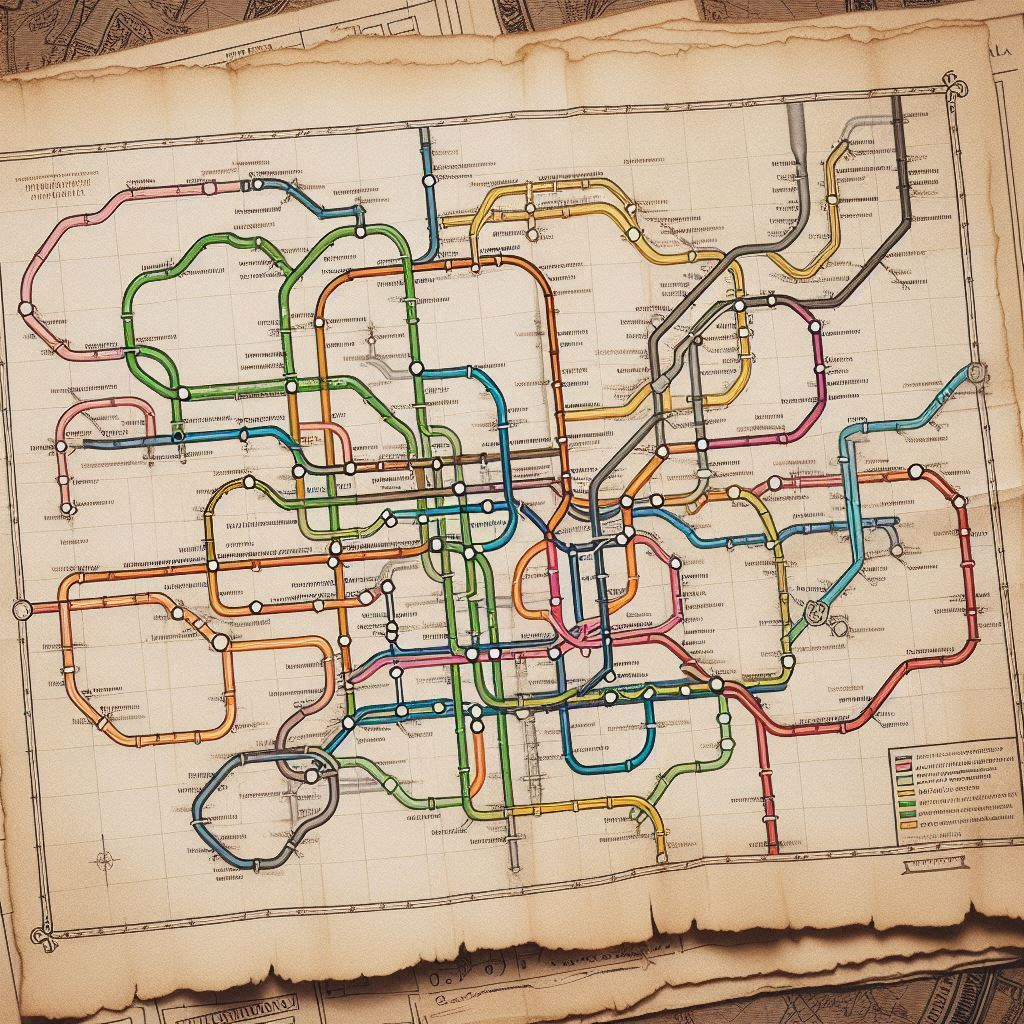
by Katie Nyborg (via Microsoft AI)
One artist's attempt to recreate a historical map of the Lines in a style popular before the Third End.
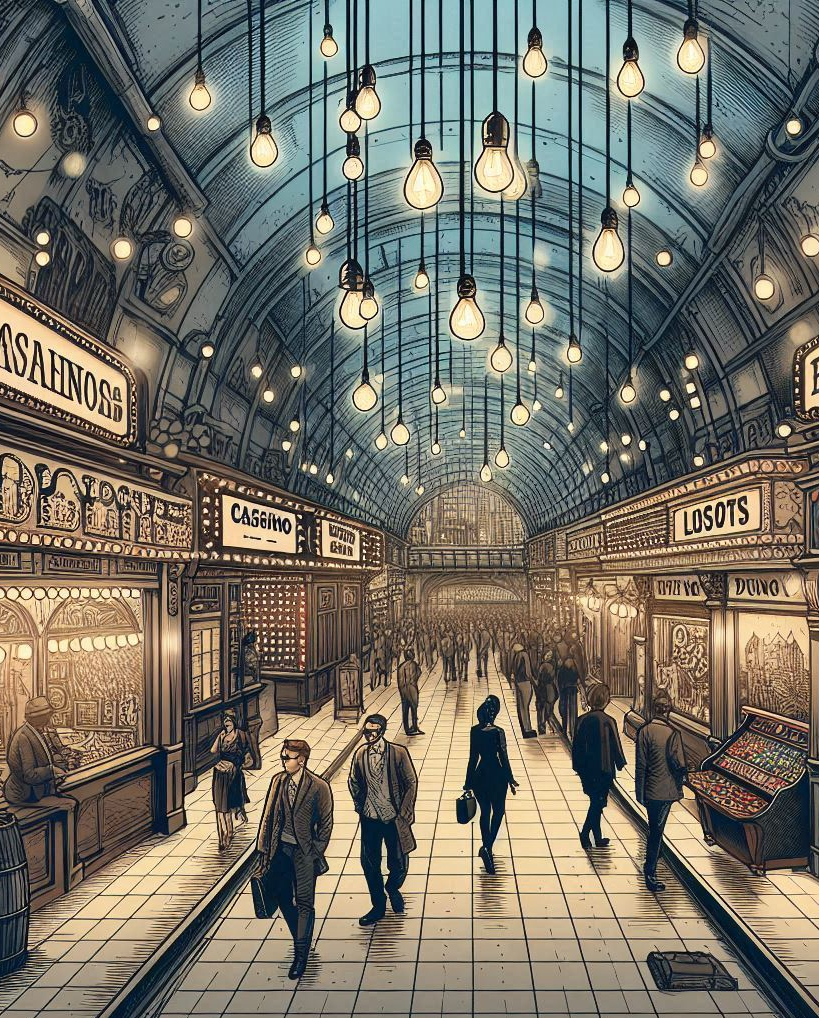
by Katie Nyborg (via Microsoft AI)
A busy platform on the First Level.
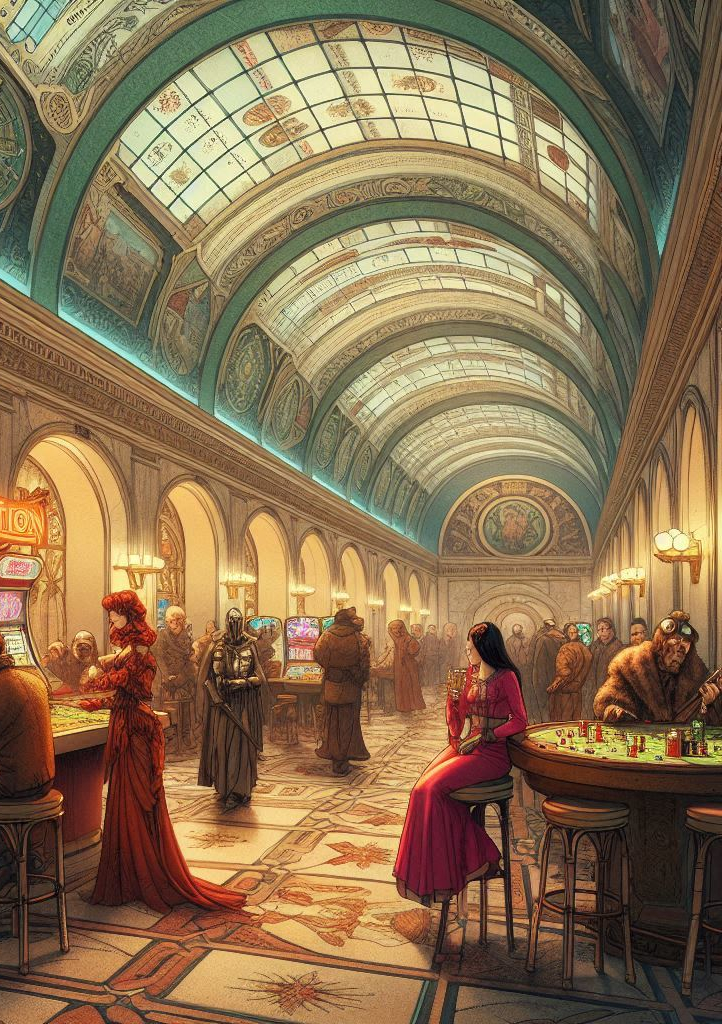
by Katie Nyborg (via Microsoft AI)
A section of a Line that houses a ritzy casino. Anyone is welcome to play a few games on their way to another Line.
S'yot dyb'z ec petab hejh selh syrt'b l'hemj'c, l'haz catt aish daem'j shil l'haz ma'ab giert'z. Claapar presa naim'c reshar daem'j.
(Translation) The Merchant's body is laden with a vast array of worldly possessions. They offer to sell to each person the items they require, at what is deemed a fair price. The higher the price, the richer one will be for having paid it.
Excerpt from the Enneagon Texts.
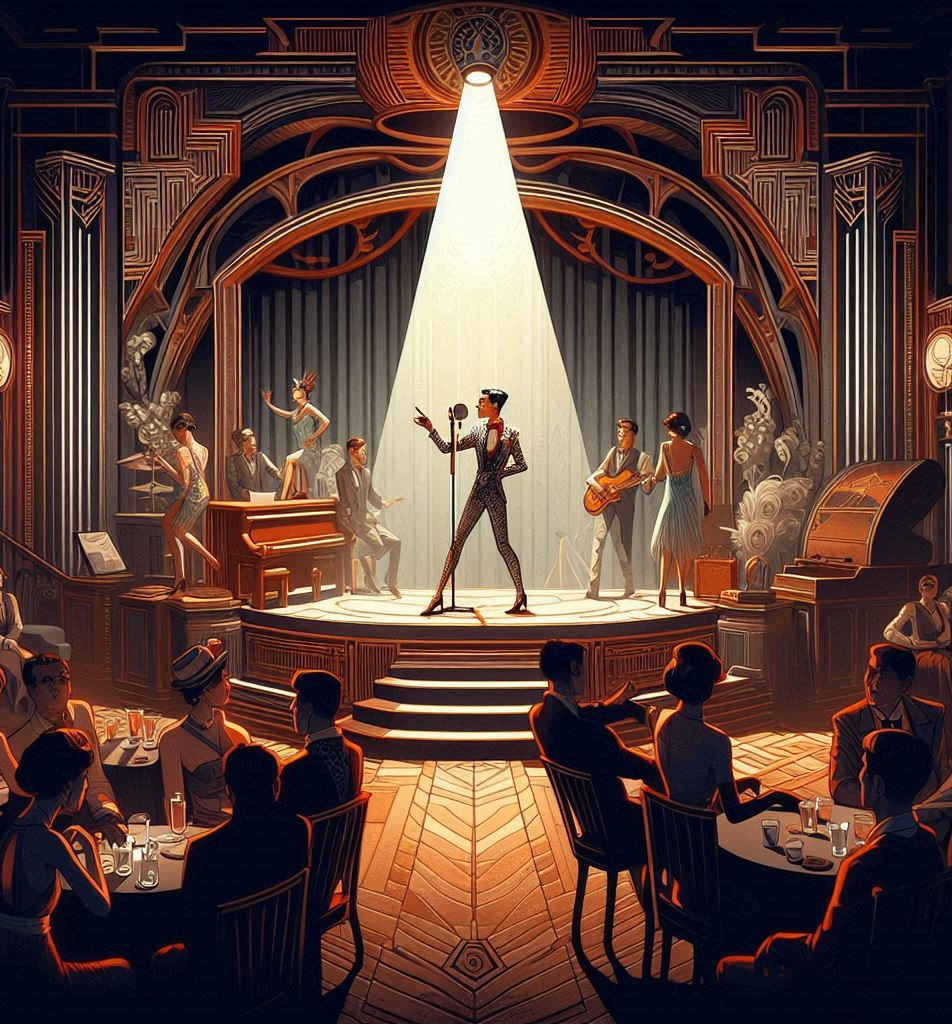
by Katie Nyborg (via Microsoft AI)
A club where even the rich and famous can unwind.
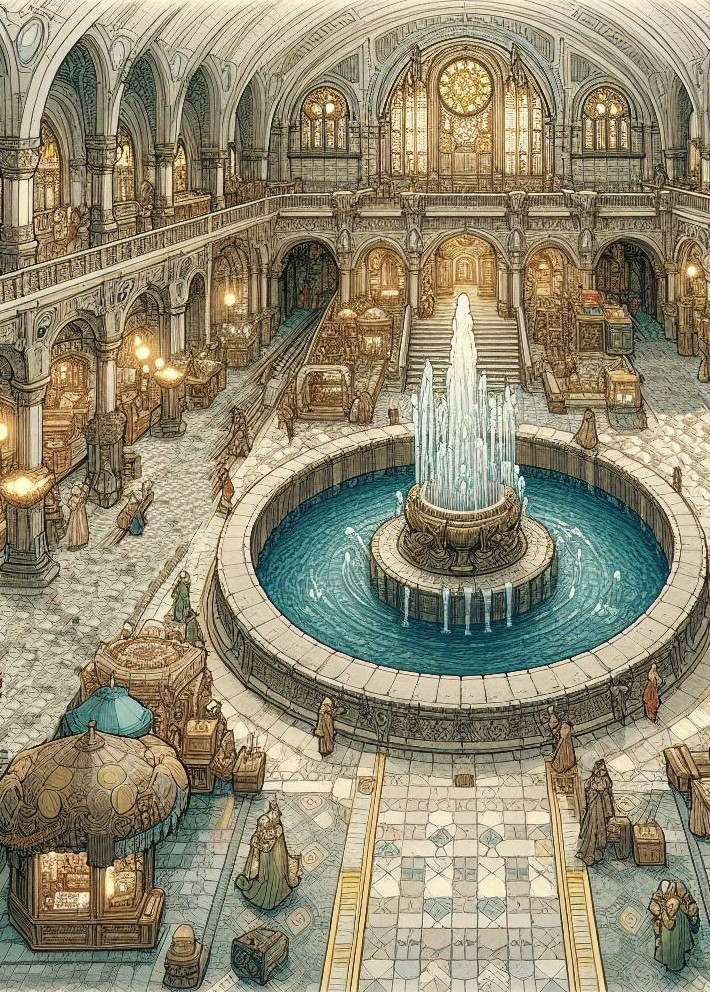
by Katie Nyborg (via Microsoft AI)
The famous public fountain found in the Strip.

I've been listening to these 1930s music tracks played over rain and thunder lately. Great for rest and sleep btw. I could imagine an aesthetic like that as I'd explore the Lines lol! Cool Article- ty for sharing!
Thank you very much for the kind words! One of my big inspiration is a videogame set in the early 1930s, so I love that the same era of music came to mind for you. :)