
Corbel
In the city of Corbel, handshakes are always performed by clasping one another’s forearms, which makes for a heartier gesture, as well as a simple way to check newcomers for tricks up their sleeves...
Corbel, cosmopolitan island of the eastern Azule, has survived long eons armed with two of the greatest weapons known to Erebosian kingdoms—coin and leverage. Once, it was a destination for summering royals, a place to be wed surrounded by the bold artwork of emerging masters thriving within the spiritual capital of mercantilism, but now, its citizens are captives within their own walls.
Barred by a fleet of ironwood ships led by Florent’s greatest admiral, Astyages Gul, Corbel’s first weapon, that of the coin, has been stripped from its side. The city’s elite, already at odds with the Domini’s newfound generosity toward the theocratic domain of Vichy, fears that its church’s influence will tarnish Corbellian culture, but mostly, they fear what supporting it will do to their dwindling treasuries.
Much of Corbel’s revenue has been donated in the form of tithes to Vichy’s church. This act of submission to the Sigilist religion helps finance its campaigns for spiritual dominance across Erebos and is an expensive political gamble—a calculated misdirection designed to turn the prying eyes of religious zealots away from the five families who have long controlled the island nation. Desperate to maintain their meager holdings upon the mainland, Corbel, and the Splendid Kingdoms at large, have little choice but to show favor to their powerful neighbor.
While the city pirouettes at the edge of oblivion, its corrupt rulers, the Five Domini and their kin, take precautions to endure whatever is to come. That these bloodlines run back to the ruinous past of ancient Corbellus should be no surprise. While the city’s peasantry waits in squalor, asking themselves why Corbel hasn’t been put to the torch, the powers that be parlay with their captors and bide their time, hopeful that the tide will turn in their favor.
The city’s rulers know they can wait out Florent’s invasion. Should the order be given for the Shahanshah’s infantry to violently overthrow the city, the island would be retaken within a year. Ships wear, soldiers hunger; a sustainable attack on Corbel means an invasion of the mainland, where Vichy is dominant, and even Florent does not dare such foolery. If every brick were razed, the population killed to the last yapping dog tethered in a courtyard, the nation would rise again. So long as the five families survive, so does Corbel.
While the Domini admire their own cleverness, cracks in Corbel’s veneer grow wider, as whispers of conspiracy spread from the high courts into the trapped population. Old bits of folklore rekindle like the stoked embers of a dying fire—the city’s people talk of the evil that legend says has been with them through the ages. They begin to wonder if the stories are true.
The mercantile capital of southern Erebos sits quietly besieged by Florent’s naval blockade, the Corbellian fleet rerouted to far-off ports or sunk to the bottom of the Azule. Nothing comes, and nothing goes. What remains of Corbel’s meager forces are trapped across the Gulf of Echoes, stretched tightly over cliff and coast, pinned between the sea and whatever calamity might spill from the Carcass Nations—powerless to intervene on behalf of their homeland.
Florent’s assault was swift. Those who dared oppose it were obliterated by the most powerful navy in the region. Those who surrendered were spared, as is often customary between nations that share such a long and storied history. For years, the servants of the Petalled Throne worked closely with the power brokers of Corbel, ensuring that both lands prospered. There was a time when the influential families of each nation joined houses through marriage. Corbel was the gateway to eastern Erebos, and Florent offered safe passage into Crisius. When these lands were in harmony, trade flowed in all directions of the compass rose.
Government
"Counted, culled, collared, and chained around the world and back again,” goes a verse in a Corbellian nursery rhyme, and with good reason. Corbel’s extravagant wealth led the small nation to unimaginable influence over continental Erebos. Although Corbel is not the capital of the Splendid Kingdoms, in times past, it felt as if it were. The monarchy rules from Bearald-upon-Muse in the west. Queen Corinthia Balladoro I, while safe from Florent’s invasion, nervously contemplates how the power might shift should the occupation carry on much longer.
Corbel itself is ruled over by five mercantile families, each an ancient bloodline running back into antiquity. They and their artisans are crown makers, both literally and figuratively. The goldsmiths of the Glittering Bazaar have long made the crowns for leaders far and wide. And while little actual nourishment originates in Corbel, it is Corbellian coin that nurtures Erebos’s royal families quite directly. Their maker’s mark, a crown interlocked with slightly smaller crowns, is an irony lost on few. However, that was before the wars.
Districts
Accademia District
On the western edge of the island sits Corbel’s famous Accademia District, a realm of grand architecture and statuary that straddles the Thread of Fatima. This waterway, much like the western city’s Bishop’s Head Canal, tethers several neighboring districts together. It terminates in the north near the Necropolis’s edge and again in the south, where it runs alongside the Rook’s foundations before flowing into the sea. While not as wide as its western counterpart, the Thread of Fatima courses past the quarter’s renowned libraries and educational institutions. Like all things in Corbel, these schools operate for profit, tasked with researching taboo subjects at the behest of influential patrons.
Corbel’s academics are as shrewd as they are secretive, researching the metaphysical truths that govern alchemical creations, the mysterious nature of wortcunning, and their connection, if any, to the power of the Sigil’s divine symbols. Those who dedicated themselves to the breaking of curses are of most interest to Grand Duke Niccolo Alexandrescu and often find their work well-financed by the Bank of Benedetti & Lanza, an institution with close ties to the five families.
Bishop’s Head Canal
At the southeastern edge of the island, the mouth of the Bishop’s Head Canal opens upon the Gulf of Echoes, eventually giving way to the Azule. It is a significant thoroughfare of the city, once filled with pleasure ships, gondolas, and barges overflowing with goods from one port or another. Now, the canal is quiet, save for the occasional splash of a body being discarded into its dark depths. The great artery flows through the eastern city until terminating at the fortified wall at the edge of the Foreign District.
The Garden of Prosperity
Once filled with the sounds of laughing children and the joyful pentameter of verse, the Garden of Prosperity was home to the idle pursuits of the impossibly wealthy and their privileged offspring. Now, most of its villas stand empty, though some have been transformed into makeshift barracks for the patrolling portions of the Shahanshah’s occupying force. Of those few Corbellian families who remain, few dare leave the grounds of their walled homesteads.
The Glittering Bazaar
Located in the southeastern corner of the city is the world-renowned Glittering Bazaar. Once a vibrant network of spice-filled market squares and alleyway stalls overflowing with finery from far-off kingdoms beyond the Azule, it’s now the foothold from which Florent’s soldiers launch their excursions into the rest of the city. While the Shahanshah’s forces unquestionably control the Bazaar and the southern ward of the Foreign District, their influence lessens across the three bridges that reach farther into Corbel. It was here that the Red Gloves made a stand against their encroaching foe. The three-day-long Battle of Rider’s Gate was the only portion of the invasion that resembled a proper war, and Admiral Astyages Gul became the Glittering Bazaar’s new master once the guard was pushed deep into the city’s interior.
Golden Basilica
At the heart of the city, atop the only hill of note, rests the Golden Basilica—guarded exclusively by the Custode Vigilante. From this location, the five families govern the Dominion of Corbel. Only the most honored guests are allowed to enter the marvelous citadel. It gets its name from the golden dome that crowns its central hall. The Basilica’s edifice, adorned with beautiful sculptures, is the very epitome of opulence—a thing of terrible beauty constructed from burgundy and black marble.
Avenue of Mirrors
One of the stranger features of Corbel is its Avenue of Mirrors. As far as the public knows, there is one way into and out of the Basilica grounds. A wide street spanning the distance of multiple city blocks on which no shops or stalls are allowed. The Domini’s guards line the road, tending to large burning pyres and countless brasiers, monitoring all who come and go from the Golden Basilica and its grounds. Huge reflective surfaces, polished silver columns, and wide mirrors line the avenue. While most of the Custode Vigilante keep a watchful eye on those few who navigate the steep high street, others watch only the reflective surfaces—their backs turned to the citizens who shuffle past.
Necropolis
Corbel’s city of the dead has puzzled master artificers for ages. Much of its winding avenues, built to impersonate the cobbled streets of a living city, wind far below sea level, and the runoff that spills into the Necropolis from a number of the canals that border the district has no discernible destination. Like the Warren, what should ultimately be a submerged city district is empty—a cauldron waiting to be filled. The reason behind this is extensively debated. Some say a creature lives at the bottom of the well at the Necropolis’s center and drinks all the seawater that continuously drains into it. Others muse that a powerful spell keeps the basin dry, and should the one who cast it die, their magic would dissipate, causing the Necropolis to flood. Perhaps the wisest interpretation is that within every lie is a grain of truth, and to dwell on such things is a fruitless endeavor.
The Rook
Built on a small outcropping of high ground during the ninth year of the first era of the current age, the Rook stands as the Domini’s last bastion for retreat should the Golden Basilica fall, and it has endured for centuries. The main means of access to the castle is governed by a keystone bridge connecting the gatehouse to the Vaults District. The bridge can easily be destroyed and sunk into the canal should the correct stones come away from its foundations. The other means is the Cancello Empireo, the fortified wall that runs between the Rook into the bedrock beneath the Hanging Terraces. Even before the first wall of either destination is reached, an attacker must fight through several sets of interior chambers and gates and capture each before attempting to breach the next.
Snail’s Helm
Just off the northern coast of the city proper is the district known as Snail’s Helm, a rat’s nest that runs up and along the spiraling jagged rock that breaches the waters of the Gulf of Echoes. Here, the downtrodden of Corbel dwell in relative isolation and obscurity. The docks, like those in the city proper, have fallen into Florent’s control. However, the transition of power in Snail’s Helm was handled ceremoniously and without violence, as the few Red Gloves stationed within the district fled without hesitation when the first masts of the Shahanshah’s fleet came into view.
Temple District
After retreating into the Temple District, the Red Gloves sacked and displaced most of the pious, save those in service to the temple of Sigil, which remained under the Widow’s protection. Rich in offerings and stockpiled supplies meant for the city’s paupers, the Temple District was ripe for the picking when it became clear that there would be no swift victory against Florent’s invasion of Corbel. Here, the Gloves stew in musty cellars, sleeping on pews from which prayers were once uttered to the divine and dreaming of a way out the city.
Vaults
It’s become clear that the merchant bankers of Vaults caught wind of Florent’s attack days before the rest of the city, providing them with ample time to pour from the city like rats from a sinking ship. That the banks were closed on the day before the arrival of the flotilla goes without saying. In their wake, no guards were posted and no precautionary measures were taken. All that mattered was slipping away without startling the peasantry and their betters. Institutions such as the Bank of Benedetti & Lanza or the Reloquin Guild are uncrowned governors of enormous wealth. Whoever wins this siege knows better than to pick a fight with these arbiters of literal fortune. But there are still those who might dare, and without question, the district bankers did not flee with their vaults in tow.
The Warren
Once a verdant garden quarter filled with palatial homes, Kurèt’s Chalice flooded in the twelfth era of the current age when a large portion of Corbel’s underground caverns suddenly imploded. The devastation fractured the eastern side of the city, collapsing large parts of the Foreign District and ultimately drowning what is now called the Warren, an interior lake of half-submerged structures. While no one of repute lives in the Chalice’s remains, it makes for lovely pleasure boating. One can idle along crystal-blue waters surrounded by placid ruins overtaken by the untended flora of their rooftop gardens.
Maps
-
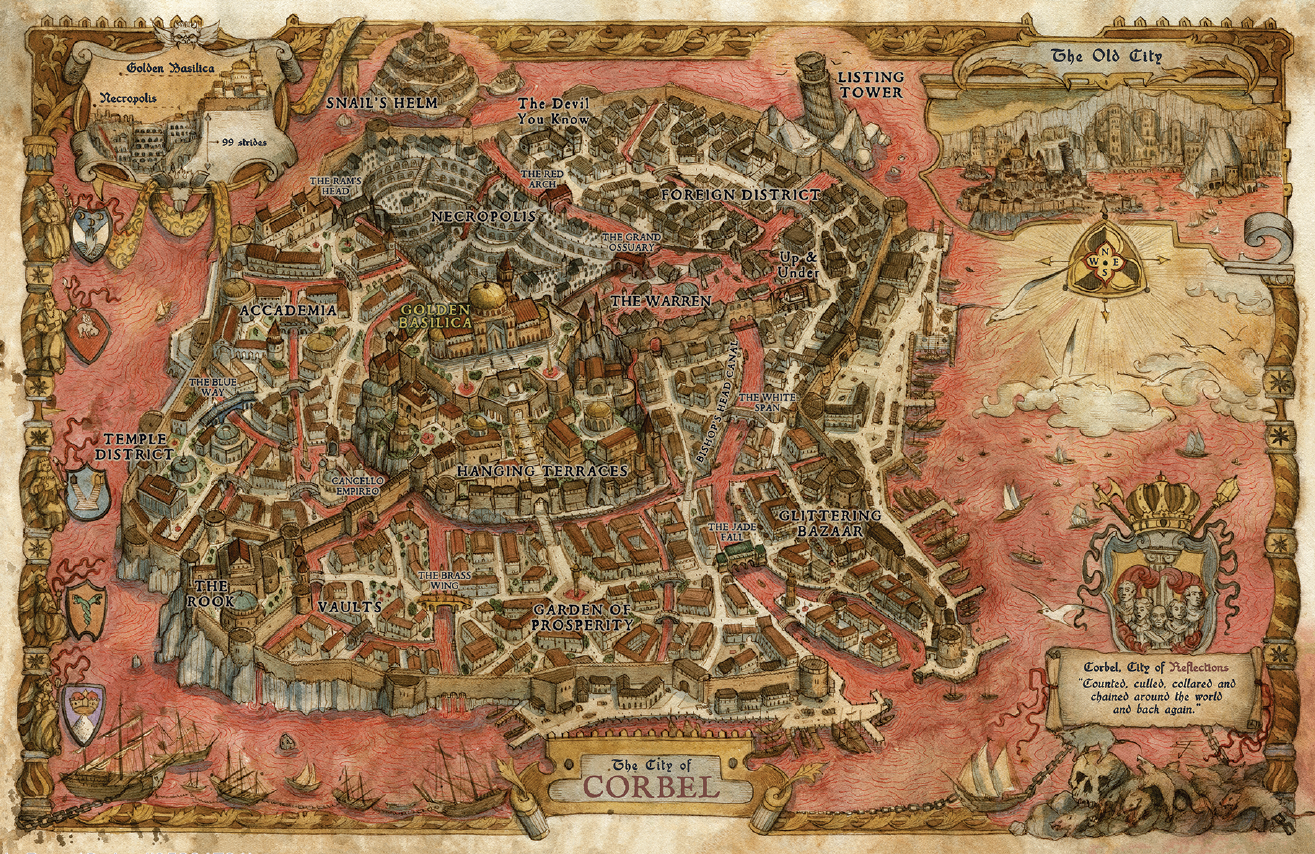
The City of Corbel