
Onatar
Onatar is worshiped wherever raw matter becomes something more. His presence is felt in the heat of the forge, the glow of glassworks, the rhythm of hammers, and the careful hands of those who shape, repair, and build. He is the Sovereign of craft, invention, endurance, and transformation—the divine principle that civilization is not only imagined, but made. To revere Onatar is to believe that creation is a sacred act, and that effort itself is a form of prayer.
His temples are not silent halls but working places: foundries, workshops, guildhalls, and great manufactories where fire is never allowed to die. Worship of Onatar is inseparable from labor. The forging of a blade, the firing of clay, the cutting of stone, the assembly of engines, and the patient mending of what is broken are all rites in his name. His priests often serve as master artisans, engineers, instructors, and overseers of great civic works, blessing tools and teaching that excellence is an offering, and perseverance a virtue.
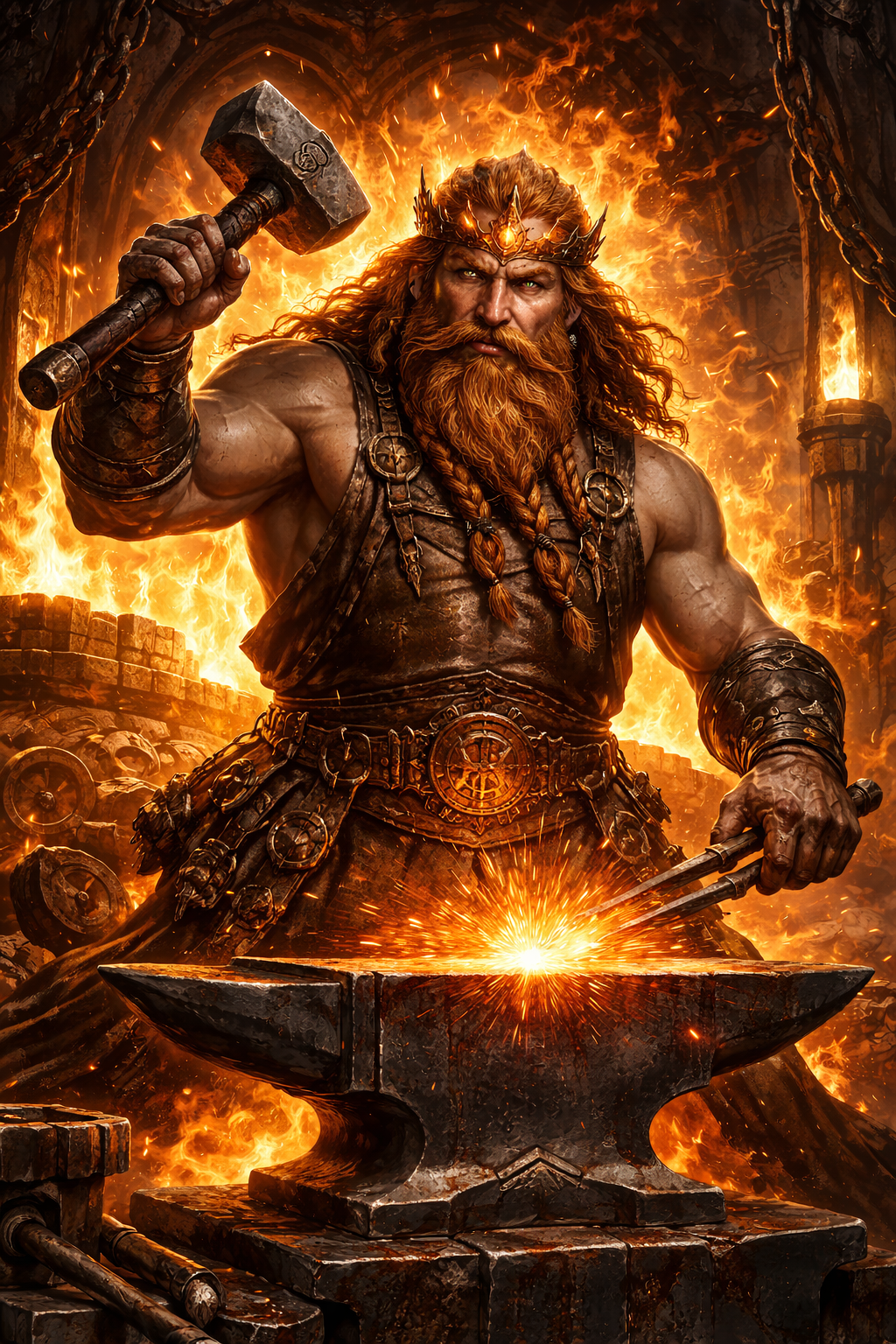
In the myths of the Host, Onatar is the shaper. He is said to have given form to the tools of the Sovereigns, to have tempered Dol Dorn’s steel, framed Aureon’s halls of record, and kindled the hearth-fires Boldrei guards. He is depicted as smith, architect, or laborer-king, broad of form and burn-marked, crowned in sparks rather than gold. Where Olladra invites chance and Aureon defines law, Onatar stands between them, taking what is possible and making it real. It is said that when the Sovereigns will change upon the world, it is Onatar who teaches mortals how to build it.
He is the patron of smiths, artisans, inventors, some who craft magic items, and even a small but growing number of warforged. Dwarves in particular revere him; he commonly appears as a dwarf smith in holy texts, and sometimes as a brass dragon. Wizards and Kineticists who specialize in fire also often hold him in high regard.
Divine Domains
Onatar presides over craft, fire, invention, metalwork, architecture, industry, and endurance. His influence extends to every discipline that transforms material into meaning: blacksmithing and masonry, glassworking and alchemy, engineering and artifice, shipbuilding and siegecraft. He governs not inspiration alone, but the long, disciplined process by which inspiration is made real.
He is widely revered by artisans, engineers, architects, miners, smiths, brewers, alchemists, artificers, and laborers, as well as by those who build nations through infrastructure rather than decree. Where Aureon provides the designs and Boldrei preserves what is built, Onatar is the one who makes the world solid.
Artifacts
Artifacts attributed to Onatar are almost always tools of making rather than instruments of rule. Legendary relics include hammers that never strike falsely, anvils that repair what is laid upon them, crucibles that transmute impurities into strength, and ever-burning furnaces said to have been kindled from his own forge-fires. Some tales speak of frameworks—scaffolds, molds, and blueprints—that allow impossible structures or creations to take form.
Unlike the relics of Dol Dorn or Dol Arrah, Onatar’s artifacts are often immobile, bound to workshops, foundries, and great civic projects. They are inherited by communities rather than wielded by heroes.
Holy Books & Codes
Onatar’s faith preserves guild codices, masterwork registries, architectural treatises, engineering manuals, and artisan lineages. His temples often maintain the Books of Craft, records of techniques, inventions, and masterworks, carefully annotated across generations. These works are not merely instructional but devotional, as every innovation is treated as both technical progress and spiritual offering.
Some traditions also keep Forge Chronicles, which record great constructions, legendary creations, and the rebuilding of cities after catastrophe, emphasizing that making and remaking are equally sacred.
Divine Symbols & Sigils
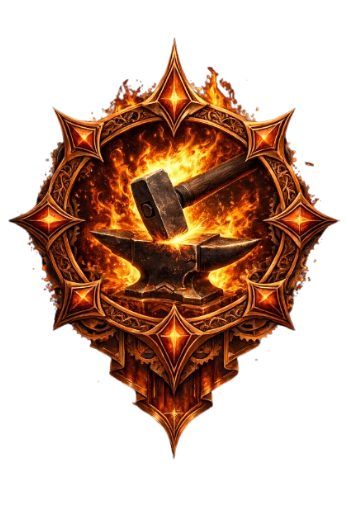
Onatar is most often represented by hammer and anvil, flame crowned with steel, stylized gearwork, or interlocking tools. In Host iconography, his aspect of the octogram is commonly rendered in copper, iron-gray, ember-red, and gold, symbolizing heat, metal, and perseverance.
His symbols are worked directly into tools, keystones, doorframes, weapons, and machinery. Many bearers do not wear them as jewelry, but build them into what they use.
Tenets of Faith
Followers of Onatar are taught that creation is responsibility. His doctrine emphasizes patience, skill, honest labor, innovation tempered by wisdom, and the obligation to repair what is broken. Wastefulness, shoddy work, and willful stagnation are all seen as spiritual failures.
Onatar’s priests teach that mastery is not dominance, but service to the future, and that every craftsperson works not only for themselves, but for all who will depend upon what they make. A common maxim among his faithful holds that "nothing truly endures unless it is made with care."
Holidays
Onatar’s holy days are commonly tied to construction cycles, industrial seasons, and commemorations of great works. Observances include The Kindling, when new forges or workshops are consecrated; The Day of Tools, honoring laborers and artisans; and The Great Reforging, celebrating reconstruction after war or disaster.
These festivals often involve public works, mass repairs, guild initiations, and the ritual extinguishing and rekindling of fires, symbolizing both endurance and renewal.
Divine Goals & Aspirations
Onatar is believed to labor toward the advancement and preservation of constructive knowledge. He opposes decay not as a natural process, but as a surrender to neglect. He is said to guide mortals toward invention, toward rebuilding after ruin, and toward the refinement of tools that elevate entire societies.
Some theological schools hold that Onatar’s hidden work is the quiet shaping of ages, placing ideas, materials, and opportunities into the world so that civilizations may build themselves upward rather than merely outward.
Titles
- The Sovereign of Fire and Forge
- The Great Shaper
- The Maker of All Things
Alignment Neutral Good
Areas of Concern
- Craft, invention, and creation
- Fire, metal, and industry
- Architecture, endurance, and rebuilding
- Artisans, smiths, and engineers
- Miners and laborers
- Architects and builders
- Alchemists and artificers
- Brewers, glassworkers, and potters
- Guildmasters and industrialists
Anathema Sabotage honest work, create shoddy or dangerous craft, hoard innovation, allow useful knowledge to be lost, destroy without purpose
Follower Alignments NG, LG, N
Domains Fire, Artifice, Earth, Creation, Strength
Subdomains Industry, Toil, Metal, Ash, Construct, Renewal
Favored Weapon Warhammer
Symbol Hammer and anvil wreathed in flame; the octogram worked in copper and ember-red
Sacred Animal Ox, forge-lizard
Sacred Colors Copper, ember-red, soot-black, gold