

Western Wastes
The Western Wastes are a vast stretch of area between the Red Mountains and the headwaters of the Caldar River. Encompassing more than 21,000 square miles (just smaller than the State of West Virginia), it is a tractless expanse of arid prairie and barren rocky hills.
The Wastes are widely considered part of the eastern-most extent of the larger Western Desert, which is itself only a small portion of the larger interior desert that covers most of the continent. Largely devoid of intelligent inhabitants, only the fierce Sand Drakes and many communities of Goblinoids can be called residents.
Scattered amongst the empty stretches of high desert are many ancient ruins of a forgotten and largely unknown race of beings that built large structures and vast cities of stone in and amongst the hills and mountains.
Geography
Primarily high arid desert. Areas of very rough and broken terrain separated by large expanses of flat plains and dry washes. Water is scarce and often mineral-laden as it is coming from deep within the earth. The Caldar River is the largest and most prolific source of fresh water in the region.
Climate
Hot, dry summers with temperatures exceeding 100 degrees in the afternoon. Cold, dry winters with fierce winds and frigid nights. Prone to massive dust storms that can drop enough fine dust to bury a horse and that last for days on end.
Fauna & Flora
Areas of plains topography have many varieties of course, deep-root grasses like salt grass, needle grass, squirreltail and cheatgrass. Cactus are common throughout, with many varieties partially or entirely edible. Trees are found mainly in low-lying areas and along river bottoms, mainly scrub oak and red birch.
Where grass and shrubs are plentiful, bison, auroch, oryx, deer and wild ponies can be found. Hare and rabbits are common, as are rodents and squirrels. Predators common to the region include wolves, badgers, lions and foxes and all are dominated by the deadly Sand Dragons.
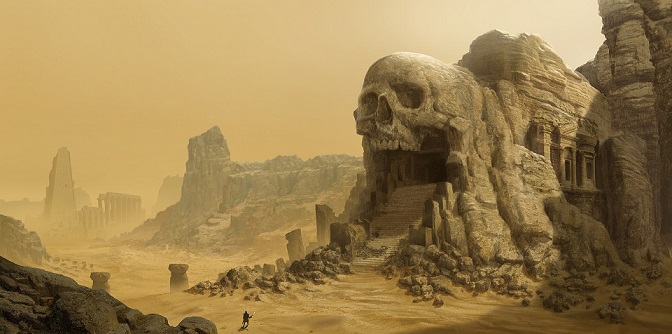
A view of the legendary Temple of the Skull in the ancient City of Cherepa
