
Simulacrium
The Court of Transcendent Judgement
The Simulacrium is the plane in which disputes between transcendent beings are examined and resolved. It is neither a seat of dominion nor a place of worship, but a neutral forum established to prevent divine conflict from destabilizing the ordered structure of reality.
Though no god is truly subordinate to another, the existence of the Simulacrium reflects a shared recognition among the divine that unrestrained rivalry would invite catastrophe.
Nature of the Simulacrium
The Simulacrium manifests as a vast circular chamber of pale stone, flawless in construction and absent of visible joints or tool marks. The space is finite, yet resists any clear sense of boundary. Sound carries with clarity and restraint, never echoing, never fading.
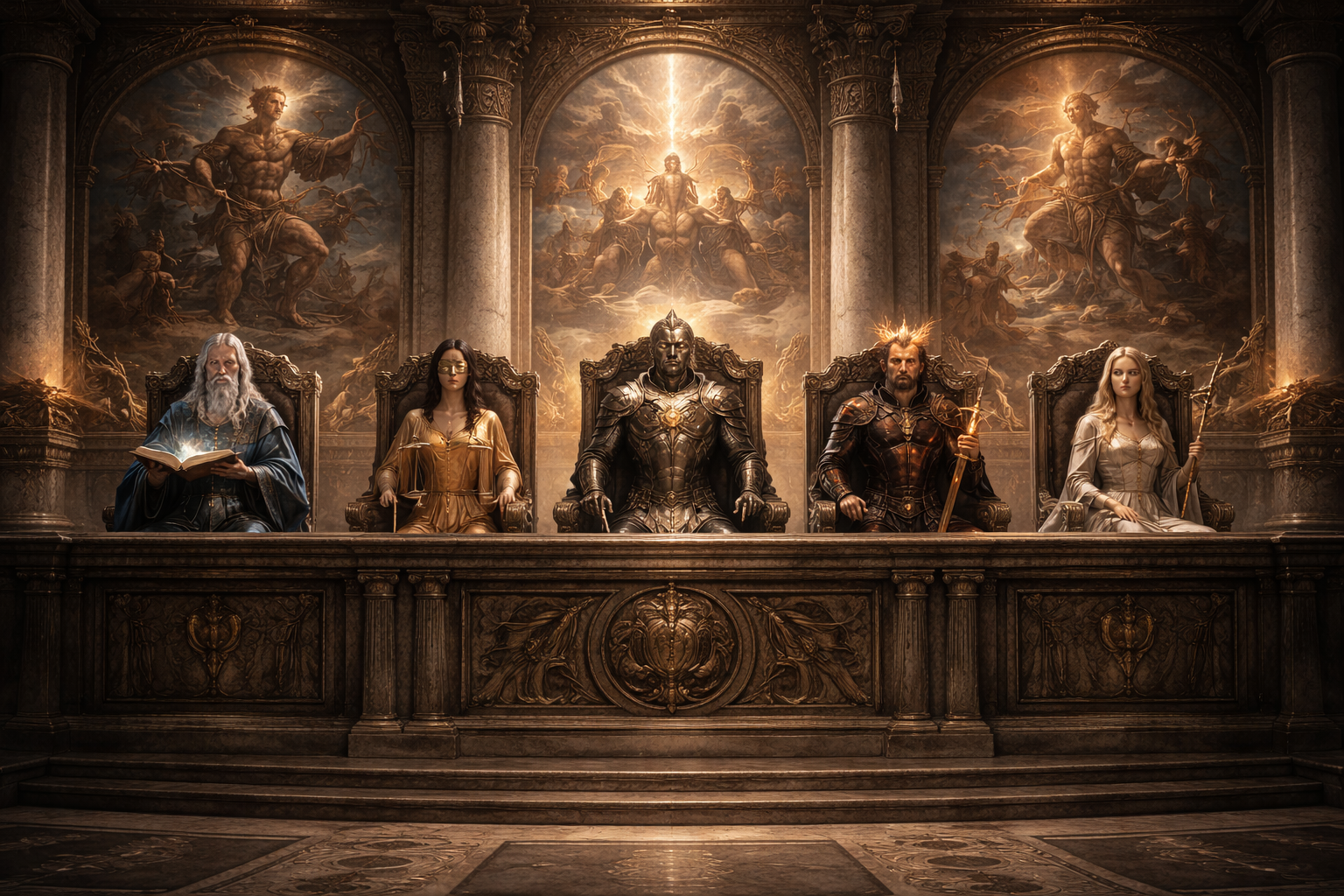
Along the far arc of the chamber stands a high stone bench upon which sit the Judicia. Behind them rise immense frescoes carved directly into the stone, depicting formative moments from the gods’ mortal lives: acts of endurance, sacrifice, ambition, and failure. These images do not alter, even as myth and memory elsewhere are revised or forgotten.
The remainder of the chamber is mutable. When the gods assemble as a council, a great circular table of dark, ancient wood manifests at the chamber’s center, surrounded by thrones shaped according to the iconography and nature of each attending deity. When judgement is to be rendered, the space reforms into a formal court, austere and hierarchical, designed to emphasize deliberation, testimony, and consequence.
The Judicia
Presiding over all proceedings are five demigods collectively known as the Judicia. They are not patrons of worship nor rulers of realms. Each embodies a principle without which judgement at a cosmic scale would be incoherent or destructive.
Ratiocinium represents disciplined reason. It ensures that arguments presented before the court are internally consistent, free from contradiction, and grounded in rational structure rather than divine impulse or passion.
Aequantis embodies balance. It weighs action against consequence, power against restraint, and intent against outcome, without regard to the status or magnitude of the being involved.
Talio stands for proportional consequence. It does not pursue cruelty or vengeance, but ensures that violations are answered with responses equal in measure, preserving deterrence without excess.
Continuum represents precedent and structural continuity. It guards against rulings that would fracture reality through inconsistency, contradiction, or reckless novelty.
Auctoritas embodies legitimacy and final authority. It confers weight and conclusiveness upon deliberation, transforming judgement from opinion into decree.
The Judicia do not command obedience. They deliberate, evaluate, and pronounce.
Judgement and Authority
The rulings of the Simulacrium are not binding in the absolute sense. No law exists above a god. Yet to act in open defiance of a decree rendered by the Judicia is to invite the unified opposition of the divine order.
Such defiance is interpreted not as dissent, but as rejection of the compact that restrains divine conflict. As a result, judgements are almost universally observed, even when deeply resented.
Disputes brought before the Simulacrium include competing claims over souls, violations of divine covenant, and acts of interference that threaten metaphysical stability. Mortal affairs appear only when they have become entangled in divine contention.
On Presence and Perception
Mortals do not enter the Simulacrium unintentionally. Those permitted to stand within it experience an acute amplification of consequence and significance. Time proceeds normally, but perception does not. Most mortal minds retain only partial recollection, their memories reshaped into symbols they are capable of bearing.
The Simulacrium is not impartial in the mortal sense. Its purpose is not mercy, but containment.
It exists to remind the gods that even they operate within a structure that predates their ascension, and that the cost of disregarding that structure is neither theoretical nor symbolic.

Comments