

Mendleaf
Mendleaf is the common name given to a widespread medicinal fern-like plant recognizable by its distinctive blue-green or teal foliage. Found throughout many of Kermoria's temperate forests and woodlands, it favors shaded, moderately damp ground beneath established tree cover, particularly along streambanks, sheltered slopes, and forest clearings. Though easily overlooked among ordinary ferns and undergrowth, Mendleaf is sufficiently common that knowledgeable herbalists can gather it reliably across much of the temperate world.
The leaves contain mildly antiseptic compounds and substances that encourage damaged tissue to close and repair itself, making Mendleaf one of the staples of mundane medicine. Fresh leaves may be crushed into poultices or incorporated into salves applied around deep cuts, sutured wounds, surgical incisions, and amputations, where they help discourage infection while supporting the body's natural healing process. Dried Mendleaf is consequently found in the kits of countless healers, surgeons, military medics, and experienced travelers, even among practitioners with little knowledge of true alchemy.
When properly refined, these same properties make Mendleaf a versatile ingredient in healing and greater healing potions. Its restorative power is not particularly dramatic on its own; unlike Lifevine or Troll's Tongue, Mendleaf cannot force the body into extraordinary regeneration. Instead, alchemical preparation greatly accelerates what the plant already does naturally: helping living flesh mend itself. Skilled alchemists can push this effect considerably further with sufficient quantities and careful preparation, though there are ultimately limits to how much regenerative power can be coaxed from such an otherwise humble plant.
The leaves contain mildly antiseptic compounds and substances that encourage damaged tissue to close and repair itself, making Mendleaf one of the staples of mundane medicine. Fresh leaves may be crushed into poultices or incorporated into salves applied around deep cuts, sutured wounds, surgical incisions, and amputations, where they help discourage infection while supporting the body's natural healing process. Dried Mendleaf is consequently found in the kits of countless healers, surgeons, military medics, and experienced travelers, even among practitioners with little knowledge of true alchemy.
When properly refined, these same properties make Mendleaf a versatile ingredient in healing and greater healing potions. Its restorative power is not particularly dramatic on its own; unlike Lifevine or Troll's Tongue, Mendleaf cannot force the body into extraordinary regeneration. Instead, alchemical preparation greatly accelerates what the plant already does naturally: helping living flesh mend itself. Skilled alchemists can push this effect considerably further with sufficient quantities and careful preparation, though there are ultimately limits to how much regenerative power can be coaxed from such an otherwise humble plant.
Properties
Material Characteristics
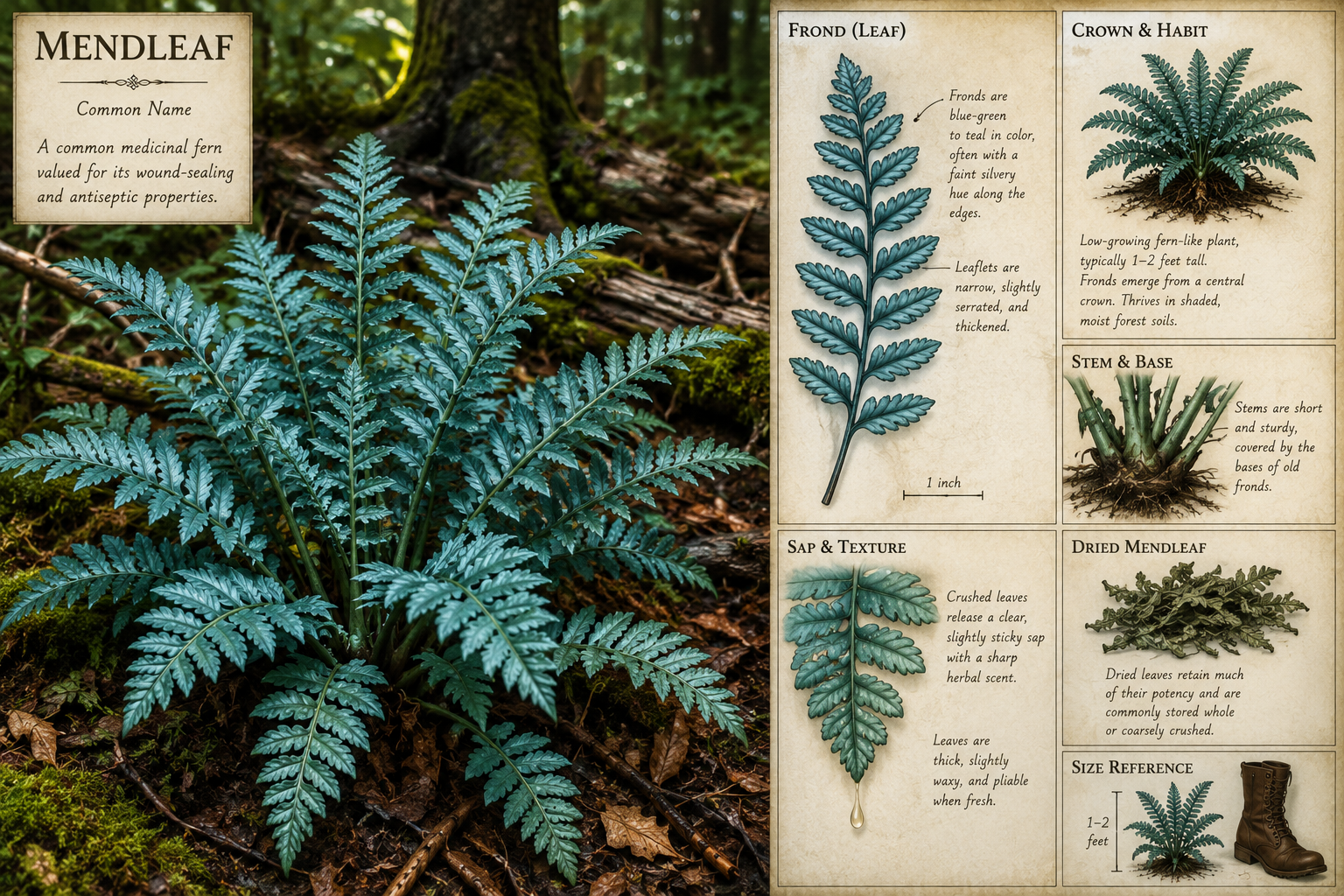
Mendleaf is a low-growing, fern-like plant typically reaching between one and two feet in height. Its fronds spread outward from a dense central crown, each composed of numerous narrow, gently serrated leaflets. The plant's most distinctive feature is its coloration: rather than the rich green typical of surrounding ferns, Mendleaf ranges from muted blue-green to dusky teal, often developing a faint silvery cast along the edges of mature leaves.
Fresh leaves are surprisingly thick and slightly waxy, becoming soft and pliable when crushed. Damaged foliage releases a small amount of clear, mildly sticky sap with a sharp herbal scent, and freshly broken stems quickly develop a thin film across the exposed surface—an innocuous example of the same wound-sealing properties for which the plant is valued medicinally. Older fronds darken toward the base and eventually fade to a dull blue-gray before dying back.
Mendleaf is otherwise an unassuming plant and can easily disappear among ordinary forest undergrowth. Experienced herbalists generally identify it by the combination of its teal coloration, waxy leaves, and characteristic astringent scent when bruised, rather than any particularly dramatic feature.
Fresh leaves are surprisingly thick and slightly waxy, becoming soft and pliable when crushed. Damaged foliage releases a small amount of clear, mildly sticky sap with a sharp herbal scent, and freshly broken stems quickly develop a thin film across the exposed surface—an innocuous example of the same wound-sealing properties for which the plant is valued medicinally. Older fronds darken toward the base and eventually fade to a dull blue-gray before dying back.
Mendleaf is otherwise an unassuming plant and can easily disappear among ordinary forest undergrowth. Experienced herbalists generally identify it by the combination of its teal coloration, waxy leaves, and characteristic astringent scent when bruised, rather than any particularly dramatic feature.
Type
Organic
Related Locations
Related Professions

Comments