
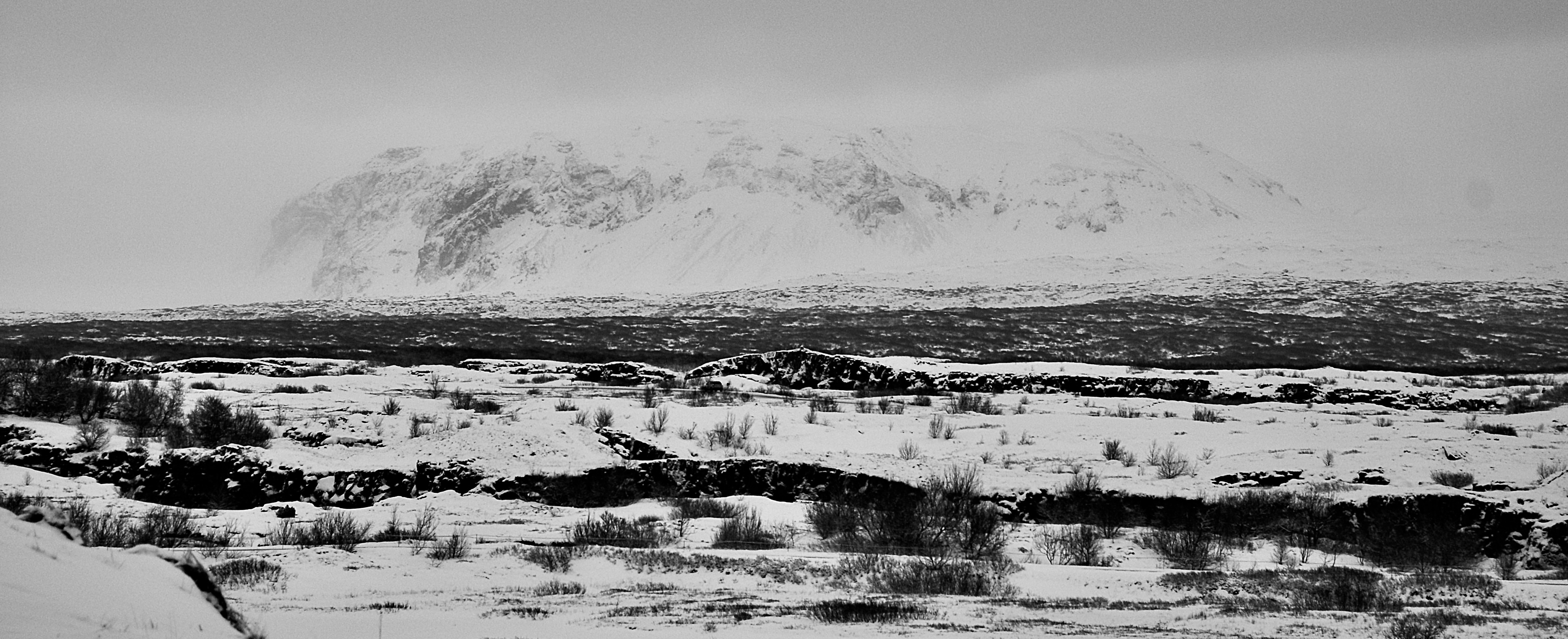
Divine Desolation
Of all of the areas of desolation wrought on the Material Plane of Kelbonnar by the Divine War, the Divine Desolation in the far north is by far the largest. It is a relic of the Battle of Fallen Feathers, one of the first and by far the largest of the battles between the Divines and their servants to have taken place on the Material Plane. The battle has made the area a cursed place, choked with the disquiet spirits of the many Celestial Warriors who fell there in combat.
Geography
The Divine Desolation lies in the far north of Kelbonnar’s Material Plane, literally splitting the continent of Hunar in twain.
Before the Divine War, the Fields of Malfrost and the peaks of the Frost Tooth Mountains north of them spread right across Hunar from east to west in an almost unbroken swathe. Now, the landscape has been completely levelled, with not even the tallest and strongest of the mountains that once lay in the region of the Divine Desolation remaining standing.
Instead, the landscape is pitted with huge craters and rifts, created by powerful blasts of Celestial magic, which combined with the ice and snow that blankets the region, make it incredibly dangerous and in many places nigh on impossible to traverse.
The Battle of Fallen Feathers
In the year 32 DW, with no immediate end in sight to the Divine War, Astartes decided that a decisive show of strength was necessary to prove to his fraternal adversary Polephemon that the Astartians would eventually prove triumphant, and that the Polephemites should lay down their arms and accept Astartes' claim to be the ruler of the Divines. To that end, Astartes mustered an enormous force of Celestial Warriors and planned to sweep across the Material Plane of Kelbonnar, destroying all pockets of Polephemite worshippers and garrisons that Polephemon had stationed across the plane, thereby gaining control of the plane of existence with the most worshipers of the Divine Pantheon and choking Polephemon and his allies of a key source of their power. Astartes planned to move in a swift decisive strike from the far north of the Material Plane, on the continent of Hunar, right to the south in one fell swoop. However, unbeknownst to him, traitors from within his forces warned the Polephemites of what was about to happen and before Astartes’ surprise assault had even begun, Polephemon began planning his counterattack. When the vanguard of the Astartian forces descended on the Material Plane, instead of finding the vacant expanse of the Fields of Malfrost as they expected, they were instead met by a Forlorn Hope force of Polephemites. Though this initial defence force had no aspirations of total victory, they sacrificed themselves to prevent Astates’ forces from gaining any momentum and held them up for long enough that Polephemite reinforcements were able to arrive and turn Astartes’ decisive manoeuvre into a long attritional engagement. The battle raged for weeks, leaving the vast expanse of Hunar over which it was fought a scarred desolation, and resulted in the Astartians retreating, their grand plans for a lightning strike takeover of the Material Plane abandoned. Many thousands of Celestials were slain in the engagement, and the air was so thick with feathers plucked from their wings that the episode became known thereafter as the Battle of Fallen Feathers.Localized Phenomena
The sheer number of Celestial warriors who fell in the Battle of Fallen Feathers has made the Divine Desolation into a region that is a strongly liminal space with the Ethereal Plane. The souls of the slain Celestials still continue to fight in the ethereal and these conflicts, ranging from one-on-one duels to whole segments of the wider battle regularly spill back out onto the Material Plane.
These ghostly battles are not simply curious sites for those who see them. So strongly tied to the region are the spirits that the can harm living people who happen to get in their way, and many a salvager in the desolation has been slain by a spiritual arrow or a gout of magical fire unleashed by one of the spectral warriors. This phenomenon is particularly dangerous during daylight hours, as it is often incredibly difficult to discern when and where spirits appear. Seasoned travellers in the desolation know that the surest sign that fallen warriors are manifesting in the vicinity is when one hears the sounds of battle suddenly ringing out all around you.
At night, it is much easier to tell where these manifestations appear. Indeed, the celestial spirits throw out so much light that they can often be seen from several miles away in dark conditions. When huge numbers of them spill out from the Ethereal Plane, the light they throw off can be seen from incredibly far away. Indeed it can be commonly observed from Hafanheim, but also on occasion from as far afield as Jaarn, Stavanska and Laufey's Camp.
Natural Resources
The scant resources which could once be extracted or gathered from the reaches of the Fields of Malfrost and Frost Tooth Mountains that once extended into the area of what is now desolation where all destroyed in the cataclysmic engagement of the Battle of Fallen Feathers.
Now the only resources which could theoretically be gathered in the region are the remains of the celestial warriors who fell in the battle, and the weapons and armour that they bore into battle. Though it may seem ill-advised to do so, the potential riches to be gained from acquiring and selling such relics regularly attracts bands of adventurers and salvagers to make the dangerous trip into the desolation. Many of those parties never return and of those that do, few return with the full complement of members they set out with.
Alternative Name(s)
Tundra of the Restless Dead
Location under
Related Myths

Comments