
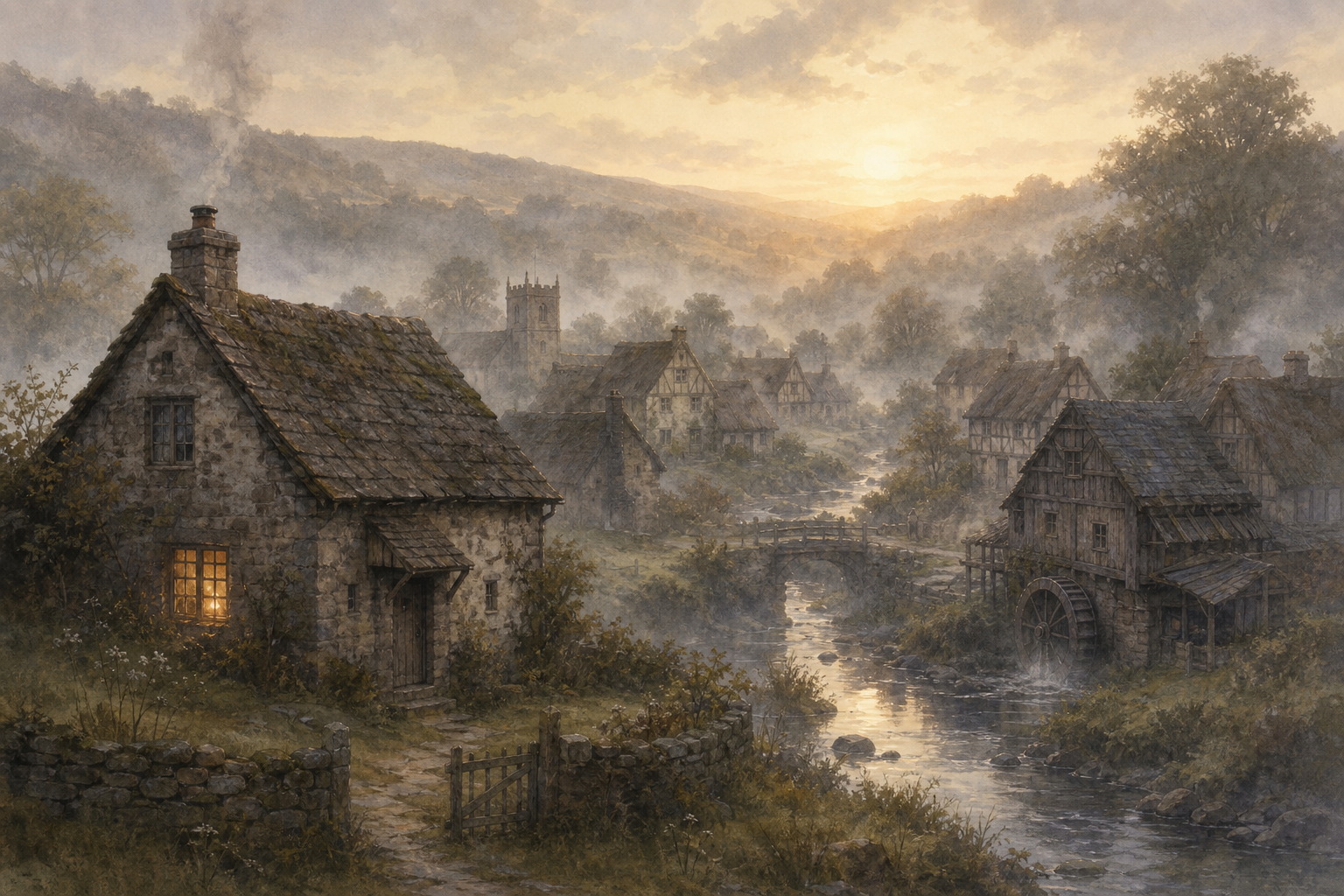
Lowmere
Lowmere's founding predates written record in the region, though local memory places it at roughly 210 years prior to the Age of Attunement, around 1825 AD, generations before The Harmonious Coil's rise. Villagers peak of it less as a date and more as "before the roads came," a phrase Keepers still use to mark anything untouched by Coil influence.
No single founder is named. Village lore credits a handful of families who fled religious persecution generations before the Coil existed, settling in a low, misty hollow that made them hard to find. The founding families' surnames are still carried by many Lowmere housholds today, a rare thread of continuity in a land the Coil has otherwise unraveled.
No single founder is named. Village lore credits a handful of families who fled religious persecution generations before the Coil existed, settling in a low, misty hollow that made them hard to find. The founding families' surnames are still carried by many Lowmere housholds today, a rare thread of continuity in a land the Coil has otherwise unraveled.
Demographics
Lowmere is home to roughly 40 to 50 families, somewhere between 150 and 200 souls, nearly all dscended from the handful of founding households that settled the hollow in 1825 AD. Age skews older than most Fray settlements, since many young people who chafe at Lowmere's quiet, insular rhythm eventually drift toward Ironspire or deeper into The Fray in search of trade, adventure, or distance from the village's watchful memory. Those who stay tend to be deeply rooted, either by faith, by family land, or by an unspoken sense that leaving means abandoning something worth guarding.
Government
Lowmere has no formal ruler. It is governed by a rotating council of elders, one representative from each of the old founding families, who meet only as needed rather than on any fixed calendar, usually when a dispute, a harvest decision, or an outside threat calls for it. In practice, though, the village's true moral center is whoever currently serves as caretaker of the old chapel, a role that carries no political title but commands deep, quiet trust.
Defences
Lowmere keeps no militia and boasts no walls. Its defense has always been its obscurity: a low, mist-shrouded hollow tucked off the main Fray roads, easy to miss unless a traveler already knows to look for it. Villagers rely on a simple bell system, rung from the old chapel tower, to warn of unfamiliar riders or wagon on the approach roads, giving families time to tidy away anything that might draw unwanted attention
Industry & Trade
Lowmere sustains itself through small-scale farming, modest livestock, and a handful of skilled trades: a miller, a weaver, a beekeeper, and a few families who tend orchards along the hollow's damp, fertile slopes. Trade with the wider Fray is limited and deliberate. Lowmere sells just enough grain, honey, and woll at Ironspire's markets to afford what it cannot produce itself, salt, tools, medicine, without drawing steady traffic back toward the village.
Infrastructure
Lowmere has no paved roads, only packed dirt paths that turn soft with mist and rain, and a single wooden bridge crossing the stream that feeds the hollow. Water comes from a shared well at the village center and a scattering of smaller family wells, while the old chapel bell serves double duty as both a warning system and a call to gather, whether for worship, council, or harvest. There is no formal schoolhouse; children are taught letters, Scripture, and trade skills at home or in small gatherings led by whichever elder has the patience and the time.
Assets
Materially, Lowmere is unremarkable: a scatter of modest farmhouses, a mill, a handful of orchards, and small stores of grain and preserved food set aside for lean winters. Its true wealth is far less visible: generations of oral tradition, hand-copied Scripture, and old hymns passed down through families who never stopped teaching them, even after the wider real forgot why they mattered. The old chapel itself, plain and unremarkable from the outside, holds far more than anyone passing through would ever guess.
Guilds and Factions
Lowmere has no formal guilds in the Coil sense, only informal circles built around shared trade and shared faith: the millers and orchard-tenders who work the land together, and a smaller, quieter circle who gather around the chapel caretaker for study, prayer, and the careful keeping of old words. This second circle has no name that outsiders would recognize, and villagers speak of it only obliquely, as "those who remember" or "the caretaker's friends."
History
Lowmere's history is quiet and largely uncrecorded, a village content to live and die without drawing the attention of chroniclers. Its one defining hardship came generations before the Relegation Era, in what villagers still call the Fever Winter, a wasting illness that swept through the hollow over a single hard season, claiming several children and elders with no clear cause and no cure to be found. Among its youngest victims was a small sibling of the boy who would grow up to become Brother Simeon Vale, and the loss marked him deeply as a child too young to fully understand it.
Rather than turning inward in fear or blame, Lowmere's families kept vigil together, sitting through the nights with the dying and the grieving openly rather than looking away. Simeon later wrote that his earliest memory of true faith was not a sermon but the sound of his mother praying the Psalms of lament aloud beside his sibling's bed, unashamed of her grief and unwilling to soften it into easy comfort. That posture, walking straight into sorrow rather than around it, became the seed of the theology of presence Simeon would spend his life refining, first as a monk of the Valley Brothers, later as the author whose words would outlast the Coil's attempt to burn them.
Simeon left Lowmere as a young man to enter the Valley Brothers monastery, and the village saw little of him after that beyond occasional letters and, eventually, quiet copies of his writing passed hand to hand. When word reached Lowmere of his disappearance following the banning of The Cost of the Crown: Faith Through Fire, the village did not mourn him as lost so much as folded him into its own long practice of grief: holding vigil, refusing to forget, and waiting.
Rather than turning inward in fear or blame, Lowmere's families kept vigil together, sitting through the nights with the dying and the grieving openly rather than looking away. Simeon later wrote that his earliest memory of true faith was not a sermon but the sound of his mother praying the Psalms of lament aloud beside his sibling's bed, unashamed of her grief and unwilling to soften it into easy comfort. That posture, walking straight into sorrow rather than around it, became the seed of the theology of presence Simeon would spend his life refining, first as a monk of the Valley Brothers, later as the author whose words would outlast the Coil's attempt to burn them.
Simeon left Lowmere as a young man to enter the Valley Brothers monastery, and the village saw little of him after that beyond occasional letters and, eventually, quiet copies of his writing passed hand to hand. When word reached Lowmere of his disappearance following the banning of The Cost of the Crown: Faith Through Fire, the village did not mourn him as lost so much as folded him into its own long practice of grief: holding vigil, refusing to forget, and waiting.
Points of interest
The heart of Lowmere is a modest stone-and-timber house at the edge of the village, once the childhood home of Brother Simeon Vale, now known quietly among the faithful as the Vale House. Sometime after the Harmonious Coil began burning his books and erasing his name from public record, but while Simeon was still believed to be alive and in hiding, Lowmere's families gathered without ceremony and rededicated his family home as a second chapel. No formal announcment was made to the wider realm; the village simply began meeting there, lighting a single lamp in the front window each evening, a signal that has never gone dark since.
Word is said to have reached Simeon himself, smuggled through the same quiet channels that carried his banned writings, that his childhood home had become a place of prayer in his name. Villagers who remember the telling say he wept on hearing it, not from pride, but because it meant Lowmere had chosen to remember him exactly as he'd taught: through vigil, not applause. Today, the Vale House holds little that would draw a stranger's eye, a hearth, a few old benches, a shelf of hand-copied pages, but for Makers and Agents of Dissonance who know its history, it remains a rare, unguarded place where his theology of presence is still lived out nightly, one lamp at a time.
Word is said to have reached Simeon himself, smuggled through the same quiet channels that carried his banned writings, that his childhood home had become a place of prayer in his name. Villagers who remember the telling say he wept on hearing it, not from pride, but because it meant Lowmere had chosen to remember him exactly as he'd taught: through vigil, not applause. Today, the Vale House holds little that would draw a stranger's eye, a hearth, a few old benches, a shelf of hand-copied pages, but for Makers and Agents of Dissonance who know its history, it remains a rare, unguarded place where his theology of presence is still lived out nightly, one lamp at a time.
Architecture
Lowmere's building are simple and old-fashioned, stone foundations topped with timber and thatch or weathered shingle, built for warmth and endurance rather than show. Homes are modest, low-eaved, and close to the ground, clustered loosely around the village well and the original chapel rather than arranged along any planned street. The Vale House stands apart mainly in its upkeep: its stonework is a little better tended than its neightbors, its lamp always trimmed and lit, a small, quiet signal of what it means to those who know.
Geography
Lowmere sits in a low, misty hollow tucked well off the main roads of The Fray, ringed by gentle rises that keep it half-hidden from casual view. A shallow stream winds through the village on its way toward Ironspire, feeding the mill and watering the orchards along its damp, fertile banks, The same terrain that shelters Lowmere from prying eyes also traps moisture close to the ground, giving the whole hollow its perpetual soft-focus, dreamlike quality, mist clinging in the low places long after sunrise.
Climate
Lowmere's climate is cool and damp for most of the year, with heavy morning mists that linger in the hollow well past dawn and rains that come often but gently, feeding the stream and orchards rather than threatening them. Winters are the harshest season, cold and close, the same conditions that once fed the Fever Winter generations ago, a fact older villagers still quietly note each year when the first hard frost comes.
Natural Resources
The hollow's damp, fertile soil supports orchards, grain, and modest livestock, while the stream provides both water and the modest power that turns Lowmere's single mill. Honey comes from a handful of kept hives along the orchard's edges, and nearby stands of timber supply enough wood for the building and repair without any need for large-scale logging. Nothing here is abundant enough to draw outside interest, which suits Lowmere exactly as well as it always has.
Founding Date
aprox. 1825 AD
Population
150-200
Inhabitant Demonym
Lowmerens; "Hollow folk"
Location under
Related Professions


Comments