
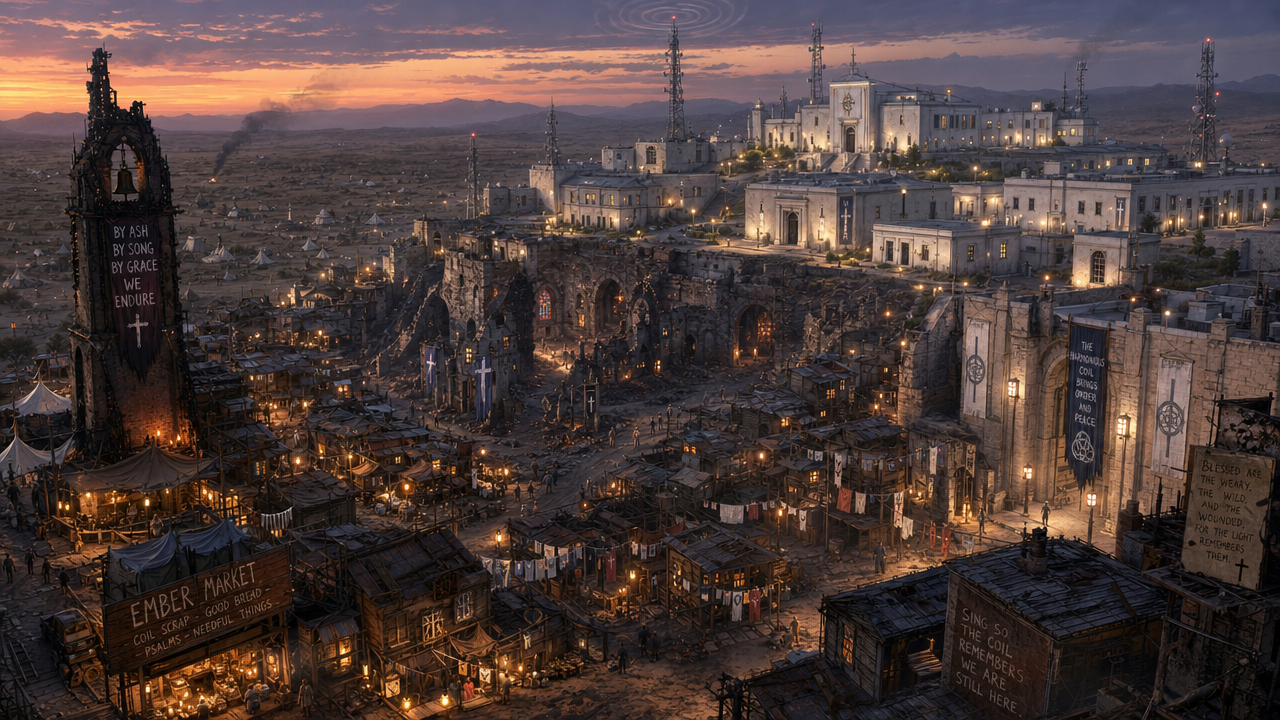
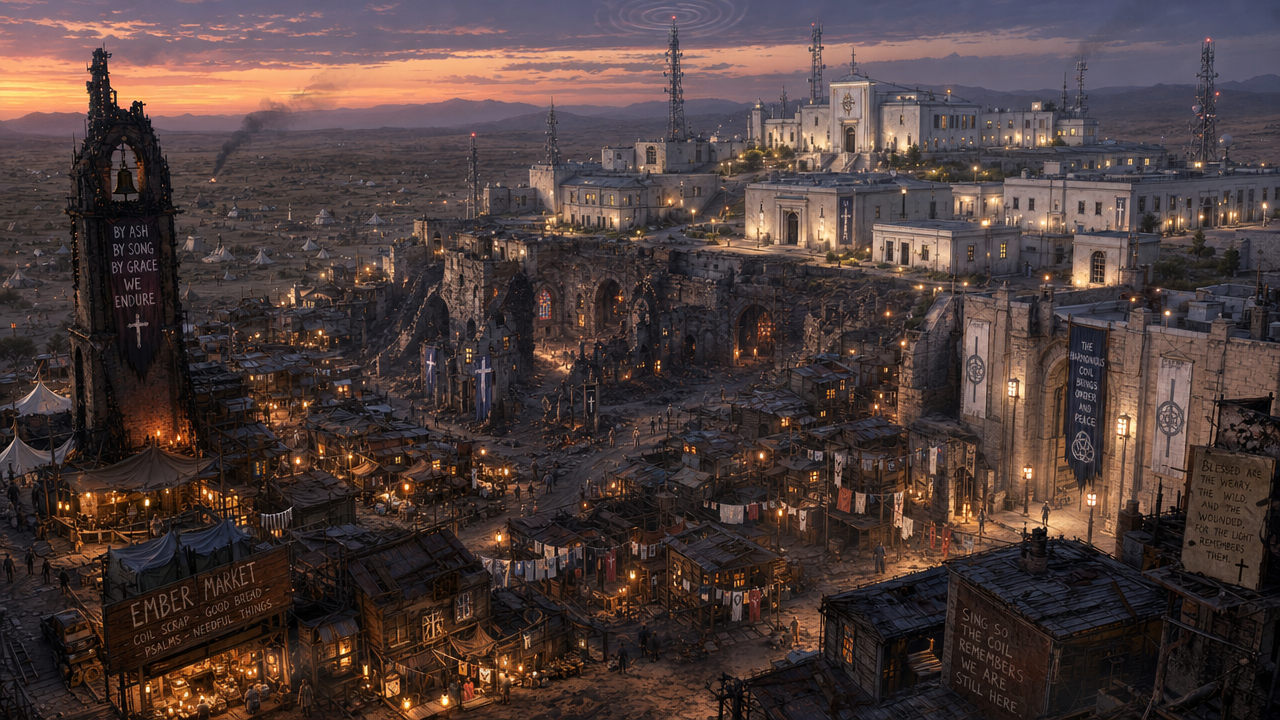
Embergate
Officially, this town was founded by a delegation of Harmony Strategists and Unburdening Custodians appointed by the Conductors to oversee exile populations in The Fray.
Secretly and culturally, Embergate's people trace its founding to unnamed pastors, mechanics, and hymn-singers of the original ash settlement, whose chapels and homes formed the bones of the present city.
A common nickname in the Fray is Ashgate, referencing the burned foundation beneath the streets. It is called The Ember Cradle by resistance circles, emphasizing its role as birthplace of the First Ember movement. It's bureaucratic designation in Coil and state records is Sector E-7, which avoids acknowledging its history.
Secretly and culturally, Embergate's people trace its founding to unnamed pastors, mechanics, and hymn-singers of the original ash settlement, whose chapels and homes formed the bones of the present city.
A common nickname in the Fray is Ashgate, referencing the burned foundation beneath the streets. It is called The Ember Cradle by resistance circles, emphasizing its role as birthplace of the First Ember movement. It's bureaucratic designation in Coil and state records is Sector E-7, which avoids acknowledging its history.
Demographics
Emberagate’s population skews heavily toward exiles branded Agents of Dissonance by the Harmonious Coil: outspoken pastors and lay leaders, artisans whose work stirred “unrest,” musicians and poets, and families who refused re-attunement. Economically, most Emberans live at or just above subsistence level, relying on informal trade, repair work, and mutual aid rather than formal salaries. A small, better-provisioned minority of Coil staff, border medics, and state clerks reside in the inner administrative quarter, creating a visible gap between those who enforce harmony and those who are forced to live in its shadow. Culturally, the city blends Fray frontier toughness with deeply rooted faith practices—street prayers, hymn-sings, and shared Scripture—creating a community that is poor in coin but rich in relational and spiritual capital.
Government
On paper, Emberagate is run by a state-appointed Prefect of Rehabilitation, advised by a resident Harmony Strategist and Unburdening Custodian from the Harmonious Coil. Laws emphasize curfews, registration of new arrivals, and mandatory attendance at “stability circles”—group meetings where Custodians monitor emotional temperature and recommend attunement regimens. Taxes are light in coin but heavy in compliance: exiles must contribute labor to border works, clinics, or sanitation, and any perceived dissonance can result in loss of rations or transfers deeper into The Fray. Beneath the official layer, an informal council of church elders, mechanics, and quarter-mothers coordinates food sharing, shelter, and quiet defiance, making Emberagate a place with two governments—one of paperwork and one of prayer.
Defences
Emberagate’s most obvious defenses are modest: low stone walls, watchtowers facing The Fray, and a shallow dry moat that slows carts more than armies. Its true defensive layers are subtler. Coil-installed frequency masts at the town’s edge can broadcast calming tones to dampen riots or disorient charging bandits; surveillance lenses mounted on the towers watch for large gatherings, especially near the old chapel ruins. The exiles themselves maintain hidden defenses—concealed escape routes through collapsed basements, lookout posts in half-burned bell towers, and a network of signal hymns whose melodies warn of incoming patrols. The result is a city that looks lightly guarded but is, in practice, constantly monitored from above and quietly shielded from below.
Industry & Trade
Emberagate survives on repair work, small-scale crafts, and border trade. Many Emberans are skilled in mending tools, hacking old communications arrays, and refurbishing discarded Coil tech, selling their expertise to caravans passing between harmonized realms and The Fray. Informal markets line the outer streets: patched clothing, simple instruments, handwritten Scripture verses, and basic foodstuffs traded more in favors than in coin. Official exports include timber, scavenged metal, and occasional surplus crops from small farms just beyond the walls; imports consist of medical supplies, grain shipments, and standardized goods sent by the state to keep the exiles alive but dependent. By design, Emberagate produces little wealth of its own but generates relational and spiritual “capital” that fuels the wider resistance.
Infrastructure
Emberagate’s infrastructure reflects its half-tamed status. The inner quarter has Coil-standard amenities: a small transit depot for autocarriages, a clean but crowded clinic staffed by Custodians, and reliable water cisterns tapped from a nearby spring. The outer streets rely on wells, rain barrels, and jury-rigged wiring strung between leaning buildings, with patched combustion vehicles and carts dominating transport. Sewers are minimal; waste is managed by communal labor rather than hidden pipes. A single Coil House serves as both administrative hub and shelter during disasters, while the ruined chapels beneath the city quietly function as emergency refuges and worship spaces. Overall, the systems are just good enough to prevent catastrophe but never comfortable enough to feel like home.
Districts
Emberagate is informally divided into three main districts. The Inner Gate houses the Prefect’s offices, the Coil House, the clinic, and housing for Coil staff and compliant exiles; streets here are straighter, lamps brighter, and patrols more frequent. The Ashstreets spread around the old chapel ruins, hosting dense housing, workshops, and markets run by Emberans; alleys weave through half-collapsed foundations, and it is here that resistance and underground church life thrive. Beyond them lies the Fray Edge, a sprawl of tents, shacks, and small farms where new exiles first arrive, traders camp, and risk from bandits or wild Fray creatures is highest. Power flows from Inner Gate outward, but culture flows the opposite direction: what happens in the Ashstreets slowly reshapes the whole city.
Assets
Materially, Emberagate owns little beyond its walls, wells, and basic civic buildings. Its most valuable “assets” are intangible: the memory of the burned chapels beneath it, the web of relationships among exiles, and the presence of key figures tied to the First Ember resistance—mechanics, pastors, musicians, and, unbeknownst to most, a child once taken from its streets who grew into a Harmony Strategist. Official assets listed in Coil reports include the border clinic, a small attunement center, and the frequency masts on the outskirts. Unofficially, the city’s greatest wealth is its stories and songs, which cannot easily be cataloged or confiscated.
Guilds and Factions
Several factions quietly shape Emberagate’s life. The Coil Delegation—Prefect, Harmony Strategist, Custodian, and their staff—represents official authority, focused on managing exile behavior and reporting dissonance metrics. The Remnant Church organizes worship, mutual aid, and nonviolent resistance, spread through house gatherings and ruined-chapel networks. The Ashstreet Mechanics and tinkerers, some linked to figures like , control repair work and tech salvage, giving them leverage over both exiles and the Coil. Smaller groups include youth hymn circles, scripture-copying collectives, and black-market traders who move goods and messages deeper into The Fray. Alliances between these factions are fluid, but a shared conviction—that Emberagate’s people are more than their exile status—binds many of them together against Coil narratives.
History
Originally a loose settlement of refugees and frontier believers on The Fray’s edge, Emberagate’s predecessor grew into a hub for underground chapels and early Agents of Dissonance. An early Harmonization Sweep, justified by claims of plague and rising violence, destroyed much of the settlement’s religious and communications infrastructure, leaving charred foundations and ash fields. In the following decades, the state and Coil rebuilt the area as a formal exile town, renaming it Sector E-7 and establishing a Prefect, Coil House, and clinic. Locals, however, continued to call it Emberagate, insisting that the “embers” of the first resistance still burned beneath the new streets. Over time, waves of exiles and quiet remnant communities turned Emberagate into both a wound and a seedbed for the broader First Ember movement.
Points of interest
Key sites in Emberagate include the Sunken Chapel, a partially collapsed sanctuary beneath the Ashstreets where original altar stones and wall inscriptions remain; the Ember Market, a chaotic but warm stretch of stalls selling salvaged tech, handmade crosses, and simple food; the Coil House at Inner Gate, whose clean halls contrast brutally with the surrounding poverty; and the Ash Bell Tower, a scorched tower used as a lookout and hymn-signal point. On the Fray Edge, a small communications array—rumored to be linked to mechanics like Silas—hums intermittently, drawing curious youth and worried Coil technicians.
Tourism
Emberagate is not a tourist destination in the conventional sense. Visitors are mostly border traders, Coil auditors, relief workers, and the occasional curious official seeking to “observe exile conditions.” A few itinerant preachers and musicians from deeper in The Fray come deliberately to encourage the remnant believers, drawn by stories of the Sunken Chapel and Ember Market. Those who stay overnight use simple inns at the Fray Edge or guest rooms above shops; Coil staff lodge in Inner Gate quarters. Most outsiders leave with an uneasy sense that they have walked through a place both forgotten and spiritually charged.
Architecture
Emberagate’s architecture is layered. The lowest structures are blackened stone and brick remnants from the original settlement, their arches and doorways bearing faint carvings of verses and abstract crosses. On top of these, Emberans have built mismatched wooden and masonry homes, patched with salvaged metal and cloth. Inner Gate buildings—Prefect’s hall, Coil House, clinic—follow Coil-standard design: smooth facades, pale stone or concrete, minimal ornamentation, and acoustic ceilings tuned for quiet. In the Ashstreets, balconies sag, laundry lines crisscross alleys, and doorframes are adorned with hand-painted symbols of hope, often in defiance of Coil aesthetic regulations. The overall look is half-ruin, half-living tapestry.
Geography
Emberagate sits on a low rise at The Fray’s edge, where scrubland and rocky outcrops give way to more cultivated terrain toward the chartered realms. The city overlooks a shallow ravine scattered with chapel ruins and old signal towers, now half-buried in dust. A small spring emerges from the hillside just beyond the walls, feeding cisterns and a narrow stream that runs through part of the Ashstreets. Surrounding land supports small farms and grazing, but beyond the Fray Edge district the ground quickly becomes uneven and treacherous, dotted with sinkholes, thorn thickets, and ruins of older, forgotten structures. The horizon is wide and exposed, making Emberagate feel simultaneously vulnerable and open to the sky.
Climate
The climate around Emberagate is harsh but survivable: hot, dusty summers with frequent dry winds that carry grit through the streets, and cold, biting winters with occasional sleet or light snow that turns the ash fields slick. Rain comes unpredictably in short, intense storms, filling the ravine and cisterns and briefly turning the outer farms green. The wind is a constant presence—sometimes a gentle breeze that cools hymn gatherings, sometimes a howling force that seems to strip sound from the air, echoing the Coil’s fear of dissonant noise.
Natural Resources
Emberagate’s main natural resources are its spring, modest arable land, and salvageable stone and metal from the ruins around it. Farmers on the Fray Edge grow hardy grains, roots, and a few fruit trees that can withstand wind and irregular rain. Timber is scarce, gleaned from scrub and imported; most building wood comes from dismantled structures. The ravine and nearby ruins provide stone and scrap metal for construction and repair, as well as occasional finds of old devices that mechanics repurpose. Spiritually, the city’s most precious “resource” is the faith and resilience of its people—a well that the Coil cannot easily tap or drain.
Founding Date
20RE
Founders
Alternative Name(s)
Ashgate; The Ember Cradle; Sector E-
Type
Large town
Population
10,500
Related Ethnicities
Inhabitant Demonym
Emberans (formal Ashfolk (colloquial Fray sla
Location under
Owner/Ruler
Ruling/Owning Rank
Owning Organization
Related Professions


Comments