
Illismene
Illismene (Darnian: Ілисмîн, ꛲ꚩꛜꛬꛢ /ɪˈləz.min/, Othian: Ільисмîн /ɪˈɬəs.miːn/) is the capital of Darnau and the most populous city in Is Nagain. It forms one pole of the Southeastern Triangle, along- side Dunvervolly and Bride. Illismene has emerged as a centre of finance, commerce, industry, art, and culture. Darnau's historic animosity towards Otha has manifested as a rivalry between Illismene and Dunvervolley.
Illismene is host to many Naganian branches of international companies and native Naganian companies, including the massive Wendum Steel. Illismene is a centre of finance within Nagain and the global southwest, and the Illismene Stock Exchange has the largest market capitalisa- tion in Nagain. The GDP per capita in Illismene is the highest of any city in Nagain. Illismene is also a cultural and artistic hub, especially notable for its film industry.
The city grew very quickly, attracting people from within Darnau, the rest of Nagain, and even from abroad. Many foreigners, particularly Vessians, came to Illismene and were instrumental in developing the modern city, its infrastructure, and particularly its industry. Due to Nagain's formal ban on unskilled immigrant labour, the city attracted many labourers from within Nagain to help build out the new city and work within its industry. Wages were thus high, but import duties and restrictions allowed for native industry to develop.
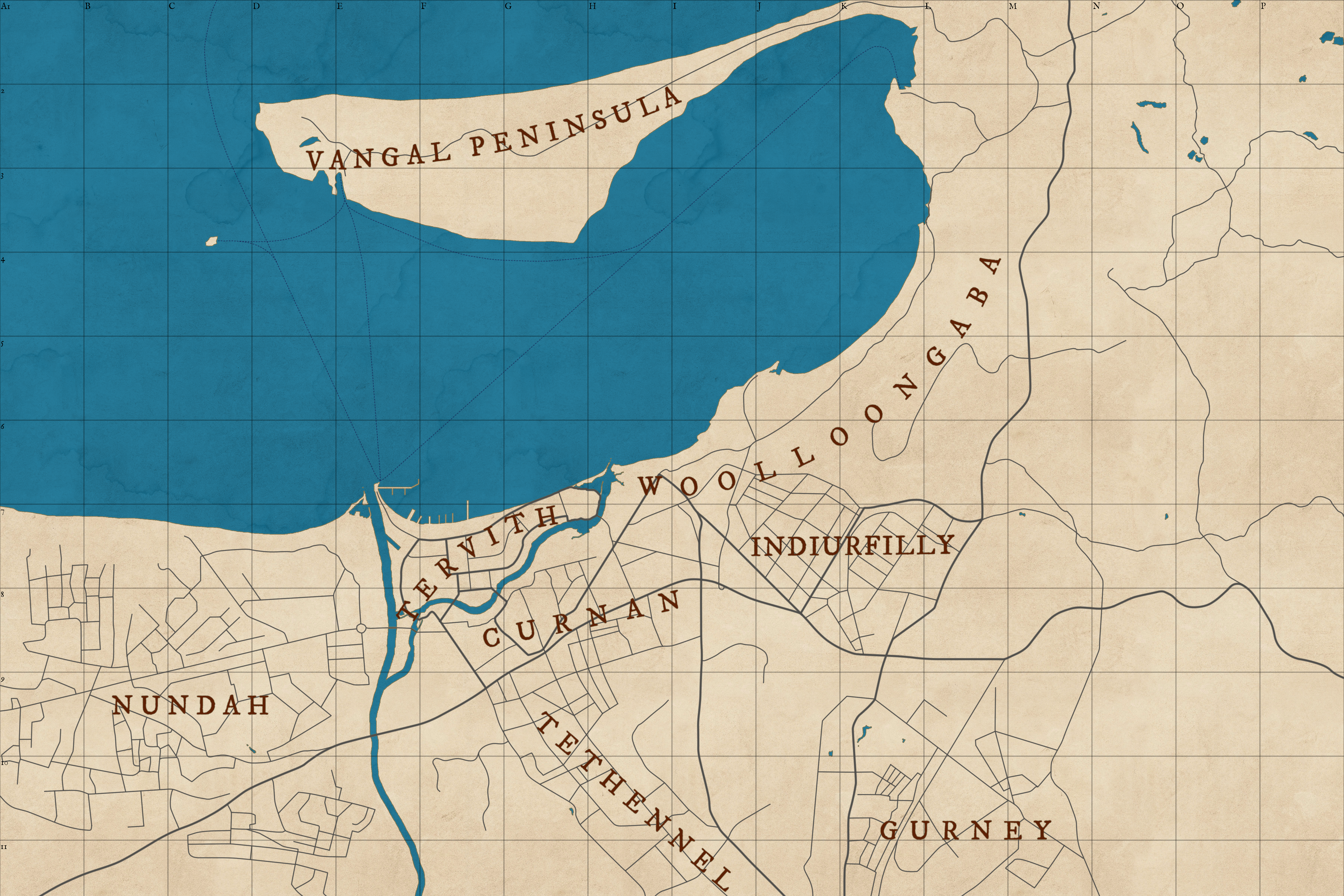
As the city grew, its borders were enlarged twice: first in 2875, with the incorporation of the eastern two thirds of Woolloongaba and the new district of Indiurfilly west of Curnan, and again in 2892, incorporating Gurney south of Indiurfilly, Nundah west of the Umvry, and the Vangal Peninsula across the harbour.
Illismene is host to many Naganian branches of international companies and native Naganian companies, including the massive Wendum Steel. Illismene is a centre of finance within Nagain and the global southwest, and the Illismene Stock Exchange has the largest market capitalisa- tion in Nagain. The GDP per capita in Illismene is the highest of any city in Nagain. Illismene is also a cultural and artistic hub, especially notable for its film industry.
History
Time of Tumult
Modern History
Illismene was incorporated and reestablished in 2848 as a city county within Darnau's new constitutional framework. As a city county, it has the rights and powers of a city (êmwn) and a county (powyl). As the capital city of Darnau, it was also afforded additional special powers. Following the end of the Time of Tumult, Darnau very quickly began their own development project alongside the Othian country-wide programme of "Harmonious Governance" meant to modernise the country. The Great Court withing the royal palace was remodeled and made into the meeting chamber for the newly created Darnian Parliament.The city grew very quickly, attracting people from within Darnau, the rest of Nagain, and even from abroad. Many foreigners, particularly Vessians, came to Illismene and were instrumental in developing the modern city, its infrastructure, and particularly its industry. Due to Nagain's formal ban on unskilled immigrant labour, the city attracted many labourers from within Nagain to help build out the new city and work within its industry. Wages were thus high, but import duties and restrictions allowed for native industry to develop.
As the city grew, its borders were enlarged twice: first in 2875, with the incorporation of the eastern two thirds of Woolloongaba and the new district of Indiurfilly west of Curnan, and again in 2892, incorporating Gurney south of Indiurfilly, Nundah west of the Umvry, and the Vangal Peninsula across the harbour.
Geography
Illismene lies on a small peninsula in the southeast of Darnau. The old city is situated in the lowlands along the coast of Darnau Bay, while new developments have stretched out into the hills and valleys that surround the lowlands. The city is also located at the mouth of the Umvry and Bech Oolloon rivers.Ecology
The most prevalent plant communities in the region are grassy woodlands and chaparral, with some pockets of forest, consisting mostly of eucalyptus, bottlebrushes, bloodwoods, ginkgos, and myrtles.Climate
Illismene has a humid subtropical climate, with hot summers and mild winters. The Tri-continental Oscillation plays and important role in deter- mining Illismene's weather patterns and its wet year-dry year cycles. The weather is moderated by its proximity to the ocean, with more inland districts like Tethennel and Gurney experiencing more extreme temperatures. Fog is common, particularly in the winter. It tends to be very low-lying, and often does not reach up to the high ridges in Woolloongaba and the south of the city.Rainfall has relatively low variability throughout the year, but the city experiences cycles of wet and dry weather, typically in the range of one to five years. In general, though, summer and autumn experience slightly more precipitation than winter and spring.
Regions
Illismene was incorporated and reestablished as a city within the new constitutional framework of Darnau and Is Nagain in 2848, consisting of the regions of Tervith, Curnan, the eastern third of Woolloongaba, and the northern half of Tethennel. These regions put together are often re- ferred to as "Old Illismene". As the city's population grew, it grew out around the old city, and in 2875, the city was expanded to include the rest of Woolloongaba and the new district of Indiurfilly west of Curnan. In 2892, the city limits were expanded again to its current borders, incorp- orating Gurney south of Indiurfilly, Nundah west of the Umvry, and the Vangal Peninsula across the harbour.Old Illismene
The old, bronze age, pre-contact city was centred on the island of Tervith (Тервіѳ, ꚦꛐꛇ꛰) and the surrounding land east of the Umvry. Tervith serves as a mercantile hub, with the city's docks, and historically was host to numerous merchants and artisans. Today, many skilled artisans remain, though their crafts are now more catered to bespoke works for the wealthy and for tourists, as actual industry has moved south into large factor- ies. On the eastern tip of the island is the palatial complex, a fortified palace which serves as the official royal residence for the queen of Darnau. The Great Court has been remodeled into serving as the Darnian Parliament.Curnan (Кирнан, ꛟ꛱ꛌꛏ꛰), just across the Bech Oolloon, a small fork off the right bank of the Umvry, was the centre of the city's wealth and nobility, and today remains so, though many nobility, either due to losing their estate, or moving to other wealthy districts with more space, have left, replaced by nouveau riche, particularly the younger and more cosmopolitan, which has transformed the region into an eclectic mix of modern bohemian and traditional Darnian, its architecture is wrought from stone, imposing and monumental, the sort of projection of power and divinity one would expect from a bronze age city.
Tethennel
Once the outskirts of the city where the less wealthy lived and on the border of the agrarian farmland which has since been developed, Tethenel (Теѳеннел, ꚦꛇ꛰ꛛꛜ꛱) is situated in a narrow valley stretching to the southeast. Originally a poorer district, some of this character remains, but particu- larly its northern limits are becoming more middle class in character. It displays a mix of old and new architecture.Woolloongaba
Like Curnan, Woolloongaba (Ѡѿлѿнгаба, ꛉꛜ꛱ꛉ꛰ꛔꛧ) was largely home to wealthy nobility, and its furthest western reach, situated between Tervith, Curnan, and Indiurfilly, largely retain this character, and is more similar to Curnan and Old Illismene than the rest of Woolloongaba, which con- sists of beaches, mostly public, and large houses on the ridge overlooking Indiurfilly to its south. Woolloongaba remains largely undeveloped, with large stretches of nature on private land.Indiurfilly
Indiurfilly (Індіѡрфілі, ꚩ꛰ꚱ꛱ꚾ꛰ꛌ꛰ꛭꛜ) quickly developed into Illismene's central business district as the city and Darnau modernised and industrialised, and the needs of the modern economy exceeded what the old town could provide. Indiurfilly is a modern metropolis, with several skyscrapers, though it is still suffused with distinct Naganian style. It has consciously emerged as a rival to Otha's Dunvervolley in competition for which city gets to represent Is Nagain on the world stage.Gurney
Situated in a smog-choked valley across a ridge from Tethennel, Gurney (Гирні, ꚣꛌ꛰ꚳ꛰ꛜ) is an industrial and lower-class district that grew south of Indiurfilly. Much of the heavy industry of Illismene is situated in Gurney.Nundah
Nundah (Нинда, ꛏ꛰ꚱ) consists of the suburbs which developed west of the Umvry. It was a separate city until it was incorporated into Illismene in 2892. It is a middle class district, with the northern reaches being upper-middle to upper class beachfront property.Vangal Peninsula
The Vangal Peninsula (Левис Ѡвангал, ꛜꛮꚩ⋮ꛉ꛰ꛮꛕꛜ꛱) is a peninsula connected to the mainland by a narrow strip which creates the Darnau Bay which most of the city sits on. Most of the land is undeveloped, and is host to large manors and private beaches. The wealthy flocked to the region parti- cularly between 2875 and 2892, developing large, extravagant manors, which, unlike in Woolloongaba, were outside the city's limits, and there- fore the city's tax regime. The peninsula was incorporated into Illismene in 2892, largely in order to levy tax on the region.Economy
Darnau's reserved powers as a federal subject allow it to create a favourable environment for business and international investment. While Dunvervolley and Otha have remained largely closed to international direct investment, seeking indigenous development, Darnau and Illismene have actively tried to court international companies into investing in Illismene.Demographics
Illismene has always been a cosmopolitan city, historically attracting trade from neighbouring kingdoms like Otha, Ponu, and Iledor. In recent times, the city's population has boomed as it has become a centre of industry and commerce within Nagain, attracting significant internal migration from the rest of Darnau and from greater Is Nagain. The city also hosts a significant immigrant population, mostly comprised of indus- trialists and businessmen invested in Naganian industry.
No official censuses was taken 2850, and the exact geographic definition of the city wasn't defined until 2848. The population in 2850 was 305,745, making it the third most populous city in Is Nagain at the time, behind Dunvervolly and Reth Aran. The population ballooned, and the city ra- pidly expanded, with the neighbourhoods of Nundah and Gurney developing, and Tethennel stretching further down its valley. By 2900 the population was 1,146,208, making it the largest city in Is Nagain. 82% of the population is Darn- ian, with another 10.2% of the population being Naganian elves from outside Darnau, mostly from the neighbouring king- doms of Ponu and Iledor. 6.8% of the population is foreigners, with about one third of
No official censuses was taken 2850, and the exact geographic definition of the city wasn't defined until 2848. The population in 2850 was 305,745, making it the third most populous city in Is Nagain at the time, behind Dunvervolly and Reth Aran. The population ballooned, and the city ra- pidly expanded, with the neighbourhoods of Nundah and Gurney developing, and Tethennel stretching further down its valley. By 2900 the population was 1,146,208, making it the largest city in Is Nagain. 82% of the population is Darn- ian, with another 10.2% of the population being Naganian elves from outside Darnau, mostly from the neighbouring king- doms of Ponu and Iledor. 6.8% of the population is foreigners, with about one third of
Year | Pop. | ±% |
|---|---|---|
2850 | 305,745 | — |
2860 | 390,641 | +27.8% |
2870 | 440,118 | +12.7% |
2880 | 685,980 | +55.9% |
2890 | 889,211 | +29.6% |
2900 | 1,146,208 | +28.9% |
Comments