
Endor
General Description
Endor is the ancient and venerable capital of the formor Enderlinian Empire, a city whose name is woven into the very foundation myths of the continent of Enderlin. Long before the rise of the Kaiserreich Mittemark, before the fracturing of imperial authority, Endor stood as the unquestioned heart of civilization—seat of emperors, cradle of law, and beacon of learning.
Where Mittemark represents the ambition and strength of the present age, Endor embodies the weight of history. Though it no longer serves as the political capital of the Kaiserreich, its influence has never truly faded. Instead, Endor has transformed from a center of direct rule into a bastion of tradition, scholarship, and institutional authority.
From Imperial Throne to Living Legacy
At its height, Endor governed an empire that stretched across nearly all of Enderlin. The collapse of that empire struck the city hard. Trade routes shifted, Noble houses departed, and the once-bustling imperial court grew quiet. Yet Endor did not fall into ruin. Its deep foundations—both physical and cultural—allowed it to endure, preserving much of the old imperial grandeur that Mittemark can only imitate.
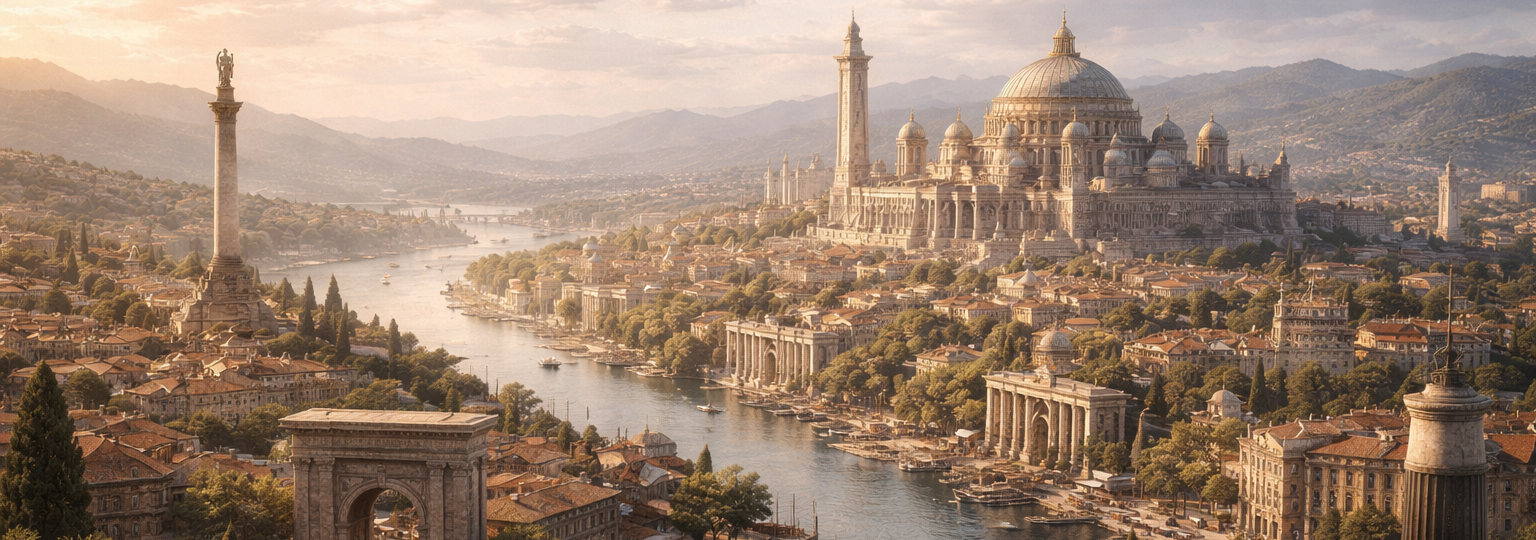
Today, Endor remains one of the largest cities on the continent, rivaling Mittemark in both population and prestige. Its streets are broader, its buildings older, and its monuments more solemn. Marble forums, ancient aqueducts, and weathered triumphal arches stand as reminders of an age when the world answered to Endor alone.
Seat of Ancient Institutions
Though no longer the official capital, Endor still houses many of the most important imperial institutions. The Imperial Library, the greatest repository of knowledge in Enderlin outside of the Great Library of Lóchlindor located in Lóchlindor, draws scholars from every realm. The Imperial Mage Academy, founded in the final centuries of the old empire, continues to shape arcane doctrine and magical law. The Imperial High Court, guardian of ancient legal tradition, still convenes within Endor’s hallowed halls, lending the city immense judicial authority.
Dominating the western quarter of the city stands the Old Imperial Palace, once the primary residence of the emperors. While Mittemark now holds the winter court, the palace has found new life as the Imperial Summer Palace, favored for its milder climate and gentler winters. When the court resides here, Endor briefly feels as it once did—alive with banners, processions, and whispered intrigue.
Geography
Geographically, Endor lies between the fertile provinces of Endor, of witch ists the namesake, and Kornau, surrounded by rolling fields of grain and ancient estate lands. This region, often called the breadbasket of the Kaiserreich, has sustained the city for millennia. Vast granaries, river docks, and Merchant houses line Endor’s waterways, ensuring that even in decline, the city has never known true famine.
Culture
Culturally, Endor is a city of memory. Its citizens take immense pride in their heritage, often seeing themselves as the true heirs of imperial legitimacy. This has fostered a long-standing and complex rivalry with Mittemark. Where Mittemarkers see Endor as stagnant and overly nostalgic, Endorians view Mittemark as an upstart capital—powerful, yes, but lacking the soul of empire.
This rivalry remains one of the defining tensions within the Kaiserreich. Though cooperation is common and open conflict unthinkable, comparisons between the two cities are constant: whose academies are superior, whose courts carry greater weight, whose streets reflect true imperial dignity. In truth, both cities are indispensable—one the living past, the other the ruling present.
Endor is also famed for its monuments and landmarks. The Forum of Founders, where the first imperial charter was proclaimed, still hosts public gatherings and ceremonies. The Obsidian Column, erected after the defeat of the Orc clans of Varrak-Khul, bears the names of fallen legions carved deep into black stone. The Hall of Eagles, once the meeting place of the ancient Imperial Senate, now serves as a ceremonial assembly hall and museum of state.
As dusk falls over Endor, lantern light reflects off stone that has witnessed centuries of triumph and tragedy. Bells toll from towers older than many kingdoms, and the city settles into its familiar rhythm—slower than Mittemark, quieter perhaps, but no less resolute.
Life Within the First Capital
Despite its age and gravitas, Endor is far from a city frozen in solemn remembrance. Beneath the shadow of monuments and marble colonnades thrives a lively urban culture, shaped by generations of scholars, artisans, bureaucrats, and travelers who pass through its gates.
Taverns and Social Life
The most famous tavern in Endor is undoubtedly The Gilded Laurel, an establishment said to have been founded during the reign of the Third Emperor. Located near the Forum of Founders, it is renowned for its honey-dark ale, polished oak interior, and walls lined with faded banners of long-disbanded legions. Scholars argue loudly here, magistrates drink discreetly, and more than one imperial decree has been informally debated over its tables before ever reaching the High Court.
In contrast, the Laughing Griffin, closer to the river docks, caters to merchants, performers, and visiting river sailors. Music spills into the streets most nights, and its reputation for lenient house rules makes it popular with students of the Imperial Mage Academy—much to the disapproval of their instructors.
Food and Culinary Traditions
Endorian cuisine is famous throughout the Kaiserreich for its balance of rustic Kornauan ingredients and refined imperial technique. The city is especially known for Golden Spire Bread, a tall, layered loaf baked in fluted molds, traditionally served during festivals and court sessions alike.
Another local staple is Emperor’s Stew, a slow-cooked dish of grain-fed beef, root vegetables, and dark herbs, said to follow a recipe preserved in the Imperial Palace kitchens since the early empire. Street vendors also sell honeyed nut cakes and spiced river-fish wraps, quick meals beloved by scribes and students.
Entertainment and Spectacle
Endor is home to the legendary Circulus Aeternum, a permanent stone circus and performance ground dating back to imperial antiquity. While no longer hosting gladiatorial combat, it now features acrobats, trained beasts, illusionists, and dramatic historical reenactments—particularly popular are stylized retellings of imperial victories and the defeat of the Orc Clans of Varrak-Khul.
Seasonal festivals often include parades through the old avenues, with performers wearing stylized masks of ancient emperors, mythical heroes, and even satirical depictions of modern Mittemarkers—an indulgence tolerated by the authorities, if not always appreciated.
Customs and Character
Endorians are widely regarded as courteous, verbose, and quietly stubborn. They favor long-form debate over hasty decisions and tend to reference historical precedent even in mundane matters. A common saying within the city is: “Nothing is new in Endor—only rediscovered.”
While they outwardly respect Mittemark’s authority, many Endorians privately believe that true imperial culture can only be learned, not proclaimed. This belief manifests less in rebellion and more in subtle condescension, academic rivalry, and an unwavering confidence in their city’s enduring relevance.
Endor no longer commands the empire, but it defines it. To walk its streets is to walk through history itself, and as long as the Kaiserreich endures, the First Capital will remain its conscience, its memory, and its enduring symbol of what empire once was—and might yet be again.

Comments