
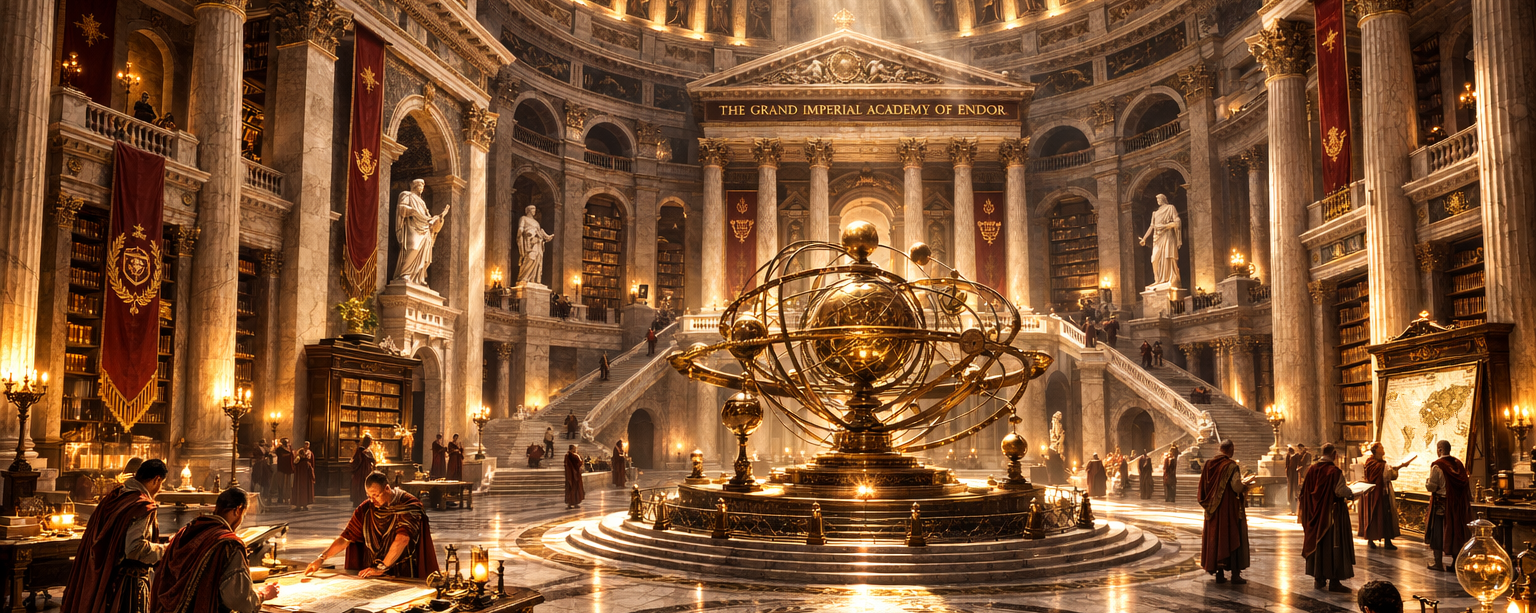
Grand Imperial Academy
The Grand Imperial Academy of Endor
Also known as the Endor Imperial Institute of Science
Within Endor's vast academic quarter—where colonnades echo with centuries of debate and ink-stained scholars hurry beneath vaulted ceilings—stands one of the most influential institutions in all of Enderlin: the Imperial Endor Academy.
It is not a temple, nor a mage’s tower.
It is a university.
Founded under imperial charter during the early consolidation of the Enderlinian Empire, the Academy was established with a singular mandate: to pursue knowledge through observation, reason, measurement, and proof. Where other institutions bend toward theology or arcane speculation, the Academy concerns itself with the tangible world.
It teaches every branch of science known to Enderlin.
It teaches none devoted to religion or magic.
Over generations, the Academy has grown into the intellectual heart of the Empire—its scholars advising architects, generals, physicians, shipwrights, and lawmakers alike. To graduate from its halls is to carry not faith, but evidence.
The Academy Complex
The Imperial Endor Academy is not a single hall but a sprawling complex of lecture theatres, laboratories, archives, observatories, botanical courts, and anatomical chambers. Built in layered expansions over centuries, the architecture reflects its evolution—from ceremonial imperial stonework at its façade to increasingly practical, functional interiors designed for study and experimentation.
Stone gives way to wood.
Ceremony gives way to inquiry.
Tall windows admit steady light into drafting galleries. Courtyards house experimental gardens. Subterranean vaults preserve specimens in alcohol and salt. Towers rise above the city skyline, crowned with instruments that track the heavens.
The Academy is organized into several primary Faculties.
The Faculty of Natural Philosophy
The oldest and most storied division of the Academy, the Faculty of Natural Philosophy studies the laws governing the physical world.
Here scholars investigate:
- Motion, mechanics, and structural engineering
- Optics, acoustics, and applied mathematics
- Astronomy and celestial mapping
- Early theories of energy, pressure, and force
Within its lecture halls, demonstrations are common—falling weights, rotating armatures, calibrated lenses, and carefully measured experiments performed before silent rows of students.
Its astronomical observatory is among the most precise in Enderlin, and its celestial charts are used by navigators across the continent.
The Faculty of Biological Sciences
Expanding from early anatomical studies, this faculty encompasses zoology, botany, medicine, and ecology.
Its eastern galleries house preserved specimens: articulated skeletons, scaled reptiles suspended in glass cylinders, pressed flora catalogued by region and climate. Each entry is labeled in careful script—taxonomy, origin, ecological niche, and contested classification notes layered across generations.
Beyond the specimen halls lie controlled observation chambers:
- Humid vivariums replicating jungle climates
- Dry terrariums simulating arid regions
- Aquatic basins modeling river and coastal ecosystems
Here, behavior is recorded over months and years. Molting cycles are charted. Feeding responses documented. Diseases studied not as curses—but as biological phenomena.
The Academy’s physicians are trained first as scientists.
The Faculty of Geography and Environmental Studies
Born from imperial cartography, this division studies geography, geology, hydrology, and climate systems.
What began as mapmaking has expanded into a discipline of planetary understanding.
Students chart river basins, analyze soil composition, study erosion patterns, and model seasonal wind currents. Survey instruments line preparation rooms beside oilskin-bound field journals. Standardization is emphasized: discovery means nothing without replication.
Its research has reshaped agriculture, mining practices, and long-distance trade routes throughout the Empire.
The Faculty of Engineering and Applied Mechanics
Where theory meets construction.
This faculty develops structural design principles, mechanical systems, hydraulic devices, and early industrial innovations. Prototypes line workshop halls—gear assemblies, reinforced bridge models, pressure vessels, irrigation pumps.
Imperial infrastructure often begins here.
Graduates serve as chief engineers in cities, naval yards, and fortifications across Enderlin.
The Faculty of Civic and Analytical Sciences
Though devoted to science, the Academy also studies systems of governance, economics, and demography—through data rather than doctrine.
Population trends are measured. Trade flows mapped. Urban sanitation modeled. Statistical reasoning is taught alongside rhetoric and logic.
It does not teach law as theology.
It teaches governance as structure.
The Explorers’ Guild
Operating as the Academy’s sanctioned field arm, the Explorers’ Guild began as a cartographic initiative under imperial commission.
Geography led to biology.
Biology led to ecology.
Curiosity became doctrine.
Guild members conduct expeditions beyond Endor, returning with maps, specimens, soil samples, and documented observations. Each journey must be formally sanctioned. Each claim must survive review.
Failed expeditions are recorded—not erased.
At the heart of the Explorers’ Guild stands the Hall of Expeditions, where maps stretch from floor to ceiling. New ink is never applied casually. Every mark represents verified return.
The Chamber of Review
All major findings pass through layered scrutiny.
Claims of new species, geological anomalies, engineering breakthroughs, or statistical theories are reviewed by senior scholars in a severe chamber known simply as the Chamber of Review.
Comparative morphology.
Habitat plausibility.
Mathematical consistency.
Reproducibility of results.
Ambition is tested against precedent.
Reputation is earned slowly.
Leadership
The Academy is governed by the Imperial Academic Council, composed of elected senior scholars from each Faculty. While it operates under imperial charter, it maintains a fiercely guarded intellectual independence.
The current High Chancellor, Magistrate Corvin Hale, is known less for oratory and more for procedural reform. Under his leadership, inter-faculty collaboration has expanded, and standardized scientific methodology has been codified across all disciplines.
Influence Across Enderlin
The Imperial Endor Academy’s reach extends far beyond its stone walls.
- Imperial bridges are built using its engineering principles.
- Naval expeditions rely on its astronomical tables.
- Physicians trained in its halls serve in every major city.
- Agricultural reforms trace back to its soil studies.
Where temples claim truth through revelation, the Academy claims it through measurement.
In a world where magic and faith shape much of society, the Imperial Endor Academy stands apart—not in opposition, but in method.
It preserves what is known.
It questions what is claimed.
It refuses what cannot be tested.
And though some whisper that the age of discovery is nearing its end, the Academy’s laboratories remain full, its maps still contain blank spaces, and its scholars continue to ask the most dangerous question of all:
How do we know?
General Stats:
Type: Imperial University / Scientific Institution
Founded: 24 IA
Location: Academic Quarter, Endor, Kaiserreich Mittemark
Population: ~6,800 (scholars, students, researchers, engineers, explorers, administrative staff)
Inhabitants: Scientists, physicians, engineers, cartographers, statisticians, natural philosophers, and Explorers’ Guild members
Primary Faculties:
- Faculty of Natural Philosophy (physics, mathematics, astronomy)
- Faculty of Biological Sciences (medicine, zoology, botany, ecology)
- Faculty of Earth & Environmental Studies (geography, geology, climatology)
- Faculty of Engineering & Applied Mechanics
- Faculty of Civic & Analytical Sciences (economics, demography, statistics, governance systems)
Main Features:
- Grand Astronomical Observatory
- Hall of Expeditions
- Chamber of Review
- Imperial Cartographic Archives
- Anatomical Theatres & Specimen Galleries
- Applied Mechanics Foundry Complex
Governance: Imperial Academic Council, led by the High Chancellor
Notable Exports:
- Engineering schematics and infrastructure designs
- Astronomical charts and navigation tables
- Medical research and trained physicians
- Standardized surveying methods
- Statistical and economic models used in imperial administration
Notable Imports:
- Specimens and samples from across Enderlin
- Survey data and expedition records
- Rare minerals and biological curiosities
- Foreign engineering texts and scientific manuscripts
Defenses:
- Imperial charter protection
- Structural fortification integrated into architecture
- Throne Guard

Comments