
Mittemark
General Description
Mittemark is the proud and vibrant capital of the Kaiserreich Mittemark, the principal successor state to the once-mighty Enderlinian Empire that ruled the breadth of the continent of Enderlin. When the empire fractured and its old heartlands splintered, Mittemark emerged as the strongest inheritor—not by conquest, but by blood, culture, and the possession of the empire’s most developed and prosperous core territories.
The city itself was not the throne of the old empire—that honor belonged to Endor, the venerable First Capital. But after the imperial collapse, Mittemark’s location, resource-rich surroundings, and resilience allowed it to rise swiftly to prominence. Over time, it became the new seat of imperial authority, a role it now embraces with a blend of pride and rivalry.
From Throne to Modern Capital
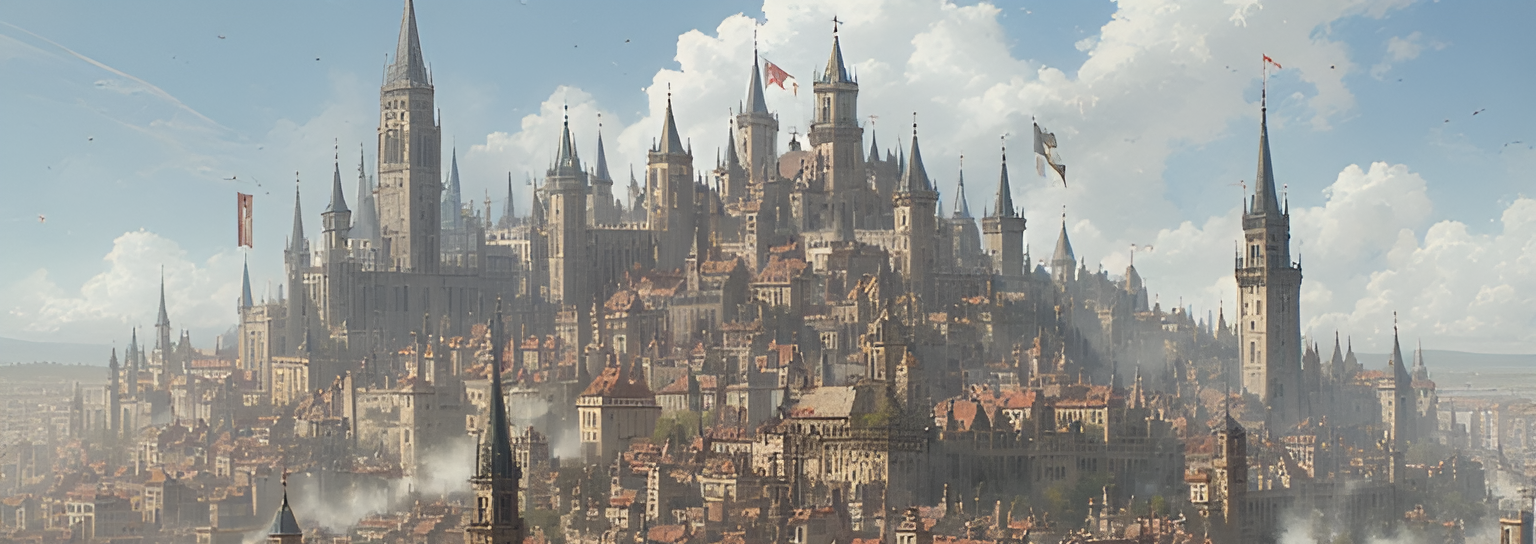
Today, Mittemark stands as one of the largest and most influential cities on the continent, home to nearly 250,000 inhabitants. Its reputation is built on centuries of resilience, culture, and political power. The skyline is dominated by the Imperial Palace, the Imperial Diet, and the great halls of the Imperial House of Commerce, institutions that uphold the dignity and legacy of the Kaiserreich.
Forests surround much of the region, with scattered pockets of farmland feeding parts of the population. Yet Mittemark’s vast size means it depends heavily on the fertile western provinces of Kornau and Endor, the empire’s famed “breadbasket.” Centered around the old capital of Endor, Kornau’s and Endor's endless fields of grain and rich agricultural estates keep the imperial capital fed. Without Kornau’s bounty, Mittemark would face hunger within weeks.
Seat of Imperial Authority
Mittemark is the administrative and ceremonial heart of the Kaiserreich. The Imperial Palace houses the winter court and serves as the residence of the Kaiser. The Imperial Diet convenes within its grand chambers, while the halls of the Imperial House of Commerce settle trade disputes and regulate commerce across the empire, serving as the central hub for economic and mercantile authority. Additionally, the Imperial War Academy trains the empire’s officers and strategists, reinforcing Mittemark’s role as the center of military education and planning.
While Endor retains much of its historical and scholarly importance, Mittemark’s institutions are oriented toward governance, politics, and military organization, reinforcing the city’s role as the beating heart of contemporary imperial power.
Geography
Strategically, Mittemark lies at the confluence of the River Endor and the River Spree, whose joined waters flow eastward toward the Inland Avalon Sea and the grand port city of Rivendam. This makes Mittemark a natural crossroads for trade, diplomacy, and military logistics.
Its surrounding forests and nearby farmland provide natural resources, while river transport allows for efficient movement of goods and people. The city’s position has been a key factor in its economic and political dominance.
Culture
Culturally, Mittemark is a city of ambition and influence. It maintains a long-standing—sometimes friendly, sometimes bitter—rivalry with Endor, the cradle of the old empire. Where Endor boasts ancient prestige, Mittemark counters with growth, political dominance, and the energy of a thriving metropolis.
Mittemark is also known for its monuments and landmarks. The Imperial Palace, the Diet Hall, and the Commerce Halls are all symbols of authority. Public squares host festivals, military parades, and civic celebrations that emphasize the city’s prominence and power.
Life in the Imperial Capital
Mittemark is far from a city solely of politics and bureaucracy. Beneath the imposing spires of the Imperial Palace and the busy halls of the Imperial House of Commerce, a lively urban culture thrives. Merchants, guildmasters, officers, and scholars all intermingle in bustling marketplaces, workshops, and streets that echo with commerce and ambition.
Taverns and Social Life
The most renowned tavern in Mittemark is The Silver Eagle, known for its robust amber ale, smoky roast meats, and walls lined with portraits of many great imperial victories and spoils of war. Here, merchants haggle, officers exchange news of campaigns, and city officials discuss policy over steaming mugs.
Another popular spot is The Emperor's Rest, catering to traveling dignitaries and visiting merchants. Its walls are lined with portraits of every emperor of the Enderlinian Empire, from Reinhard the First, the founding emperor, to Reinhard the Third, the last of the old imperial line, and the current emperor of Mittemark. The tavern is famed for its lavish seafood platters and strong spiced wine, and on certain nights, street performers and musicians fill the courtyard with lively entertainment.
Smaller inns and taverns cater to students from the Imperial War Academy and clerks from the House of Commerce, offering quick meals like hearty meat pies, spiced sausages, and riverfish skewers, often enjoyed with frothy ales or local ciders.
Food and Culinary Traditions
Mittemark’s cuisine reflects its position as the empire’s political and economic hub. Signature dishes include Kornauan Grain Stew, a filling mixture of local grains, root vegetables, and smoked meats; Imperial Roast Duck, glazed with honey and herbs; and Layered Almond Cakes, often served during festivals or at guild banquets.
Street vendors line the market squares selling quick snacks such as cheese-filled pastries, salted pretzels, honey-drizzled nuts, and spiced riverfish wraps, popular among the busy city officials and academy cadets.
Entertainment and Spectacle
Mittemark hosts the grand Imperial Amphitheater, where theatrical plays, mock battles, and jousting tournaments are performed. Seasonal parades and civic celebrations fill the streets with music, banners, and ceremonial processions. Merchants often sponsor performances in the grand Imperial Market, while the War Academy stages military drills for the public during national holidays.
Festivals are occasions of grandeur: banners of the Mittemark Dynasty flutter, orchestras play in open courtyards, and fireworks illuminate the riverbanks, reinforcing the city’s image as the empire’s thriving heart.
Customs and Character
Mittemarkers are ambitious, pragmatic, and politically minded. They value efficiency, loyalty to the Kaiser, and the projection of imperial strength. Social interactions are often framed by negotiation, debate, or the exchange of favors. While respectful of Endor’s cultural prestige, Mittemarkers pride themselves on innovation, growth, and maintaining the empire’s stability and prosperity.
A common saying in the city reflects their ethos: “In Mittemark, the empire moves forward, not backward.” Residents take pride in their city’s institutions, from the Diet to the War Academy, and the streets pulse with the confidence of a capital that commands both commerce and power.
Mittemark is not just a city of stone and timber; it is the beating heart of the Kaiserreich. Its streets, halls, and markets reflect centuries of resilience, ambition, and the enduring power of a city that rose to inherit the legacy of a fractured empire.

Comments