

Common
Common (Enderian)
Common is the most widely spoken and understood language in Enderlin, serving as the primary tongue of trade, diplomacy, governance, and everyday communication—particularly within realms ruled by humans or shaped by human influence.
Its dominance began during the height of the Enderlinian Empire, when imperial decree established Common as the official administrative language of law, taxation, military command, and record keeping. Imperial officials, merchants, and soldiers carried the language across the continent, embedding it deeply into public life. Even after the empire’s eventual collapse, Common endured, its usefulness and familiarity ensuring its survival long beyond imperial authority.
Origins and Development
At its core, Common remains firmly rooted in Old Human (Enderian), the language spoken by the first human settlers when they arrived in Enderlin roughly 1,500 years ago. The fundamental grammar, sentence structure, and much of the everyday vocabulary still derive directly from Old Human.
As humans expanded and came into sustained contact with other peoples—elves, dwarves, halflings, dragonborn, and more—the language gradually absorbed a vast number of loanwords, expressions, and subtle linguistic influences from these cultures. Elven terms entered Common through magic, scholarship, and diplomacy; dwarvish words through craftsmanship, engineering, and warfare; halfling phrases through trade and travel; and dragonborn honorifics through formal and ceremonial speech.
Rather than replacing its roots, these influences layered upon them, shaping Common into a human language adapted for a multicultural world.
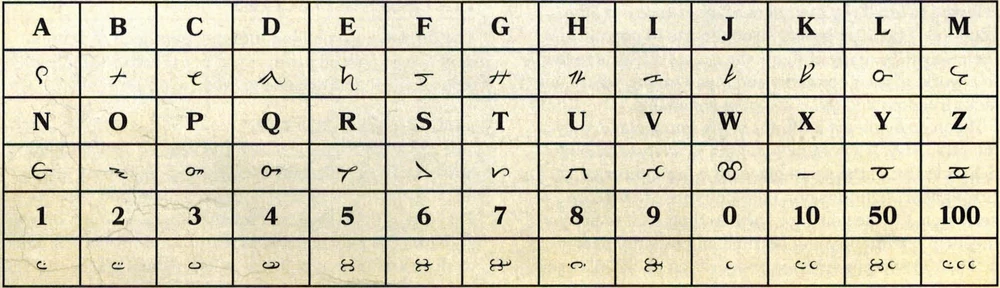
This image shows Old Human (Enderian) next to the Common Script.
Use in Modern Enderlin
Today, Common functions as the lingua franca of the continent. Most cities, ports, and trade hubs conduct business in Common, even when other languages dominate private or cultural life. Contracts, treaties, bounties, and public notices are almost always written in Common.
While pronunciation, idioms, and slang vary widely from region to region, speakers of Common can usually understand one another with minimal difficulty. Accents often betray a speaker’s homeland or native tongue, but rarely hinder communication.
Dialects
Nearly every country and region in Enderlin has developed its own dialect of Common, shaped by local culture, climate, and neighboring languages. Some dialects are so distinct in pronunciation, vocabulary, and idiomatic expression that outsiders might mistake them for separate languages. Despite these differences, the standard form of Common—taught in schools and used in official documents—ensures that speakers of any dialect can communicate effectively.
In general:
- All humans on the continent of Enderlin speak the standard form of common.
- In almost every country many people still speak a local language that is related too common as they have the same roots in the old human language.
All speakers of Common, regardless of origin, can rely on the standard form to bridge these differences, ensuring mutual intelligibility across Enderlin.
Cultural Perception
Among humans, Common is often viewed as natural and unremarkable—the language of daily life. Among nonhuman peoples, opinions vary: some see it as a practical necessity, others as a reminder of human dominance, and a few resent its spread as cultural erosion.
Despite these tensions, few deny its usefulness. In Enderlin, if two strangers share no other language, Common is the language they try first.
Native Name: Enderian (Old Human root)
Script: Common Script (derived from Old Human runic cursive)
Primary Speakers: Humans; widely spoken by most other races
Geographic Spread: Continent-wide across Enderlin
Status: Lingua franca; official language of law, trade, and diplomacy
Origin:
Evolved from Old Human, later influenced by Elvish, Dwarvish, Halfling, and Draconic languages during the Enderlinian Empire.
Dialects:
Numerous regional accents; grammar remains largely standardized.
Ease of Learning:
Easy — designed through centuries of use as a shared tongue.

Comments