

Draconic
Draconic (Glav / Iokharic)
Draconic, known among scholars as Glav (“speech” or “converse”), is the ancient tongue of dragons and their descendants. In Enderlin it is most closely associated with Dragonborn and Kobolds, though its influence reaches far beyond those peoples. To speak Draconic is to echo the language of the Dragon Age itself—a tongue shaped by fire, command, memory, and divine authority.
While most dragonborn and kobolds speak Common fluently, Draconic remains the language of ritual, oath, prayer, and formal declaration, especially within the Emirate of Zaharat AL-Nar, where it is treated not merely as a language, but as a sacred inheritance.
Origins and Development
Draconic is among the oldest mortal languages known in Enderlin. Dragonborn tradition holds that it predates all other tongues, gifted—or imposed—upon the world by the first true dragons, far before the Dragon Age. Whether this claim is literal or symbolic remains debated, but few scholars deny Draconic’s profound influence on later languages.
The earliest known form of Draconic, often referred to by scholars as Auld Wyrmish, was spoken long before recorded history. Over time, it evolved into more recognizable forms, including Aragrakh, before stabilizing into what is now known as modern Draconic. Despite its age, the language has changed far less than most mortal tongues, a fact often cited by dragonborn priests as evidence of its divine origin.
Both kobold Yipyak dialects and dragonborn formal Draconic descend directly from these ancient forms, preserving elements lost in other languages.
Dialects and Regional Forms
Draconic is not a single, uniform tongue. Dragons themselves speak numerous dialects, shaped by ancestry and temperament. In Enderlin, however, several forms are most commonly encountered:
- Ashenfire Draconic (Tymantheran) — The formal, ritualized dialect spoken by dragonborn of Zaharat al-Nar. This version emphasizes clarity, authority, and precise pronunciation, and is used in prayer, law, and state doctrine.
- Dragonborn Common Draconic (Tymantheran common) — A more conversational form spoken by dragonborn living outside Ashenfire, often softened by local accents and Common loanwords.
- Kobold Draconic (Yipyak) — A faster, sharper dialect marked by clipped syllables and communal phrasing, reflecting kobold social structures and survival-focused culture.
Despite these differences, most speakers of Draconic can understand one another with relative ease, particularly in formal or ritual contexts.
Script and Written Use
Draconic uses its own ancient writing system known as Iokharic, a script of sharp angles, sweeping curves, and deliberate spacing. Each character is designed to be carved into stone, obsidian, or metal—materials favored by dragonkind.
In Zaharat al-Nar, Iokharic is omnipresent:
- Temple inscriptions
- Legal decrees
- Military oaths
- Religious texts dedicated to Bahamut
Outside Ashenfire, written Draconic is most commonly encountered in arcane tomes, ancient ruins, and scholarly treatises, as the language is widely used for magical theory due to its precision and emphasis on intent.
Among kobolds, written Draconic is rare but deeply respected, often reserved for clan records, warnings, or sacred markings.
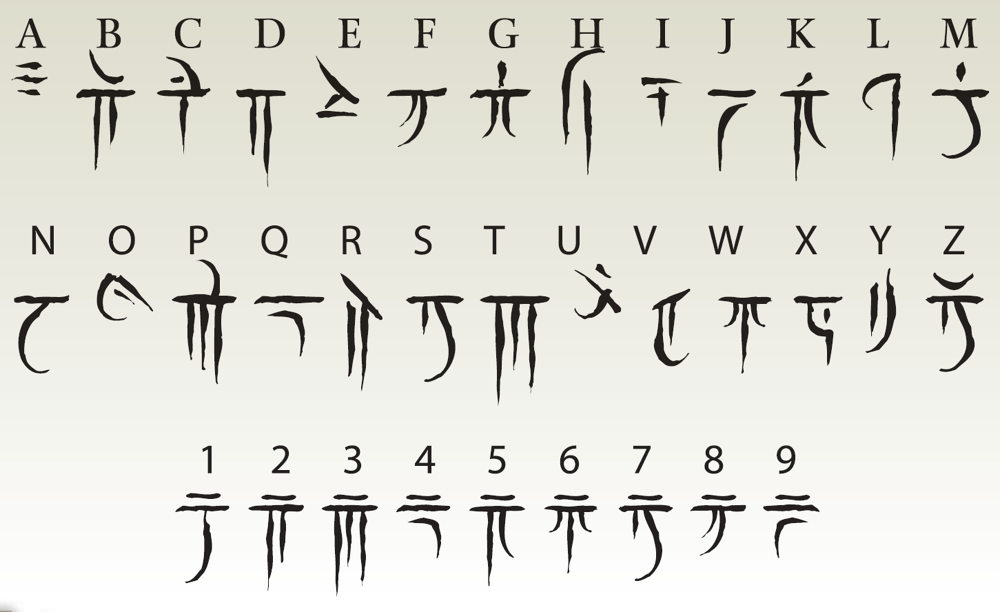
Example of the Iokharic alphabet.
Use in Modern Enderlin
Draconic remains a living language, though its use is highly contextual.
Common uses include:
- Religious rituals and prayers to Bahamut
- Formal oaths, vows, and declarations of honor
- Arcane study and magical notation
- Communication within dragonborn or kobold communities
- Commands or warnings meant to carry weight and authority
In everyday conversation, most dragonborn default to Common, particularly outside Ashenfire. However, switching to Draconic—especially mid-sentence—is often used to emphasize seriousness, dominance, or sacred intent.
Among kobolds, Draconic is frequently mixed with gestures and tonal emphasis, preserving older speech patterns that scholars believe echo ancient draconic commands.
Cultural Significance
To dragonborn, Draconic is not merely ancestral—it is proof of divine proximity. Speaking it correctly is seen as a reflection of discipline, faith, and respect for Bahamut’s order. In Zaharat al-Nar, misusing Draconic in ritual contexts is considered irreverent at best and heretical at worst.
Kobolds, by contrast, view Draconic as a language of survival and legacy. It connects them to dragons who once ruled the world and to gods who shaped their fate, even when those gods are feared or resented.
Across Enderlin, the sound of Draconic still carries an instinctive weight. Even those who do not understand it often recognize its tone—commanding, ancient, and unyielding.
Names and Vocabulary
Dragonborn and kobold names often retain Draconic roots, even when adapted into Common pronunciation.
Common Dragonborn Names
Azharakul
Razeem
Tharaxys
Valkyrr
Zahryx
Molgrax
Common Kobold Names
Yip
Sska
Krix
Talsh
Vree
Nok-Nok
Selected Draconic Terms
glav — speech, language
iokhar — written word, law
zahra — fire, sacred flame
thar — honor-bound oath
baham — justice, divine judgment
korth — clan, sworn kin
ashkar — trial, crucible
Many of these words appear unchanged in dragonborn-accented Common, particularly in religious or military contexts.
Native Name: Glav (also called Draconic or Iokharic in scholarly Common)
Script: Iokharic Script (ancient draconic alphabet)
Primary Speakers: Dragonborn, Kobolds; studied by mages and scholars
Geographic Spread: Ashenfire (Zaharat al-Nar), dragonborn enclaves, kobold clans; encountered in arcane and religious texts across Enderlin
Status: Sacred, ancestral, and ritual language; widely respected but rarely used casually
Origin:
One of the oldest known mortal languages, believed by dragonborn tradition to predate all others. Draconic emerged somewhere during the Ancient Age, shaped by true dragons and later inherited by their mortal descendants. Early forms such as Auld Wyrmish and Aragrakh influenced numerous later tongues, particularly among draconic and reptilian peoples.
Dialects:
Numerous dialects tied to draconic ancestry and culture. Dragonborn of Zaharat al-Nar speak a formal, ritualized dialect called Tymantheran; kobolds use a faster, clipped variant known as Yipyak. True dragons possess distinct dialects that can differ as greatly as separate languages, though most forms remain partially intelligible.
Ease of Learning:
Moderate to Difficult — complex phonetics, strict emphasis patterns, and precise grammar. Spoken fluency requires discipline, while written mastery of Iokharic is considered a scholarly or religious achievement.

Comments