

Elvish
Elvish (The True Tongue)
Known among elves as the True Tongue, Elvish is one of the oldest living languages in Enderlin and among the most influential tongues ever spoken on the continent. To the elves, it is not merely a means of communication but the closest expression of thought, memory, and identity—a language believed to reflect the world as it should be, rather than as it is.
Elvish is renowned for its fluid sound, melodic cadence, and immense expressive depth, making it exceptionally suited for poetry, music, philosophy, magic, and the study of the natural world. Even when spoken plainly, it carries rhythm and emotion that many other languages lack.
Unlike Common, Elvish was never spread through conquest or decree. Instead, it endured through culture, scholarship, and reverence, carried by elven diplomats, mages, historians, and artists across the ages.
Origins and Early History
Elvish predates all known Humans languages and many nonhuman tongues. Its exact origin is unknown even to the elves themselves, a fact they regard not as a failure of history, but as evidence of the language’s sacred antiquity.
What is known is this: Elvish did not originate in Enderlin.
The True Tongue was first spoken on Aelthirion, the vast elder continent beyond the known seas, larger even than Enderlin itself. According to ancient elven records, Elvish developed there long before the Star Age, likely shaped by early elven civilization in close communion with magic, moonlight, and the natural world.
Several surviving pre-Star Age texts suggest that the language was refined or formalized by the Moon Elves of Aelthirion, whose scholars and poets are believed to have standardized much of its grammar and script. Whether they were its creators or merely its greatest preservers remains a subject of debate among elven historians.
At the dawn of the Star Age, roughly 2,500 years ago, the first elven fleets crossed the ocean from Aelthirion to Enderlin, navigating by the newly visible stars. With them, they carried the True Tongue, introducing Elvish to the continent long before Common or Imperial law ever existed.
What is beyond dispute is that Elvish predates Old Human by centuries and served as a root language, influencing later elven dialects and contributing heavily to arcane, druidic, and philosophical terminology across many cultures.
Structure and Expression
The True Tongue is a highly nuanced and contextual language. Tone, rhythm, vowel length, and word order subtly alter meaning, allowing a single phrase to convey layered emotion—reverence, sorrow, warning, longing—without changing vocabulary.
Elvish excels at expressing:
- Emotional states and inner reflection
- Natural cycles and subtle environmental changes
- Magical theory and metaphysical concepts
- Memory, fate, and the passage of time
However, it has limited vocabulary for industry, engineering, or mechanical processes, reflecting elven cultural priorities. For this reason, Elvish is rarely used for legal codes, military logistics, or technical manuals.
Written Form — Espruar Script
Elvish is written using Espruar, a graceful, flowing script designed to mirror the language’s musical and emotional depth.
Espruar consists of sixty-two characters, with an exceptionally rich vowel system. Where Common typically uses a single vowel sound, Espruar often provides four or more distinct vowel forms, allowing writers to convey tone, emphasis, and emotional context directly through spelling.
The script is most commonly seen:
- Engraved on jewelry, monuments, and ceremonial items
- Inscribed on magic items and arcane texts
- Used in ancient elven records and star-lore
Because of its elegance and flexibility, Espruar has been adopted as the writing system for several other languages, including:
- Sylvan
- Undercommon
- Aquan
- Certain regional tongues influenced by elven culture
It is also commonly used by mortal scholars to record Deep Speech, which has no native script of its own. While effective, this usage is often regarded by elves as deeply unsettling.
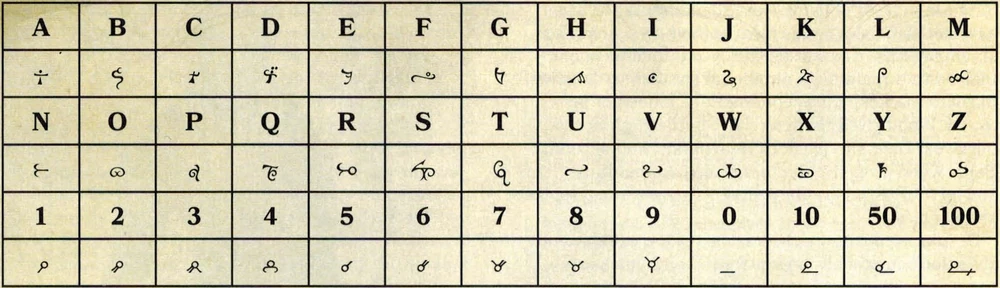
Elvish too common direct translation.
Use in Modern Enderlin
In the present age, the True Tongue is spoken primarily within:
- Elven realms such as Lóchlindor and Elenvaleis
- Elven households, temples, and cultural institutions
- Arcane circles, druidic traditions, and historical scholarship
Outside elven lands, Elvish is most often encountered in formal names, magical terminology, ancient inscriptions, and ceremonial speech. Many educated non-elves—particularly wizards, bards, and diplomats—learn a scholarly form of the language.
In the Kingdom of Cormerault, Elvish holds a unique position. Centuries of coexistence and intermingling have led to a ruling class dominated by half-elves, making full-blooded elves rarer than elsewhere. Though Common governs administration, Elvish remains a language of heritage, legitimacy, and noble tradition.
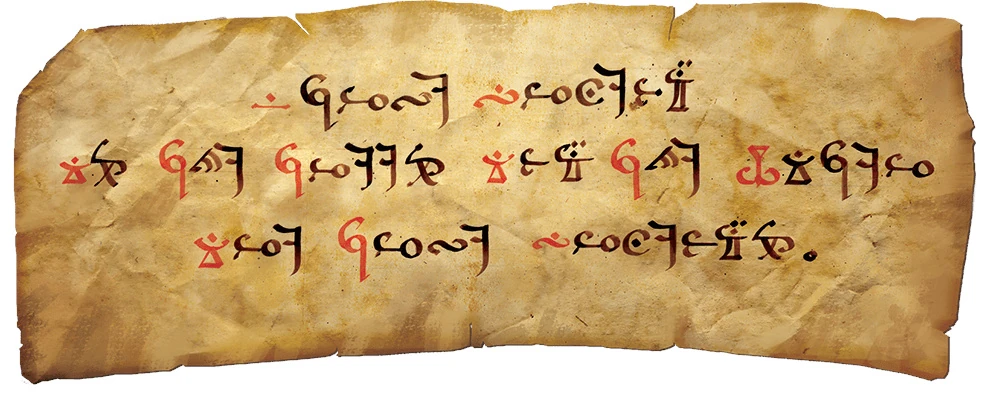
Example of Espruar Script saying:
"A true friend As the trees and the water Are true friends."
Cultural Perception
To elves, calling their language the True Tongue is not arrogance but belief: it is seen as the language closest to the original harmony of the world. Speaking it correctly is a sign of respect, while careless or crude usage can be deeply offensive.
Among non-elves, Elvish is often perceived as:
- Beautiful but difficult
- Ancient and enigmatic
- Closely tied to magic, stars, and forgotten ages
Some view its continued use as aloof or exclusionary; others see it as a bridge to knowledge older than any empire. Regardless of opinion, Elvish is spoken not for convenience, but for meaning, memory, and wonder.
Where Common is the language of the present world,
the True Tongue is the language of the stars—and of what was lost before history began.
Names in the True Tongue
Elven names are traditionally given in Elvish, with meanings tied to nature, memory, stars, or personal virtue. To an elf, a name is not merely an identifier, but a reflection of essence and intention. Many elves receive additional names over the course of their long lives—honorifics, poetic epithets, or private names known only to family or close companions.
In dealings with non-elves, elven names are often simplified or adapted into Common-friendly forms. While this practice is accepted for convenience, it is rarely preferred among elves themselves.
Common Elven Given Names (Male)
Aelar
Elarion
Faelar
Letharion
Sylvaris
Thalanil
Vaerion
Common Elven Given Names (Female)
Aelira
Calenwe
Ilyrana
Lethiel
Naivara
Sylwen
Thiriel
Common Elven Family Names / Line Names
Moonwhisper
Starbloom
Dawnpetal
Silverfrond
Nightwillow
Ashenleaf
True elven family names often carry deeper, poetic meanings in Elvish that are difficult to translate fully into Common. As a result, Common renditions tend to capture imagery rather than literal meaning.
Among elves, addressing someone by their full Elvish name is a sign of respect or intimacy. Conversely, shortening or altering a name without permission—especially in the True Tongue—is considered rude at best and insulting at worst.
To know an elf’s name as it is spoken among their own people is to be trusted with a small but meaningful part of who they are.
Native Name: The True Tongue (Elvish self-name)
Script: Espruar (graceful, vowel-rich elven script)
Primary Speakers: Elves; also studied by mages and scholars
Geographic Spread: Elven realms in Enderlin; originated in Aelthirion
Status: Ancient and prestigious; language of magic, culture, and history
Origin:
Brought to Enderlin by the first elves arriving by sea at the beginning of the Star Age. Developed on Aelthirion, likely refined by early Moon Elf civilizations; its earliest origins are unknown even to elves.
Dialects:
Distinct cultural dialects by elven group; generally mutually intelligible (e.g. Wood Elves of Elenvaleis and Moon/High Elves of Lóchlindor).
Ease of Learning:
Moderate to Difficult — nuanced vocabulary and layered meanings.

Comments