
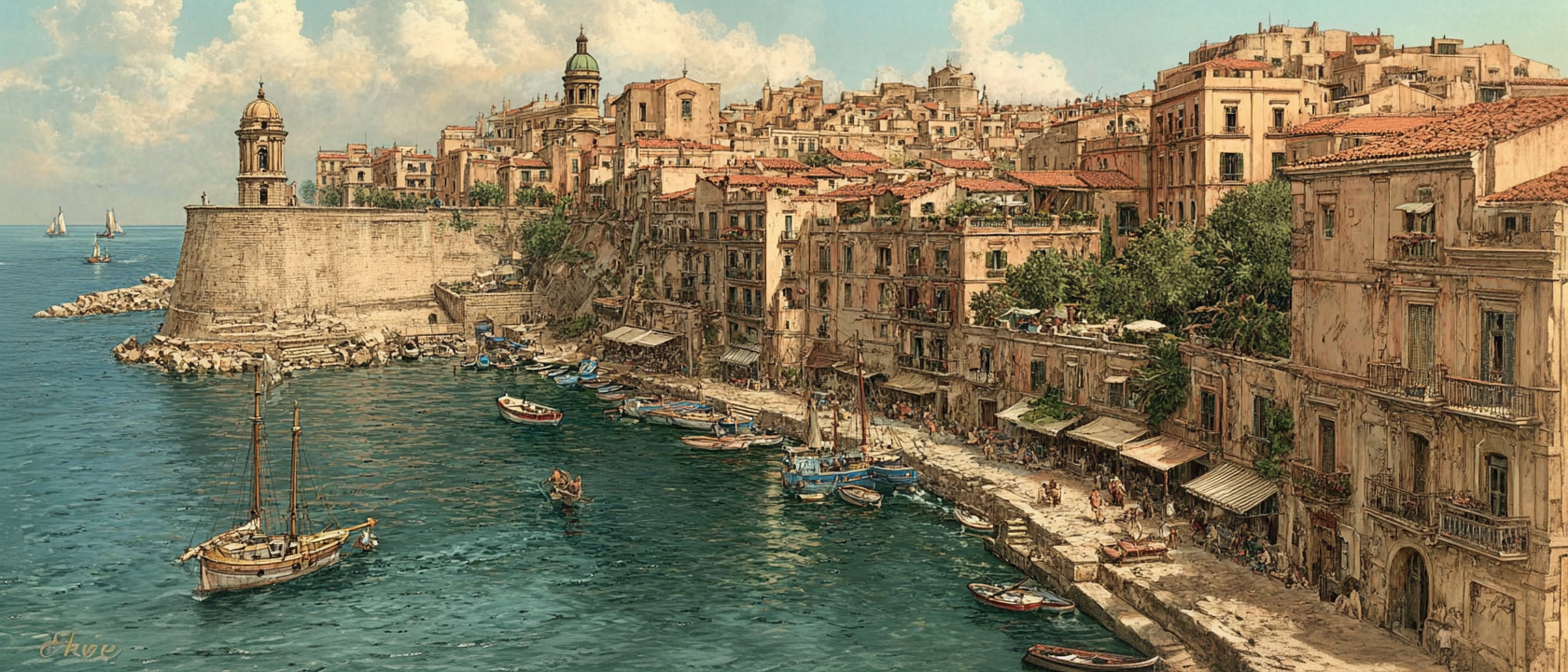
OSTIA AUSTRALIS
The Eastern Coast · Town · Provincia Australis
Ostia Australis is not interested in being Portus Meridiani and has made this clear, over the centuries, through the specific method of being exactly what it is and declining to be anything else. It is a fishing town and a salt town and a place where the boats go out and come back and the catch is processed and the salt is packed and the day ends with the kind of tired satisfaction that physical work in productive conditions produces. Nova Romae finds this either admirable or unglamorous depending on which senator you ask, and the people of Ostia Australis find Nova Romae's opinion on the subject interesting in the way that people find things interesting when they have no particular need to act on them.
Ostia Australis sits on the southern coast approximately 150 kilometres east of Portus Meridiani, where a natural bay with a sheltered inner harbour has supported the province's primary fishing fleet for as long as the province has existed. Its thirty-five thousand residents are organised around the sea in the particular way of coastal fishing communities that have been doing the same work in the same place for a very long time: the fishing fleet's rhythms are the town's rhythms, the seasonal patterns of the southern coast fisheries are the town's calendar, and the collective knowledge of where the fish are and when is the community's most valuable asset, more carefully held than the salt pans' output records and more jealously protected from outside assessment than any other piece of commercial information in the province.
The fishing community's relationship with Rome is the specific relationship of people who cooperate readily on everything that does not touch their boats and become comprehensively unhelpful on everything that does. This is not hostility. The town pays its taxes, maintains its civic obligations, responds to official correspondence with appropriate promptness on civic matters, and provides the provincial administration with the documentary cooperation that a well-functioning community offers to its governing authority. It does not provide accurate catch volume data. It does not permit independent surveys of the offshore fishing banks whose location and seasonal behaviour the community treats as collective property. And it maintains, in careful collective silence, the arrangement that has existed for decades between the town's blue-water fishing boats and the waters that, under their official licenses, they are not supposed to reach.
I have spent more time in Ostia Australis than my professional obligations strictly required. It is the most honest community I have encountered in sixty years of observing Roman provincial life — honest in the specific sense of being precisely and completely what it presents itself as, without the layer of institutional performance that most communities maintain for the benefit of visitors who might be useful. It fed me very well. It told me a great deal about fishing and almost nothing about the things I most wanted to understand. I consider this a successful relationship from both sides.
Demographics
Thirty-five thousand permanent residents organised around the maritime economy with the social density of a community that has been working together in conditions requiring mutual dependence for long enough that the social structure has become inseparable from the economic one. The fishing families are the town's primary demographic — households whose relationship to specific boats, specific banks, and specific seasons has been passed down for generations. The salt families are fewer in number but comparable in social weight: the three families controlling the salt pan operations have a multigenerational claim on that productive function that the fishing families respect because they depend on each other's outputs. The processing and service community — the people who salt the fish, pack the barrels, maintain the boats, supply the fleet — is the town's largest working population and the one whose daily life is most visibly connected to the harbour's rhythm.
Non-Roman residents are fewer here than in Portus Meridiani — the town's economic focus on primary production rather than trade transit means it does not generate the commercial diversity that attracts the halfling commercial presence. There are, by Varro's count on his most recent visit, approximately two hundred halfling residents, almost all of them connected to the Merchant Council's quiet monitoring operation that tracks the blue-water fishing boats' movements without acknowledging that it does so.
Government
The town prefect, Aulus Piscator Salis, fifty-eight, in his ninth year, is a local man — the first prefect in three generations to have been born in the town rather than appointed from outside, a change the provincial governor's predecessor made in the belief that local knowledge would improve administrative effectiveness and that has indeed improved administrative effectiveness by the specific method of ensuring that the prefect knows exactly which questions the fishing community will not answer and has stopped asking them. Piscator Salis administers the town's civic functions with the competent ease of someone who grew up here, understands everyone in it, and has made the professional assessment that the town's collective management of its own economic interests is both effective and preferable to any alternative he could implement. He reports to the governor. His reports are accurate about what he knows and silent about what he does not, and what he does not know is exactly coextensive with what the fishing community has decided he should not.
Defences
A watch of sixty — adequate for a town of thirty-five thousand with stable social norms and no history of significant disorder. The watch's primary function is the maintenance of public order in the harbour during the unloading periods when the fleet returns from extended trips and the combination of exhaustion, relief, and pay creates the conditions that coastal town watches have been managing since the first century. There is no garrison. The province's garrison is at Portus Meridiani. Ostia Australis has not needed one in living memory and does not expect to need one, a confidence the town's residents extend not to any military assessment but to the simpler observation that nobody has ever wanted to invade a fishing town badly enough to justify the effort.
Industry & Trade
The fishing fleet is the town's economic foundation and its primary identity. Approximately two hundred vessels work the southern coast fisheries in rotating patterns calibrated to the seasonal movements of the target species — the inshore banks in the third through fifth months, the deeper offshore grounds from the sixth through ninth, the coastal and harbour work through the winter when the open-water fleet is in. The processing facilities along the harbour's northern edge handle the catch at scale: salting, smoking, barreling, and packing for transport to Portus Meridiani and the interior market. The processed fish of Ostia Australis supply a significant fraction of the province's preserved protein needs and command a modest premium in Nova Romae's better markets, where the specific salting technique the town has refined over eight centuries is considered to produce a product the interior processors cannot replicate.
Salt production is the town's second economic pillar, operated by the three families whose pans occupy the flat coastal ground east of the harbour. The pans have been producing in the same configuration for eight centuries, the technique unchanged because it works and the output reliable because the technique is known completely. The three families supply the town's own processing needs and export the surplus through Portus Meridiani. Their output figures, as reported to the provincial tax authority, bear the specific relationship to their actual output that characterises every commercial operation in this town: accurate about the quantity the town chooses to acknowledge and silent about the rest.
Coastal trade connects Ostia Australis to Portus Meridiani and to the smaller communities along the Mare Profundum shore. The town does not participate in the Brindala trade — it has no deep-water merchant fleet, no interest in luxury goods transit, and no commercial relationship with the halfling ferry service beyond the informal and bilateral silence about where both parties' boats go when they are not where they are supposed to be.
Infrastructure
The harbour is the town's defining infrastructure — a natural bay whose sheltered inner basin the community has extended over centuries with a curved stone breakwater now three times its original length, each generation adding what the previous one built, the breakwater's accumulated construction representing the town's most sustained collective civic project and the one it is most proud of. The provincial road connects Ostia Australis to Portus Meridiani 150 kilometres to the west and to the coastal route running east toward Provincia Mediorum. The fish processing facilities along the harbour's northern edge are the town's most significant industrial infrastructure, maintained collectively and rebuilt as needed without official administrative direction. The salt families' compound on the eastern edge maintains its own water management system for the pans, a network of channels and sluices that the families have been managing for eight centuries and that no outside engineer has been invited to inspect.
Districts
The town divides naturally into three zones whose boundaries everyone understands and no official document has ever precisely defined. The Fishing Quarter occupies the harbour front and the streets immediately behind it — the boats, the docks, the processing facilities, the warehouses, the rooming houses where the fleet workers live close enough to hear the harbour bells. The Salt Quarter occupies the eastern coastal ground around the pans — the three families' residential complex, the salt processing and packing buildings, the weighing offices whose records are the most carefully maintained documents in the town and the most carefully controlled in terms of who reads them. The Town Quarter covers the remaining residential and civic area: the forum, the prefect's office, the market that serves the permanent population's domestic needs, the temples, the watch house, and the eating establishments of which Varro has recommended the harbour's eastern house to anyone who would listen for thirty years without naming it in this document on the grounds that naming it would change it.
Guilds and Factions
The Fishing Community (informal collective) — not an official guild, not a registered organisation, and not anything that would survive formal definition. The fishing families of Ostia Australis share information, coordinate fleet movements, manage the offshore bank knowledge collectively, and make decisions about what the community does and does not tell the provincial administration through a process of consensus that no outsider has successfully mapped. Their primary interest is the continuation of their way of life without interference. Their secondary interest is the offshore banks remaining uncharted and unregulated. Their relationship with the Halfling Merchant Council's monitoring operation is one of mutual acknowledgment and mutual silence.
The Three Salt Families (Familia Salaria) — the Salsus, Cristalli, and Brine families, each with a multigenerational claim on their specific section of the pan operations. They cooperate on shared infrastructure and compete on everything else with the particular precision of families who have been adjacent competitors for eight centuries and have developed an elaborate formal courtesy that conceals the competition from outsiders and deceives nobody in the town.
The Halfling Merchant Council Monitoring Station (unofficial presence) — approximately two hundred halfling residents whose official reason for being here is commercial, whose actual function is tracking where the blue-water fishing fleet goes when it goes south of its licensed range, and whose relationship with the fishing community is the most comfortable mutual surveillance arrangement in the province. Both parties find it useful. Neither party has reported it to their respective governing authorities.
History
Ostia Australis was established in the first century A.P. as the province's eastern coastal fishing settlement, its natural harbour making it the obvious location for a community that intended to work the southern coast fisheries seriously. It has been doing exactly this for eight centuries without significant disruption, which is either a testament to the town's stability or evidence that nothing sufficiently dramatic has happened here to merit a historical entry, depending on your view of what constitutes significant. The halfling arrival in 1000 A.P. affected Ostia Australis less than it affected Portus Meridiani — the town had no luxury trade to transform and no merchant class to be displaced — though the subsequent appearance of halfling monitoring personnel in the town is a development whose timeline the fishing community has chosen not to document precisely.
For full chronological detail, see: Annales Mundi.
Points of interest
The Breakwater (civic infrastructure) — the harbour's defining feature, three times its original first-century length, extended by each generation of the fishing community without official direction or public funding. The current outer end of the breakwater is the best viewpoint in the town: the fishing fleet's departure and return are visible from it in their entirety, and the community gathers there at the seasonal fleet movements in a way that has no official name and is not organised by anyone and happens with complete reliability every year.
The Salt Pan Complex (restricted industrial site) — the eastern coastal ground occupied by the three salt families' operations, visible from the headland as a pattern of shallow rectangular basins extending toward the sea. Access is by family permission only, which is granted to provincial tax inspectors on scheduled visits and to nobody else. The salt families' residential and working complex, accumulated across eight centuries, is the closest thing the town has to monumental architecture — not because it was built to be impressive but because eight centuries of building what you need produces, incidentally, buildings that last.
The Harbour's Eastern Eating House (unnamed) — Varro declines to name it. It exists. It serves the fish prepared in the coastal style that eight centuries of practice has refined to its essential form. It is not difficult to find if you ask the right person. The right person is anyone who has been in the town for more than two days and has demonstrated the appropriate attitude toward fish.
The Prefect's Office (civic administration) — a building of appropriate provincial standard, containing the town's official records, the tax ledgers, and the prefect himself for most of the working day. The records it contains are complete and accurate within the limits that the fishing community has established. The prefect is aware of these limits. He does not discuss them.
Tourism
Ostia Australis does not encourage visitors and does not discourage them, which is a posture that produces a specific kind of tourism: people who arrive knowing what they are coming to and finding exactly that. The town's food — the fish, prepared in the coastal style that eight centuries of practice has refined to its essential form, and the salt-preserved products that the salt families produce to a quality the interior provinces cannot replicate — is the primary attraction for the visitors who come intentionally. Varro has recommended the harbour's eastern eating house to anyone who will listen for thirty years. He declines to name it in this document on the grounds that naming it would change it.
Architecture
A working coastal town without architectural pretension — limestone buildings in the coastal style, scaled to function rather than impression, the harbour infrastructure maintained to the standard of equipment that people depend on daily and cannot afford to have fail. The fish processing facilities along the harbour's northern edge are the town's most significant industrial buildings, their scale reflecting the volume of catch that the fleet brings in at the season's peak and the processing capacity required to salt and pack it before it spoils. The salt families' compound on the eastern edge of the town — the multigenerational residential and working complex of the three families whose pans produce the province's primary salt output — is the closest thing the town has to institutional architecture, its buildings accumulated across eight centuries in the same unselfconscious way as the breakwater, each generation adding what was needed rather than what was impressive.
Geography
The town occupies a natural bay on the southern coast's western reach, its inner harbour sheltered by a curved headland that the community has extended with a stone breakwater over several centuries of incremental construction — each generation adding to what the previous one built, the breakwater now three times its original length and the primary piece of civic infrastructure that the town's population maintains collectively and without official administrative direction. The salt pans occupy the flat coastal ground east of the town, their extent visible from the headland as a pattern of shallow rectangular basins that the salt-making families have been working in the same configuration for eight centuries, the technique unchanged because it works and the output reliable because the technique is known completely. The offshore fishing banks — the community's most significant economic and political asset — are south and southwest of the harbour mouth at depths and distances that the fishing families know precisely and that no imperial survey has documented, because no imperial survey team has ever returned from the attempt with data the families considered accurate.
Climate
The warmest location in the province, the eastern coast's character slightly different from Portus Meridiani's river-mouth position — more exposed to the open ocean's weather patterns, the prevailing westerly winds stronger here than further west, the sea conditions in the southern ocean's winter months the reason the blue-water boats limit their southern ranging to the eight months when the weather is manageable. The fishing community's weather knowledge is the most practically complete on the southern coast — the accumulated observation of two hundred fishing families across twelve generations, held in the same collective and non-documentary form as the knowledge of the offshore banks' locations.
Natural Resources
The offshore fishing banks south and southwest of the harbour mouth are the town's primary natural resource and its most significant secret. The inshore banks are documented in provincial records. The offshore banks — the deeper grounds that the blue-water fleet works through the summer months — are known precisely to the fishing families and to no imperial survey, because no imperial survey team has ever returned from the attempt with data the families considered accurate. The fish populations in these banks are, by the fishing community's collective assessment, substantially more productive than the provincial records suggest. The fishing community's collective assessment of the provincial records is that they are accurate about what the community has decided the province should know.
DM ONLYThe salt pan ground east of the town produces salt of consistent quality in volumes that supply the town's processing needs and generate a surplus for export. The coastal waters provide shellfish, inshore fish, and the seasonal species that the harbour market sells fresh. The surrounding coastal terrain provides limestone for construction, clay for tile, and the scrub grazing that the town's small livestock population depends on.
Military
Watch of 60 (public order)
No garrison
Economy
Southern coast fishing fleet (~200 vessels, official output ~60% of actual)
Salt pan production (three families, official output managed)
Fish processing and preservation
Coastal trade
Connections
Portus Meridiani: coast road east ~80km
Southern ocean fishing banks: south and southwest, uncharted
Halfling ferry routes: unofficial overlap with blue-water fishing range

Comments