
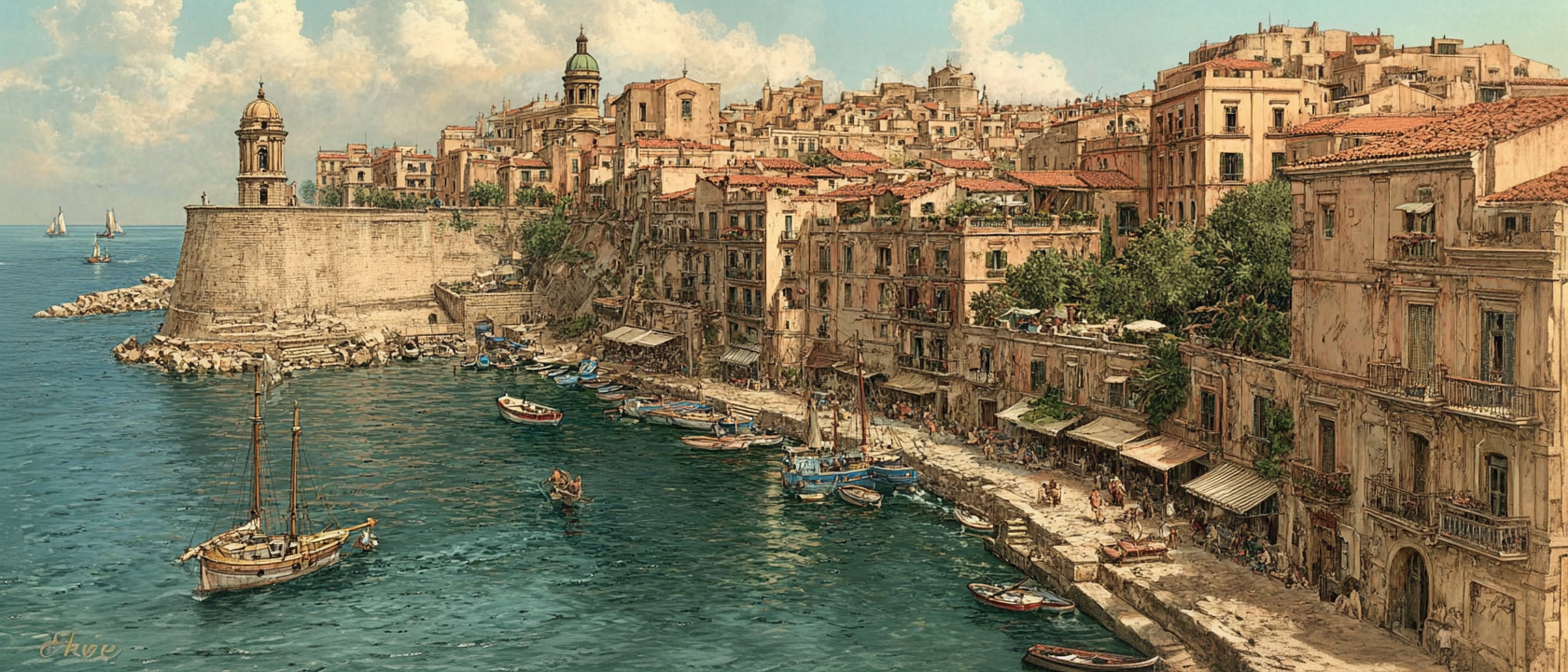
FISHING QUARTER
The Fleet's Home · District · Ostia Australis
"The Fishing Quarter smells like the sea and fish and salt and rope and the specific compound of wood preservative that the boat maintenance tradition here has used since the fourth century. I am aware that this is not a recommendation by most people's standards. I intend it as one. A place that smells consistently of its primary function is a place that knows what it is, and knowing what you are is, in my experience, the quality most productive of genuine capability. The Fishing Quarter is very good at what it does. It is good at it in the particular way that comes from doing the same thing very well for a very long time without being distracted by the question of whether it should be doing something else."
The Fishing Quarter occupies the harbour's northern and western edges — the boat moorings, the processing facilities, the chandleries and repair operations, and the residential streets of the fishing families who have been working these waters for generations. Approximately fifteen thousand permanent residents, the district's social organisation built around the fleet's rhythms: the departure schedules, the return patterns, the processing cycle when the boats come in, the maintenance cycle between trips. The district has the specific social density of a community whose members' lives are organised around shared risk — the sea's unpredictability means the fishing families maintain the collective mutual support structures that shared danger produces, and these structures are the most effective social safety net in the province, operating entirely outside the imperial administrative system.
The collective knowledge management that keeps the offshore bank locations out of imperial records is the district's most institutionally significant function and its least visible one. The knowledge is held in the same way as all the fishing community's technical expertise: orally, practically, transmitted through the experience of working alongside people who know things rather than through documents that can be examined. The distinction between what the district knows and what it records is the most complete example of selective documentation in the province, and it has been maintained so consistently for so long that the current generation of fishing families does not experience it as selective documentation. It is simply knowledge that lives in people rather than in papers, which is how knowledge has always lived here.
Access
District streets — publicly accessible.
Boat moorings — fishing family access.
Processing facilities — fishing industry access.
Collective knowledge — not accessible to outsiders by any means the district has found it necessary to explain.

Comments