

Wizard Homebrew Class
Wizards are intellectual scholars and supreme magic users, drawing from the arcane arts they perfect. Knowledgeable and enigmatic, wizards use their arcane research to cultivate their own large repertoire of powerful spells within a spellbook throughout their adventures. These arcane encyclopedias allow wizards to have a spell for almost every occasion or problem.
Wizards also tap into a special wellspring of magic known as mana, which they use to shape and alter their spells to fit the perfect situation. Many of the spells used today are created by experienced wizards who seamlessly weave mana and magic together. This dedication to the mastery of the arcane arts allows wizards to become extraordinary mages that wield immense power within their fingertips.
Quick Build
You can make a wizard quickly by following these suggestions. First, put your highest ability score in Intelligence, followed by Dexterity or Constitution as your second highest ability score. Second, choose an origin that increases your Intelligence. Third, choose the Fire Bolt, Mage Hand and Prestidigitation cantrip, and the following 1st-level spells for your spellbook: Burning Hands, Detect Magic, Feather Fall, Mage Armour, Magic Missile, and Thunderwave.
Spellcasting
As a student of arcane magic, you have a spellbook containing spells that show the first glimmerings of your true power.
Cantrips
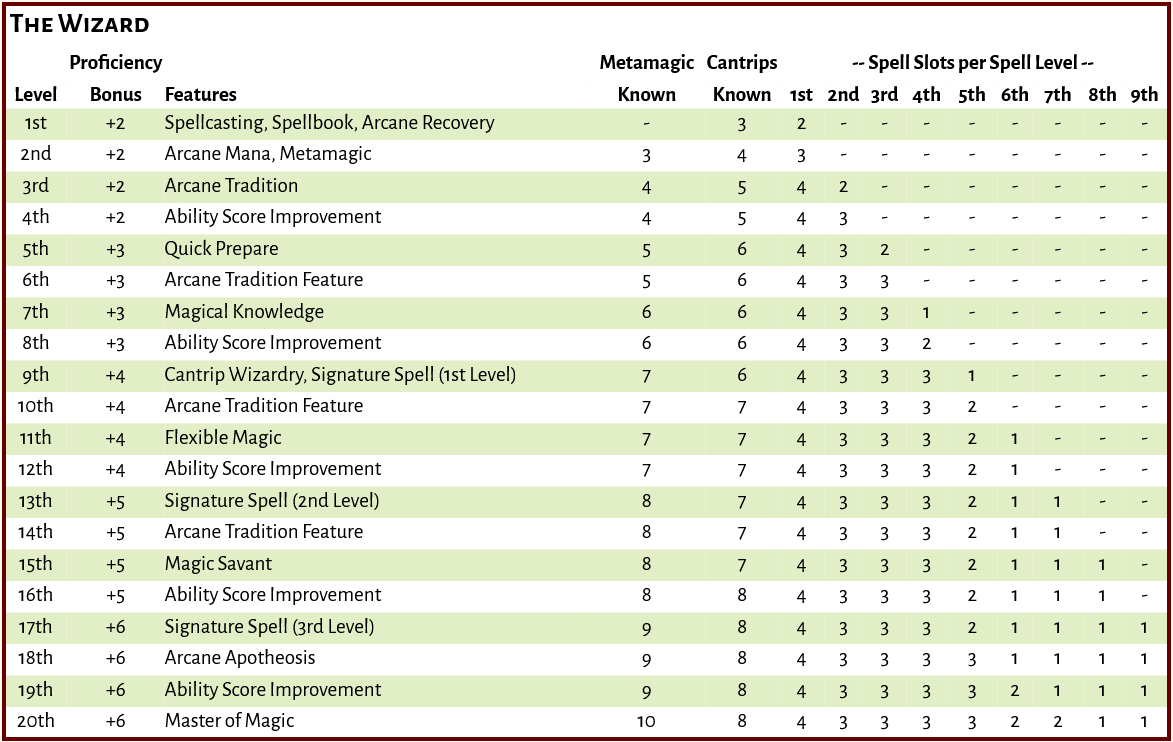
At 1st level, you know three cantrips of your choice from the wizard spell list. You learn additional wizard cantrips of your choice at higher levels, as shown in the Cantrips Known column of the Wizard table.
Preparing and Casting Spells
The Wizard table shows how many spell slots you have to cast your wizard spells of 1st level and higher. To cast one of these spells, you must expend a slot of the spell's level or higher. You regain all expended spell slots when you finish a long rest.
You prepare the list of wizard spells that are available for you to cast. To do so, choose a number of wizard spells from your Spellbook equal to your Intelligence modifier + your wizard level (minimum of one spell). The spells must be of a level for which you have spell slots.
For example, if you're a 3rd-level wizard, you have four 1st-level and two 2nd-level spell slots. With an Intelligence of 16, your list of prepared spells can include six spells of 1st or 2nd level, in any combination, chosen from your spellbook. If you prepare the 1st-level spell magic missile, you can cast it using a 1st-level or a 2nd-level slot. Casting the spell doesn't remove it from your list of prepared spells.
You can change your list of prepared spells when you finish a long rest. Preparing a new list of wizard spells requires time spent studying your spellbook and memorizing the incantations and gestures you must make to cast the spell: at least 1 minute per spell level for each spell on your list.
Spellcasting Ability
Intelligence is your spellcasting ability for your wizard spells, since you learn your wizard spells through dedicated study and memorization. You use your Intelligence whenever a spell refers to your spellcasting ability. In addition, you use your Intelligence modifier when setting the saving throw DC for a wizard spell you cast and when making an attack roll with one.
Spell save DC = 8 + Intelligence modifier + Proficiency Bonus
Spell attack modifier = Intelligence modifier + Proficiency Bonus
Ritual Casting
You can cast a wizard spell as a ritual if that spell has the ritual tag and you have the spell in your spellbook. You don't need to have the spell prepared to cast it as a ritual.
Spellcasting Focus
You can use an arcane focus or your spell book as a spellcasting focus for your wizard spells.
Spellbook
Your time learning arcane magic shows itself through your spellbook, the repository of your wizard magic.
Appearance
Your spellbook is a unique compilation of spells and notes that reflect your arcane research. You determine the appearance of your spellbook, and you can determine if it appears as a physical object.
For example, it might be a functional leather volume filled to the brim with notes and scribbles, spectral words that float around your body, runic stones you trace with each casting, or even arcane writings tattooed across your arms and body.
Known Spells
Your spell book contains six 1st level wizard spells of your choice.
Each time you gain a wizard level, you can add two wizard spells of your choice to your spellbook. Each of these spells must be of a level for which you have spell slots, as shown on the Wizard table.
Cantrip Formulas
You have scribed a set of arcane formulas in your spellbook that you can use to formulate a cantrip in your mind. You know three cantrips of your choice from the wizard spell list. You learn additional wizard cantrips of your choice at higher levels, as shown in the Cantrips Known column of the Wizard table.
Whenever you finish a long rest and consult those formulas in your spellbook, you can replace one wizard cantrip you know with another cantrip from the wizard spell list.
Spell Copying
Your spellbook grants you the ability to decipher magical script and writings, and reproduce its magic. When you find a wizard spell of 1st level or higher in a book or a scroll, you can add it to your spellbook if it is of a spell level you can prepare and if you can spare the time and money to decipher and copy it.
For each level of the spell, the process takes 10 minutes and costs 20 gp. The cost represents material components you expend as you experiment with the spell to master it, as well as the fine inks you need to record it. Once you have spent this time and money, you can prepare the spell just like your other spells.
If you copy the spell from a scroll, the scroll is destroyed after you copy the spell.
Replacing your Spellbook
If you lose your spellbook, you lose the ability to cast any of your spells you haven’t prepared with your spellbook.
During a long rest, if you have lost your spellbook, you can perform a 1 hour ritual to regenerate your spellbook and all its contents. The spellbook appears in your hands when you complete the long rest and causes the old spellbook to magically disappear.
Arcane Recovery
You have learned to regain some of your magical energy. When you finish a short rest, you can use this feature to gain a number of Recovery Points equal to half your Wizard level (rounded up) that you use to recover expended spell slots with a combined level to the amount of points you have. You can choose how you divide these points but you cannot use this feature to exceed your maximum number of spell slots in a certain level, or regain a spell slot of 6th level or higher. For example, if you're a 4th-level wizard, you have two Recovery Points when you use this feature, which you can use to recover either a 2nd-level spell slot or two 1st-level spell slots.
When you reach level 2, you can alternatively use your Recovery Points to regain expended mana points. Every Recovery Point you use regains 2 expended mana points, and you cannot exceed your maximum number of mana points.
After you use this feature, you must complete a long rest before you can use this feature again. You can use this feature twice before needing to complete a long rest at 7th level in this class, and you can use this feature three times at 15th level.
Arcane Mana
At 2nd level, you tap into a deep wellspring of magic within yourself. This wellspring is represented by mana points. You have a maximum number of mana points equal to your Wizard level + your Intelligence modifier. You regain all your expended mana points when you complete a long rest.
As a bonus action, you can use your mana points to restore expended spell slots, or sacrifice spell slots to restore expended mana points.
Restoring Spell Slots: You can spend mana points to regain one of your expended spell slots. To restore a spell slot, you must spend a number of mana points equal to double to spell slot’s level. When you restore a spell slot, you cannot exceed your maximum number of spell slots for that slot’s level, you can only restore a spell slot of a slot level you can cast, and you cannot restore a spell slot of a level higher than 5th level.
Restoring Mana Points: You can expend one spell slot and regain a number of mana points equal to the double the slot's level. When you restore expended mana points, you cannot exceed your maximum number of mana points.
Metamagic
At 2nd level, you gain the ability to twist your spells to suit your needs. You gain three Metamagic Options of your choice from the list below. You can use only one metamagic option on a spell when you cast it, unless otherwise noted.
You gain additional metamagic options when you reach higher levels in this class, as shown in the “Metamagic Known” column in the Wizard table. When you gain a level in this class, you can replace one metamagic option you know with another option.
List of Metamagic Options here.
Arcane Tradition
When you reach 3rd level, you choose an arcane tradition from the list of available traditions, shaping your practice of magic. Your choice grants you features at 2nd level and again at 6th, 10th, and 14th level.
Quick Prepare
Starting at 5th level, you can use your spellbook to quickly change your magic. You can replace one of your prepared spells with one of your unprepared spells in your spellbook. When you do so, you must spend a number of minutes equal to the level of the unprepared spell to complete the preparation. You can use this feature a number of times equal to your proficiency bonus, and regain all uses when you complete a long rest.
Magical Knowledge
Beginning at 7th level, you can use your arcane magic to conjure success. When you make an ability check with an intelligence skill, you can spend 2 mana points to treat a roll of 9 or lower as a 10. You must choose to use this feature before the results of the check are determined, and cannot use this ability on any intelligence ability checks that aren’t related to a skill.
Cantrip Wizardry
Beginning at 9th level, your proficiency in magic enhances your cantrips. Whenever you use your metamagic to shape a cantrip you cast, you reduce the mana point cost of any metamagic you use by 1.
Signature Spell (1st level)
Starting at 9th level, your expertise in the arcane allows you to cast one of your spells with ease.
Choose one 1st level wizard spell in your spellbook. This spell becomes one of your Signature Spells and this spell is always prepared and does not count against the number of spells you can prepare. You can cast this signature spell once at its lowest level without expending a spell slot. When you do so, you can’t do so again until you finish a short or long rest. You can still cast this spell with your spell slots after using this special casting.
When you gain a level in this class, you can replace your 1st level signature spell with one of your other 1st level wizard spells in your spellbook.
Flexible Magic
Starting at 11th level, you learn how to effortlessly change and shape your magic into spell slots or mana points.
When you use your Arcane Mana feature to spend mana points to create expended spell slots, or spell slots to create expended mana points as a bonus action, you can expend mana points to create multiple spell slots, or expend multiple spell slots to create mana points.
Additionally, at the start of your turns, you can use your Arcane Mana feature to spend mana points to create one expended spell slot, or one spell slot to create expended mana points.
Signature Spell (2nd level)
Starting at 13th level, your expertise in the arcane allows you to cast another one of your spells with ease.
Choose one 2nd level wizard spell in your spellbook. This spell becomes one of your Signature Spells and this spell is always prepared and does not count against the number of spells you can prepare. You can cast this signature spell once at its lowest level without expending a spell slot. When you do so, you can’t do so again until you finish a short or long rest. You can still cast this spell with your spell slots after using this special casting.
When you gain a level in this class, you can replace your 2nd level signature spell with one of your other 1st level wizard spells in your spellbook.
Magic Savant
Starting at 15th level, you discover how to manipulate your arcane magic over certain spells to cast them at will. Choose a 1st-level wizard spell and a 2nd-level wizard spell that are in your spellbook. Alternatively, you can choose for both spells to be 1st level wizard spells.
These spells are always prepared, and do not count against the number of spells you can prepare. You can cast these spells at their lowest level without expending a spell slot. If you want to cast either spell at a higher level, you must expend a spell slot as normal.
When you gain a level in this class, you can replace one or both of these spells with other spells in your spellbook. The new spells must either be one 1st level wizard spell and one 2nd level wizard spell, or two 1st level wizard spells.
Signature Spell (3rd level)
Starting at 17th level, your expertise in the arcane allows you to cast another one of your spells with ease.
Choose one 3rd level wizard spell in your spellbook. This spell becomes one of your Signature Spells and this spell is always prepared and does not count against the number of spells you can prepare. You can cast this signature spell once at its lowest level without expending a spell slot. When you do so, you can’t do so again until you finish a short or long rest. You can still cast this spell with your spell slots after using this special casting.
When you gain a level in this class, you can replace your 3rd level signature spell with one of your other 1st level wizard spells in your spellbook.
Arcane Apotheosis
Starting at 18th level, you can suspend your magical knowledge to bolster your magic reserves.
Once on your turn, you can sacrifice one of your prepared spells and regain a number of mana points equal to the level of the spell (1 mana point if the spell is a cantrip). When a spell or cantrip is sacrificed in this way, you can no longer cast the chosen spell or cantrip until you complete a long rest, and the number of prepared spells you can prepare or cantrips you know is reduced by 1 until you complete a long rest. You cannot sacrifice any spells you always have prepared with this feature.
Master of Magic
Beginning at 20th level, you become an unmatched master of the arcane. You gain the following features:
Spell Mastery: When you cast a spell with a spell slot of 5th level or lower, roll a d20. If you roll a 6 or above, you cast the spell without expending the spell slot, then the number you need to roll on the d20 increases by 2. This number keeps increasing by 2 for every successful roll you make. When you complete a long rest, the number you need to roll resets back to 6.
Metamagic Mastery: When you cast a spell, you can use up to two metamagic options on the casting of that spell. This limit does not count towards any metamagic options that already can be used alongside other metamagic options.
Wizard Features
As a Wizard, you gain the following class features:
Hit Points
Hit Dice: 1d6 per Wizard level
Hit Points at 1st Level: 6 + your Constitution modifier
Hit Points at Higher Levels: 1d6 (or 4) + your Constitution modifier per Wizard level after 1st
Proficiencies
Armour: None
Weapons: clubs, daggers, light hammers, slings, quarterstaffs, light crossbows
Tools: Choose 1 from Alchemist’s Supplies, Calligrapher’s Supplies, or one Gaming Set
Saving Throws: Intelligence, Wisdom
Skills: Choose 3 from Arcana, History, Insight, Investigation, Medicine, Performance, and Religion
Starting Equipment
Each character begins their journey with equipment to aid in their adventuring. Some classes will give you a choice between certain equipment, your options are shown with the letters (a), (b) etc. When given this choice, you can only take one option from the choices. Your character starts with the following items on them:
- (a) club, (b) dagger, (c) light hammer, or (d) quarterstaff
- (a) sling or (b) dagger
- (a) arcane focus or (b) component pouch
- (a) dungeoneer’s pack or (b) scholar’s pack
Link to Wizard Spell List here.
Link to Metamagic Options here.
Remove these ads. Join the Worldbuilders Guild

Comments