

Black Gate
The Black Gate of Cherepa is a massive architectural façade made entirely of a black, iron-like substance. It is located about a thousand yards across the valley from the Temple of the Skull and faces the entrance to the ruined city.
The structure stands 210' tall at its peak, and its large flanking towers stand 175' high. The façade is the entrance to a deep and very complex system of catacombs and tunnels that enter into the valley walls through a tall and straight escarpment that extends some 80' out of the nearly vertical valley wall.
Purpose / Function
The purpose of the Black Gate is not fully understood. Many experts have expressed the conviction that it is purely decorative in design and purpose. Some have seen it as a protective or even defensive feature, meant to secure and protect the underground passages behind it.
Architecture
The Black Gate is an incredibly ornate and complicated structure built on a metallic framework that is secured by means not fully understood to the natural rock face of the valley wall. Upon this metal framework is a layered fronting of thousands of delicate panels of an iron-like metal that has an almost black patina, but no rust. Even in the very arid climate of the Western Wastes, some rust and corrosion would be expected on any iron still exposed. This metal, however, shows wear from abrasive materials (falling rocks, blowing sands) but no rust or corrosion.
The panels themselves have been cut into thousands of unique scrolled and latticed designs, or rolled and shaped to represent columns, lintels, etc. Many dozens of narrow metal stairs, so steep as to be almost ladders, allow even large Humanoids an opportunity to move up and down the façade between the panels and the natural rock face.
Only two actual openings into the escarpment exist. The largest opening is the main entrance at the ground level. This opening is an arched entryway that is 16' wide and 30' tall at its peak. The second opening is 80' above the ground and is 12' and 18' tall at its peak. This entrance has no access to the ground from outside the façade, and can only be examined when approached from within the underground structure, unless one were to actually climb the outside of the structure to gain access.
Defenses
The two openings into the interior of the escarpment have no doors and do not appear to have ever had them. There is no visible means by which the entrances can be closed or secured, thus making the argument that the Black Gate's purpose was defensive seem very unlikely.
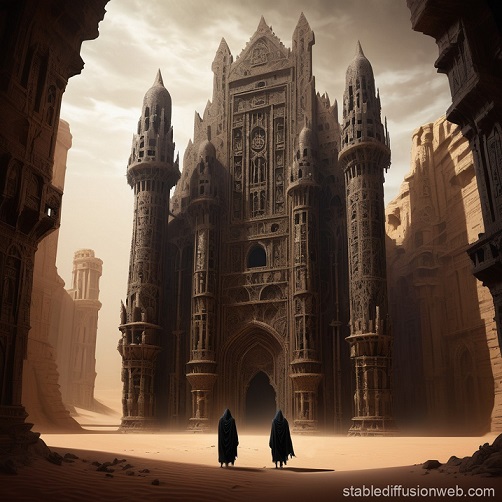
The Black Gate of Cherepa, with the steep valley wall to the right
