Thirteen Realms
Scene
The Laws of Thirteen Realms
The mortal Realm operates by physics, causality, and naturalism — the same rules a reader is already familiar with. There is no native magic. Reproducibility (the same experiment yielding the same answer) is one of the mortal Realm's distinguishing features, and it's the reason humanity has been able to build cumulative knowledge.What looks like magic is the rules of another Realm operating temporarily within the mortal one. Each of the thirteen Realms has its own internal logic — its own "way things are":
Faith (reverence with material weight) is the operating currency of Celestia
Contract (binding speech) reshapes reality in Arcadia
Alchemical fire copies patterns in the destroyed Realm of Sheol
Information constitutes existence in the Iron Nexus
Consumption ranks all beings in Voracia
Belief manifests in Umbra
When a being from one Realm carries their ontology into another — through Liminality, imposition, or sufficient force of presence — the rules of one Realm temporarily assert themselves over another. A god working a miracle on Earth is imposing Celestial logic on the mortal Realm. A nightmare manifesting in a subway is Umbra overlapping with physics.The thesis is one sentence: there is no magic; there is only the way things are. The cosmology has consequences. Three Realms have been altered or destroyed by attempts to violate that thesis.
Cosmology
The cosmos cannot tell its own origin, and this is itself a feature of the cosmology rather than a gap.
Every Realm is a configuration of four basal truths: That Which Is, That Which Is Not, That Which Begins, That Which Ends. Reality is downstream of these truths. The basal truths themselves are the conditions under which any "before" or "after" can mean anything, which means asking what came before them is asking a question the cosmos has no apparatus to answer. Even Ruskenn — the gestalt consciousness that contains accumulated awareness stretching back before the Realms differentiated — does not know. The Hive remembers the basal truths recognizing themselves as separate; it does not remember what preceded that recognition. The investigation terminates there.
Multiple mortal traditions have observed pieces of the truth. The Rigveda's Hymn of Creation — the Nasadiya Sukta, with its closing line "He who surveys it from the highest heaven, he alone knows — or perhaps even he does not know" — is among the most accurate accounts a mortal has produced. Various creation myths from various cultures encode partial observations of the Realms differentiating from the basal truths. None of them is wrong; none of them is complete.
This has consequences for the setting. Three Realms have been damaged or destroyed by beings attempting to reach the basal truths directly, hoping to find the answer or seize the power. There is no answer to find and no power to seize. The boundary is categorical, not a puzzle.
Initial Active Setting
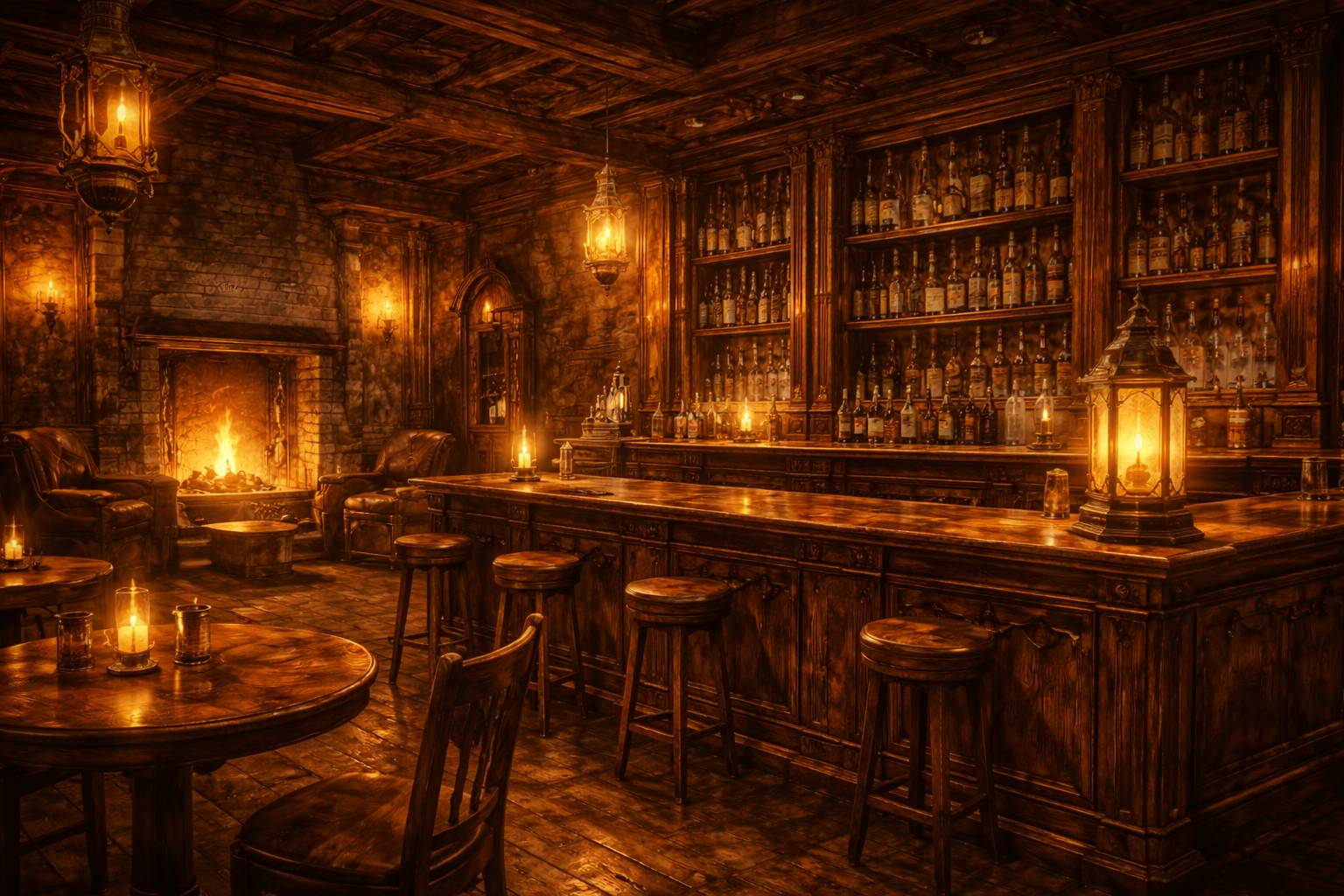
The active setting has two layers.The first is the present-day mortal Realm — primarily contemporary Earth, with recurring locations in Dublin (where Jack's most-used door opens), Berkeley, Stockholm, and a handful of other cities. Stories often begin here, with mortal protagonists encountering Liminal phenomena that suggest the cosmos is larger than mortal science admits.The second is Jack's Tavern itself, which sits at the threshold between Realms. The Tavern functions as the cosmological neutral ground where beings from any Realm may meet, and it's where most cross-Realm conversations and negotiations happen. From the Tavern, characters can reach any of the thirteen Realms — though doing so safely requires preparation, allies, or both.The full cosmos is available as a setting, but not all of it is in active use at any given time. New stories typically expand outward from the mortal Realm and the Tavern rather than starting in, say, Voracia or Nyxaloth.
The Thirteen Realms and all content herein — lore, characters, stories, and world material — are the original work of deryck1228 and are protected under copyright. All rights reserved. No portion of this world may be reproduced or used without explicit permission.
Artwork appearing throughout these pages is either commissioned from credited artists (see individual article attributions) or serves as AI-generated placeholder art pending final illustration. All placeholder art will be replaced as the world develops.
The Thirteen Realms is a work of dark fiction. While the setting touches real world historical events, belief systems, and stories, any resemblance to real persons, places, or events is coincidental. Some content may not be suitable for all readers.
Step carefully. Not all doors in the Thirteen Realms open from the inside.
© deryck1228 2026. All rights reserved
Artwork appearing throughout these pages is either commissioned from credited artists (see individual article attributions) or serves as AI-generated placeholder art pending final illustration. All placeholder art will be replaced as the world develops.
The Thirteen Realms is a work of dark fiction. While the setting touches real world historical events, belief systems, and stories, any resemblance to real persons, places, or events is coincidental. Some content may not be suitable for all readers.
Step carefully. Not all doors in the Thirteen Realms open from the inside.
© deryck1228 2026. All rights reserved