Thirteen Realms
Scope
The motivation behind building Thirteen Realms
I've been running tabletop games in this setting for years, and somewhere along the way it grew past being scaffolding for sessions and became a cosmology I wanted to think about carefully on its own terms.
A few convictions drive the work. The first is that "magic" is the word we use when we stop asking how something works — and that a fantasy world whose rules are stable enough to be reasoned about produces better stories than one where the GM is the only one who knows what's possible. The second is that consequence is the engine of meaning: if the world never breaks your heart, your triumphs don't matter. The third is that the world's alien beings are most interesting when they're allowed to stay alien, not when they're tidied up into approachable shapes for the protagonist's comfort.
I'm building this publicly partly for accountability — private notes can sprawl forever — and partly because the cosmos got too interesting to keep to myself.
The goal of the project
Three things, in roughly descending order of certainty. First, accountability. Private notes sprawl forever; publishing forces the kind of finishing that worldbuilding otherwise resists. Every article I post is a piece of the world that exists in a form other than my own head, and that's clarifying in ways I didn't expect when I started.Second, conversation. I'd like to find the readers and GMs who are genuinely interested in this kind of setting — people who enjoy rigorous internal logic, alien beings allowed to stay alien, and consequence as the engine of meaning. Comments, questions, and pushback all sharpen the work.Third, optionality. There's a manuscript in progress and a system-agnostic game framework that already runs at my table. Either of those might eventually become a published thing. I'm not certain which, and I don't need to be certain yet. Publishing the world publicly is the move that keeps both doors open.
Thirteen Realms's Unique Selling point
The thesis is one sentence: there is no magic: there is only the way things are. Every Realm in the cosmos operates by its own consistent internal logic. What mortals call supernatural is one Realm's rules imposing themselves on another's territory. Faith isn't a mystical energy — it's the operating currency of a Realm where reverence has material weight. Contracts aren't spells — they're the foundational physics of a Realm where speech reshapes reality. Alchemical fire that copies what it touches isn't enchanted — it's the basic substance of a Realm built on mimicry. Two consequences follow. The first: nothing in this cosmos is arbitrary. Everything can be investigated, hypothesized about, tested. Players and readers don't ask what their spell can do; they ask what follows from how reality works here. The second: consequences are real. The same rules that let a character invoke their god's protection are the rules that bring the dawn at the wrong moment for someone searching the rubble. The world is honest in both directions.
Theme
Genre
Cosmological fantasy, with strong mythological and contemporary fantasy elements.The cosmos is the central subject — thirteen Realms, each with its own internal logic, drifting through the foundations of existence. The action ranges from present-day cities (Dublin, Berkeley, Stockholm) to Realms whose physics break mortal comprehension. Real-world mythological traditions — Norse, Vedic, Sumerian, Vodou, Egyptian, and others — are treated as legitimate partial observations of the cosmos, not decorative reskinning.Tone: warmth containing alien things without domesticating them. Comparable in feel to writers who take their cosmology seriously — Pratchett, Le Guin, Gaiman, Susanna Clarke. Comparable in rigor to settings that reward investigation and reasoning rather than mystery for its own sake.
Reader Experience
The tonal register I aim for is warmth containing alien things without domesticating them.The cosmos is consequential rather than cruel. Things matter. The work beyond the minimum — Jack polishing brass that's already clean, a fey making coffee no one needs to drink — is where the setting's emotional center lives. The surplus, the freely given care, the extra mile that nobody required: that's the world's heart.At the same time, the alien stays alien. A Voracian predator who debates philosophy at the bar is still a predator; he just respects the Contract. A god accumulating Faith from awestruck mortals is still extracting a resource. The setting holds these things at once and doesn't tidy them up into something comfortable.Loss is real and permanent. Sheol is gone. Stambhana is frozen. Some characters are dead and will stay dead. The world doesn't soften, and it doesn't apologize. But it isn't grimdark — humor emerges from character, kindness is freely given, and the surplus is everywhere if you know where to look.Players and readers who pay attention are rewarded with a cosmos they can reason about. Those who don't are still welcome at the table. The fire is warm. The stories are real.
Recurring Themes
A few themes recur throughout the setting and shape how it feels to read or play in.The way things are. Every Realm operates by its own consistent internal logic, and consequences propagate according to those rules regardless of intention. The cosmos isn't cruel; it is consequential. Players and characters are free to reason about it, exploit its logic, and discover its edges — and the same logic that lets them succeed lets them fail.The surplus. The work beyond the minimum, the care that no rule required — Jack polishing brass that's already clean, a fey making coffee no one needs to drink, the freely given kindness. This is where the setting's heart lives. The cosmos is large and frequently hostile, and the response is not to match its hostility but to maintain the small acts of decency that nothing forces.Both/and. Moral and ontological ambiguity is genuine, not performative. Every faction has reasons; every being is the hero of their own story and the villain in someone else's. A Realm can be a paradise that is also powered by screaming souls. Both facts are true. Neither cancels the other.Loss that endures. Sheol is gone. Stambhana is frozen. Certain characters are dead and will stay dead. The setting does not offer false hope about genuine destruction — and the permanence of loss is what makes the triumphs that follow it matter.
Character Agency
Very high — but the framing matters.Agency in this setting is not "the GM bends the world to let you succeed." It's "the world has consistent rules, and within those rules you can reason about anything, attempt anything, and reshape anything if you're clever or persistent or willing enough."The system that produces that agency: NPCs have their own agendas and pursue them whether anyone is watching. Factions move toward their goals on their own timelines. The default trajectory of the cosmos is the thing the players perturb, not the thing the GM is waiting to spring on them.The cost of that freedom is that the same rules apply to everyone. The fire you can persuade not to bite you is the same fire that burns what you cannot protect. The Contract that protects you in Jack's Tavern is the same Contract that binds the being across the bar from you. Cleverness works because the world is honest, which means failure works too.This is not adversarial GMing. It's the opposite. The world is stable enough that a clever player can find applications of its logic the worldbuilder never anticipated — and have those applications work.
The Thirteen Realms and all content herein — lore, characters, stories, and world material — are the original work of deryck1228 and are protected under copyright. All rights reserved. No portion of this world may be reproduced or used without explicit permission.
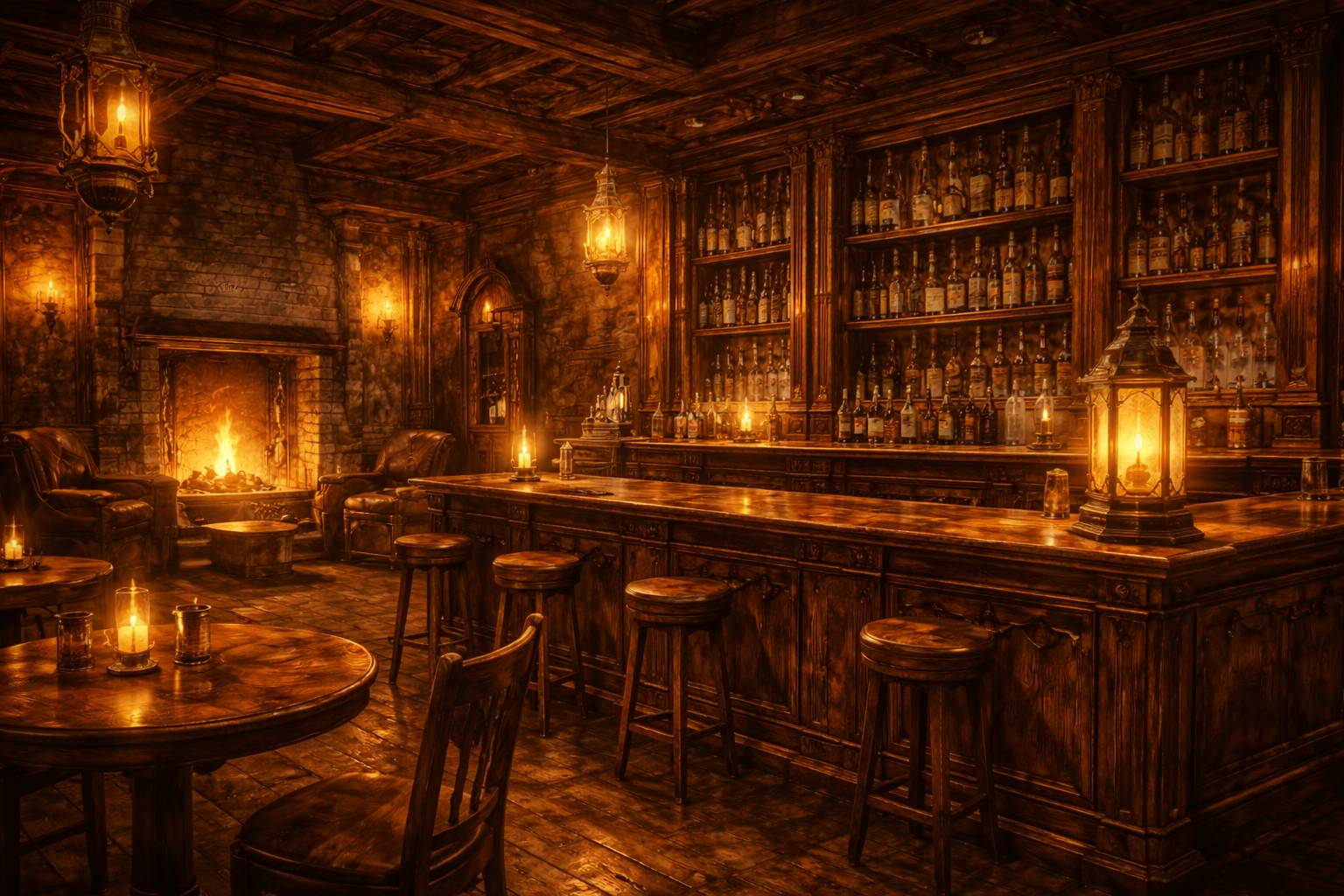
Artwork appearing throughout these pages is either commissioned from credited artists (see individual article attributions) or serves as AI-generated placeholder art pending final illustration. All placeholder art will be replaced as the world develops.
The Thirteen Realms is a work of dark fiction. While the setting touches real world historical events, belief systems, and stories, any resemblance to real persons, places, or events is coincidental. Some content may not be suitable for all readers.
Step carefully. Not all doors in the Thirteen Realms open from the inside.
© deryck1228 2026. All rights reserved
Artwork appearing throughout these pages is either commissioned from credited artists (see individual article attributions) or serves as AI-generated placeholder art pending final illustration. All placeholder art will be replaced as the world develops.
The Thirteen Realms is a work of dark fiction. While the setting touches real world historical events, belief systems, and stories, any resemblance to real persons, places, or events is coincidental. Some content may not be suitable for all readers.
Step carefully. Not all doors in the Thirteen Realms open from the inside.
© deryck1228 2026. All rights reserved