
Maka

The Sērbaka Homeworld

Standing out as an uncomfortable place for life to begin, Maka is hot and arid, clutching a weak, tenuous, and potentially toxic atmosphere; suitable only for the creatures that managed to evolve here.

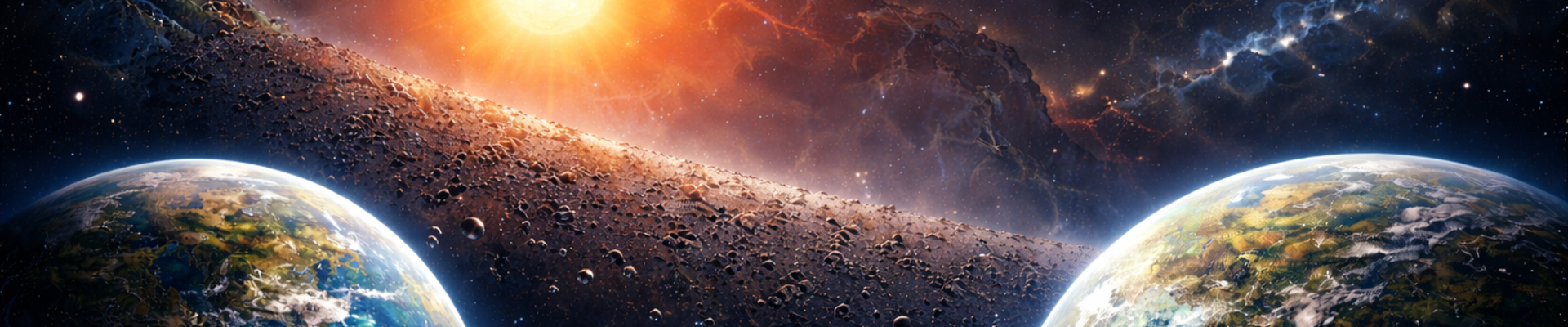
Maka, alongside Kēst, the Kašē homeworld, form a binary planetary system – a pair of similarly sized worlds mutually locked in co-orbit around a central point between them – constantly vying for second planet from Ňisa, their parent star. Covering roughly 73.8% of Maka, a single supercontinent blankets the world, leaving the remaining 26.2% covered in water, comprised of a single large central ocean, several inland seas, and freshwater sources like groundwater, lakes, and rivers. Amidst average global temperatures of 28.2°C (82.8°F), Maka is nearly devoid of snow and ice, with only the tallest mountains sporting white peaks.

Estimated at over 6 billion years old, Maka remains an active world, constantly reshaped through tectonic activity, weathering, and erosion, to include historical (extinct) glaciation and meteorite impacts. Furthermore, tidal heating, or frictional heating, resulting from the eccentric orbital interaction between Maka and Kēst, feeds endless energy into both worlds, promoting and fueling perpetual vulcanism.

Maka Compared to Earth

Maka is a beautiful world, even given its shortcomings, the sky is blue, a deep blue, darker than earth, a result of the thinner atmosphere. Ňisa, the baking sun at the center of the solar system is reddish-orange, due to its smaller size and lower spectral classification, only 38% as bright as Sol, however it simultaneously appears 15% larger in the sky, another artifact of its smaller mass and luminosity, requiring Maka (and Kēst) to be 32% closer to their parent star to be in the habitable zone. Kēst hangs large in the Maka sky, appearing twice the size of Earth’s moon, even though it is 4.3 times the diameter and 2.2 times further away. Furthermore, Maka experiences phenomenal auroras, a consequence of the planet’s proximity to Ňisa and interactions between the remarkably strong Maka magnetosphere and the stars coronal mass ejections. And there is more beauty to be found, vivid colors, unlike anything found on Earth.

Low atmospheric pressure has many other effects upon the planet, one of which is the boiling point of water is reduced; fresh water on Maka boils at 83.9° C (183° F), making the planets hold on its surface water tenuous at best. As temperatures spike in the hot seasons, there are scant few degrees between the air temperature and the boiling point of water which accelerates the water cycle increasing atmospheric water vapor volume, providing significant moisture to inland areas that would otherwise be much dryer.

As a curious side effect of lower atmospheric pressure, popular human foods that contain starch such as rice, potatoes, and wheat are challenging to cook, resulting in generally overcooked exteriors while remaining crunchy in the middle. Resolving this can be as simple as cooking within pressurized containers but since this pertains to food unconsumable by Sērbaka, it is a technology that never reached the Maka population.

Geography

Great Basin Ocean
Total Surface Area
91,100,000 km2
(35,200,000 mi2)
Avg. Depth
1,400 m
(4,600 ft)
Max. Depth
3,720 m
(12,200 ft)
Avg. Tidal Range
2.78 m
(9.13 ft)

The Great Basin Ocean comprises roughly 82% of all surface water on Maka, making it perhaps the single most important biomes on the planet. It hides many wonderous and impressive features – continental shelves, oceanic plains, mountains, volcanoes, trenches, canyons, plateaus, and a global oceanic ridge – while simultaneously harboring many diverse organisms, including crucial photosynthetic life which produce much of the world’s oxygen. Further assisting the Great Basin Ocean in its life sustaining efforts, are several inland seas, each equally diverse and accounting for a further approximately 8% of all surface water, combined. Unfortunately for Sērbaka, the Great Basin Ocean and seas are ill suited for consumption due to their high salinity, though other factors still make them incredibly attractive locals to live.

Exacerbating issues further, atmospheric moisture, soil, and deep, essentially inaccessible, underground reservoirs conspire to lock away approximately 8% of all freshwater on Maka; Sērbaka have no sufficient methods for extracting water from any of these resources, leaving a meager 2% of various freshwater sources and biomes accessible to Sērbaka. Lakes, oasis, rivers, streams, and aquifers form the bulk of these reserves, each hosting varied and distinct species.

As impressive as freshwater and marine biomes are, on Maka, they do not come close to the grandeur and scope of dry land, featuring elevations ranging from 491 m (1,611 ft) below sea level to 9,759 m (32,019 ft) above sea level, the pinnacle of the tallest snow-capped mountain. Two biomes dominate vast tracts of the Maka surface: grasslands and deserts.

Grasslands
Annual Precipitation
15-50 cm/ year
(6-20 in/year)
Temperature Range
-20° to 58° C
(-4° to 136° F)
Savannas
Annual Precipitation
15-75 cm/year
(6-30 in/year
Temperature Range
35° to 55° C
(95° to 131° F)
Deserts
Annual Precipitation
1-28 cm/year
(0.4-11 in/year
Temperature Range
2° to 65° C
(36° to 149° F)

Grasslands, including savannas, cover approximately 56% of all dry land, an amazing 175 million km2 (67.6 million mi2) of grasses, flowers, herbs, and intermittent tree, all prospering and feeding great herds of large herbivores, which in turn nourish Sērbaka and numerous other predators. Frequent droughts and high summer temperatures bring seasonal fires which are vital for biodiversity of these biomes. Temperate grasslands are one of the few biomes on Maka, aside from high elevations that see any form of regular seasonal snow fall.

Deserts swallow up another approximately 37% of land, or 116 million km2 (44.7 million mi2). These seas of sand, gravel, and rock are among the most challenging environments for life, anywhere. Extraordinarily little rain falls here, when it does, it falls in concentrated bursts, interspersed between long rainless periods, however, night cooling causes condensation of dew, which often exceeds annual rainfall. Despite the lack of water and extreme, wildly fluctuating, temperatures, a large variety of plants prosper in the harsh deserts of Maka, and in turn numerous faunae, primarily small mammalian-like and reptilian-like life thrives there.

Alpine, chaparral, deciduous forest, and rainforest biomes split the remaining 7% of land.

Age
9.2 bn local years (6.03 bn Earth years)
by HiClipArt

Orbital Characteristics

Aphelion
111,103,000 km
(69,036,000 mi; 0.743 AU)
Perihelion
105,303,000 km
(65,432,000 mi; 0.704 AU)
Semi-Major Axis
108,203,000 km
(67,243,000 mi; 0.723 AU)
Eccentricity
0.0268°
Avg. Orbital Speed
39.07 km/s
(140,646 km/h; 87,379 mph)
Inclination
2.33°
Ascending Node (☊)
74.94°
Arg. of Periapsis (ω)
337.38°
Co-orbit
Satellites
~10,000 artificial

Physical Characteristics

Mean Radius
5,806.66 km
(3,609.09 mi)
Mean Circumference
36,484.32 km
(22,670.31 mi)
Total Surface Area
423,704,000 km2
(163,592,000 mi2)
Land Surface Area
312,626,000 km2
(120,706,000 mi2)
Water Surface Area
111,078,000 km2
(42,887,000 mi2)
Volume
8.20102E+11 km3
(1.96753E+11 mi3)
Mass
5.96106E+24 kg
(1.31441E+25 lb.)
Mean Density
7.269 g/cm3
Surface Gravity
11.798 m/s2
Rotation Period
25.05 Earth hours
Axial Tilt
37.16°
Albedo
0.19 Bond
Mean Surface Temp
28.2°C (82.8°F)

Atmosphere

Surface Pressure
56.204 kPa (at MSL)
(8.15 psi; 0.5547% Earth)
Boiling Point of Water
83.9° C (183° F)
Scale Height
7.4 km
(4.6 mi)
Nitrogen (N2)
60.860%
(34.220 kPa; 4.963 psi)
Oxygen (O2)
22.168%
(12.456 kPa; 1.807 psi)
Neon (Ne)
13.675%
(7.687 kPa; 1.115 psi)
Carbon Dioxide (CO2)
2.201%
(1.239 kPa; 0.179 psi)
Argon (AR)
1.062%
(0.589 kPa; 0.085 psi)
Methane (CH4)
0.005%
0.0028 kPa; 0.0004 psi)
Carbon Monoxide (CO)
0.029%
(0.0159 kPa; 0.0023 psi)
Water Vapor (H2O)
Up to ~4% by volume
(Climate Variable)
Type
Planet
Location under
Owning Organization
Related Ethnicities
Inhabiting Species

Atmosphere

For nonnative species, the atmosphere of Maka can present significant hazards. These risks are readily mitigated through standard precautions, most notably the use of air filtration and supplemental oxygen. The principal challenge for off-world visitors is Maka’s low surface pressure, approximately 55% of Earth standard, which reduces oxygen availability to levels comparable to an altitude of roughly 4,700 m (15,400 ft) on Earth. While this low-density atmosphere supports efficient convective heat transfer and rapid cooling, it is physiologically demanding for organisms unadapted to hypoxic conditions.

In addition to reduced pressure, Maka’s atmosphere contains elevated concentrations of carbon dioxide and carbon monoxide. These gases arise primarily from frequent and persistent grassland and savanna fires, a natural consequence of arid interiors, seasonal drought, and extensive biomass-dominated landscapes. Lower ambient oxygen levels promote inefficient combustion, allowing carbon monoxide to persist alongside increased carbon dioxide. Species lacking appropriate physiological tolerance may experience adverse effects including impaired judgment and coordination, reduced concentration, abnormal fatigue during exertion, respiratory distress with potential long-term cardiovascular damage, nausea, fainting, headaches, and dizziness.

Despite these challenges, Maka’s atmosphere is dynamically stable and self-regulating. The planet’s low total water inventory produces a sharply focused hydrological cycle in which evaporation is rapid and geographically concentrated near oceans, inland seas, and major freshwater basins. This drives strong convective uplift and seasonal monsoonal circulation. Rainfall typically occurs in brief, intense storm events rather than prolonged precipitation, while boundary-layer humidity remains relatively stable outside of active storm zones. This configuration suppresses persistent cloud cover and long-lived atmospheric haze, contributing to a stable global mean surface temperature of approximately 28 °C.

Greenhouse behavior on Maka is similarly constrained. Atmospheric carbon dioxide is buffered over long timescales by ocean chemistry and basaltic weathering, while methane is efficiently destroyed by photochemical processes in the upper atmosphere, preventing haze accumulation. High planetary obliquity generates pronounced seasonal contrasts, producing localized summer temperatures exceeding 35 °C and winter minima below 10 °C in continental interiors. These extremes remain geographically limited and do not destabilize the global climate system.

The vertical structure of the atmosphere reflects its low pressure. Approximately four-fifths of atmospheric mass resides in a relatively shallow troposphere, above which a dry, ozone-bearing stratosphere inhibits vertical convection and reduces ultraviolet radiation at the surface. In regions of extreme topography, this boundary is directly observable. Mountain peaks that extend into the lower stratosphere are scoured of persistent snow by strong winds and sublimation under low pressure and minimal ambient water vapor.

Above these layers, the atmosphere thins progressively into ionized regions where charged particles generated by stellar radiation enable long-range radio communication and produce auroral displays. Although Maka’s gravity is sufficient to retain its atmosphere over geological timescales, slow escape of light gases continues in the uppermost layers, dominated by hydrogen and helium released primarily through photochemical breakdown of hydrogen-bearing compounds.

Atmospheric retention is further supported by a strong magnetosphere generated by Maka’s internal geodynamo. This magnetosphere extends tens of thousands of kilometers sunward and trails into a magnetotail exceeding one million kilometers in length, providing substantial protection against stellar wind stripping.

Accordingly, the Ňisa Imperium strongly advises that all species unaccustomed to Maka’s atmospheric conditions remain within prepared facilities or employ appropriate personal protective equipment when operating outdoors. Neither the Ňisa Imperium nor its agents or citizens accept responsibility or liability for injury or death resulting from disregard of these advisories.

Long-Term Environmental Sustainability

Maka’s climate is maintained by a set of reinforcing physical, chemical, and biological processes that operate over hundreds of thousands of years. The planet’s low atmospheric pressure limited total water inventory, and dark, volcanically renewed surface establish a stable climatic attractor rather than a fragile equilibrium.

Planetary albedo remains low and stable due to widespread basaltic terrain, volcanic resurfacing, and biologically pigmented surfaces. These factors prevent long-term brightening and suppress cooling in an otherwise arid environment. The hydrological cycle, constrained by low total water availability, concentrates atmospheric energy transport into seasonal convective systems without permitting persistent cloud cover or haze accumulation.

Greenhouse forcing remains bounded. Carbon dioxide is regulated by ocean chemistry and basalt weathering, while methane is rapidly destroyed through photochemical processes, preventing radiatively disruptive buildup. High obliquity introduces strong seasonal contrasts, but these are geographically limited and do not drive long-term climate instability.

Biological feedback reinforces these controls. Photosynthetic life preferentially absorbs red and near-infrared radiation, maximizing energy capture while limiting surface reflectivity. Fire-adapted ecosystems efficiently recycle surface carbon, coupling biospheric productivity to atmospheric composition without enabling runaway change.

Together, these mechanisms produce a climate system that is internally consistent, resilient to perturbation, and stable across extended geological timescales. Maka’s environmental state persists not through fine balance, but through the convergence of multiple independent stabilizing processes.


Articles under Maka


Cover image: by ChatGPT

Comments

Please Login in order to comment!
Dec 11, 2020 20:43 by Rafael Martin

WOHA the physical descriptions here are super authentic. I NEED to ask, though: How did you come up with all these numbers? Did you do actual calculations or are you just really good at comming up with numbers that sound reasonable and logical in their scope? :D

Dec 12, 2020 00:17

I used a bit of both methods. First, I had to understand what each number represented, which meant research (lots of research), providing a foundation for some educated guesses, followed by running calculations on those guesses and refining them until I was satisfied everything looked reasonable. The reward, wonderful comments like this. Thank you!

Dec 12, 2020 16:12 by Rafael Martin

That's really impressive! You definitely succeeded to make it believable! :D