
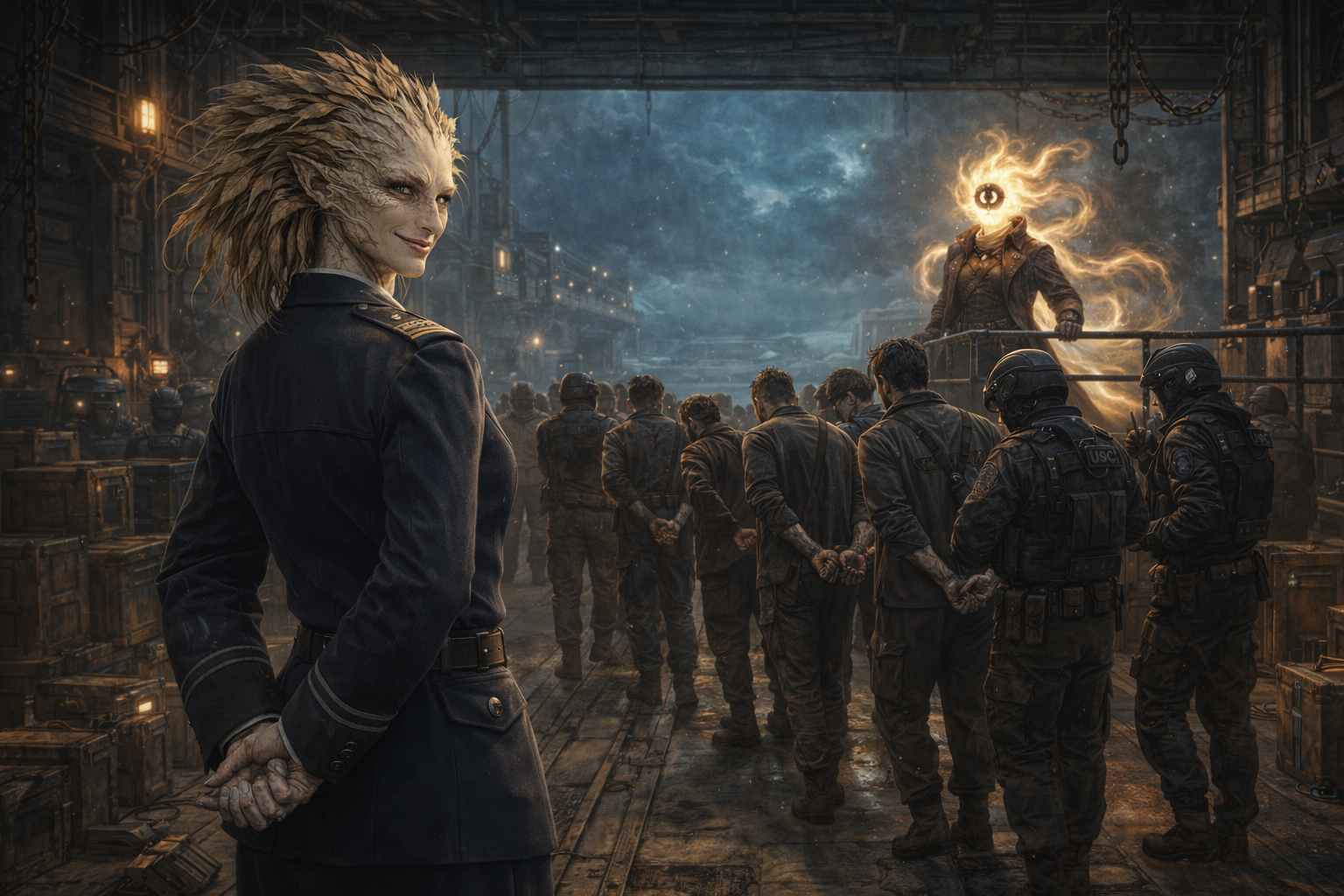
Tatu Rising
Aboard the USCMC Galleon, Tatu begins her ascent not through heroics, but through patience, discipline, and an unflinching understanding of power. Entering service as an unremarkable ship hand, she quickly identifies the rigid hierarchies and fault lines within the crew and turns rumor and resentment into leverage. When sabotage threatens the ship and its captain, Vela entrusts Tatu with an unofficial mandate to investigate from the shadows. Rather than exposing the culprits directly, Tatu engineers a situation where the conspirators condemn themselves, drawing nearly half the crew into open betrayal.
The reckoning is swift and theatrical: arrests staged beneath the looming hull of the Galleon, captain Vela calmly holding the threat of vacuum over mutineers who suddenly understand how close they came to death. Tatu is formally elevated as promised, but the victory is not without consequence. The loss of crew and mounting financial strain force Vela to sell down from the Galleon, reshaping the future of both captain and command. As the chapter closes, Tatu stands newly empowered within the USC system—respected, feared, and very much alone—having taught Vela that authority is not granted by loyalty, but by who survives the accounting.
The salvage operation marked a sharp escalation in Tatu’s rise alongside Vela, now operating without the institutional buffer of a full crew or capital ship. What began as a routine recovery mission in a low-threat deep-ocean system quickly revealed its true stakes: a vast field of avian power crystals, overlapping corporate search efforts, and organized penguin pirate interference. Leveraging superior scanners and speed, Vela kept their downsized vessel ahead of competing USCMC crews, while Tatu absorbed the mission’s violence directly—surviving a brutal close-quarters fight with pirate mechanics and an unleashed parasite swarm inside a hastily constructed underwater outpost. Together they neutralized the pirates, recovered the prospector and critical data, and secured several valuable technologies, including an improved aquatic package and a strange but potent relic weapon. The Company was satisfied—perhaps too satisfied—underscoring that the mission’s real value lay not in rescue or salvage, but in what the data implied about future exploitation. For Tatu, this session defined the new reality of the arc: stripped of scale and support, operating lean with only Vela, and proving that her ascent does not depend on command of fleets—but on surviving, adapting, and extracting advantage when the system assumes she cannot.
The loss of the Galleon’s support leaves Halcyon Verge exposed and economically adrift, forcing Vela and Tatu to think smaller, smarter, and longer-term. With USCMC interest waning, Vela proposes a privately funded wildlife exclusion zone to stabilize shipping and create passive income, a gamble that hinges on Tatu’s ability to fabricate something genuinely new. Tatu delivers: a prototype insectoid exclusion system that rivals old-galaxy relics and hints at serious future leverage if it works at scale. Returning to the quarry, they find Izel and Jiro keeping the outpost barely functional—printers repaired, crew recruited, but production stalled by logistics rather than labor. With reluctant approval, the exclusion field is deployed piecemeal across the jungle perimeter, its activation successful but not quiet. The final emitter triggers a Floran war cry from beyond the treeline, revealing a far more dangerous complication than bugs or balance sheets. As Vela refuses to abandon her people for profit, the session closes with the exclusion zone humming, the outpost still standing, and the unspoken truth settling in: Halcyon Verge’s future will now be decided not by corporate neglect, but by whether first contact with a local Floran tribe ends in negotiation—or annihilation.
Tatu’s bid to secure Halcyon Verge escalated from pragmatic opportunism into open catastrophe. What began as a technically brilliant plan to stabilize the quarry through a prototype insectoid exclusion field instead exposed a long-hidden Floran tribal presence whose hunting grounds had been quietly disrupted. When diplomacy revealed the Sky Stone tribe’s proximity and power, Tatu chose control over restraint—engineering a proxy war through deception, mercenary expendability, and misrepresented threats. The result was predictable: annihilated contractors, a blood-soaked rescue led by Jiro at devastating cost, and a fragile agreement purchased through intimidation rather than trust. The quarry was secured, but at a moral and human price that fractured every remaining alliance.
In the aftermath, Vela abandoned both the project and Tatu, revolted by the methods that had achieved success where caution could not. Rather than strip Tatu of authority, she left her everything: the outpost, the system, and a crew that despised her. Alone, distrusted, and fully in command, Tatu found herself exactly where she is most dangerous—unchallenged, unaccountable, and convinced that this, at least, is how survival works.