

Konda
Konda, officially the Verdant Empire of Konda (Ufalme Mnono ya Konda), is a Nurian nation located along the continent's northeastern coast against the Kardan Ocean. Its heartland and capital are near the center of the empire's current territory, the sprawling city of Gilkobani pouring from the thick jungles to reach towards the seaside and support the region's many ports, though by far the most bustling and crowded of its cities are those among its northern territories; the conquered cities of Mji wa Bandari, Ithaga, and Kaskazinyika each flourish with traders both foreign and local, peddling goods from across five continents. A powerhouse in matters of military and trade alike, the resources and trade ports from the Kondan conquest of kingdoms once independent to its north now allow it to far surpass even the neighboring trade kingdoms of Qoryan and Yikita in terms of wealth and foreign influence, in turn allowing the continued flow of arms and armors to the empire's borders despite rapid expansion in recent decades.
Controversially, Konda holds close ties with the Elethrian kingdom of Durrania, to which it sold the nearby island of Mwangaza (now named New Dalton) for use as a colonial trading port, securing Durranian presence near the Tradewaters – the busy meeting-point of a trio of continents, through which immense trade wealth flows through daily in all directions – under Kondan supervision. While unpopular to some, particularly Kardan trade powers across the Kondan Strait, it has allowed Konda's military forces near unbridled access to gunpowder and blacksteel.
Structure
King
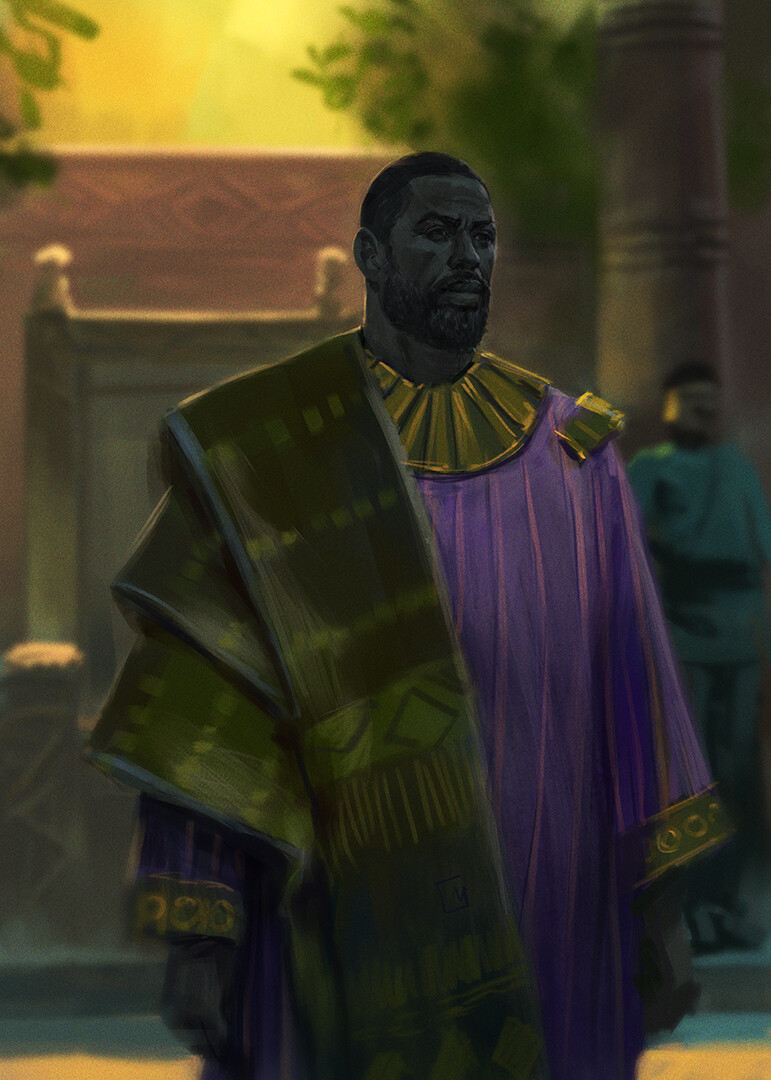
Mfalme Khalfani II sits at the head of Kondan leadership from the palace in Gilkobani, having inherited the position of king – 'emperor,' by Elethrian terminology – by the passing of his father, Khalfani wa Bakari, and is the fourth member of his family lineage to rule the empire of Konda — the thirteenth to rule the territory of Konda in general.
Following the expansionist policies of his father, Khalfani II has thus far been looked upon as a middling ruler — unremarkable through the lens of great deeds, well outdone in military prowess by his father and in diplomatic and religious ferver by his grandfather, but a boon to the realm's stability.
A warrior in younger years, his prowess on the battlefield was tested in the empire's campaigns against Sowa and Bogombe to the south, the former of which has since been resolved in truce while the latter has ground itself to a standstill. While some whisperings among varied detractors criticize his inability to conquer or produce a favorable treatise with Bogombe as a failure of his rule, few could deny that an uneventful rule is a boon for modern Konda. This and the matter of his bloodline leave Khalfani II's rule a stable one.
Military
The Kondan armies are unlike any others seen in the modern world, their rapid expansionism, flourishing trade, and invitation of Elethrian goods to their shores leaving what forces aren't levied from the population a striking mix of the traditional and contemporary. Long-guns decorated with iconography once reserved for javelins, Elethrian and Yojini suits of steel plate adorned with thatched grasses and dyed pelts, Bhaldish blacksteel shaped into the traditional curves and spikes of ceremonial weaponry — and perhaps most notably to outsiders, the near complete eschewing of battle-mages, as invocation of sorceries is considered variously a taboo or more sacred activity in the variety of unnamed cultural religions which dominate the Nurian east.
Shujaa

The mashujaa are the closest Kondan equivalent to the Elethrian practice of knighthood, though their place within society as a warrior class is more directly tied to the hierarchy of the empire itself as opposed to any particular practice of landed feudalism.
Though they do not comprise the bulk of the imperial standing armies in the modern day, their status as professional soldiers leaves them outfitted by the empire itself as opposed to needing to provide their own equipment, often leaving them as obvious stand-outs in elaborate suits of plate among the less well-armored askari who comprise the regiments serving under them.
Just as often as marching to war, the mashujaa will be seen aboard trading vessels or traveling as diplomatic emissaries, as some among their ranks are given the leeway to carry sigils of the ruling family and authorize trade agreements or treatises in their name.
Moran

Unlike the mashujaa, the Kondan ilmuran are an adopted form of soldiery from one of the many peoples now collected under Konda's borders, though their implementation into the empire's militaries bares little similarities to their traditional cultural role in Laashe cultures to the north. Even so, the importance upon which the empire places on the maintenance of their continued cultural dress and significance has inspired surprising loyalty from a conquered people.
Perhaps inspired by the native significance to livestock which the ilmuran bear among the Laashe peoples, their role in Konda's armies is as heavy cavalry and personal guardsmen for high-ranking members of the Kondan governance. Dressed in ornamented steel or blacksteel plate, sat atop barded warhorses or trained rhinos, and wielding polearms or long-guns, even a single regiment of trained moran soldiers has become a living depiction of both Konda's military might and its willingness to allow foreign cultural survival within its borders.
War-Chanters
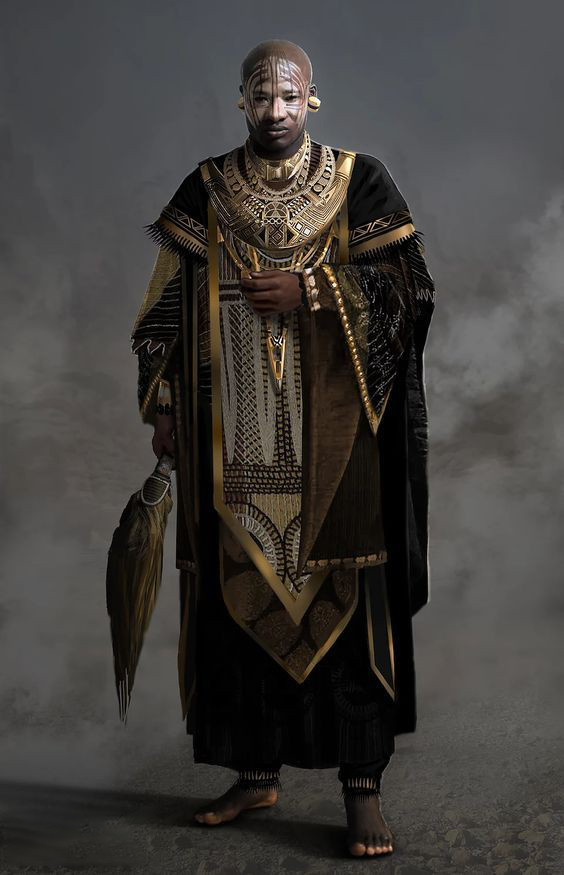
In one way or another, the invocation of sorceries on the battlefield is widely forbidden by East Nurian cultural religion, and the use of war-mages as commonly implemented across cultures by states with the power to train and field such agents would be seen as a break in taboo at absolute best or, more likely, a deligitimization in and of itself in the Kondan right to rule.
The obvious benefits stemming from the capability to bring sorcerous winds to bear on the field, however, necessitated the middle-ground in the form of the Kondan mshairi – literally "chanter" or "poet" – called "war-chanters" by the Durranians of New Dalton. Often men of religious backgrounds, these war-chanters differ from more common implementations of battlefeild magic by having memorized a select few incantations from various disciplines of mystic study and casting them repeatedly through spoken word — per religious belief, this puts distance between the chanter and the magic being invoked, showing a respect for the domain of gods and spirits in matters of mortal war rather than commanding their powers directly.
What war-chanters lose in flexibility they make up for in reliability and familiarity, able to continuously produce the effects of their memorized, verbally-invoked spells with far greater repetition than all but the most well-trained of casters, and with seemingly no danger put upon their own souls by such rapid channeling.
As much of a war-chanter's spells are often focused on healing through sanamancy, they often serve as medics both on and off the field.

Comments