
Nine Hells
in Outer PlanesThe Nine Hells of Baator, sometimes shortened to Hell or Hells, and named Baator (pronounced: /beɪˈɑːtɔːr/ bay-AH-tor) in Infernal, was the home of the devils and the plane that embodied lawful evil It was a plane of sinister wickedness and institutional cruelty, its denizens organized into a strict caste system with a very rigid chain of command. Each of the nine Hells had its own physical laws or properties of matter, but all were inhospitable or deadly to outsiders.
Cosmology
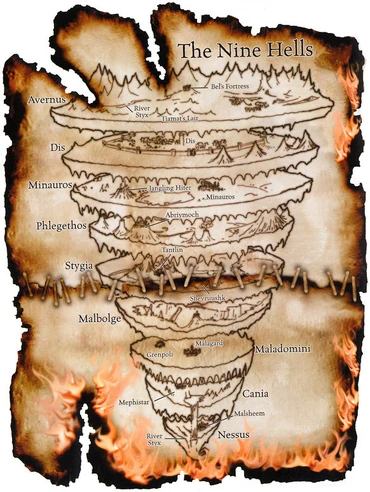
The Great Wheel cosmology model placed the Nine Hells in the Outer Planes between Gehenna and Acheron, with additional connections to Concordant Opposition and the Astral Plane. Each Hell was a different infinite layer interconnected at barriers much like a nine-layered cake—the lowest points of one layer manifested barriers that exited high above the surface of the next lower layer. The river Styx flowed through the first layer, Avernus, and also the fifth layer, Stygia, before crossing over into Gehenna.
When the Great Wheel model was overshadowed by the World Tree cosmology model, the river Styx was renamed the River of Blood and it flowed through all the fiendish Planes (except for the Supreme Throne and the Demonweb Pits) originating in The Abyss, passing through the Blood Rift—an unusual plane that connected The Abyss with the Nine Hells—bringing the devils even closer to their arch-enemies the demons, resulting in the Blood War.[28] The layers were still described as being infinite but with a central pit of finite size that opened to the next lower layer in a tiered fashion, with a drop of many miles between layers.Cosmologists verified portals between the Nine Hells and the Barrens of Doom and Despair and Clangor and, by agreement with Kelemvor, to the Fugue Plane. The Astral Plane connected all of the fiendish Planes to the Prime Material Plane, but not directly to each other.
“The Hells are not so simple to understand. Boiling down nine cosmological layers into 'evil, but with a few more rules' does generations of scholars discredit. Each layer is its own unique moral and magical ecosystem. What Zariel permits in Avernus may be blasphemy to Mammon in the chained cities of Minauros. The Hells bend not only to their whim and will, but to their mere presence. The more souls they acquire, the more that combined influence spreads.” — A letter from Sylvira Savikas
After the Spellplague, Asmodeus consumed the essence of the fallen Azuth achieving (some say regaining) greater godhood and ended the Blood War by casting The Abyss to the furthest depths of the Elemental Chaos. The World Axis cosmology model described the Nine Hells as an astral dominion floating in the Astral Sea, no longer of infinite size nor consisting of layers ruled by Asmodeus and his eight archdevil vassals. Once again the river Styx flowed through the Nine Hells and The Abyss, but then emptied its pollution into the Astral Sea.
Geography
Each of the Nine Hells was unique and usually mirrored the malevolent characteristics of its ruler, or perhaps the archdevils were shaped by the domains they schemed to control, no one can be certain. In earlier cosmologies, each Hell was a separate infinite layer rigidly joined to its neighbors by barriers at fixed locations. After the Spellplague, the domains of the archdevils were described as territories (large, but finite) or circles. The relationships between layers and circles are not fully known. What follows are descriptions of the nine Hells reported for different cosmological models that have been collated and summarized.
Trade
Inhabitants of the Nine Hells produced goods exported across the Planes, including to the planar City of Doors, Sigil. Green Baator ore and steel smelted from it was mined in Avernus. Another notable export was Baator's own whiskey. It was a pleasantly-smelling steaming-hot drink that resembled boiling goldflow. When consumed, it burned one's stomach with sweet pain. Very few mortals could stomach even a single shot.
Layers
- Dis
- Minauros
- Phlegethos
- Maladomini
- Cania
- Nessus
Inhabitants
The principal inhabitants of the Nine Hells/Baator were the devils, and their offspring in varieties too numerous to catalog here. See the main article for descriptions of the myriad devilkind. Unlike the demons of The Abyss, the devils were highly organized in their quest for power and status—scheming and plotting power plays, coups, and assassinations
.In addition to the devils, this plane was home to bonespears, gathra, haraknin, hell hounds, imps, night hags, nightmares, and maelephants.[1] Also occasionally encountered were achaierai, barghests, hellcats, mephits, rakshasa, and stench kows.
Afterlife
Beliefs about the journey of souls to the afterlife changed with the shifting cosmologies and the crystal sphere in which one resided. In some worlds, lawful evil souls were automatically destined for the Hells and arrived as mindless nupperibos or, if they were worthy, as semi-intelligent lemures. For mortals of Realmspace, however, souls first traveled to the Fugue Plane where they awaited escort to their final rest on the plane of their primary deity. While waiting, devils were allowed to bargain with the souls, playing on their fears and doubts to get them to agree that becoming a lemure with a chance for promotion was a better option than their suspected fate. Strong or crafty souls might negotiate a deal that reduced their time as a lemure or bestow a boon or punishment on those they left behind. After the Spellplague, Shar reshaped the Plane of Shadow and folded in what death energy did not get absorbed into the Elemental Chaos and created the Shadowfell. According to the World Axis view, souls on their way to the afterlife started their journey in the Shadowfell. Most made it to the Fugue Plane to await judgment, but a few remained behind or were lost.
Realms
The nine circles of Hell were each ruled by an archdevil of great power, but the Nine Hells were also the home of other powerful beings at various points in the history of the Realms. Listed here in alphabetical order are those that directly or indirectly influenced the course of events in Faerûn, Toril, and beyond.
- Asmodeus, the Overlord of the Nine Hells, exercised his power from a gargantuan citadel in the lowest rift of Nessus,named Malshee
- Azharul's Dragonspawn Pits were located in Avernus.
- Baalzebul ruled the seventh circle of Hell, Maladomini, from his huge fortress Malagard. Early source material credited Baalzebul as controlling the sixth circle (Malbolge) through his viceroy Moloch.
- Bahgtru, the strong but dim-witted son of Gruumsh, once resided in the Nine Hells before moving to the astral dominion of Nishrek as described by the World Tree and World Axis cosmology models.
- Belial was the ruler of Phlegethos, the fourth circle of Hell, based in the basalt palace Abriymoch the "Mount of Leaping Flames", nestled in the caldera of an extinct volcano. Sometime before the Spellplague he set his daughter Fierna up as the ostensible ruler while he directed from the wings.
- Dispater dominated the second circle of Hell, Dis, from his high stone (later iron) tower in the city of the same name, also called the Iron City.
- Fierna, daughter of Belial, was the archduchess of the fourth circle, fiery Phlegethos, as much as her father allowed.
- Gargauth was thought to have been an archdevil cast out of the Hells long ago for betrayal. He eventually achieved godhood corrupting souls on the Prime Material Plane.
- Geryon once ruled Stygia, the fifth circle of Hell, from a castle/city called Tantlin. At some point he was replaced or deposed by Levistus before that archdevil was imprisoned in the ice.
- Glasya, daughter of Asmodeus and former consort of Mammon was the ruler of the sixth circle, Malbolge, after her father removed the Hag Countess.
- Gruumsh, god of slaughter, chief god of the orcs, once had a realm in the Nine Hells and other Lower Planes (see Acheron) before relocating his family to the Iron Fortress in the astral dominion of Nishrek.
- The Hag Countess held sway over Malbolge, the sixth Hell, after giving unwise council to Moloch causing him to rebel against Asmodeus and be defeated. Asmodeus eventually got rid of her and installed his daughter Glasya as Lord of the Sixth.
- Hecate, the Greek interloper deity of magic and the moon, had her second realm, named Aeaea, in Minauros.
- Ilneval, master of strategy and chief lieutenant to Gruumsh, once lived in the Nine Hells before moving to Nishrek as described by the World Tree cosmology model.
- Inanna, an Untheric goddess of love and war, once had a realm in the fourth circle, Phlegethos.
- Kurtulmak, god of the kobolds, once lived in the caverns of Avernus named Draukari where he maintained the appearance of friend and ally to whichever archduke was trying to lure him to their faction at the time. He eventually moved his realm to Clangor, according to the World Tree cosmology model, but maintained a portal to the Nine Hells.
- Levistus was the ruler of Stygia before (and perhaps even while) he was imprisoned in an iceberg floating on the frozen sea.
- Luthic, mate of Gruumsh and orcish goddess of caverns, female orc fertility, and primitive medicine, shared a realm with Gruumsh in the Nine Hellsbefore moving with him and her son to Nishrek.
- Maglubiyet the Mighty One, Lord of Depths and Darkness, once had a realm in the Nine Hells as well as other Lower Planes as part of his wandering (see Acheron). Later, he moved his realm to Clangor, but he maintained a portal to the Nine Hells.
- Mammon once ruled Minauros, the swampy third circle of Hell, in a city of the same name built on many huge pillars of black stone that were constantly sinking slowly into the sludge.
- Mephistopheles presided over the frigid eighth circle of hell, Cania, from his mighty citadel Mephistar, overlooking the Nargus glacier.
- Moloch ruled the sixth circle of Hell, Cania, as the viceroy of Baalzebul before it was taken over by the Hag Countess and later Glasya.
- Sekolah, the god of the sahuagin, once swam in the deep waters beneath the ice of Stygia in a realm called Sheyruushk.
- Set, the jackal-headed Mulhorandi Lord of Evil, once controlled a huge realm in Stygia that he turned into a desert under a blazing sun. He called this realm Ankhwugaht. Later it was moved to Stygia.
- Tiamat once ruled the first circle of Hell, Avernus, from her cavernous lair Azharul, "The Dragonspawn Pits", attended by evil dragons both spiritual and incarnate, and a host of abishai At some point she was demoted to guarding the barrier between Avernus and Dis before moving to her Cave of Greed in Dragon Eyrie. After the Spellplague she became a servant of Bane in Banehold.[
- Takhisis, the Queen of Darkness from Krynn, shared many similarities with Tiamat so that some close connection between them was suspected, but maintained a distinct realm an Tiamat called Abthalom, or the Nether Reaches.