
Dis
Dis was the second layer of the Nine Hells of Baator. Ruled by its namesake, the archdevil Dispater, Dis was almost entirely taken up by the city of Dis (which was named after the other was inconsistent), such that there was debate and speculation as to whether the two were one and the same. Also known as the Iron City, City of Pain, and the Endless City Dis was the largest and most well-known of all the cities of Baator and treacherous even for the Hells, a paranoia-driven fortress-metropolis so tremendous and sprawling that it could very well be infinite.
Description
Several miles tall and hundreds across, to call Dis a vast maze of a city was an understatement; it was a labyrinthine and disorienting place almost-constantly defying possibility, where one could truly wander the streets forever and get nowhere for the effort. The residents eagerly conned and cajoled the visitors,uncovered secrets were sold to the highest bidder, and Dispater dispensed his own paranoid brand of justice. A plane of heat and pain, the layer perfectly reflected its infernal master. Like Avernus above it, it was a reality where the forces of fire and earth were magnified, but went a step further by rendering magic of air and water not just diminished, but totally impotent. Any who fail to show caution were likely to get burned in more ways than one.
From the walls to the cobblestones, all of Dis was constructed of the same smoking, unrusting, blackened iron, which glowed red-hot from the infernal heat. Just being near the smoldering metal was enough to slow and drench mortals with sweat, and even casual contact with most exterior architecture would horrifically and agonizingly burn mortal flesh. Without proper protection, most visitors would quickly end up writhing in the streets.
“Is it hot in here, or is it just me?” — Harbon Lockstone, a warrior in chainmail
While metal armor would prevent direct contact with the city's iron, it was insufficient defense against the unbearable heat; upon arrival, those wearing such gear would be slowed, weakened, and gradually baked alive, as if it was constantly under the effect of heat metal. The best defense was thick cloth, padded armor and iron-shod boots of the heaviest leather, although even magical cloth not treated against fire was at risk of bursting into flame if it made contact with the iron. Other potential defenses were certain magical items, like rings of fire resistance, or thick enough natural armor, as most baatezu had even if they weren't already immune to fire
.The burning hot buildings of Dis extended out to every horizon, occasionally broken up by the palatial mansions of particularly important devils and Blood War officers. The cityscape was connected by garbage-choked streets and ramshackle alleyways to create the tangled, narrow architectural network that was the Iron City. Within the dismal City of Pain were city squares, squalid slums, iron ramparts, eyrie-riddled towers, brooding iron gargoyles, and iron-barred cells stocked with chains and implements of torture. Beneath the crowded streets and even Dispater's own palace, in the lightless underways known as the "pits" of Dis, were numerous caverns and vast dungeons where prisoners lived lives of savage survival fighting for scraps of edible garbage from above amidst the filth and lost treasures.
Dis was the heart of arguably the greatest weapons supplying operation in the multiverse. With iron harvested from the mines beyond the city and with the many secret forging techniques unearthed by Dispater and put to use in the Iron City's workshops and foundries, an unending supply of weapons, armor and other armaments were constantly churned out and used up to fight the endless demonic hordes of The Abyss. The focus of Dis itself was far less military than Avernus however, concentrated instead on progress and industry. This reality was blurred however, for it was completely unclear what the city was meant to be progressing towards.
The urban hellscape of Dis existed in a state of perpetual remodeling, its condemned slave crews constantly building up and tearing down to the city. Roads and buildings, even paths being walked or inns in which people were asleep, might be placed, removed, obstructed, opened up, repaired, or simply rebuilt at a moment's notice, sometimes just after the latest work in the same spot was complete. Guides were of little help in a realm that changed every minute, maps were useless by the time they were drafted, and teleportation risked ending up trapped below collapsing debris or inside burning iron that wasn't there before. All the while the crews sweat and screamed and burned, completing their work with impressive speed without tools or protection.
Yet mundane labor alone could not explain the cityscape of Dis, for it changed faster than such a force could ever manage. Parts of the layout seemed to rise and fall according to some hidden terrain, but more important was the magical alteration supposedly done by none other than Dispater himself. Ever-weaving a web of impenetrable defenses around his holdings, the changes of Dis were said to be a reflection of Dispater's own mind, and the reality of that fact put into the focus the paradox that the city embodied.
Like so many other realms and layers, Dis appeared impossibly large and contained hypothetically infinite space, and yet those within always felt enclosed, trapped and oppressed. The deeper Dispater's paranoia became, the more cramped and warren-like did the city become to match. Scrying devices were omnipresent, with iron statues of Dispater following passersby with red, paranoid eyes, while the very walls could be said to have ears. And yet, even as the city seemed both claustrophobically tight and unfathomably vast, from the balcony near the top of Dispater's palace, it could all be seen at once, down to the tiniest details. The realization was enough to leave one temporarily catatonic, or, for beings of law who could withstand the revelation, permanently enlightened.
Geography
Despite its seeming infinity, there was a plane of Dis distinct from the Iron City, as could be seen from within the metropolis by the presence of distant mountains. Despite the unnerving shifting of its boundaries, some claimed that one could leave the Iron City simply by walking far enough, upon which they would find the hinterland of Dis. The city was surrounded by a moat of poisonous water, perched upon an island in the middle of the lake. The stagnant streams of cold, black water that stretched threadlike across the landscape all came together at the lake, and some yet unmined turquoise could be found in the underwater crevices along their banks.
The vale in which Dis unevenly sat was otherwise a flat, barren plain with the occasional bare hill or tor rising up smoothly from the terrain. Thousands of miles from the the City of Pain however the blasted wasteland rose into low, rolling hills occupied by enigmatic pillars of moving stone. In the hills could be found a few veins of nearly pure copper (and smaller amounts of iron, tin and zinc ores) that the devils continued to mine and guard despite having a already almost exhausted them. Eventually one reached the exterior of the plane, the sheer, jagged and iron-rich mountains that ringed it. Iron roads spanned and wended through the maze of canyons wedged between the mountains, watched over by the garrisons of iron fortresses perched atop the peaks.
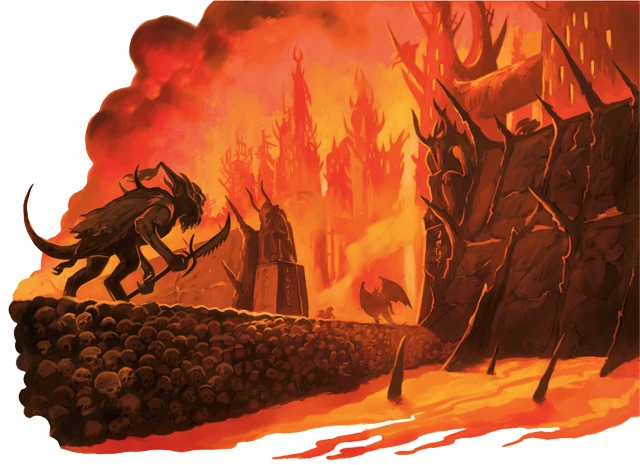
Yet even from outside the Iron City, the spatially anomalous nature of Dis was apparent. For one, the distance from one peak to another seemed unimaginable despite being part of the same range, and no matter how long and hard one travelled, even if teleportation was used, they would never reach the city or even find landmarks. The only way to progress was to follow a path at the base of the mountains which wound its way across the plain, although even this could take any amount of time. From the mountainside the path seemed to be white cobblestone, but up close was revealed to be half-buried skulls, crushed and cracked from the passage of those that came before.
Eventually the skulls gave way to tall spurs of blackened iron which rose from the ground like trees of blocky metal, increasing in number, height and thickness until they were akin to enormous walls or sheer cliffs (although the strange spatial principles made the transition point hard to identify). Then, all of a sudden, perhaps after rounding a turn, the barriers would be gone, and the traveler will have arrived in Dis, Entering always came as a break in reality, with the abrupt appearance of a rushing crowds, a cacophony of terrible noise, and the tripling of temperature.. This occurred despite Dis having an outer wall, which the visitor might be able to see far behind them despite never noticing its presence beforehand.
The ever-overcast sky above Dis was a thick, dull, smoky-hued ash-green (or sometimes tomato red), but occasionally lit up by the flickering of high-reaching lightning, accompanied by faint thunder. Reports were inconsistent on whether there were dark, boiling storm clouds or no clouds at all, but a general dark haze existed over the entire layer regardless, caused by the pall of smoke from the burning iron of Dis, as well as visible wisps of odiferous vapors coming off the poisoned water. Fierce and unpredictable winds swept ceaseless over the plains, putting landbound creatures, especially those high on an exposed position, at risk of being sent flying through the air if they stood or moved against it, while only creatures that spent years maneuvering in the fickle winds could properly fly.
Cosmography
“Be it known that the path to Dis is a treacherous one, however the path back can be even worse. There is no easy way of leaving Dis. Be careful who you cross on the way, they may have friends waiting for you on the way back.” — Verigrim the arcanaloth.
By Asmodeus's decree, no planar portals could connect directly to any layer of Hell besides Avernus. This meant that in general, if one wanted to get to Dis they would have to locate a portal on Avernus, and likewise would need to find a portal on Dis to get to Minauros below. The largest and best-known way between Avernus and Dis, which unintelligent creatures, least and lesser devils, and armies gated in from elsewhere would have to use, went through the lair of the goddess of chromatic dragons, Tiamat.
The nature of Tiamat's guardianship over the so-called "Way to Dis", was generally inconsistent and unclear, in no small part of the Dragon Queen's own active effort to obscure and misinform regarding the subject. She had been reported as dwelling in several Planes over the centuries, but her true self (as much as deities of her stature could be said to have "true selves") had always been stationed in Dis. Asmodeus gave her the formal duty of guarding the way, which she fulfilled faithfully, never allowing her stationed aspect to neglect or desert its post,although due to the layout of the path, trespassers had managed to maneuver around her while Tiamat did not wish to be disturbed.
Eventually Tiamat acquired a "battle body" in the form of the repurposed form of the dragon deity Azharul, which she used to meet with and combat those beyond her guardpost. For services rendered to him, Asmodeus held a great ceremony where he formally titled Tiamat the "Guardian to the Gate of the Second Layer". This honor did nothing to stop him from masterminding her imprisonment in her own realm by Bel to keep her in her place, since which she has sought to escape.
“If it ain't escaping and it ain't a tanar'ri, it's not my job to worry about it.” — Jal'haya the abishai, guarding the gate into Dis.
Should one manage to evade Tiamat, there was still the matter of the iron doors leading to Dis. Though not guarded by baatezu due to their strained relationship with Tiamat, they required great strength and stature greater than a normal Human's to open. More pressingly, unless the conditions were met to make it act as a magical gate (conditions sometimes hinted at but always liable to change later on), the doors would only lead into the endless tunnels of Tiamat's lair. Once finally crossed properly however, visitors would arrive in Dis halfway up one of the mountains, the door shutting behind them and refusing to budge from that side. Gate guards were present on the Dis side of the gate, such as abishai, who checked for passes, questioned intent and otherwise fought off invaders.
Besides the most famous portal, which led only to the plane of Dis, there were several portals from Avernus that led to the upper citadels of the Iron City. Examples included portals leading into Dis from the former gate-town of Darkspine and Bel's Fortress. Meanwhile, there were portals from the Iron City to the Sinking City of Minauros (including one only 30 feet (9.1 meters) above the roof of Mammon's palace of Galbuach). Another existed between the Iron City and Minauros's City of Chains, Jangling Hiter, which uniquely kept itself out of the layer's muck by a network of chains somehow attached to the underside of Dis (the residents were incurious about the feat and to ask put one at risk of being seen as a foreigner and therefore a potential victim). One route was to go through Dispater's own Iron Tower, where there was a staircase that eventually mysteriously ceased to exist, depositing the traveler in Minauros's swamp.
World Tree
In the World Tree cosmology model, Tiamat's domain on the plane of Dragon Eyrie served much the same role in guarding Dis as her home in Avernus. Several soft borders linked the Eyrie to Avernus, including Tiamat's Fortress on Avernus, the cave mouth in the rock wall behind Avernus's Maggot Pit, and the depths of certain sinkholes scattered across Avernus, called the Mouths of Azharul. Access to Dis in this cosmology was restricted to a second soft border leading from the Eyrie back into the Nine Hells, protected by Tiamat's aspect.
World Axis
“Abandon hope, all ye who enter here.” — The molten runes above the gate to Dis
In the World Axis cosmology model, the Nine Hells were a planet-shaped astral dominion floating in the Astral Sea, no longer of infinite size nor consisting of layers. In this cosmology Dis was a vast cavern over 100 miles (160 kilometers) across and easily 10 miles (16 kilometers) high illuminated by the ruddy glow of sluggish streams of lava and red-hot iron. Its floor was broken up by jagged mountains and sheer ravines, and the city sprawled unevenly across the miles of steep hillsides.
Dis could be reached via many caves in Avernus, the most notorious route being a great archway with towering, open iron doors, the Gates of Malsperanze. From there it was a steep decline to the Iron City, following a 20 miles (32 kilometers), skull-littered road and bridges of iron spanning dizzying drops. Out from the lower gate of Dis was a descending road lined with gibbets which gradually broadened out into the layer of Minauros.
Notable Locations
The Iron Tower, the personal fortress of Dispater designed first and foremost to protect him, a reflection of his iron-fisted rule. It somehow stood at the center of Dis while being visible from all directions, its presence virtually inescapable fact of Dis, yet that same presence made it almost impossible to approach, with only special techniques able to bring a visitor closer than a block away. The Tower existed in a state of constant flux, shifting in structure faster than the rest of the city, and its labyrinth of planning rooms, prisons, libraries, sanctums and other chambers shifted their layout according to the Iron Duke's whims. The Iron Tower protected Dispater even should the unending traps, walls, minions, monsters, spatial anomalies and other defenses within and without it prove insufficient, for inside its walls he was nigh-invincible, waving off even wish magic utterly undisturbed.
The Fetters, also called the Petitioner's District, a sprawling slum so-called because many of its residents were, for whatever reason, stuck there. It was devoted to Hell's foreigners, a place where they could barter for goods and information or seek infernal audiences, but also housed damned souls clever or valuable enough to avoid the typical torment. Founded by greedy and enterprising merchants, it was the closest the Hells had to a tourist spot; it provided most needed supplies, relief from the heat through tarps and carpets (really the flayed skins of lemures and nupperibos smeared with incense), and often mimicked famous parts of Material Plane cities to near-perfection. Yet Dis was still unpleasant, and reprieve was often tinged by homesickness; the replica city blocks were not as well-stocked as the originals, prices were modified to match the utility of items in harsh heat, and decent food was rare, most of it being processed or ground up fire fungus. While most other establishments in Dis refused service to non-baatezu altogether, the familiar imitations of the Fetters made the differences more glaring, as vicious gangs fought futilely for control under the watch of Dispater's spies. Known inns included "Crown of Iron", "Fool's Hope" and "King's Arms" while known taverns included "Wages of Sin" and "Filched Kiss".
The Garden of Delights, an oasis inside the inhospitable City of Pain. Sitting behind sandstone walls and a wooden gate, beautiful women collected the high entry fee, although eventually one only needed to knock. Comely servants beckoned visitors inside, quickly ushering them to silken pillows by the beautiful poolside to enjoy sumptuous meals and refreshing beverages. Palm fronds fanned the brow, lovely fairies danced, musicians provided soothing sounds, and no one, once admitted, ever had to leave. Predictably it was a trap, an illusion at first created by a single enslaved efreet, but which proved so successful that an entire group was rewarded well to maintain it. Disguised imps mingled among the guests to learn their flaws and urge them into corruption and damnation, leaving many an unsusceptible patron to die of unrealized malnutrition. The nature of Dis meant only leaving revealed this, though careful study revealed the unreality, leading the imps and illusory servants to distract the overly focused. Even with the revelation it took iron will or lengthy persuasion to leave, for the garden sapped identity and motivation. Minions of Dispater and other lawful evil beings were only admitted for work.
Mentiri, a vast, notoriously horrific prison hidden in the heart of Dis at the end of a confusing labyrinth. Utterly insidious, Mentiri performed two functions. In the "Bastille of Flesh" wing, captured mortal lawbreakers, including virtuous heroes, naive adventurers, greedy thieves, heartless mercenaries, demon cultists and Blood War captives, were "reformed" towards lawful evil. All had to compete for survival and were manipulated by polymorphed devils, most turning wicked or sycophantic from the absence of decency and hope, granting Dispater their souls and heralding their execution and subsequent damnation. Meanwhile in the Bastille of Souls, non-lawful evil souls trapped in Baator (such as captives of extraplanar raids or mortals who died in the Hells while alive) were held for ransom, since ancient pacts prevented their torment or destruction but did not mandate their release. Falxugons attempted to convince still-living associated to sign Faustian pacts in exchange for their release while amnizu negotiated trades for goods, services, information, and misdirected lawful evil souls.
Divine Realms
God Street was not exactly a divine realm in and of itself, but an area where divine realms came to be. Located in the bleak, industrial outskirts of Dis, it was home to a variety of aspiring, new, and fading deities of lawful evil. When new figures of worship, such as mythical champions or revered objects, had a critical mass of lawful evil devotional energy attach to them, a new deity would be born. The entity's soul was retrieved from whatever state it was in, including imprisonment or outright conversion into an outsider, or in cases where there was no relevant soul, such as if the being was fictional, simply coalesce into being. From there they would appear on God Street, usually in the small iron plaza bounded with faceless statues called the Borning Ring. The infinitely recursive space of Dis also made it popular for weak, realmless, pre-existing deities of lawful evil.
Upon arrival on God Street, new deities quickly ripped holes in the malleable fabric of Dis's reality, to create singular, outlandish structures dedicated to their own glory. These included shrines, statues, temples, cathedrals, strongholds and even giant vortices or faces. Each seemed improbably immense from the outside, but the lesser deities of God Street could rarely create the illusion of infinity on the inside and so placed some form of visible boundary markers, making their realms appear as building interiors or tiny, bounded universes. Uncountable numbers of these creations stood alongside each other, running down God Street's winding, seemingly infinite, intersection-free length. Only divine casters could locate and get to the divine lane without aid from one of the deities (although chaotic and good-aligned casters struggled more), and if they so desired, find a particular deity's doorstep.
No matter how powerful a deity was on a single world, they were likely to scheme for future greatness on God Street until they attained followers on multiple. Known denizens included Khandovar the Punisher (a deity of torture), Z’zelth of the Eighth Order (a deity of false knowledge), and Uin the Unseeing (a deity of blind obedience). Besides God Street, the Fetters of the Iron City were crowded with shrines to dark deities and palaces that had long since fell into rotting disrepair. Temples included Tiamat's Fane of Glory, Bane's Shrine of Swords, and Zehir's House of Shadows. At the heart of Dis was the Hall of Infernal Might, a sprawling iron cathedral dedicated to Asmodeus, who many of the damned still worshiped.
Retreat of the Fallen, realm of Druaga, Babylonian deity of summoning baatezu. A vile palace sprawled across the entirety of his realm, a place of pillars and smoky hazes with vaulted ceilings barely visible from the ground. Any follower of the Babylonians who entered Baator had to do so through his realm, for as far as his pantheon's influence extended, he was the ruler of the fiendish lands, and permitted by the archdevils to force baatezu into his service and determine what fiend to send over when a baatezu was called. The realm of the (perhaps self-titled) Ruler of the Devil World was far from the hills surrounding Dis's flat plain and tolerated without interference by Dispater.
Inhabitants
“Locked in an iron fortress within an iron city in the festering iron pit of Dis, Lord Dispater is master of all he surveys!” — Ustyhrin-ja, disciple of Dispater and chief among his erinyes.
The primary inhabitant of Dis was its ruler Dispater, whose intense paranoia meant he almost never travelled beyond the city. Indeed, he almost never left the Iron Tower, only doing so to answer the call of Asmodeus and returning as soon as possible. Within his palace was a great hoard of treasures, including gold pieces, worked turquoise gems, and spare ropes of entanglement and daggers of venom (the tools commonly used by erinyes).
The fiefs of Dis's dukes were located beyond the Iron City, between its walls and the hills past Dis's plains.Their own small, well-hidden treasure hoards, accumulated over centuries of taking minor baubles they hoped Dispater wouldn't notice or begrudge them from intruders and mining operations, could be found in their forts and fiefdoms. Within the city's bounds, and almost always within the Iron Tower, could be found the likes of his consort Lilis, his provost Biffant (who managed the affairs and staff of the Iron Tower), his nuncio Titivilus (his chief advisor and herald), and his avenger Arioch (who flew throughout the city punishing those he believed obstructed, defied or plotted against Dispater). Previous known inhabitants were the pit fiends Baalzephon, Dispater's prime minister who went on to become one of the Dark Eight, and Bel, the leader of Dispater's cornugon bodyguard force called the Iron Guard before his rise to rulership over Avernus.
Garrisoned on Dis were the Iron Defenders, a legion specialized in engineering, defensive maneuvers, and siege-breaking. Led by the Dark Eight pit fiend Zapan, the legion of Dispater consisted of experts in holding ground.
The general population of the Iron City was primarily devils and damned souls, with a few extraplanar beings in between. Its population was roughly 400,000, most of the city being an uninhabited maze despite being large enough for many more.
Devils
Dis was a cruel but effective tyranny where every devil knew its place; even then, devil nobles had to vie for space with the petitioner gangs Dispater passed his constant paranoia on to those in his service; his infernal attention made those beneath him cautious and watchful, and the only devils that survived long in the labyrinthine streets of his city shared unwavering suspicion and forward-thinking. The attention to detail this demanded left few openings in their defense and kept them alert to the myriad dangers lying in wait. Many creatures who so much as bargained with Dispater were driven to cloister themselves away, hiding in great fortresses behind clever traps and loyal servants, but they also knew the value of escape routes, and used what power he gave them to create paths that their enemies could not follow them down. At its most obvious, the influence of Dispater was seen in unsightly eyes growing all over a creature's body to watch for treachery and cover their flanks.
Most kinds of devils could be found amidst the dark, crowded streets of Dis, but certain types were more commonly observed than others. The most numerous devils of Dis were the hordes of lemures and nupperibos, least baatezu who existed in the hundreds of thousands. They acted as slave labor in the petitioner work gangs, burning in pain from the hot iron the same as other petitioners. The lemures attempted to avoid their fellow baatezu, but the strong winds sent them tumbling helplessly through the air.
There were also a good many abishai, imps and spinagons Spinagons frequently acted as foremen, directing and keeping together the work crews, but could also be found hawking faulty wares on the streets. Abishai perched and preened along the walls, keeping watch over the toiling petitioners within and without the Iron City, catching the fleeing condemned and angrily pummeling flying individuals who turned out not to be tanar'ri demons. Also common in Dis were gulthirs, and war devils were often at their most ubiquitous on the 2nd layer. Hellcats roamed the hills and thronged the streets, while spiked devils were forged from the iron mined with Dis.
Interesting among the devils common to Dis were erinyes. Dispater preferred to lead from the Iron Tower through erinyes, who flew to and from its heights to exchange information with him. He favored them not only for their beauty, but for their competence and unwavering loyalty. Erinyes could gain increased power and other rewards in Dis by currying more of his favor, as could be done by completing assignments well and diligently, or by completing the tests he often arranged for the loyalty he so desired. They filled the city and were sometimes in-training, students of the erinyes school tasked with tricking and seducing visitors to get information from them to pass to their instructor (and eventually to Dispater), which they did without specifically evil intent.
The rolling hills beyond the Iron City were haunted by wild erinyes who seldom, if ever, went into the city. Native to the plane, they could navigate its winds with relative ease, sometimes remaining perpetually aloft to buffet lemures for sport or watch for intruders. Such watchers usually flew close to spotted intruders to note their numbers and appearance before heading straight to the city to inform Dispater or one of his commanders or guards. Along the way they would almost certainly encounter others of their kind to pass the message onto if not already in a band (in which case only one would leave), leading to several strikes by erinyes groups before an organized force arrived. Since Dispater, like all archdevils, always sought potentially useful creatures or items, the erinyes tried not to kill for fear or destroying something he might have wanted.
Barbed devils were uncommon in Dis, and bearded devils rarer still, although both (and chain devils) could be found in Mentiri as guards, (and in the case of the barbed devils specifically, as staffers alongside spined devils). In addition to bearded and spined devils, legion devils and succubi dwelled in Dis in the thousands, while over a thousand kocrachons were employed by Dispater and had to study their torturous arts in his realm at the School of Pain beneath the Knoll of Blades. Horned devils and pit fiends were very rare, while styx devils, ice devils and bone devils were almost absent (although the lattermost types both guarded and ran Mentiri).[ Corruption devils spent their time overseeing lesser devils on the outskirts and tormenting the damned, enforcing Dispater's will among the writhing, fetid hives.
Petitioner work crews were the most commonly encountered groups in the Iron City, although their endless toil persisted outside of it as well. The avenues echoed with their screams as they handled the burning iron, but non-fiend petitioners, who did not naturally regenerate from injury, were allowed healing from the wounds they suffered from their labor, a "kindness" Dispater extended to them which did not apply to other forms of harm. As for why the work crews would be necessary if the city was always in flux, their Sisyphean suffering was the point in and of itself. The torturous, meaningless labor was simply designed to break the petitioners, body and soul. Otherwise they worked as attendants for infernal nobility, could be heard through vents in the walls screaming in underground dungeons, or were put to work at the foundries if they were skilled artisans in life.
Most of the petitioners of Dis were lemures, but some were horribly sculpted soul shells or former worshipers of Baatorian powers, Among the most unique of petitioners however were the shades. Sometimes, a soul experienced a revelation about their identity where they gained the ability to empathize with their victims and truly understand the consequences of the great evils they committed in life, leading them to sincerely seek repentance. Sometimes they succeeded and went to the Upper Planes, or were reincarnated by its masters to be tested with a second chance. For most however, it was but moments too late; they repented only upon arriving to the Hells, as their true fate dawned upon them. These souls entered a spiritual state called anagnorisis and were spared the usual process of torturous lemure conversion to suffer a much worse, much more lucrative fate.
Anagnorisis were converted into spectral form so they could forever lament the error of their ways. They were not spared from service in the work crews, but had the memories of their living selves returned so they could better appreciate their terrible torment. The weeping and wailing of these spectres gave off huge quantities of evil divine energy, which could then be collected by a system of metal rods erected on the towers and bridges of Dis, the occult secret to which were jealously coveted by other archdevils who had to make do with trading conversion-eligible souls to the Iron Duke. The pathetic spectres yearned for the comforting touch of the virtuous and living, but their sobbing, flailing, open-armed embrace was just as draining as their worldly counterparts, making them dangerous to the living. Meanwhile, they left even agents of the devils alone, knowing no comfort could be found in their arms.
Most of the humanoids present in Dis, such as the considerable number of Tieflings, were traders and shopkeepers as the questionable wares bought and sold in the city's numerous markets and bazaars attracted creatures from various Planes. There one could also hire a band of bloodthirsty mercenaries for the most diabolic of jobs. However, while few non-baatezu came to Dis without compelling reasons, those who chose to live in Dis were not the sanest members of their respective people; many were so desperate that the only thing keeping them alive was the hope of "one big score", and violence among thieves was not uncommon. Besides merchants, the most common humanoids of Dis were the devoted supplicants of Baator. They held in respect and reverence the baatezu, engaging in joyful pains like self-flagellation, chanting prayers for deliverance at their hands, and aspiring to one day become one of the petitioners in their service.
Besides those groups, there were planar travelers who didn't want to be in Dis, but had wound up there by some circumstance or another, such as wayward magic by addled spellcasters. Many mortals for example had been kidnapped from the Prime Material plane, such as victims of an erinyes charming lead into Baator and forced into work crews, where they could only hope to stave off inexorable transformation into petitioners. There were also prisoners of the Blood War, who often joined the kidnapped and the petitioners in screaming in the dungeons below. Freeing such unfortunates would likely only see them grabbed up by other nefarious forces unless personally escorted out of the Hells, and they would be of little use unless first fed, healed, and equipped.
Others
Besides conspiring with devils, planar travelers came to Dis to close deals with various sorts of fiends, including night hags, incubi and succubi. Stench kows worked alongside spinagons as the working backbone of the estates of the dukes, which were wandered by achaierai and mephits. Of particular note were the rakshasas; they not only crowded the streets, sealing bargains within the city, but also wandered the noble holdings and were sometimes able to achieve important positions in a duke's court, although they were too independent and ambitious to be trusted or go unwatched. The city's population also had a significant number of cambions. Besides the fiends, the city was filled with zombies, and its fetid streets writhed with rot grubs and the occasional black pudding.
History
“All know Dispater to be a paranoid lord, sequestering himself away behind endless iron corridors, nasty traps, and terrifying minions. He rarely, if ever, leaves his tower, and when he does, it’s to descend into his city, Dis.” — The Book of Fire
Ancient even by archdevil standards, Dispater's ageless rule over his self-named layer seemed to stretch back to the early days of the multiverse and the founding of Hell, with him being gifted it by Asmodeus.Notably, he was not always the recluse of a lord he had become; rather it was after the Reckoning of Hell, when the archdevils failed in a bid to unseat Asmodeus, that he refused to emerge from the Iron Citadel, shamed and weakened, but with his holdings intact.This was seemingly the start of his decline into total paranoia, as reflected by Dis itself.
For example, while cruel and manipulative, Dispater recognized the need for goodwill with other planar beings, and while war-torn Dispater was too barren to support trade, Dispater often welcomed merchants to his city and had a booming marketplace as a result. After the death of Malagard the Hag Countess at the hands of Asmodeus's daughter Glasya, seemingly with his collusion, his anxiety worsened, and he feared the half-crazed voluntary occupants were natural sources of betrayal. For fear of active provocation, he resolved to slowly squeeze them out by making Dis even more inhospitable through incremental harassment, heightened surveillance, and taxation. All the while the city became more compact and confining.
Furthermore, the betrayal of Malagard saw Dispater retreat even deeper into his inner sanctum. He was convinced his ranks were filled with his traitors and had all his devilish subjects watching each other. He gave orders through multiple layers of intermediaries and personally met with only his most trusted advisors. Since then there has been little reason for Dispater to change course, especially with his fears being actively fostered and deepened by Titivilus. While gangs still fought in the Fetters, he kept control over them through his spies, and he collected a portion from every deal made in his layer through special provisions added to any contracts signed there.
With Zariel taking Avernus from Bel, Dispater's network of spies and secrecy had only grown. His informants were tasked with watching over anyone who might prove a threat to him, and many of his messages were written on the backs of imps wearing concealing vests that would kill them if any but the intended recipient tried to take them off. Dispater himself began dwelling in his tower's libraries, and had constructed an impenetrable suit of adamantine armor created with magical secrets to protect him in any environment. No longer did he manage the day-to-day of his layer, leaving that job to Titivilus, who himself often recruited and expended outsiders through various intermediaries to create and resolve conflicts.
Rumors and Legends
There were rumors abound in the City of Dis that construction was going on just beyond the city borders, and reports claiming that nothing less than pit fiends were tasked with preventing witnesses and interference. None could tell from a distance what the massive structure was, but the same secretive sources claimed the baatezu were planning an unheard of undertaking to build a working, life-size model of Sigil. Allegedly this was to decipher how the Lady of Pain controlled her city, perhaps to tip the balance of the Blood War or attack Sigil, but construction could take eons to complete.
There was also rumors of a rogue pit fiend secretly marshalling forces to challenge Dispater's rule. Notably, the pit fiend Kri'ik was stripped of his station, if not form, for his undermining of Dispater some time before.
Lastly was the rumor that, should one manage to reach Dispater's throne room and breach his inner sanctum at the heart of the Iron City, inside was an even larger city, even farther from Dispater than before. The truth of such claims were unverified, for only his most trusted advisors could enter the room unbidden.
Basic information
Natives: Abishai, imps, lemures, nupperibos, shades, spinagons
World Tree: 2nd layer of the Nine Hells
Shape and size: Infinite
Gravity: Normal
Time: Normal
Morphic trait: Divinely
Elemental/energy traits: None
Alignment trait: LE
Magic trait: Normal
Location: The Nine Hells

Comments