
Maladomini
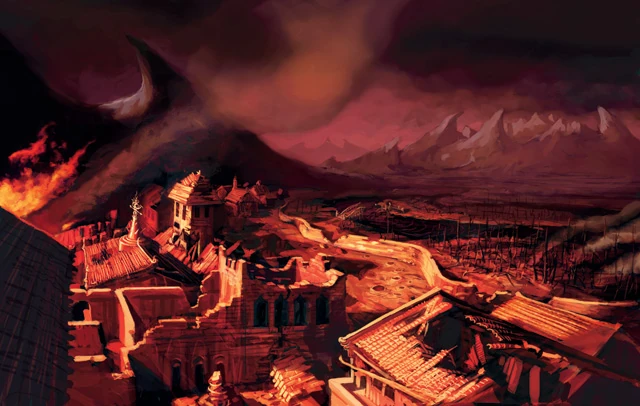
Maladomini was the seventh layer of the Nine Hells of Baator. Ruled by the archdevil Baalzebul, it was the center for all bureaucracy of the Nine Hells, a byzantine labyrinth of information where every document and deed of the infernal plane was eventually archived. The Circle of Ruins, sometimes titled of the Ruins was a testament to the degeneracy of the Lord of the Flies, its crumbling, imperfect structures the legacy of his pursuit of unattainable perfection.
Description
Like the higher layer of Minauros, Maladomini was a reeking, filth-ridden mir where the corruptive, toxic and pestilent was empowered while forces of health and vigor were weakened. It was a druid's worst nightmare, a world where all things natural were defaced or destroyed; the layer itself was like a wounded animal, constantly shuddering, moaning and oozing a foul, black ichor, clinging hopelessly to life in a state of perpetual dying. A place of abandoned cities and constant construction, pollution and deception permeated every aspect of the environment, for the watchword in the Circle of Ruins was decay, in both the physical and moral sense.
Maladomini was a scarred, urban wasteland dominated by teetering heaps of trash, its vast tracts of land depleted to the point of absolute desolation. The scattered ruins of collapsed towers and hollow fortresses formed a desolate cityscape. Between these dead cities were endless extraction pits and slag heaps that riddled the land like sores.The vast quarries and strip mines looked like gaping wounds, belching filth into the air as the layer's labor force toiled ceaselessly to find more stone and minerals in their resource-starved working areas.
Further into the mines was a vast, maze-like network of winding tunnels which honeycombed all Maladomini.Deep underground could be found the document storehouses, placed there in the event that, should Maladomini ever be met with the kind of devastation that preceded Baalzebul's curse, they would be safely intact. Each document was important in its own way, and heavily protected by various traps, devils and a precise but complex classification system any would-be thieves would be forced to navigate.
Crisscrossing the land from the quarries to the various castles of the horned devils were poorly maintained roads littered with garbage. Rivers of lava across the plane had great, arched bridges engraved with devilish faces leading across them and canals and stone-walled aqueducts cutting into them to carry the magma to the cornugon castles so as to form molten moats. Even so, the canals were polluted and clogged, spilling effluvium all throughout Maladomini.
Geography
In terms of geography, Maladomini was very similar to Malbolge, at least during the period it was under the control of Moloch (and by extension the control of Baalzebul as well). It was hot to the touch, so permeated by heat that infravision was generally useless, and filled with stinking gasses and smoke, earth tremors and underground explosions, huge caves and caverns, and pits of fire. They were also identical in terms of mineral resources (including the presence of those metals unique to the Hells, arjale and tantulhor), with the exception that diamond and obsidian was perhaps slightly more common in Maladomini.
There were several distinguishing elements however. Granite was commonly seen across the surface, and from the earth erupted not only the layer's black ichor, but also lava, the volcanic cascades swelling the magma rivers. These rivers contributed to the great sea of lava that seemingly encircled the entire plane; within that sea was a ring of volcanic mountains, and it was within that ring that the layer's civilization sat.
Most notable of the differences however were Maladomini's despoiled qualities. Under a sky the shade of blue-black blood, sentient chunks of polluted matter crawled out from the banks of sludge-ridden streams only to choke on toxic air and quickly expire. Whatever remnants of stunted trees that were still dying as opposed to dead eventually collapsed, succumbed to rot, or spontaneously burst into damp, smoldering flames upon contact with the slag, "Natural" sources of light could be found in the dim, sickly radiance emitted by green flames found on the layer, which were either flickering fires fed by the fluids seeping out from the ground along the river banks or drifting, blazing spheres
Cosmography
By Asmodeus's decree, no planar portals could connect directly to any layer of Hell besides Avernus. This meant that in general, if one wanted to get to Maladomini, they would have to go the layer above it, Malbolge, and find a portal, and likewise would need another to get to Cania below. Portals existed from at least one of the fortresses of Malbolge to Baalzebul's primary city of Malagard, as well as from Malagard to Mephistopheles's city of Mephistar.
Getting to Maladomini at all was generally not easy, but there were portals to several locations of the layer within Sigil, and portals to its city of Grenopli within the Outlands. Nearly all known portals were controlled by the baatezu, leaving many trapped there.
World Axis
In the World Axis cosmology model, the Nine Hells were a planet-shaped astral dominion floating in the Astral Sea, no longer of infinite size nor consisting of layers. In this cosmology, Maladomini was one of the largest of the Nine Hells, a subterranean maze of winding tunnels, its dozens of vast, interconnected passages each a long, curving cavern. Every tunnel was hundreds of miles long, about 3 to 5 miles (4,800 to 8,000 meters) wide, and had a ceiling around 1,000 feet (300 meters) or more overhead. Carved into the steep sides of the caverns were the ancient and ruined strongholds, palaces and cities of the layer. Sludge rivers flowed through the centers of the tunnels, some illuminated by green fire and others stewing in foul darkness.
The branching tunnels of Maladomini linked the lower Hells of Malbolge, Cania, and even Nessus together. A marble boulevard lined with hideous statues, known as the Road of Perdition, led from Malbolge to Maladomini, and Maladomini's tunnels eventually connected to the cold cavern of Cania. In the World Axis, the River Styx flowed through Maladomini to conclude in Cania's glaciers.
Notable Locations
The Carnival Eternal, a vale whose putrid pavilions were forever doused in filth from the unblockable sluice pipe above. Here Baalzebul provided successful servants unspeakable pleasures of the most diabolical, debaucherous, and degrading kind. Nine souls earned a day's vacation, ninety-nine a century, and nine-hundred ninety-nine two millennia. Among its dark delights was a hall of distorted mirrors which gave intoxicating visions of dominion as a Lord of the Nine (usually over the realms of Baalzebul's rivals Dispater or Mephistopheles and never over his own) or tempted them to walk the road of diabolism. Others included magical alcohols like "gughalaki", a sweet, ropy, almost hallucinogenic liquid produced in Maladomini from the scent glands of fiendish centipedes,] and access to the Carnival's thriving black market of contraband forbidden even in the Hells, including stolen souls, banned rituals, false documents and treasures hidden even from archdevils.
Grenpoli, the City of Diplomacy. A domed city where weapons and all types of aggression were forbidden, it contained the Political School of the Nine Hells, which offered courses on deceit and treachery to enterprising devils.
Malagard, also called Malagarde, was the greatest city of Maladomini and the home of Baalzebul. As with all the others however, he found it lacking, and its former grandeur was lost. Malagard thus became the embodiment of his sloth, its drooping, crumbling structures monuments to despair, for even Baalzebul gave up on restoring it. Occasionally a dangerous, neurotic frenzy overtook the inhabitants, prompting them rebuild, but they fell back into fatalism just as quickly. Decay advanced all the same as the buildings deteriorated and rivers of trash grew greater every day, and the atmosphere of defeat pervading it became ever more oppressive. The ennui was often contagious, and those that fell to it risked never mustering the will to leave. Baalzebul ruled from the Palace of Filth, his formerly great castle before he was cursed and it collapsed into fecal sludge.
Offalion, a pile of rubble by a blasted hillside used to simulate specific places on the Prime Material plane. The resident devils used scattered stone to craft parodies of places of influence before running through detailed political scenarios. Conferences, synods, market deals, elections, royal courts, and other such events were acted out as exercises to train devils, whose memories were typically erased by conversion into lemures, so they might subvert the societies of mortals. Each simulation had its own rules and conditions; winners were sent to their target planes to put their education into practice while losers were withheld or even demoted. Mortals were sometimes pressed into service to give advice, add authenticity, or even disrupt the scenarios as wild cards. In a sense, Offalion unintentionally served as a demonstration of Baalzebul's latest plans.
Divine Realms
Xibalba, a section of the city-palace of Malagard where the Maztican pantheon came to play the Ball Game. It was filled with a constantly changing array of buildings in the typical Maztican style, the only constant being the great Ball Court itself.
Inhabitants
The primary inhabitant of Maladomini was its ruler Baalzebul. Among his council were the respective First and Second Consorts Baftis and Lilith. Neabaz was the Herald of Lies, tasked with spreading Baalzebul's word and the only devil of his allowed to freely roam the Nine Hells.
Baalzebul also had a host of war-leaders. The generals Abigor, Bileth, and Zepar, led his armies and stood watch against his enemies. Meanwhile Barbatos, the relatively trusted Marshal of Maladomini, was responsible for all Baalzebul's armies, his charge being to arrange the messengers and weapons so that the layer's armies could be quickly gathered for battle.
Garrisoned on Maladomini were Baalzebul's Maladominaar, elite shock troopers easily capable of breaking through demonic formations with their ferocious frontal assaults. General Zimimar of the Dark Eight commanded them on the field where they scattered and divided their Abyssal adversaries.
Devils
The greatest danger of Maladomini was not any feature of the environment, but the devils under Baalzebul's command. Intelligent devils capable of complex politicking often rose through the ranks quickly, amnizus, falxugons, paeliryons, and erinyes being particularly numerous. Barbazus, lemures, and spinagons were also common, as were patrolling hamatulas and storm devil artillery. Other devils that could be found there included imps, nupperibos merregons, and cambions.
The hosts of Maladomini consisted primarily of companies of cornugons (company in this case meaning 111 individual devils rather than the usual 333). There were 60 companies under the command of Abigor and 28 under Zepar, who performed various roles ranging from warriors to messengers to laborers. The spinagons attended to the needs and wants of the cornugon laborers, typically under the oversight of an amnizu or more rarely an osyluth.
Pit fiends were rare on Maladomini and noticeably absent from Baalzebul's service there. The Lord of the Flies suspected all of being spies or puppets of Asmodeus, and so was reluctant to allow any of them on his plane, having tasked his generals with driving them all away. Even so, among the many infernal fiefs of Maladomini were the strongholds of quarrelsome pit fiends and war devils.
Maladomini also hosted various unique types of devils. The bizarre ayperobos, creations of Baalzebul, originated in Maladomini and were rarely encountered beyond it. They prowled the misty reaches or were intentionally placed as traps by other devils for travelers. There were also swarm devils, the corrupted souls of angels caught lying to their masters which reformed trapped in a mass of flies that buzzed around Baalzebul. The fiends then moved to one of Maladomini's stagnant pools, starving but never dying, eagerly awaiting a mission and chance to feed.
Petitioners and Planars
Besides lesser devils, petitioners and enslaved prisoners in Maladomini were made to dig without tools to look for more stone for the layer's cities. However, many non-devil inhabitants of Maladomini were not under the control of Baalzebul. The abandoned cities of the layer served as shelters for runaways and deserters, petitioners who fled their tormentors, native Baatorian creatures who lost their territories, beasts from other planes who became especially lost, and planewalkers trying not to be found. The occasional attempts by Baalzebul to oust them simply caused the malcontents to flee to one of the many other cities his quest for perfection gave them the option of.
Among the varied inhabitants of Maladomini were humans, demihumans, orcs, Half-Orcs, goblinoids, kobolds, giants, gith, manticores, medusae, beholders, rakshasas, yugoloths, hordlings, maelephants, and rogue modrons and baatezu. In at least one case (a population of orcs the baatezu were trying to breed into a species of lawful evil trolls) their captives did not escape, but were abandoned in an empty city by the baatezu after they didn't shape up to their expectations. In reality the project did succeed, but wasn't given enough generations, and so the enhanced orcs spread throughout the tunnels intent to one day overthrow the masters of Maladomini.
History
In eons past, Maladomini was a beautiful place, a realm of great cities. According to some origins of the Nine Hells, it was like this even before Asmodeus took over the plane. After his regime began, Asmodeus carved up Baator and rewarded those who fought under him with realms and fiefdoms, and also established the infernal bureaucracy, which would be centered in Maladomini. Reports described the seventh hell as a bustling kingdom of impressive cities and a fine collection of roads, gardens, and bridges, where every law and order was filed away in an ever-expanding series of fortresses and archives. Maladomini would be ruled by ancient ally of Asmodeus who had been with him since before he ruled Hell and whose name was lost to time, and not by chance.
The archdevil Baalzebul was once an archon of Mount Celestia by the name of Triel. Triel committed many selfish acts in his relentless quest for perfection, resulting in his fall from the Seven Heavens. He awoke in the Nine Hells with the head of a fly, corrupted but empowered greatly by the transformation. Asmodeus, perhaps due to his own familiarity with the long fall into Hell, rose the battered archon up, quickly promoting him to the ranks of nobility.
Triel soon mastered infernal politics, his interminable pursuit of perfection serving him well in scaling Hell's hierarchy, culminating in his overthrow of Maladomini's original lord. He not only became Lord of the Seventh, but expunged any record of his predecessor's identity and deeds, abandoning his former name himself and becoming Baalzebul. By the time he ruled Maladomini, he earned the title "Lord of the Flies", for his web of intrigue was purportedly so tight that not even a fly could escape.
Maladomini's Fall
Eons passed as Baalzebul achieved many victories. He managed to take control of the upper layer of Malbolge while retaining his grip on Maladomini, a feat no archdevil save arguably Asmodeus was known to have achieved, and became second only the King of Hell himself. But Baalzebul's greatest weakness had never been his lacking competence, but his inability stop when he was ahead, his irrepressible need for total perfection in all his endeavors and the extreme actions it drove him to.
F
or millennia Baalzebul longed for a city befitting his greatness. He commanded his subjects to build him city after city, but was never satisfied, declaring each and every one unworthy upon its completion. Baalzebul could see the perfect city in his mind, but could not seem to bring it into fruition, and the problem only got worse with time as he continually built and rebuilt the domains in the layer. Somewhere along the way, fertile Maladomini had become a place of despoiled land and ruined civilization. But its fall was not yet over.
Reports somewhat conflicted on what exactly was the inciting incident for Maladomini's downfall. In some versions, he kicked off the Reckoning of Hell, where the archdevils openly warred to take Asmodeus's throne, and it reached its climatic conclusion in Maladomini. In a more recent version, Baalzebul conspired to depose Asmodeus in such a way as to truly qualify as a crime: altering records in his ploy to cast his master as incompetent. This plot was foiled when an unexpected surge of the Blood War demanded his participation, and his initial refusal to send soldiers he was saving for his coup prompted an investigation that revealed his misdeeds. Baalzebul refused to submit to punishment, and the other archdevils attacked Maladomini.
Reign of the Slug
Whatever the specifics of the situation, Baalzebul's realm was wracked by war and left in a state of utter devastation. And, whether for his move against Asmodeus, the insurmountable treachery of interfering with Hell's records, or for some other ineffable reason, Baalzebul was to suffer a series of punishments for his sins.Asmodeus stripped Baalzebul of control over Malbolge, but left him in charge of maintaining Maladomini and the infernal bureaucracy. Furthermore, Asmodeus recast Baalzebul into a form reflective of his pestilent domain of garbage and filth, transforming him into a massive slug-like creature, and trapping him in that state a year for every lie he had ever told another devil, applied retroactively.
Baalzebul was left to preside over the rotting cities of Maladomini, his ability to scheme neutralized by his new limitations and his attention thus shifting to gathering souls from the Material Plane. Yet the archduke never stopped his quest for the flawless configuration for his cities, and oozed about Maladomini's cities searching the perfect combination of form and function. But while the ancient cities might have been beacons of glory and triumph long ago, Baalzebul, in his devotion to spreading misery, ultimately beat the capacity to make such structures out of his petitioners.
Oblivious to the decay of his old cities, Baalzebul always sought to improve new ones, and his servants had little choice but to continue stripping bare what little of the land was left. But rather than actually demanding renovations, Baalzebul instead spread word through his pit fiend servants that new cities had to be built from scratch, the old to be left standing as reminders of work already done and rejected. In some cases cities were to be built on new sites and the original structures remained intact if barely used, but at some point it became common practice to cannibalize the old cities for raw materials, hastening their destruction. Newer cities would be built upon the backs of the old until they all ended up below the surface, save for one.
Throughout it all, Baalzebul never truly gave up on the incomplete fortress-city of Malagard,[ even after, upon being turned into a slug, his grand castle at its center collapsed into fecal sludge, and by order of Asmodeus was to be constantly filled with garbage. Perhaps more surprisingly, despite its capital having been reduced to excrement, Malagard was still universally agreed to be Baalzebul's greatest city yet, even by those who had seen its older incarnations.
Malagard was a city of perfectly straight boulevards and countless straightly-extending, black-spired towers connected by many open and covered bridge-spans crisscrossing and slanting in all directions. It sprawled for thousands of miles, such were its numberless rooms and passages that not even Baalzebul himself was thought to have seen them all. No devil was thought to know its full dimensions and they seldom delved deep within it, to the point that escapees fled into the dungeons to escape. Even as the rest of Maladomini was blighted, green things grew in its walls, a planar plant collection tended to by nupperibos supervised by osyluths, themselves watched by cornugons. Nearly all the layer's wealth made its way there, from tapestries to furniture to precious stones and metals.
But just as none doubted Malagard was Baalzebul's greatest city, it was equally undisputed that he would reject it just as he did all others.] Whole rooms were choked with garbage and entire towers were crammed with stinking refuse even before Asmodeus cursed Baalzebul. Since none of the devils there could be bothered to repair anything, the broken, useless, filthy or dead was carried to neglected and unused areas by servant spinagons. So unkempt was Malagard that many treasures thought lost and forgotten were actually being secretly hoarded by the cornugons in the garbage. And so dire became the workers' dread that they slowed down in the final stages of construction, secretly self-sabotaging much of their work to delay the inevitable.
Recent History
But the denizens of Maladomini could not stall forever, and were eventually forced to present their work to Baalzebul somewhere around the 14th century DR. And, just as all foresaw, Malagard too was ultimately rejected. The incessant building and rebuilding of the city by the Slug Archduke eventually gave way to despair, and the once majestic city was left to slowly die. Still Baalzebul stayed there, often neglecting his depressing duties maintaining the Palace of Filth with his slime in favor of scheming for dominance, causing entire rooms to collapse and losing many great relics of power in the process.
However, Maladomini's ultimate fate might still be changed. In the late 15th century DR, Baalzebul finally reverted to his previous fly-headed form, the abject humiliation forbidding him from extending the transformation with any further lies. Maladomini was still a crumbling realm, but Baalzebul had recently positioned himself as a patron of redemption.
Basic information
Natives: Amnizus, ayperobos, barbazu, cornugons, erinyes, harvester devils, lemures, paeliryons, spinagons, black puddings, gelatinous cubes, ochre jellies
World Tree: 7th layer of the Nine Hells
Shape and size: Infinite
Gravity: Normal
Time: Normal
Morphic trait: Divinely
Elemental/energy traits: None
Alignment trait: LE
Magic trait: Normal
Location: The Nine Hells

Comments