
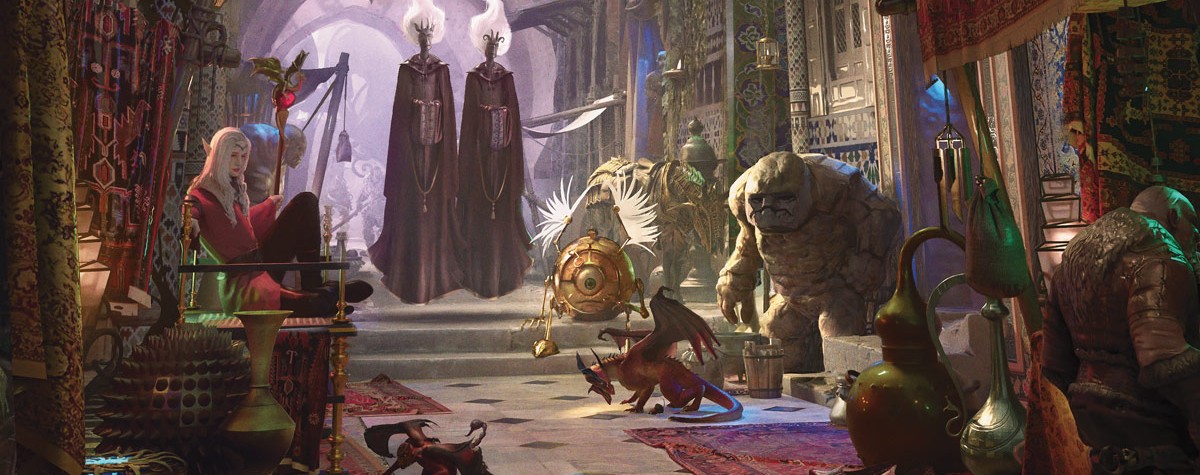
Sigil
Sigil — The City of Doors
Sigil, known across the planes as the City of Doors, is a vast planar metropolis suspended impossibly above the Spire at the center of the Outlands. Neither wholly lawful nor chaotic, good nor evil, Sigil exists as a crossroads of the multiverse — a place where all paths may meet, provided one knows how to open the right door.
To the scholars, adventurers, and planar travelers of Enderlin, Sigil is both opportunity and danger incarnate: a city where gods are barred, beliefs clash openly, and a single wrong step can send one to the farthest edge of existence.
Nature of the City
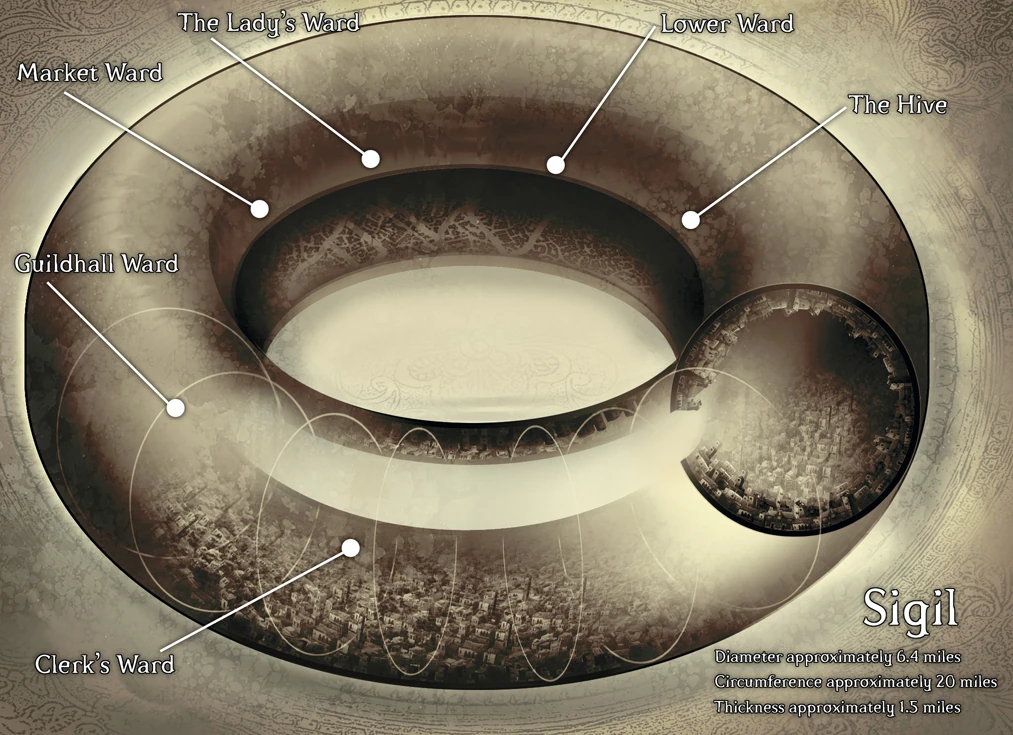
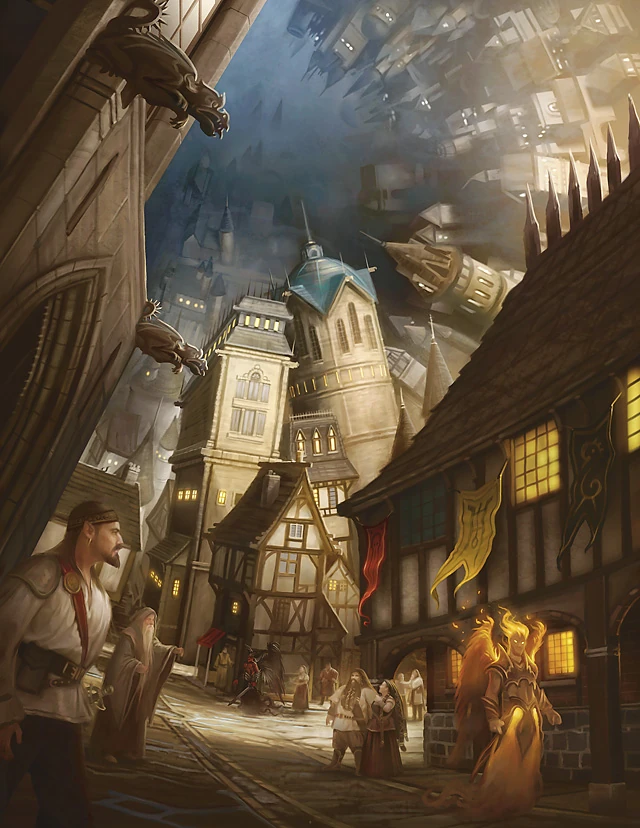
Sigil takes the form of a massive torus-shaped ring, with its inner surface forming the city itself. The sky above curves inward, allowing one to see the far side of the city arching overhead. There is no sun or moon; instead, a steady ambient light bathes the streets in perpetual twilight.
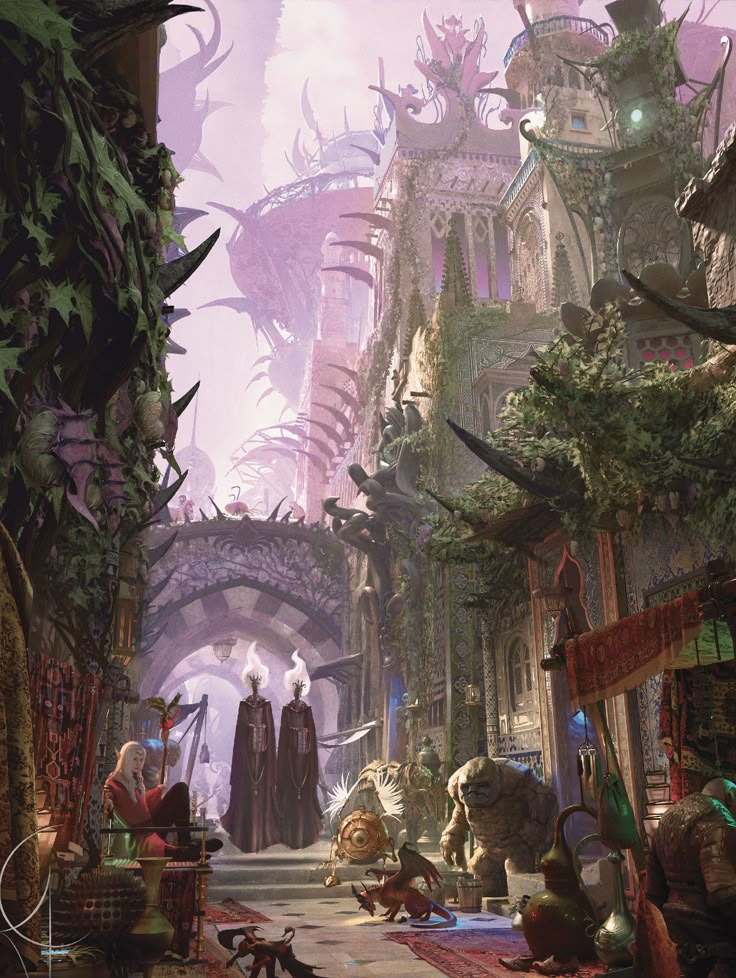
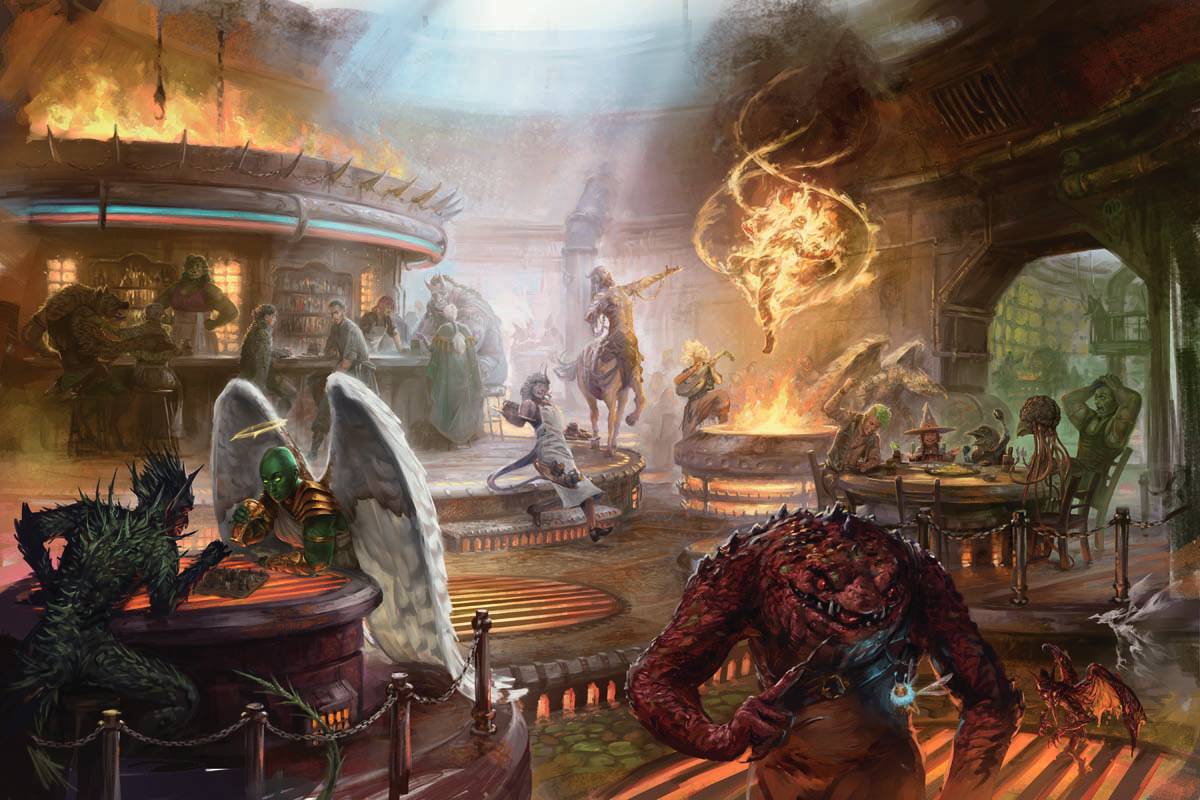
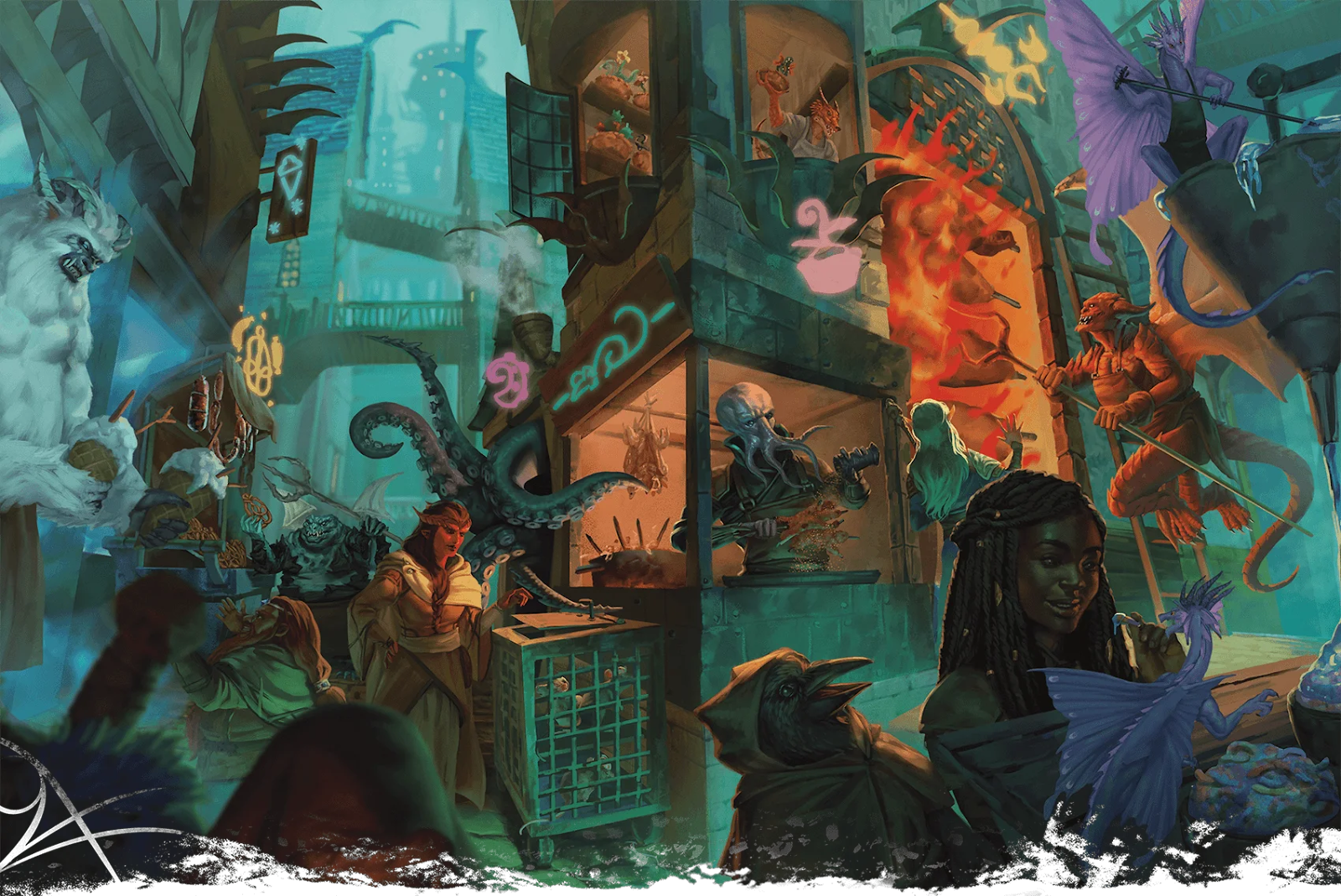
Despite its impossible geometry, Sigil feels solid and lived-in. Streets wind organically, districts bleed into one another, and architecture varies wildly — Infernal stone towers stand beside celestial spires, while humble inns sit next to alien structures built by hands not meant for this reality.
Gravity pulls outward from the ring, and falling “upward” into the open center of the torus is impossible — another of Sigil’s many defiance of planar logic.
Portals and the Doors
Sigil’s greatest feature is its countless portals.
Almost any archway, doorway, window, sewer grate, or crack in a wall might secretly be a portal to another plane, world, or realm. Each portal is activated by a specific key, which could be:
- A physical object
- A spoken phrase
- A particular action
- A state of mind or emotion
Some portals are permanent, others fleeting. Many appear without warning and vanish just as suddenly.
Because of this, Sigil is the greatest hub of planar travel in existence. A traveler from Enderlin could step through a door in Sigil and emerge in the Nine Hells, Elysium, the Feywild, or a forgotten demiplane — if they survive the journey.
The Lady of Pain
Sigil has no king, council, or god.
Instead, it is ruled absolutely by the Lady of Pain.
This enigmatic being drifts silently through the streets, her bladed halo casting long shadows. She speaks to no one, accepts no worship, and tolerates no challenge. Those who anger her may be flayed alive by invisible blades or banished into mazes — personal extradimensional prisons with no known escape.
Even the gods are barred from entering Sigil. Divine avatars cannot manifest here, and divine influence is sharply limited. Why the Lady of Pain enforces this rule — and how she possesses such power — remains one of the greatest mysteries of the multiverse.
Most inhabitants of Sigil have never seen her, yet all live in fear and respect of her presence.
Districts of Sigil
Sigil is traditionally divided into six major wards, each reflecting a different aspect of the city:
- The Hive — A sprawling, lawless district of poverty, madness, and forgotten souls.
- The Lower Ward — Close to the Outer Planes of evil, filled with forges, smoke, and dangerous industry.
- The Clerk’s Ward — Home to scholars, libraries, and planar institutions.
- The Market Ward — A bustling hub of trade where anything can be bought — for the right price.
- The Guildhall Ward — Controlled by guilds and craftsmen, balancing skill and order.
- The Lady’s Ward — Silent, ominous, and largely empty, where the Lady of Pain is most often seen.
Each ward blends into the next, and boundaries are cultural rather than physical.
Factions and Belief
Sigil is a city of ideas as much as people.
For centuries, powerful factions have risen and fallen within the city — groups organized around philosophies about the nature of reality, morality, and existence itself. Some believe belief shapes the planes. Others claim that meaning is an illusion, or that balance is the only truth.
Though factions wax and wane, philosophical conflict remains constant in Sigil. Debates can be as dangerous as duels, and ideas may be worth killing — or dying — for.
Inhabitants
Sigil is home to an unmatched diversity of beings drawn from across the multiverse:
- Mortals from countless worlds, including Enderlin
- Celestials, fiends, and planar natives, often living side by side
- Exiles, refugees, and planar wanderers who belong nowhere else
- Petitioners who have not yet settled into a final afterlife
Most notable among Sigil’s inhabitants are the Dabus — strange, floating humanoids believed to be servants or extensions of the Lady of Pain herself. The dabus maintain the city’s infrastructure, repairing streets, buildings, and portals with quiet efficiency.
They speak only in rebuses — floating symbols and images that convey meaning without sound — and show little emotion or individuality. To interfere with a dabus is considered extremely dangerous, as harming one is widely believed to invite the Lady of Pain’s attention.
Whether the dabus are constructs, outsiders, or something else entirely remains unknown.
Magic and Law
Magic functions normally in Sigil, but divine magic is constrained. Clerics and paladins may find their powers subtly altered, while spells that call upon direct divine presence often fail.
Law exists, but it is enforced inconsistently. Sigil’s true laws are unwritten and enforced indirectly — primarily through fear of the Lady of Pain and the mutual self-interest of the city’s inhabitants.
Role in the Multiverse
Within the Great Wheel, Sigil is the ultimate crossroads — a place where all paths intersect, yet none dominate. It is a city that exists outside the control of gods, where belief competes with balance, and where mortals can stand at the center of infinity.
To walk Sigil’s streets is to understand that the multiverse is not ruled by morality alone, nor by chaos or law — but by choice, consequence, and the doors we dare to open.
Outlands map:
Outlands environment:

Comments