

Giant
Giant (Gol-Kaa)
Gol-Kaa, known simply as Giantish or Giant in Common, is the ancestral language of Goliaths, Firbolgs, and their kin across Enderlin. Among Giants themselves, it is often referred to as the Tongue of Stone and Sky—a language of endurance, challenge, and kinship. While most goliaths speak Common fluently, Gol-Kaa remains a living thread linking the tribes of the highlands, mountains, and northern tundras, binding them to their giant heritage.
Resonant and commanding in sound, Gol-Kaa mirrors goliath values: strength, perseverance, clarity, and honor. Its words carry weight, often spoken deliberately to mark importance or command attention. It is rarely casual, reserved instead for moments of counsel, ritual, or personal instruction.
Origins and Development
Gol-Kaa descends from the speech of the first giants who roamed Enderlin in the Ancient Age, long before humans, elves, or dwarves made their mark. The language emphasizes precision, cadence, and the physicality of speech—reflecting a people for whom words and deeds were inseparable.
Over centuries of coexistence with Humans and Dwarves, Gol-Kaa adopted select loanwords, particularly for trade, travel, or newly encountered technologies. Yet its core grammar, vocabulary, and rhythm remain distinctly giant, preserving echoes of colossal ancestors in every utterance.
Despite these influences, the language’s structure—rooted in inflected verbs, variable plural forms, and weighty declaratives—remains unlike any human tongue. Spoken properly, Gol-Kaa can convey respect, challenge, or authority with a single sentence; misused, it can unintentionally insult or confuse.
Script and Written Use
Goliaths historically use a older variant of Khuzdul runes to write Gol-Kaa, though literacy is largely practical rather than artistic. Nomadic tribes rarely write in their ancestral language, relying instead on Common for trade or correspondence. Written Gol-Kaa is typically reserved for:
- Clan genealogies and records
- Runes marking tombs, high passes, or sacred sites
- Ritual inscriptions during oaths or rites of passage
Though few outsiders understand it, Gol-Kaa is not secret—its oral use, cadence, and emphasis are sufficient to preserve the language as a living, breathing tradition.
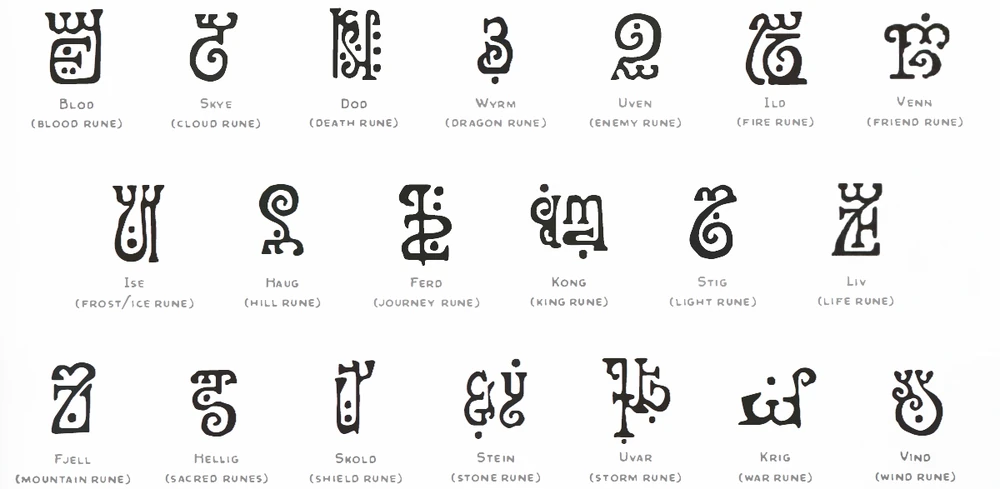
An example of runes used by giants for runecasting and art.
Use in Modern Enderlin
Gol-Kaa is primarily spoken within goliath clans and northern highland communities. In mixed settlements, goliaths shift fluidly between Common, Dwarvish, and Gol-Kaa, depending on audience and purpose.
Common uses include:
- Tribal councils, rites, and ceremonial challenges
- Family instruction, storytelling, and history recitation
- Formal negotiation within goliath clans
- Naming and addressing elders, leaders, or revered ancestors
Though seldom used casually with outsiders, goliaths teach Gol-Kaa to every child, ensuring its endurance even in distant lands or among nomadic clans.
Cultural Significance
To goliaths, Gol-Kaa is more than language—it is the voice of ancestry, the echo of mountains, storms, and glaciers. Speaking it affirms belonging to the highland tribes and honors the giants whose strength shaped their world.
Many goliaths believe that words spoken in Gol-Kaa carry the weight of truth itself, particularly in challenges, oaths, or blessings. To abandon the language is unthinkable; even among generations raised in human lands, goliaths maintain its cadence and vocabulary, connecting past and present.
Names and Vocabulary
Goliath names preserve the cadence and strength of Gol-Kaa, often reflecting natural elements, lineage, or feats of personal endurance.
Common Goliath and Firbolgs Surnames
Stonevein
Highpeak
Stormhand
Frostbrow
Ironhoof
Skybreaker
Common Male Given Names
Korrath
Thalen
Brundir
Hrothgar
Ulgor
Varrek
Common Female Given Names
Sura
Feyla
Brinra
Thyra
Khalda
Olvara
Selected Gol-Kaa Terms
- jotun — giant
- huslyd — family
- fer — to go / journey
- ferd — going; journey
- berg — mountain
- stunra — strength
- haldor — oath / promise
These words are often retained in goliath-accented Common, subtly influencing regional speech.
Native Name: Gol-Kaa
Script: older variant Khuzdul Runes (logographic and symbolic, also used in runecasting)
Primary Speakers: Goliaths, firbolgs, and other giant-kin
Geographic Spread: Northern highlands, mountains, tundras of Enderlin; Hrafngard and nomadic clans
Status: Ancestral and ceremonial language; used for tribal councils, oaths, rituals, and storytelling
Origin:
Descended from the speech of the first giants of Enderlin in the Ancient Age; preserved among highland and northern tribes as the Tongue of Stone and Sky.
Dialects:
Minimal regional variation; differences arise mostly between nomadic and settled clans, races, and ceremonial versus daily speech.
Ease of Learning:
Moderate to difficult — rhythm, inflected verbs, and weighty declarations convey meaning; misuse can signal disrespect or misinterpret intent.

Comments