
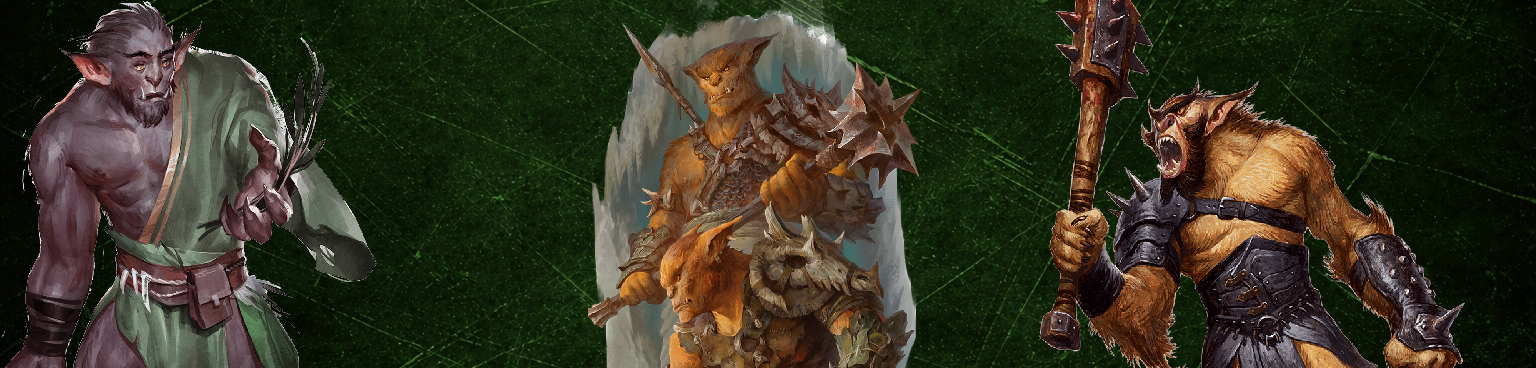
Bugbears
General Description
Bugbears are an ancient and imposing people, known for their towering stature, quiet presence, and an unsettling talent for vanishing into shadow. Broad of shoulder, long of limb, and covered in coarse fur, bugbears possess a fearsome appearance that has shaped how other peoples of Enderlin perceive them—often to their detriment. Yet beneath this exterior lies a culture defined not by savagery, but by patience, memory, and calculated restraint.
Unlike many large folk, bugbears are unnaturally stealthy, capable of moving with near-silent precision through terrain that should not accommodate their size. This trait is widely believed to be a lingering echo of Feywild magic, a heritage that still clings to their blood and instincts. Bugbears often speak of “thin places,” moments where shadow deepens and sound dulls—spaces where they feel most at ease.
Though commonly grouped with other goblinoids by outsiders, bugbears consider themselves distinct, bound by shared history and transformation rather than simple kinship. To bugbears, survival is not won through chaos or rage, but through observation, preparation, and striking only when advantage is certain.
Origins and the Feywild Theory
Bugbears, alongside dwarves, orcs, goblins, goliaths, and several other peoples, inhabited Enderlin long before the Ancient Times. Their presence predates many recorded kingdoms, and their earliest myths speak not of conquest, but of endurance.
Modern scholars widely support what has come to be known as the Feywild Theory.
According to this theory, bugbears were once goblins—or a goblinoid offshoot—who were drawn or displaced into the Feywild in the elder ages. Whether this passage was accidental, divine, or the result of ancient bargains remains unknown. What is agreed upon is that their prolonged existence within the Fey Realm altered them profoundly.
Time flows strangely in the Feywild. Magic saturates flesh and thought. Over generations—perhaps centuries measured in the Material Plane—these goblins changed. Their bodies grew larger and stronger, their senses sharper, and their instincts attuned to shadow and silence. Fey magic reshaped them into what the world now knows as bugbears.
Many traditions claim that when these transformed peoples finally returned to the Material Plane, they did so urged onward by their god, Maglubiyet, who sought to reclaim them as instruments of conquest and war. In this telling, Maglubiyet did not create the bugbears—but he claimed them, shaping their early return to Enderlin through bloodshed and domination.
In the centuries since, this bond has fractured.
While many bugbears—particularly among the clans of the Great Desert—still honor Maglubiyet as a god of strength, survival, and inevitable conflict, others have rejected their ancient war-god entirely. This rejection is most common among bugbears who have left the desert to seek lives among other peoples, where Maglubiyet’s relentless doctrine of conquest holds little place.
These bugbears often turn instead to gods of endurance, shadow, nature, or fate—divinities they feel better reflect what they have become rather than what they were once commanded to be. Among such individuals, Maglubiyet is remembered not as a master, but as a force of the past—powerful, undeniable, and no longer absolute.
The Clans of the Great Desert
The largest concentration of bugbear culture is found among the Clans of the Great Desert, particularly within the broader sphere of the Varrak-Khul peoples. In this harsh environment of burning days and freezing nights, bugbears thrive through cooperation, foresight, and ruthless efficiency.
Desert bugbear clans are typically semi-nomadic, moving between known water sources, ancient ruins, and defensible canyon settlements. Their societies are structured around:
- Clan elders, valued for memory and experience rather than age alone
- War-leaders, chosen for tactical sense and restraint
- Scouts and lurkers, who range far ahead of the clan, unseen
In these lands, bugbears are respected—if feared—by neighboring goblinoid groups. Goblins often serve as traders or messengers between clans, while orcs and ogres may form temporary war-bands alongside bugbear leaders whose plans consistently lead to survival.
Honor among desert bugbears is practical rather than ceremonial. Oaths are kept because breaking them brings future ruin, not because of moral idealism. Reputation, once earned, is rarely forgotten.
Bugbears Beyond the Desert
While the Great Desert remains their cultural heartland, bugbears are not confined to it. Across Enderlin, small numbers of bugbears can be found far from their ancestral territories.
Some travel as mercenaries, their combination of strength and stealth making them highly valued in border wars and covert conflicts. Others serve as caravan guards, scouts, or wilderness guides—roles where their talents are undeniable, even if their presence unsettles those they protect.
In cities and settled lands, bugbears often face deep prejudice. Their size and goblinoid heritage invite suspicion, and many are assumed to be violent or untrustworthy before ever speaking a word. As a result, urban bugbears tend to keep to the margins of society, forming small communities or working in professions where solitude is possible.
Despite this, some have integrated successfully, particularly in regions accustomed to diverse peoples. Those who do are often known for an unshakable adherence to contracts and a long memory for both kindness and betrayal.
Bugbears and the Wider World
To most of Enderlin’s peoples, bugbears remain figures of fear or rumor—shadows at the edge of the firelight. Yet their long presence on the continent ensures that they have shaped history more than most realize.
- To scholars, they are a living example of Fey influence upon mortal peoples.
- To generals, they are invaluable assets—or dangerous enemies—depending on allegiance.
- To other goblinoids, they are both kin and reminder of what Fey magic can create.
Bugbears themselves rarely seek acceptance. They endure, adapt, and wait. Time, after all, has never been their enemy.
Bugbears and Mixed Heritage
True mixed-heritage bugbears are rare. While interbreeding with other goblinoids is biologically possible, cultural boundaries and the lingering effects of Fey ancestry make such unions uncommon.
When they do occur, offspring may display unusual traits—unnatural stillness, heightened senses, or an instinctive pull toward shadowed places. Such individuals are often viewed with cautious respect among bugbear clans and with unease elsewhere.
For gameplay purposes, mixed heritage has no mechanical effect unless otherwise agreed upon with the DM. Characters of mixed ancestry use the Bugbear species traits, with any cultural or social consequences determined through roleplay.
General Traits:
Creature Type: Humanoid (Goblinoid)
Size: Medium (about 1.8–2.4 meters tall).
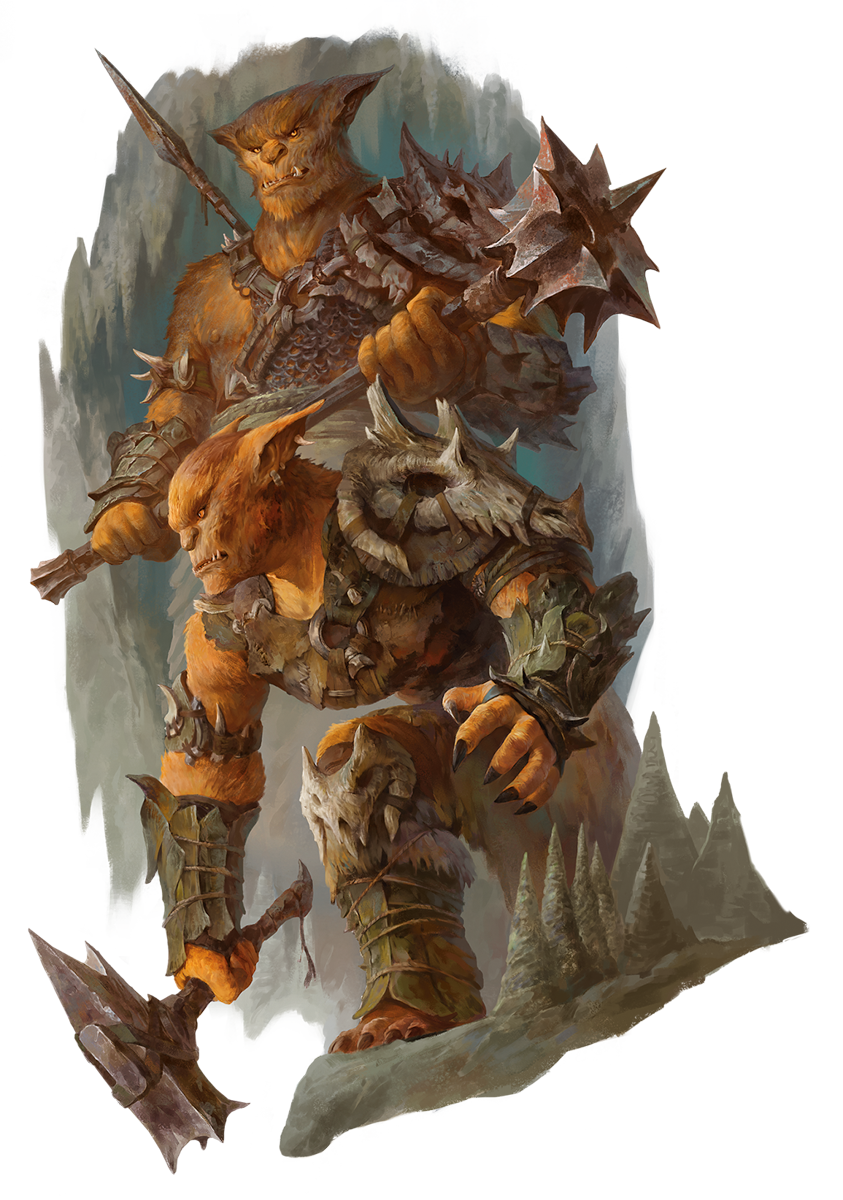
Bugbears are long-limbed and powerfully built, covered in coarse hair, with wedge-shaped ears and pronounced teeth. Despite their size, they are capable of remarkable stealth and quiet movement.
Speed: 9 meters per round (30 feet)
Average Lifespan: Around 80–100 years, though many bugbears remain physically formidable well into later adulthood.
Languages: You can speak, read, and write Common and Goblin.
Goblin is a harsh but flexible language shared among goblinoid peoples, well suited to rapid speech, commands, and battlefield communication. Bugbears living among other cultures often learn additional languages out of necessity rather than tradition.
Ability Scores: Bugbears do not grant ability score increases. These are determined by your Background.
Bugbear Special Traits:
Darkvision
Accustomed to shadowed spaces, hidden lairs, and twilight environments, you have Darkvision with a range of 18 meters (60 feet).
You can see in dim light as if it were bright light, and in darkness as if it were dim light. You discern colors in darkness only as shades of gray.
Fey Ancestry
Your long-forgotten ties to the Feywild still linger in your blood. You have Advantage on saving throws you make to avoid or end the Charmed condition.
Long-Limbed
When you make a melee attack on your turn, your reach increases by 1.5 meters (5 feet) for that attack.
This unnatural reach is a remnant of fey distortion, allowing bugbears to strike from unexpected distances.
Sneaky
You gain proficiency in the Stealth skill.
In addition, without squeezing, you can move through and stop in a space large enough for a Small creature, reflecting your supernatural ability to fold yourself into shadows and tight spaces.
Powerful Build
You count as one size larger when determining your carrying capacity and the weight you can push, drag, or lift.
Surprise Attack
Your people perfected ambush long before recorded history.
If you hit a creature with an attack roll, the target takes an extra 2d6 damage if it hasn’t taken a turn yet in the current combat.
Notes:
- Bugbears are most commonly found in the Great Desert, ancient ruins, borderlands, and remote regions
- Many desert clans still revere Maglubiyet, though his worship is far from universal
- Bugbears living among other peoples often abandon strict goblinoid traditions while retaining their emphasis on strength, self-reliance, and cunning

Comments