
Whitefork Granite
Whitefork Granite
Stone That Does Not Shift
Overview
Whitefork Granite is not a kingdom, nor a fortress, nor a clan stronghold. It is a tradition.
For as long as most records in Gothmyr recall, the name “Whitefork Granite” has been associated with precision-cut stone of exceptional durability and disciplined craftsmanship. The stone is quarried from the rounded granite hills near the meeting of river and forest outside Whitefork, where bedrock rises close to the surface and the grain of the earth runs thick and true.
Whitefork Granite is known not for ornamentation, nor jewel inlay, nor gilded relief. It is known for foundations. Bridges that do not sag. Gatehouses that do not crack. Keeps that do not settle unevenly with the thaw of winter.
Dwarves of Whitefork Granite claim no superiority in warcraft or siege engine design. Their focus is singular: the study, shaping, transport, and installation of granite with such exact tolerances that mortar is often unnecessary.
It is said among masons across Gothmyr:
“If it bears the Whitefork mark, the stone will outlive the lord who ordered it.”
Location
The primary quarry terraces lie within the granite crescent hills west of Whitefork, between the Grüner and the Icegreen Rivers. The hills are weathered and rounded, not jagged like the Ridgewall. Exposed outcrops reveal dense, fine-grained stone ideal for structural cutting.
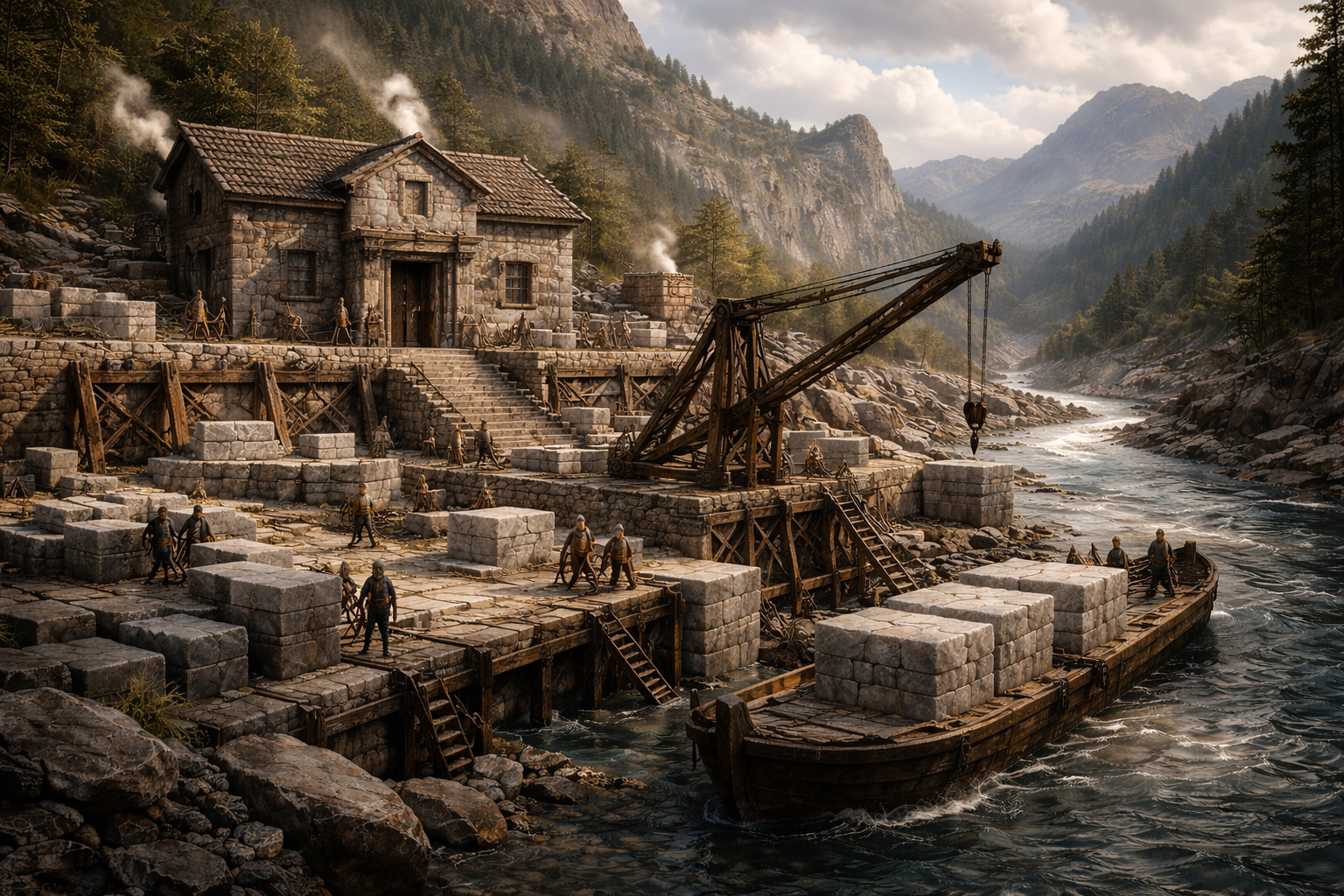
Stone is cut in stepped quarry faces and transported via reinforced sled platforms to river docks. From there, barges carry shaped blocks south along the Icegreen and its tributaries into Gothmyr and beyond.
The river transport system is one of the primary reasons Whitefork Granite gained prominence, allowing heavy stone to move efficiently without massive overland caravans.
History
Whitefork Granite predates the current political structure of Whitefork town itself. Early military outposts and baronial expansions during the Age of Enlightenment required reliable fortification stone, and dwarven masons began refining the granite from the nearby hills.
Over generations, techniques evolved:
• Grain alignment cutting
• Interlocking load geometry
• Stress distribution carving
• Seasonal expansion tolerances
The guild formalized standards and began marking finished stone with a subtle mason’s seal.
Unlike many dwarven holds known for boasting lineage and conquest, Whitefork Granite gained renown quietly through repetition. Structures built with its stone simply endured.
It is recorded that portions of Southgate Keep and several baronial bridges within Gothmyr contain Whitefork Granite installations.
Craft & Technique
Whitefork Granite is not merely quarried stone. It is precision-engineered.
Each block is:
• Cut along natural grain lines
• Measured to uniform tolerances
• Shaped for dry-set interlock when required
• Documented for load-bearing distribution
Large installations are never sold as raw material alone. Contracts require installation oversight by Whitefork masons trained in the guild’s methods.
The stone is known for:
• High compressive strength
• Resistance to freeze-thaw fracturing
• Minimal erosion under water flow
• Stability under heavy vertical loads
Whitefork masons rarely advertise these traits. The buildings themselves speak.
The Guild Structure
Whitefork Granite operates as a formal dwarven guild.
Guildmaster
Guildmaster Torven Halgrym oversees contracts, apprenticeships, and quarry management.
Senior Masons
Certified masters who supervise cutting, shaping, and installation teams.
Stonekeepers
In select major installations, a Stonekeeper remains or returns periodically to inspect and certify structural integrity.
Stonekeepers are not political envoys nor spies. They are structural custodians. Their presence is contractual and limited to significant builds.
Trade & Reach
Whitefork Granite is transported primarily via river barge. Its trade range extends realistically along connected waterways and into nearby strongholds and keeps.
Because of transport limits, Whitefork Granite is rarely used for decorative projects. It is reserved for:
• Gatehouses
• Foundations
• Bridges
• Retaining walls
• Structural cores of keeps
It is considered expensive not because of rarity, but because of precision labor.
Whitefork Granite cannot be acquired through bribes or coercion. The guild maintains discretion over contracts and may refuse work if structural integrity would be compromised by political meddling or improper alteration.
Reputation
Among dwarves, Whitefork Granite is respected as disciplined craft.
Among humans, it is regarded as “stone that does not fail.”
Among engineers and masons, it is considered the benchmark standard for load-bearing granite in Gothmyr.
Among political powers, it is not feared. It produces no weapons. No jewels. No rare metals.
Only granite.
And yet, when foundations matter, the name surfaces.
Current Events
Whitefork Granite continues to fulfill contracts throughout Gothmyr, with increasing requests for inspection and reinforcement following seasonal flooding along the Icegreen River.
There are reports of new quarry faces being opened along the northern terraces, suggesting deeper strata of particularly dense stone.
Some whisper that the guild turns down more contracts than it accepts.
But such matters are guild business.
Rumors
• Whitefork Granite stone has never failed under proper installation.
• A collapsed tower in the Iron Kingdoms reportedly did not use Whitefork stone, despite the lord’s claim.
• The guild records every structure it installs in a private ledger that spans centuries.
• The masons answer to an older authority deeper in the hills.
Most dismiss the last as romantic exaggeration.
After all, they only make granite.

Comments