

Boldrei
Boldrei is worshiped wherever people choose to live together instead of alone. Her presence is felt in lamplit kitchens and crowded tenements, in fortress halls and village commons, in the quiet strength of shared labor and the unspoken rituals of daily life. She is the Sovereign of community, hospitality, and the bonds that turn shelter into home. To revere Boldrei is not to seek revelation or conquest, but to protect what already exists: family, neighbor, custom, and the fragile trust that allows civilization to endure.
Her temples rarely dominate skylines. They are instead woven into them—great hearth-halls, neighborhood shrines, and meeting houses whose doors are rarely closed. Worship of Boldrei is inseparable from life itself. Preparing food for others, maintaining a home, welcoming strangers under one’s roof, resolving disputes before they become violence, and preserving tradition are all considered sacred acts. Her priests often serve as mediators, caretakers, and civic anchors, overseeing festivals, marriages, adoptions, and oaths of fellowship. In her name, contracts are witnessed not by law, but by conscience.
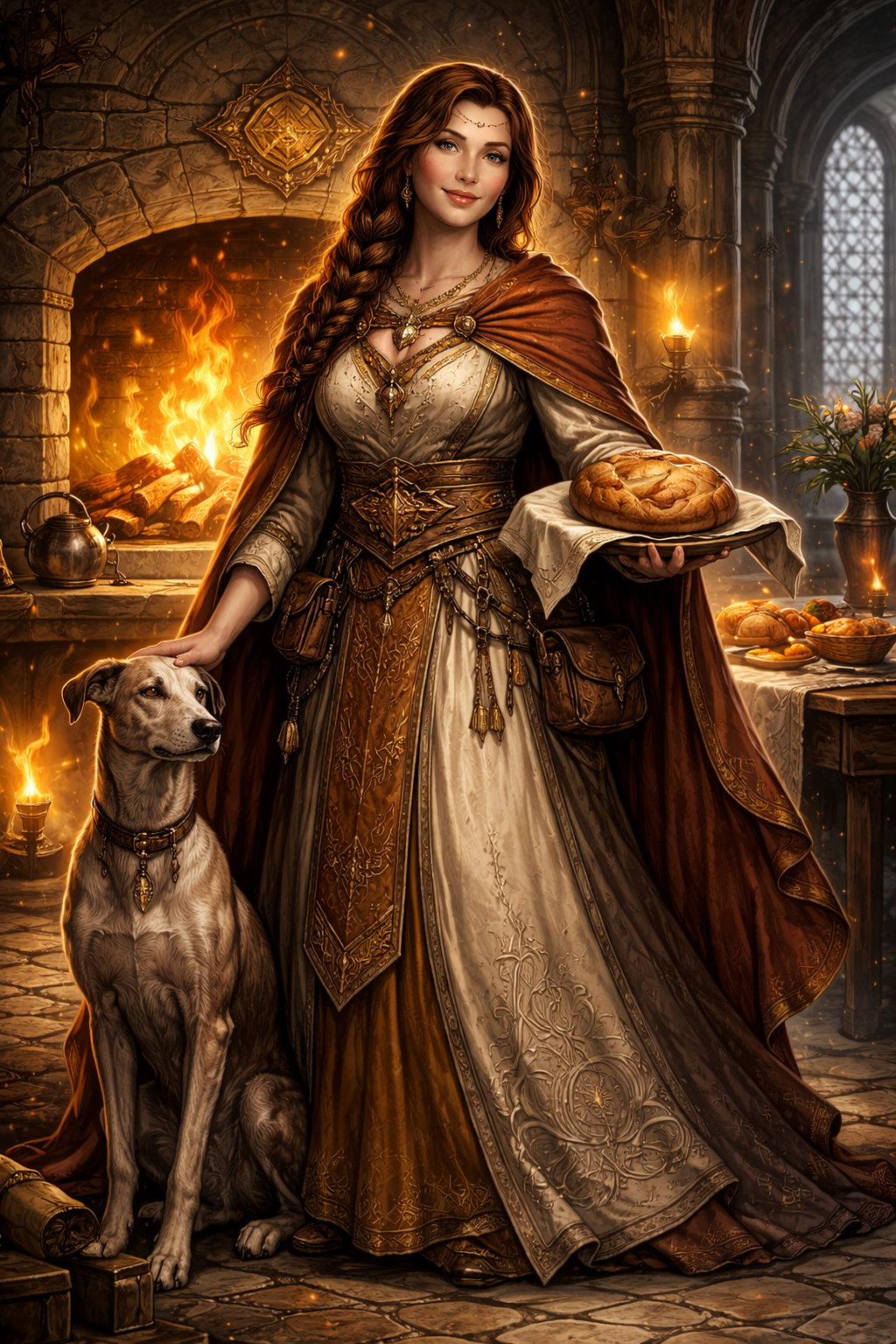
In the myths of the Host, Boldrei is the keeper of the space between the Sovereigns. Where Dol Dorn defends, Aureon codifies, and Dol Arrah guides, Boldrei sustains. She is said to have taught mortals how to build not merely walls, but households, and not merely cities, but societies. She is portrayed as a matron, a host, a builder, or a quiet guardian of the threshold, her hands always occupied—kneading, weaving, tending flame, or opening doors. It is said that no hall stands long without her blessing, and no nation survives once her name is forgotten. Boldrei is typically portrayed as a commoner of any race or a copper dragon protectively brooding over a nest of eggs.
Divine Domains
Boldrei presides over the domains of community, home, hospitality, tradition, family, and cooperative labor. She governs the invisible structures that allow societies to persist: trust between neighbors, customs passed across generations, and the unspoken rules that bind individuals into something greater than themselves. Her influence is felt wherever people build homes, form households, establish civic spaces, or gather for shared purpose. Though not a god of law in Aureon’s sense, she is deeply concerned with social order, etiquette, and the rituals that transform coexistence into belonging.
Her worship is common among artisans, innkeepers, midwives, builders, city elders, civic leaders, and anyone who values stability over spectacle. She is often invoked at the founding of settlements, the opening of halls, the forging of guilds, and the reconciliation of feuds.
Artifacts
Relics associated with Boldrei are rarely weapons or tools of conquest. Instead, they are foundational objects, imbued with power through generations of use. These include ever-burning hearthstones, architectural keystones that stabilize entire structures, cauldrons that nourish multitudes, and woven banners that inspire unity among divided peoples. Some legends speak of tables at which no guest leaves hungry, doors that cannot be barred against the innocent, and bells whose sound compels truce within their hearing.
Such artifacts are most often found in public spaces rather than treasuries. They are guarded not by wards, but by communities.
Holy Books & Codes
Boldrei’s faith possesses no single canon, but instead maintains collections of customs, civic codes, genealogies, and ceremonial scripts. Her temples preserve marriage rites, adoption records, guild charters, architectural traditions, and the chronicles of towns rather than empires. The most respected of these works are often called Hearth-Codices, compendiums of local law, tradition, and social obligation, continually expanded as communities evolve. In Boldrei’s doctrine, the preservation of culture itself is scripture. What is remembered and practiced is sacred.
Divine Symbols & Sigils
Boldrei is most often represented through hearths, rooflines, interwoven rings, chalices, keys, and knots, all symbolizing enclosure, continuity, and shared space. In Host iconography, her aspect of the octogram is commonly worked in warm gold, umber, and soft red, reflecting firelight and home.
Her symbols are embedded into architecture, household items, civic seals, and clothing fasteners. Many are worn not as declarations of faith, but as everyday objects whose meaning is quietly understood.

Tenets of Faith
Followers of Boldrei are taught that no structure endures without maintenance, and that the smallest acts of care shape the largest civilizations. Her central teachings emphasize hospitality, responsibility to one’s community, respect for tradition, and the peaceful resolution of conflict whenever possible. She instructs the faithful to shelter the vulnerable, honor agreements of fellowship, preserve customs that strengthen social bonds, and place the well-being of the collective above personal pride.
A common maxim of her priesthood holds that "a city is not stone and law, but breath and memory."
Holidays
Boldrei’s holy days are marked by communal gatherings rather than spectacle. Her festivals celebrate settlement foundings, seasonal transitions, harvest feasts, and anniversaries of peace accords. Common observances include The Lighting of New Fires, commemorating the establishment of homes and halls, and The Day of Shared Bread, when communities prepare and distribute food together.
These holidays emphasize cooperation, hospitality, remembrance, and public reconciliation. They are often accompanied by building projects, restorations, weddings, and civic ceremonies, all undertaken in her name.
Boldrei’s Feast (9 Rhaan): This feast of community is an occasion for extravagant parties, and is also the traditional day for elections.Divine Goals & Aspirations
Boldrei is believed to labor toward the preservation of social continuity across the ages. She opposes forces that atomize society: cruelty, isolation, reckless ambition, and the erasure of shared identity. While Aureon preserves truth and Dol Arrah guards justice, Boldrei works to ensure there remains a society capable of valuing either.
Some theological traditions hold that Boldrei’s hidden work is the quiet knitting together of cultures after catastrophe. Wars may be won by Dol Dorn and treaties written by Aureon, but it is Boldrei who teaches survivors how to live together afterward.
Titles
- The Sovereign of Hall and Hearth
- The Hearth-Mother
- The Keeper of Traditions
Alignment Neutral Good
Areas of Concern
- Community, home, and family
- Hospitality, cooperation, and tradition
- Architecture, civic life, and shared labor
- Artisans and builders
- Innkeepers and hosts
- Midwives, caregivers, and healers
- Guild elders and civic leaders
- Parents and heads of households
- Mediators and community stewards
Anathema Betray communal trust, refuse hospitality to those in need, destroy homes without cause, erode cultural bonds, sow division for personal gain
Follower Alignments NG, LG, LN
Domains Community, Family, Protection, Good, Earth
Subdomains Home, Cooperation, Hospitality, Defense, Memory, Resolve
Favored Weapon Heavy mace
Symbol A stylized hearth-flame within a roof or knot; the octogram worked in gold and warm red
Sacred Animal Dove, hound
Sacred Colors Gold, warm red, hearth-brown